How One Baseball Catcher’s “INSANE” Reflexes Returned 7 Live Grenades in Seconds—Saved His Battalion
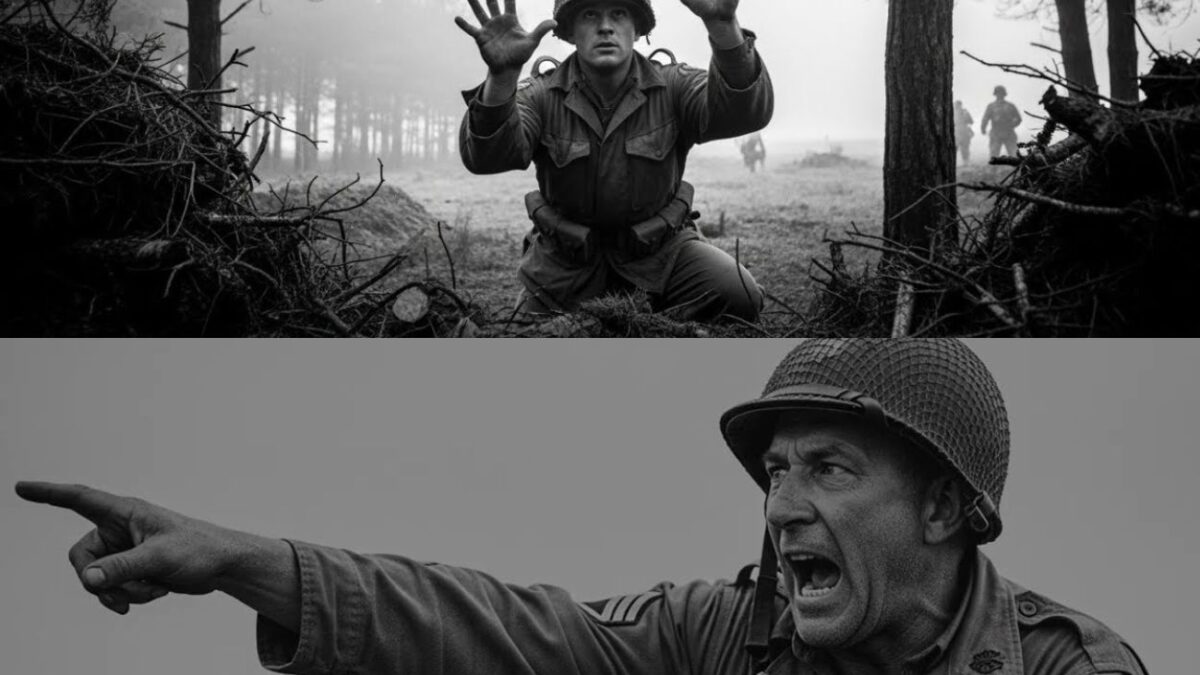
The Vosges Mountains of eastern France stood completely wrapped in a relentless, suffocating autumn fog on the bitter morning of October 15, 1944. A damp, unforgiving chill penetrated deep through layers of wool and canvas uniform, settling directly into the aching bones of forty-two exhausted American infantrymen. Lieutenant James Morrison moved forward with agonizing slowness, straining his red-rimmed eyes into the gray void where he could barely distinguish his own trembling hand.
For three agonizing days, the platoon had crept cautiously through dense pine forests, navigating terrain that local French villagers had warned was the most unforgiving in the province. Every snapping twig, every sudden gust of freezing wind rattling the wet needles overhead, carried the terrible promise of sudden, violent death from unseen snipers. Morrison, a thirty-one-year-old former history teacher from rural Pennsylvania, had convinced himself through sheer desperation that they were merely approaching a lightly held, retreating observation post.
That hopeful assumption was about to shatter against the jagged reality of European combat, exposing his men to a lethal meat grinder. Morrison paused behind a moss-covered boulder, raising his fist to halt the long, single-file line of weary soldiers trailing behind him like ghosts. The air smelled of damp pine decay, wet limestone, and the unmistakable, sulfurous tang of distant, rumbling artillery fire that had shaken the valleys throughout the night.
Among the men who dropped instantly into the wet brush was Private First Class Thomas Begay, crouching low with the quiet, practiced grace of his homeland. At twenty-three years old, Begay was thousands of miles away from the sun-drenched red sandstone mesas and wind-carved canyons of the vast Arizona Navajo reservation. He had grown up speaking Diné Bizaad as his native tongue, a complex and musical language steeped in ancestral songs, ancient desert winds, and sacred family ceremony.
Drafted into the army and shipped overseas six months earlier, Begay served primarily as a field radio operator, though Morrison regularly utilized him as an advance scout. The young Navajo possessed an extraordinary, almost supernatural awareness of natural landscapes, noticing minute disturbances in leaf litter, broken twigs, and changes in bird behavior. Morrison had quickly learned during their bloody march across France to trust the quiet private’s instincts far more than the outdated, water-stained tactical maps in his satchel.
Beside Begay knelt Sergeant William Chen, a hardened twenty-seven-year-old Chinese American veteran who had survived the dust storms of North Africa and the bloody beaches of Sicily. Chen was a native of San Francisco, a tough, pragmatic city kid whose sharp brown eyes missed nothing and whose cynical demeanor shielded an intense devotion to his squad. He checked the action of his M1 Garand with silent, mechanical precision, wiping condensation from the oiled steel receiver with the torn sleeve of his dirty field jacket.
A few yards back, Private First Class Robert Kowalski pressed his young body against the frigid earth, shivering uncontrollably from a mixture of cold and creeping dread. Kowalski was only eighteen, the fresh-faced son of a Detroit automotive assembly-line worker, who had enlisted on his birthday with starry-eyed dreams of military glory. In his breast pocket rested three crumpled, unsent letters addressed to his mother and sweetheart, foolishly promising that the Allied forces would have the war won by Christmas.
As the clock crept toward eight in the morning, an unexpected alpine updraft began to stir the mountain air, shredding the dense blanket of fog like tattered curtains. Morrison raised his field binoculars to his eyes, expecting to see empty trees, but the scene that materialized before his lens made his heart seize with terror. Rising directly ahead of them was a steep, heavily fortified hillside, cleared of undergrowth to provide overlapping, uninterrupted kill zones across the only route of advance.
The position was not a light outpost at all, but a heavily fortified redoubt anchoring an entire secondary defensive sector of the retreating German army. Dug deeply into the rocky crest were interlocking timber-and-earth bunkers, reinforced machine-gun nests, and meticulously prepared firing trenches bristling with lethal weaponry. Morrison counted at least fifty seasoned German infantrymen manning the perimeter, their camouflaged helmets visible above sandbags, completely dominating the open, wet slope below.
The American platoon had walked squarely into a tactical slaughterhouse, completely exposed on an upward incline with virtually no substantial cover to protect their retreat. Chen crawled forward until his shoulder pressed against Morrison’s muddy knee, his jaw clenched tight enough to crack his molars as he took in the catastrophic sight. “Lieutenant, we need to get the hell out of here right now,” Chen whispered through gritted teeth, his voice barely carrying above the faint rustling of the pines.
“Look at those angles, sir—they’ve got overlapping fields of fire with MG 42s zeroed on every inch of this clearing,” Chen continued urgently. “If they open up on us, this entire draw turns into a butcher’s shop before half the boys can even release their safety catches.” Morrison lowered his binoculars, feeling a cold, suffocating weight crash down upon his chest as he assessed the completely bare, sixty-yard slope behind them.
“We can’t pull back across that bare ground, Bill,” Morrison replied, his voice trembling slightly before he forced it back into an authoritative, calm cadence. “The moment forty-two men turn around and scramble down that muddy grade, their spotters will see the brush waving and their gunners will cut us in half.” Any sudden movement down the exposed hillside would inevitably invite a relentless storm of high-velocity lead that would annihilate the entire platoon in seconds.
High above them in the camouflaged timber bunker, Hauptfeldwebel Anton Weber swept his Zeiss binoculars across the lower forest edge with practiced, dispassionate efficiency. At thirty-eight, Weber was an iron-willed veteran of the Wehrmacht who had survived the invasion of Poland, the blitzkrieg through France, and two horrific winters on the Eastern Front. He had seen thousands of young men die in the snow outside Kharkov, and the brutal crucible of total war had left his soul thoroughly exhausted and hardened.
Weber commanded fifty-two disciplined, well-supplied soldiers, men who possessed ample ammunition, entrenched positions, and the supreme tactical advantage of unassailable high ground. Beside him crouched Gefreiter Hans Becker, a nineteen-year-old conscript from the farming valleys of upper Bavaria whose young face was lined with premature exhaustion and stress. Becker held the wooden stock of his Mauser rifle with white-knuckled intensity, his youthful eyes darting nervously toward the dark pine tree line below their fortress.
“Do you see them down there, Herr Hauptfeldwebel?” Becker asked in a hushed, nervous German dialect, swallowing hard against the dry lump forming in his throat. Weber didn’t immediately lower his optical glasses, his scarred face remaining as expressionless as the cold granite rocks anchoring their machine-gun emplacements. “I see their helmets and the wet canvas of their field packs, Hans,” Weber replied in a low, level monotone honed by years of battlefield command.
“An advance platoon, probably forty or fifty men at most, entirely caught out in the open like sheep waiting for the slaughter,” Weber murmured coldly. “They don’t know we’ve already spotted their forward scouts, and they don’t realize their escape path down the ravine is completely covered by our heavy mortars.” “Shall I give the order to the machine-gunners to open fire now?” Becker asked, his finger instinctively hovering over the trigger guard of his loaded rifle.
“Patience, boy,” Weber commanded quietly, raising an authoritative hand to check the young soldier’s understandable but tactically premature eagerness. “Let them bunch up closer as they realize their mistake; wait until the fog clears completely so we don’t waste precious ammunition shooting at shadows.” “When they inevitably panic and try to run down the hill, we will catch them in a crossfire and finish this miserable business in two minutes flat.”
Down in the mud, Morrison’s mind raced frantically through every page of infantry doctrine he had studied during officer candidate training back at Fort Benning. Every conventional military solution presented in the tactical manuals pointed inexorably toward utter disaster and the horrific destruction of his entire command. A frontal assault uphill against entrenched positions was sheer lunacy; his men would be scythed down before they crossed twenty yards of exposed dirt.
Remaining motionless was equally fatal, as the midday sun was rapidly dissolving the remaining wisps of mist, leaving them exposed to enemy observers. Surrender was an unthinkable humiliation that would consign his men to brutal prisoner-of-war camps, where disease and starvation were common companions. Morrison buried his face in his cold, mud-caked hands, feeling the agonizing, solitary burden of leadership crushing down upon his exhausted shoulders with monstrous weight.
A soft rustle of wet pine needles broke his despairing trance as Private Begay quietly low-crawled toward the command position, sliding effortlessly through the brush. Unlike Kowalski, whose eyes were wide with terror, or Chen, whose jaw was set in bitter resignation, Begay looked strikingly composed and remarkably alert. There was an intense, contemplative stillness in the young Navajo soldier’s dark eyes, the calm demeanor of a man who saw an unconventional solution where others saw doom.
“Lieutenant,” Begay spoke softly, his English marked by the distinct, measured cadence of a man whose thoughts were shaped by an entirely different linguistic grammar. “I have an idea that might get us out of this trap, sir, but you will have to trust me, because it goes against your military training.” Morrison looked up, his face pale and drawn, his eyes searching the serene, unreadable expression of his young scout with a mixture of hope and skepticism.
“Thomas, at this point I’d listen to an idea from the devil himself,” Morrison whispered, leaning his ear close to Begay’s mouth to keep their voices down. “What have you got? Because in about ten minutes, that sun is going to light up this whole valley, and those Germans are going to slaughter us.” Begay took a slow, deliberate breath, glancing upward through the pine branches toward the towering, rocky ridgeline that loomed over their precarious position.
“Sir, you are thinking only about guns, bullets, and fields of fire,” Begay explained in a steady, confident whisper that immediately arrested Morrison’s attention. “Look at how this valley is shaped—it is narrow, walled in by high stone faces and ancient trees, acting like a giant natural sounding bowl.” “My people have lived in red rock canyons for hundreds of years, where sound does not travel in straight lines; it bends, multiplies, and confuses the mind.”
“What are you proposing, Begay?” Chen interjected, having slid closer to hear the conversation while keeping his rifle aimed steadily at the ridgeline bunkers. “Are you saying you want to talk them out of shooting us?” Chen’s cynical tone carried no malice, only the desperate edge of a seasoned veteran facing death. “Not talk to them, Sergeant,” Begay replied quietly, turning his gaze toward Chen with an expression of profound cultural certainty.
“I will sing to them; I will shout to them in the ancient way of my ancestors, the way our warriors called out before going into battle.” “If I move through the rocks and vary my throat, the echoes in this basin will make them believe an entire division is surrounding their flanks.” Morrison stared at Begay in stunned silence, his rational, Western-trained mind struggling to comprehend the audacious, seemingly absurd nature of the private’s proposal.
He was being asked to stake the lives of forty-two men not on an artillery barrage or an infantry maneuver, but on an ancient vocal illusion. Yet, as he looked back at the impossible slope and the bristling German machine guns, the terrible arithmetic of their tactical situation left him with no alternatives. “If you expose yourself, Begay, they will concentrate every rifle they have on your position,” Morrison warned, his voice thick with concern.
“They will not know where to aim, Lieutenant,” Begay said calmly, a faint, knowing smile touching the corners of his chapped lips. “In the canyons, a warrior learns to throw his voice like a bird throwing its song, making the hunter look east while the stone falls from the west.” “Give me five minutes to reach that cluster of boulders on the left draw, and instruct the men to wait for my lead before showing any movement.”
Morrison looked deeply into Begay’s dark, resolute eyes, finding no bravado, no foolish bravado, only the profound quietude of ancestral confidence. “Do it, Thomas,” Morrison commanded quietly, reaching out to give the private’s sturdy shoulder a firm, desperate squeeze. “May whatever God you pray to watch over your voice today, because our lives are entirely in your hands.”
Begay nodded once, unslung his heavy radio pack to leave it behind, and began to crawl laterally through the wet bracken with astonishing, soundless agility. He moved like a mountain lion, utilizing the natural depressions of the mountain slope, never raising his torso more than a few inches above the soil. Within three minutes, he had vanished completely into a deep outcropping of mossy limestone boulders situated fifty yards to the platoon’s left flank.
Hunkered behind the stone, Begay closed his eyes for several long seconds, grounding himself in the frigid air and the damp scent of the earth. He thought of his grandfather back in Arizona, an elder who had taught him the traditional ways and recounted the legendary deeds of ancient warriors. He remembered the sacred songs of protection, the hunting calls used to disorient prey, and the thunderous battle cries that once caused enemy hearts to wither.
Begay drew cold alpine air deep into the very bottom of his lungs, expanding his diaphragm until his chest felt ready to burst with energy. Then, opening his mouth wide, he unleashed a sound that shattered the damp silence of the Vosges Mountains like a sudden, unexpected bolt of lightning. It began as a low, guttural roar that vibrated deep in his chest, resonating with a primeval force that seemed completely alien to modern mechanical warfare.
Almost instantly, the tone leaped octaves into a high-pitched, ululating battle cry, a complex, piercing vocalization that rose and plunged in terrifying waves. The acoustic shape of the limestone basin caught the powerful sound waves, bouncing them violently off the sheer rock faces and the dense canopy of pines. To human ears, the sound did not originate from a single throat; it splintered into dozens of distinct, overlapping echoes that seemed to encircle the entire slope.
Up in the fortified bunker, Hans Becker practically jumped out of his skin, his rifle clattering against the rough wooden edge of the firing embrasure. His eyes dilated with primal terror as the eerie, bloodcurdling cry washed over the bunker, seemingly dropping down directly from the mist-shrouded peaks above. “Gott im Himmel!” Becker gasped, frantically sweeping his rifle barrel toward the dense woods on their extreme left flank, his heart hammering against his ribs.
“What is that? What kind of devils are making that sound?” Becker yelled, his voice cracking with a sudden, overwhelming hysteria that broke through military discipline. Even Anton Weber, veteran of a hundred bloody engagements across the Eastern Front, felt a cold shiver of dread slither down his rigid spine. He had heard the terrifying shrieks of Russian cavalry charges and the wails of wounded men in burning ruins, but he had never encountered anything like this.
The sound was completely outside European military experience, an ancient acoustic weapon engineered to trigger the deepest, most instinctual fears of the human animal. It suggested something wild, vast, and entirely unseen, evoking terrifying images of ferocious, merciless colonial shock troops known to operate with the Western Allies. Before Weber could even formulate a command, Begay abruptly shifted his position, scurrying twenty yards through a rocky fissure to a new acoustic angle.
Drawing another massive breath, the young Navajo soldier altered his technique, utilizing rapid throat manipulations to simulate distinct voices calling out in coordinated sequence. From the left outcropping came a piercing, sharp cry; an instant later, an echoing response boomed from a ravine high above the German right flank. Begay picked up a heavy, broken pine branch and smashed it rhythmically against a hollow cedar trunk, creating the unmistakable thud of men advancing through brush.
He hurled large stones down into a gravelly drainage gulley, sending cascades of shale clattering noisily through the woods to mimic the boots of infantry. To the panicked German defenders perched on the crest, the auditory landscape transformed completely from a silent forest into a massive, rapidly closing trap. The overlapping war cries, the crashing branches, and the rattling stones painted a terrifying mental picture of an overwhelming force maneuvering to cut off their rear.
“They’re moving through the trees on our flanks!” a German machine gunner screamed from an adjacent trench, his nerve snapping under the acoustic onslaught. The gunner swung his heavy MG 42 wildly toward the empty eastern woods, firing a frantic, three-second burst that shredded pine branches into a rain of green needles. “Cease fire! Cease fire, you fool!” Weber barked, his voice struggling to maintain authority against the rising tide of confusion sweeping through his ranks.
Weber lifted his field glasses again, frantically scanning the perimeter, but the deceptive echoes made it utterly impossible to determine the true source of danger. Every time his eyes settled on a ridge, a terrifying new war cry seemed to erupt from the exact opposite direction, mocking his tactical training. His mind, trained in classical Wehrmacht strategy, immediately sought a logical military explanation for the bizarre, overwhelming auditory phenomena confronting his command.
The Americans had clearly lured them into a false sense of security, using the pinned platoon below as bait while a massive flanking element executed an encirclement. Down on the lower slope, Sergeant Chen watched the unfolding chaos with wide, astonished eyes, instantly recognizing that the crucial turning point had arrived. Without waiting for a formal command from Morrison, Chen tapped the shoulders of his two nearest squad leaders, motioning them forward with aggressive hand signals.
“Kowalski, Miller! On your feet, keep your heads down, and start shifting between those pines!” Chen hissed in an urgent, commanding whisper. “Run five yards, drop, fire one round into the brush, then crawl ten yards sideways and show your helmet again! Make them think we’re everywhere!” Kowalski, his paralyzing fear suddenly replaced by an intoxicating surge of adrenaline, leaped up and sprinted between two thick, mossy spruce trees.
He dropped to one knee, squeezed the trigger of his Garand toward the upper ridgeline, then rolled instantly into a muddy hollow before scrambling to the left. Across the sixty-yard front, forty-two American soldiers began executing this dynamic, deceptive dance, appearing and disappearing behind rocks and trees like phantoms. Combined with Begay’s continuous, thundering vocal performance, the sporadic rifle fire from constantly shifting positions confirmed Weber’s absolute worst tactical nightmare.
Two years earlier, in the freezing snows outside Smolensk, Weber’s previous battalion had been systematically encircled by Soviet forces employing silent infiltration tactics. That horrific winter disaster had resulted in the butcher of eight hundred of his comrades, an agonizing psychological scar that Weber had carried ever since. The memory of that encirclement was visceral, blinding his rational judgment and replacing his professional arrogance with an overwhelming instinct for survival.
“Herr Hauptfeldwebel, look!” Becker cried out, pointing a trembling hand toward the upper tree line where Begay’s echoes made the forest seem alive with hostiles. “They are already behind our secondary line! If they seize the crest behind the mortar pits, we will be completely surrounded and butchered to a man!” Weber stared at the dense foliage, his veteran instincts violently warring against the sensory evidence that his eyes and ears were desperately feeding his brain.
He held fifty-two men in fortified frontal positions, but his entire defense was fatally oriented toward stopping an uphill assault from the valley below. If an unseen enemy force of unknown size had successfully navigated the rugged draws to envelop his rear, his bunkers would become wooden coffins. Every second he hesitated brought the imaginary noose tighter around his unit’s neck, threatening to cut off their only open road back to the German lines.
Weber made the decision that commanders throughout military history have made when confronting an unseen, terrifyingly ambiguous enemy presence. “Ablösen! Fall back! Controlled withdrawal to the secondary line at the crossroads!” Weber bellowed, his voice echoing sharply across the fortified trenches. “Spike the heavy mortars! Bring the machine guns and ammunition boxes! Move quickly through the rear ravine before their flanking units cut the road!”
The order acted like an explosive release valve on the mounting terror that had paralyzed the young, inexperienced recruits and veteran soldiers alike. What was intended to be an orderly, disciplined tactical withdrawal instantly devolved into a hurried, panicked scramble to escape the supposedly closing jaws of the trap. German soldiers abandoned sandbagged redoubts that had taken three painstaking days to construct, tossing aside entrenching tools, heavy packs, and spare field gear.
They hauled their machine guns from the timber embrasures, tumbling out of the back of the bunkers and retreating in headlong flight down the reverse slope. Within four chaotic minutes, the formidable defensive line that commanded the entire valley had been completely and unconditionally abandoned by its garrison. From his boulder hideout, Begay maintained his thunderous, echoing war cries, his voice growing rough and hoarse, but refusing to let the acoustic pressure relent.
Only when the frantic crashing of boots and the desperate shouts of retreating German soldiers faded entirely into the distant mountain gaps did Begay stop. He slumped back against the wet granite, his lungs burning like molten fire, his throat raw and taste of copper resting upon his dry tongue. He closed his eyes, offering a silent prayer of gratitude to the protective holy spirits of his distant ancestors who had carried his voice across the mountain.
A profound, almost unnatural silence descended over the forested slope of the Vosges, broken only by the gentle dripping of melted fog from pine needles. Lieutenant Morrison slowly rose to his feet from behind his muddy boulder, holding his carbine loosely at his side as he stared upward in absolute disbelief. Where ten minutes prior a deadly array of German weaponry had promised certain death, there was now only the desolate emptiness of abandoned trenches.
“Cease fire… cease all fire,” Morrison croaked, his voice trembling with an overwhelming wave of shock, relief, and sheer, disbelieving awe. Chen walked up beside him, his Garand lowered, his dark eyes wide as he stared at the crest where German helmets had been clearly visible moments earlier. “Sweet mother of God,” Chen breathed softly, crossing himself with a muddy hand despite his usual hardened skepticism toward matters of religion and faith.
“Did they really just run? Did that crazy kid actually scare an entire fortified German company off the highest hill in the sector with just his throat?” Morrison didn’t answer immediately; he simply began walking up the steep, muddy slope, his boots sinking into the wet ground that should have been his grave. The platoon followed cautiously, their weapons raised, expecting an ambush at every step, but finding only discarded ammunition canisters and dropped mess kits.
When they reached the crest, the true magnitude of what had transpired became shockingly apparent to every single American soldier in the company. The German positions were masterworks of field engineering: deep, timber-shored trenches with overhead cover that could have withstood direct mortar hits for hours. Crates of 7.92mm ammunition sat unopened; pristine MG 42 machine-gun barrels lay cooling on abandoned tripods; unfinished bowls of hot cabbage soup sat steaming on log tables.
“They had enough ammo and firepower here to hold off an entire battalion for three days,” Chen murmured, picking up an abandoned German field cap in wonder. “And they left it all… they ran like the devil himself was breathing down their necks, all because of an echo bouncing off some cold rocks.” Morrison turned and walked back toward the left flank, where he found Private Begay slowly emerging from the rocky outcropping, leaning heavily on a wooden staff.
The young Navajo private looked physically drained, his face streaked with sweat and mud, his chest still heaving slightly as he struggled to draw air. Morrison approached him, stopped two feet away, and for several long moments could find no words adequate to express the debt he owed this quiet soldier. Finally, the lieutenant reached out, took Begay’s calloused right hand in both of his own, and gripped it with profound, emotional gratitude.
“Thomas,” Morrison whispered, his voice cracking with emotion that he could no longer conceal from his men. “You just saved forty-two lives today.” “I have never witnessed anything so magnificent or so brave in my entire life; where on earth did you learn to manipulate sound like that?” Begay managed a tired, gentle smile, turning his gaze eastward toward the gray sky that was finally clearing to reveal the pale blue horizon beyond.
“In the canyons of the reservation, Lieutenant, our elders teach us that the wind and the rocks have ears, and that sound is an alive thing,” Begay replied softly. “A hunter who only uses his arrows is a poor hunter; the great warrior is the one who understands how to make the landscape fight for him.” “My grandfather always taught me that the highest victory in war is the one that breaks the enemy’s will without creating more weeping widows.”
“Today, Lieutenant, not a single mother in Pennsylvania, California, or Germany has to receive a telegram saying her boy died on this mountain slope.” Morrison swallowed hard, nodding in deep reverence as the profound wisdom of the young indigenous soldier settled into his own troubled soul. The tactical consequences of Begay’s miraculous deception reverberated far beyond that single isolated hillside during the critical days that followed.
The fortified position Weber had abandoned was the northern anchor of the Wehrmacht’s entire secondary defensive line across that mountain corridor. With the high ground secured without a single Allied casualty, American armored columns and motorized infantry were able to exploit the resulting tactical vacuum. Within forty-eight hours, an entire division poured through the breach, bypassing heavily defended German choke points and unhinging the enemy’s regional defenses.
Military intelligence officers who arrived to inspect the abandoned complex were completely baffled by the lack of artillery damage or signs of intense struggle. Morrison submitted a detailed after-action report detailing the engagement, but standard military bureaucracy possessed no vocabulary for ancient indigenous acoustic warfare. The official commendation eventually awarded to Begay cited “extraordinary initiative, courage, and tactical ingenuity in the face of superior hostile forces.”
Yet the sterile, typed words on the parchment could never capture the spiritual majesty or psychological brilliance of what had actually occurred in that ravine. For Private Begay, the extraordinary event was marked by a deep, bitter historical irony that was impossible for a thoughtful young Navajo to ignore. He was fighting in a segregated uniform for a nation that had spent generations systematically attempting to eradicate his native language and traditional culture.
As a young boy, Begay had been forced into government-run boarding schools where speaking Diné Bizaad was brutally punished with soap and the strap. He had been told by white teachers that his ancestral traditions were primitive, worthless superstitions that had no place in the modern civilized world. Yet here, in the ancient mountains of Europe, that exact “primitive” cultural heritage had accomplished what modern military technology could not achieve.
While his Navajo brothers in the Pacific were confounding Japanese intelligence with their unbreakable spoken code, Begay had used their ancestral voice to save his brothers in France. The war raged on for another seven grueling months, leading the platoon through freezing forests, bombed-out villages, and finally across the mighty Rhine River. Begay survived the conflict without a physical scratch, continuing to serve honorably as a scout and radio operator until Nazi Germany finally surrendered in May 1945.
When the guns finally fell silent across Europe, the men of the forty-second platoon scattered back across the vast expanse of the American continent. Lieutenant Morrison returned to his quiet classroom in Pennsylvania, hanging his uniform in the closet and picking up his chalk with a transformed perspective on humanity. He never taught history the same way again; he taught his students that true wisdom was never the exclusive property of dominant empires or advanced technology.
He maintained a lifelong correspondence with Begay, writing long, thoughtful letters every autumn to commemorate the chilly October morning that had bound their souls forever. Sergeant William Chen returned to the foggy streets of San Francisco, taking over his family’s restaurant and becoming a celebrated neighborhood storyteller. Whenever patrons asked about his combat decorations, Chen would push aside his medals and recount the incredible tale of the Navajo warrior who routed fifty-two Germans with a song.
Young Robert Kowalski returned to the roaring automotive factories of Detroit, married his sweetheart, and safely raised four children who adored their gentle father. On quiet evenings on the front porch, Kowalski would tell his children about Private Begay, teaching them that true courage came in quiet, unexpected packages. “The strongest weapon in the world isn’t a cannon or a bomb,” Kowalski would tell them softly, looking out into the twilight; “sometimes it’s a voice that speaks truth to fear.”
Far across the ocean, Gefreiter Hans Becker survived the brutal collapse of the Third Reich, spending two difficult years in an Allied reconstruction labor camp. In 1952, disillusioned with war-torn Europe, Becker immigrated to the United States, settling in the Midwest where he worked as a skilled master carpenter. Decades later, at an informal gathering of veterans in Chicago, Becker struck up a conversation with an elderly American who had served in the Vosges campaign.
As they compared dates and map coordinates over coffee, Becker experienced a revelation that made him weep openly with profound, enduring relief and wonder. For thirty years, he had carried the bitter shame of that chaotic retreat, believing his unit had been outmaneuvered by an elite, ruthless commando battalion. To finally learn that their retreat had been orchestrated by a single young Navajo man wielding an ancient war cry filled Becker not with anger, but with awe.
“We were not defeated by an army,” Becker remarked to his family later that night with a quiet smile; “we were defeated by the spirit of the mountain itself.” Thomas Begay returned to the sacred red rock lands of the Navajo Nation in 1946, slipping quietly back into the rhythms of desert life and traditional ceremonies. He married, raised children and grandchildren, and worked as an advocate for his community, rarely speaking of the medals gathering dust in a cedar drawer.
He lived a long, blessed life that stretched into his eighties, passing away peacefully surrounded by family under the vast, starry skies of his beloved Arizona in 2004. At his funeral, three elderly men with canes—one from Pennsylvania, one from California, and one from Michigan—stood weeping beside his red earth grave. They had traveled thousands of miles across the country to pay final homage to the man who had given them sixty years of life, children, and grandchildren.
As the funeral service concluded and the desert wind began to whisper through the sagebrush, an elder stepped forward to sing a traditional Navajo traveling song. The ancient, sacred voice rose into the sky, carrying the spirit of Thomas Begay on its final journey toward the holy mountains of his ancestors. It was the same enduring voice that had once echoed through the Vosges Mountains, proving forever that ancestral wisdom is an immortal shield against darkness.

