How One Apache’s ‘INSANE’ Arrow Modification Silently Killed 23 SS Guards in Normandy
The dawn of June 5, 1944, remained buried beneath an impenetrable veil of mist.
Across the jagged French coastline, the Atlantic gale drove cold salt spray deep into the interior.
Here lay the ancient bocage country, a labyrinth where towering hedgerows cast profound and suffocating shadows.
Within this landscape, specialized reconnaissance teams prepared for the largest amphibious assault ever conceived.
Among these soldiers stood one man carrying a weapon that seemed utterly severed from twentieth-century warfare.
Corporal Charles Chibitty, a Comanche attached to the 4th Infantry Division, moved with quiet, absolute certainty.
For three damp months in southern England, he had laboured in secret over an implement of ancestral design.
He had shaped a silent mechanism to grant his squad an essential advantage in the dangerous work ahead.
Neither he nor his comrades could foresee that this improvisation would remain classified for over twenty years.
What had begun as a quiet experiment would become one of the European campaign’s most singular successes.
It demonstrated that amidst industrialised combat, primordial principles could outmatch modern machinery.
The oldest solutions retained their lethal relevance, cutting cleanly through the roaring chaos of mechanized battle.
Ninety days before the landings, steady rain lashed the sprawling military encampments across southern England.
Thousands of Allied soldiers drilled constantly, braced for an invasion everyone anticipated but none dared name.
Inside a corrugated maintenance shed, Chibitty sat surrounded by the absolute pinnacle of contemporary warfare.
Racks of Garand rifles, fragmentation grenades, and field transceivers cluttered the damp wooden tables.
Yet he ignored the steel and grease, focusing entirely on an implement standard doctrine deemed obsolete.
Before him lay a recurved sporting bow, secured through trades of cigarettes and rare officer rations.
Military brass had cast bows aside generations earlier in favour of gunpowder and rifled barrels.
Yet Chibitty perceived an operational vulnerability that conventional doctrine routinely dismissed.
Firearms, even when fitted with state-of-the-art suppressors, could not provide absolute acoustic discipline.
The latch clattered as Lieutenant James Morrison pushed into the shed, shedding water from his heavy helmet.
Morrison was an experienced veteran of the North African desert, hardened into respecting practical utility over dogma.
He stopped near the workbench, his gaze shifting from the wooden limbs to the Comanche corporal.
“What exactly do you intend to accomplish with that implement, Corporal?” Morrison inquired quietly.
Chibitty continued wrapping thin steel wire around a treated cedar shaft without pausing his motion.
“Our orders demand the silent removal of sentries along the cliff perimeters,” Chibitty stated smoothly.
“The suppressed pistols we carry are effective at ten paces, sir, but they still produce an unmistakable report.
Within the bocage, sunken earthen lanes and thick hedgerows act as acoustic conduits across open terrain.
Even an efficient suppressor will alert defensive positions fifty yards away before our men can clear the ditch.”
Morrison stepped closer, lifting one of the finished arrows into the lantern light to inspect the craftsmanship.
The shaft was kiln-dried wood, yet altered through a sequence of mechanical refinements that transformed it completely.
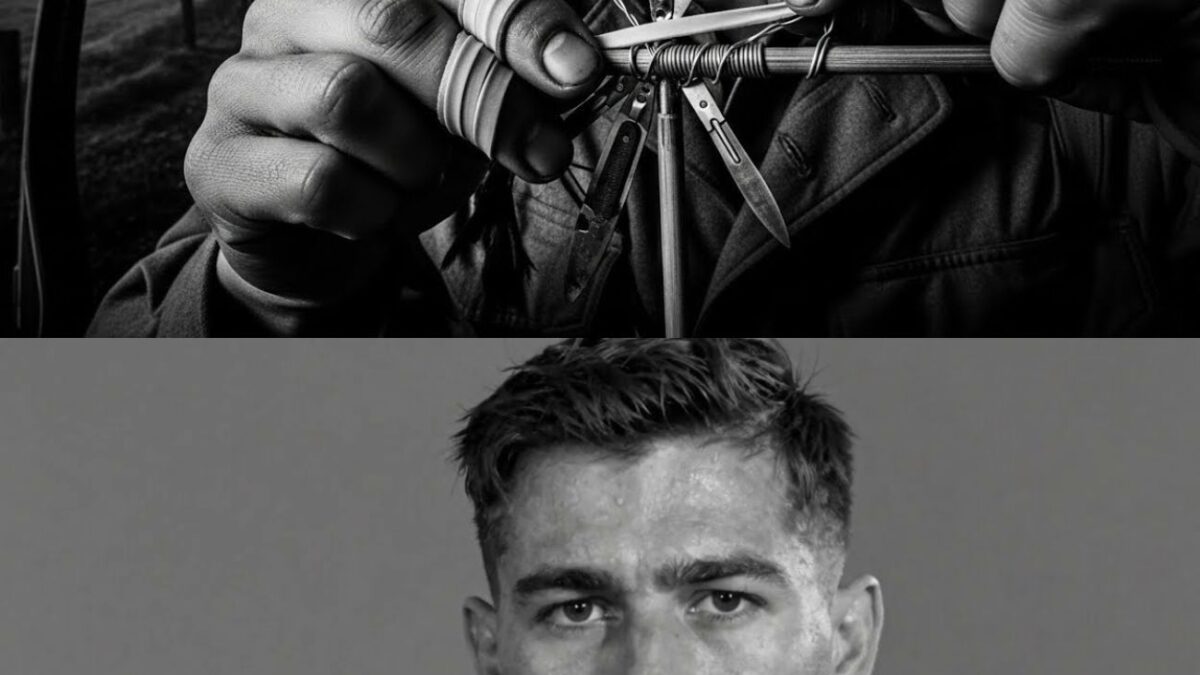
Near the broadhead, thin strips of rubber cut from inner tubes were wound tightly and bound with fine wire.
Behind this dampener, the original feather fletching had been replaced with cut vanes of rigid vulcanized material.
These smaller surfaces were designed to stabilize the projectile swiftly over moderate distances with minimal drag.
The lieutenant then touched the tip, finding three surgical scalpels bound together into an immaculate broadhead.
The honed edges glinted sharply in the lantern glow, reflecting hours of meticulous, uninterrupted whetting.
“How long have you spent refining these, Corporal?” Morrison asked, running a thumb near the edge.
“Six weeks, Lieutenant,” Chibitty answered calmly as he tied off another strand of binding wire.
“The rubber eliminates the primary vibration through the stave and dampens the hum of the string upon release.
Standard hunting arrows produce a distinct whistle as the fletching cuts air across fifty yards.
These modifications reduce that audible frequency by seventy percent, verified out to sixty paces.”
Morrison laid the arrow down, mentally reviewing the squad’s operational mandate for the landing phase.
They were designated to spearhead the initial push, securing exits and neutralizing observation posts overlooking the shore.
Every sentry neutralized without an alarm meant fewer machine guns sweeping the open sand below.
“Prove it,” Morrison commanded softly, his skepticism yielding to the demands of tactical survival.
They waited until well past midnight, when the sprawling training camp succumbed to quiet exhaustion.
Chibitty positioned targets across a flooded meadow, mounting ripe melons atop firm sandbags to simulate human density.
Morrison observed through field glasses as the Comanche corporal adopted his stance in the darkness.
The first shaft vanished into the mist at thirty yards, the bowstring producing nothing louder than a dry snap.
Across the lane, the target burst open with a dull, wet thud that carried no farther than five paces.
The second release at forty-five yards mirrored the precision of the first, splitting the center cleanly.
At sixty yards, through a sudden crosswind, the third arrow drove through the sandbag with stopping force.
Morrison lowered his binoculars, nodded once in the gloom, and turned back toward the dark barracks.
Forty-eight hours later, Chibitty received quiet authorization to carry the customized rig as an auxiliary weapon.
It had to remain entirely supplementary, never interfering with his service rifle or standard tactical ammunition load.
No ledger recorded the authorization; it existed solely on the practical discretion of a field commander.
Within their close-knit reconnaissance squad, reactions to the unconventional weapon varied between men.
Sergeant William Kowalski, a veteran of Monte Cassino’s brutal assaults, remained outspokenly unimpressed.
He trusted only what possessed high velocity, having witnessed how unforgiving modern operations proved to be.
“You’re going to get yourself killed playing frontier scout against machine guns,” Kowalski muttered coldly.
Private First Class James Washington, an engineering student from Michigan, voiced practical mechanical doubts.
He noted that arrows could not be replenished from standard supply crates dropped into combat zones.
“The draw requires two hands and leaves you entirely exposed,” Washington argued during evening equipment maintenance.
“A rifle gives you nine rounds as fast as you can pull the trigger, without fatigue or windage issues.”
Only Private Robert O’Malley, a tracker and radio operator from Montana, immediately recognized the concept’s value.
“Silence buys ground,” O’Malley remarked as he cleaned his radio connectors alongside the corporal’s workbench.
“Out in timber, if game hears the release, you go hungry; how many shafts can you pack without noise?”
Chibitty demonstrated his solution: a canvas pack fitted with individual slots to prevent shafts from rattling.
He carried eighteen arrows, their crests marked with bands of paint to indicate predetermined range calibrations.
Red denoted thirty yards, yellow represented forty-five, and green signified maximum effective flight at sixty.
During the final weeks of spring, their operational exercises grew increasingly intense and specific in scope.
Sand tables were constructed to replicate the cliff topography and bocage layout east of the designated beachheads.
Scouts memorized every sunken road, farm track, and estimated pillbox position until navigation became instinctual.
Chibitty spent every spare hour testing glues, wrapping materials, and practicing rapid releases under stress.
He trained until he could select, nock, draw, and discharge an arrow in less than four seconds flat.
Morrison watched the progress carefully, mapping exact tactical contingencies where silent elimination would preserve life.
German artillery observers occupied strongpoints along the high ground, directing fire onto incoming amphibious landing craft.
Neutralizing these command elements without triggering flares or panic would determine the entire assault’s tempo.
On June 4, severe Channel gales forced supreme command to postpone the invasion by twenty-four hours.
The delay settled over the troop ships like lead, keeping men confined to pitching holds under suffocating pressure.
Chibitty utilized the agonizing delay to retreat into mental preparation, checking his gear with detached precision.
He was not the sole indigenous soldier in the European theater; many served across every division and branch.
Yet his individual methodology remained entirely unique, wedding tribal hunting wisdom directly to tactical reconnaissance.
On the evening of June 5, the immense armada departed, churning dark water toward the Normandy coast.
Morrison assembled his men near the wet iron ladder of their transport for their final briefing.
Their primary objective consisted of five German observation posts commanding the bluffs over the sand.
“We land with the initial waves,” Morrison instructed, holding onto the steel bulkhead against the surging swell.
“We have ninety minutes to silence all five positions before defensive artillery locks onto the landing lanes.
Naval bombardment cannot hit these positions without destroying the high ground facilities we need intact.”
The implications settled silently across the small team: this was purely close-quarter infiltration work.
They would navigate hostile, unfamiliar terrain behind forward enemy lines completely cut off from heavy support.
The Channel crossing proved punishing, the landing craft plunging through grey swells that sickened even veterans.
Chibitty ignored the motion, sitting upright while methodically reviewing every component of his kit.
The bow rested within waterproof canvas, tied securely against his pack frame alongside his Garand.
His combat knives were honed, his boots muffled with cloth wraps, his mind clear of distraction.
Dawn cracked the horizon as thunderous naval bombardments detonated against the French bluffs ahead.
Battleships and cruisers laid down a rolling barrage that vibrated through the metal hull of the assault craft.
Bombers screamed through the cloud ceiling, leaving plumes of black smoke along the perimeter of the beaches.
At 0645 hours, the steel ramp dropped into churning surf, throwing the men into waist-deep water.
They drove forward through surf, shrapnel, and chaos, moving directly toward the designated cliff path.
The ascent up the bluff proved far steeper and slicker than the English mock-ups had indicated.
Heavy mud and loose shale dragged at their gear, transforming standard loads into exhausting dead weight.
Using anchored guide ropes, they scrambled up the incline, clearing the lip into the bocage country.
Instantly, the visual landscape contracted to the immediate hedgerow, shutting out the wider beach completely.
These ancient barriers consisted of thick earthen mounds topped with centuries of dense roots and hawthorn.
A soldier could walk within five yards of an entrenched machine-gun nest without seeing the barrel.
Morrison checked his compass and signaled the squad forward into the first sunken wagon track.
Their immediate target lay three hundred yards inland, positioned to look down upon the primary landing exit.
They advanced along the wet verge, stepping quietly through tall grasses to mask the sound of movement.
Sergeant Kowalski held point, his carbine raised, scanning the hedge for tripwires or snipers.
Suddenly, Kowalski raised a clenched fist, freezing the patrol instantly along the shadow of the bank.
Morrison crawled forward on his belly, pushing aside ferns to peer into the clearing ahead.
The observation post stood before them, a low sandbagged bunker reinforced with heavy oak beams.
Intelligence had briefed them to expect four sentries manning an optical rangefinder and a field telephone.
Through the leaves, Morrison counted eight German soldiers dispersed around the perimeter and communication trench.
Two manned the observation scope, one operated the radio, and two patrolled the defensive parapet.
Three more were visible near the timbered entrance of an underground bunker, smoking out of the wind.
Eight defenders altered their tactical calculus entirely; suppressed pistols could not drop so many before an alarm sounded.
Morrison slipped back into the ditch beside Chibitty, his jaw tight as he weighed their options.
“Can you take them without a shout?” the lieutenant whispered, his eyes searching the corporal’s face.
Chibitty adjusted his pack, bringing the bow forward and quietly stripping away the waterproof canvas cover.
“I can drop the observers and the parapet guards before they locate the source,” Chibitty stated evenly.
“Once the first man drops, we will have perhaps twelve seconds before the survivors grasp the situation.
Your riflemen must sprint the perimeter trench the moment the fifth arrow flies, or they will reach cover.”
Morrison nodded once, signaling Washington and Kowalski to position themselves for an immediate assault.
O’Malley unslung his carbine, covering the right flank while maintaining visual contact on the dugout door.
Chibitty rose slowly onto one knee, using a break in the thick brush to establish clean sightlines.
He drew an arrow marked with red lacquer, seating the nock securely against the waxed linen string.
The range stood at thirty-four yards, with a cross-breeze drifting along the face of the earthen bank.
Chibitty drew the shaft smoothly, feeling the familiar pull of seasoned wood across his fingers.
The modified string released with a soft flutter that was completely swallowed by the distant rumble of coastal artillery.
The German observer peering through his mounted optics collapsed forward instantly across the iron mount.
His companion turned toward him, opening his mouth in confusion, only to meet the second incoming shaft.
The man slumped into the muddy bottom of the trench, dead before his hands could leave his pockets.
Chibitty nocked his third arrow in one continuous motion, his focus narrowing entirely on the parapet.
The sentry along the sandbags sensed the movement, turning his rifle toward the hedge line with sudden suspicion.
Chibitty’s third broadhead caught him in the throat, driving him backward into the revetment without a cry.
The two remaining trench sentries were looking down toward the beach, blinded by the coastal explosions.
A fourth arrow took the first through the shoulder and chest, collapsing him into the firing step.
The fifth shaft struck the second guard three seconds later as he turned to look for his companion.
From the underground bunker, a non-commissioned officer stepped out onto the duckboards, holding a tin cup.
He took two paces, stopped dead at the sight of the fallen sentries, and reached for his holstered pistol.
Morrison fired twice with his suppressed pistol, the rounds striking the officer before he could shout.
Kowalski and Washington burst through the hedgerow, entering the trench line with weapons ready.
Two surviving guards inside the shelter attempted to bring a machine pistol to bear from the dark entrance.
A short, violent burst of carbine fire inside the entrance ended all resistance within five seconds.
The entire engagement had lasted under thirty seconds, leaving the vital observation post completely neutralized.
O’Malley moved quickly to the German radio, severing the battery cables to ensure no signal could escape.
Morrison checked his watch; they were slightly ahead of schedule, with four more positions remaining.
The second post fell thirty minutes later, situated in the upper floor of an abandoned stone barn.
Chibitty dispatched three German observers through the open hayloft window before they could identify their danger.
The third post, nestled inside an apple orchard, required a mixed engagement of bow and knife work.
At the fourth location, an alert patrol spotted their approach, initiating a sharp firefight that cost time.
Washington sustained a grazing flesh wound to his upper arm, but they overran the dugout rapidly.
Yet it was the fifth and final position that would define the day’s combat in subsequent intelligence reports.
Intelligence had described this final objective as a minor relay bunker manned by three communications technicians.
When the squad reached the surrounding treeline, they discovered an extensive, heavily reinforced headquarters complex.
At least fifteen soldiers occupied firing bays, command trenches, and concrete machine-gun positions covering the road.
This site was no mere relay point; it coordinated the entire artillery sector overlooking the landing beaches.
A direct charge against such fortifications with four men was impossible and would invite immediate destruction.
Morrison knelt low in the brambles, checking his remaining ammunition with an expression of grim resolve.
“We cannot leave this strongpoint active,” Morrison said, his voice flat with the weight of the reality.
“If their guns remain coordinated, the second wave will be wiped out trying to exit the sand.”
Chibitty studied the perimeter with patient, searching eyes, observing the patterns of the enemy sentries.
The fortification was constructed to defeat frontal assaults originating from the beach access roads to the west.
The rear perimeter, facing deep into French farmland, relied merely on concertina wire and passive assumptions.
“Divide the squad, Lieutenant,” Chibitty proposed quietly, his fingers resting lightly along his quiver.
“Take Kowalski and Washington to the front tree line and open fire to draw their attention westward.
Make them believe an entire platoon is probing their main perimeter along the secondary road.
O’Malley and I will circle through the drainage ditch to the rear gate and dismantle their communication.”
“How many shafts remain?” Morrison asked, looking down at the depleted quiver on the corporal’s pack.
“Thirteen finished arrows,” Chibitty replied, tapping the remaining steel-tipped shafts secured in their slots.
“It will be enough if your diversion pulls their attention away from the southern gate.”
Morrison hesitated for a fraction of a second before extending his hand to the Comanche corporal.
“Fifteen minutes for you to gain position; make every shaft count, Charles,” the lieutenant said grimly.
Chibitty and O’Malley slipped into the drainage ditch, crawling through stagnant mud beneath thick briers.
They reached the rear apron of the compound unobserved, concealed by the bank of an irrigation ditch.
Precisely fifteen minutes later, Morrison, Kowalski, and Washington opened rapid, aggressive rifle fire from the west.
The reaction inside the German headquarters compound was instantaneous, noisy, and completely predictable.
Alarms sounded as soldiers rushed from their quarters toward the western sandbags to return fire.
A runner dashed from the radio shelter, racing toward the primary mortar pit with urgent fire coordinates.
Chibitty rose smoothly from the drainage ditch, drawing a yellow-banded shaft back to his cheek.
The arrow caught the runner cleanly in stride, dropping him silently into the mud between two tents.
A machine gunner traversing his weapon toward the west fell next, pinned through his collar from behind.
A telephone operator stepped outside with a spool of wire, turning directly into the third incoming shaft.
O’Malley observed through his optics, whispering a steady, quiet count into the grass beside the corporal.
“Three down… four down… fifth man dropped near the mortar pit,” O’Malley breathed softly.
The German defenders remained entirely focused on the tree line, believing fallen comrades were casualties of rifle fire.
Chibitty moved along the perimeter wire with fluid patience, never rushing his draws or forcing a shot.
He remembered his grandfather’s guidance during autumn deer hunts in the scrub country of southwest Oklahoma.
To survive, a hunter must become an invisible extension of the land, moving within the rhythm of the wind.
A German Feldwebel emerged from the bunker, shouting commands as he realized the fire was misdirected.
He pointed toward the rear wire, having spotted the silent fallen men scattered across the courtyard.
Chibitty’s eighth shaft took him down instantly, but the sergeant’s final shout had alerted the bunker crew.
“They’re inside the wire!” a voice screamed in German as defenders scrambled to reverse their defensive orientation.
Morrison recognized the shift, leading Kowalski and Washington in a ferocious frontal breach over the sandbags.
Caught between two converging forces, the remaining German garrison collapsed into confusion and chaos.
Chibitty cast his bow aside, brought his Garand to his shoulder, and joined the final clearing action.
Within four minutes of close-quarters combat inside the trenches, the headquarters bunker fell silent once more.
Fourteen defenders lay dead across the courtyard; one terrified young private surrendered with his hands high.
Morrison’s squad had carried out their mission completely, securing all five vital coastal observation posts.
The beach exits below were cleared for the inland push, saving hundreds of advancing infantrymen from artillery fire.
Their own squad had sustained only two minor injuries: Washington’s graze and a twisted ankle on Kowalski.
Morrison’s official post-action report detailed twenty-three confirmed sentry eliminations accomplished entirely by bow.
Each had been executed with an acoustic silence that suppressed service weapons simply could not achieve.
The lieutenant formally recommended classification of the tactics and immediate deployment in specialized operations.
Military Intelligence acted with astonishing speed, transferring Chibitty to southern England within seven days.
Ordnance officers, commando instructors, and tactical planners interrogated the corporal regarding his weapon and doctrine.
They examined the modified broadheads, measured string dampeners, and analyzed his fletching designs with microscopic care.
Chibitty answered their inquiries patiently, yet warned them that machinery alone could not duplicate the results.
The bow was merely an instrument; its effectiveness required patience, judgment, and complete sensory immersion in the land.
One intelligence major, deeply immersed in psychological warfare, probed into the mental strain of such operations.
“How do you master fear when engaging an armed enemy at hand-to-hand distance without a rifle?” he asked.
Chibitty looked at the officer, his thoughts drifting back to the red dirt and silence of his home.
“You must stop viewing yourself as an intruder upon the land,” Chibitty answered quietly to the room.
“When you become part of the terrain, silence is not something you make; it is what remains.”
The major took extensive notes before stamping the entire file with the military’s highest classification marking.
With the Cold War already visible beyond the horizon, commanders sought to preserve such techniques for future reconnaissance.
For two decades, the record of the Comanche corporal’s actions remained buried in secure military archives.
Official histories described the heroic scaling of the bluffs and the taking of coastal bunkers in conventional terms.
Chibitty returned to his division, fighting through the hedgerows, the Hurtgen Forest, and the Battle of the Bulge.
When peace returned in 1945, he packed his duffel bag and journeyed back to his family in Oklahoma.
Like thousands of his generation, he rarely spoke of the violence he had witnessed across European battlefields.
When pressed by neighbors, he praised the bravery of his companions, keeping his personal achievements unspoken.
The classification order was finally lifted in 1965, though few took notice in an era dominated by Vietnam.
A military historian compiling records of Native American veterans eventually discovered the unusual Normandy after-action report.
He traveled to Oklahoma, finding Chibitty working quietly as a teacher and craftsman on the Comanche reservation.
The interview revealed dimensions of the Normandy engagement that official military reports had missed entirely.
Chibitty explained that his reliance on ancestral weapons had been born out of deep concern for his friends.
He had seen too many young men perish because loud technology announced their presence to ready defenders.
“Our weapons made too much noise, and noise gets young men killed,” Chibitty reflected from his porch.
“I wanted to give my squad a few extra seconds of life in those narrow, sunken roads.”
He recounted how captured German prisoners had spoken of an unseen terror along the coastal cliffs that morning.
They believed specialized snipers or mysterious weapons had struck their sentries down without sound or smoke.
The reality that an ancient weapon had neutralized their defenses proved deeply unsettling to their professional officers.
The historian asked why he believed the War Department had kept the files locked away for twenty years.
“They thought it was about the wood and the string,” Chibitty replied with a faint, knowing smile.
“It was never about the bow; it was about thinking outside the manuals they make everyone memorize.
Once you turn something into an official drill, the enemy learns how to defend against it tomorrow.”
His insight reflected a enduring truth regarding the nature of warfare across all historical eras.
The most devastating tactic remains the one an adversary cannot anticipate within his own doctrine.
Once an improvisation is standardized and mass-produced, it becomes conventional, surrendering its greatest strength.
The arrows themselves became rare artifacts, several preserved by squad members who understood their historical significance.
One modified shaft rests today within an Oklahoma museum case, displayed alongside other wartime service medals.
The placard identifies it simply as a hunting arrow carried on D-Day, silently concealing its lethal work.
Chibitty’s recurve bow was returned to him after the war, hanging in his workshop for decades unremarked.
Following his death in 1987, his family entrusted the weapon to the Comanche Nation’s tribal museum.
Visitors often pass the glass case with casual interest, unaware of the lives it preserved along the bluffs.
Lieutenant Morrison enjoyed a long, distinguished military career, eventually retiring with the rank of colonel.
Throughout his later years, he consistently advocated for personal initiative over rigid institutional tactical conformity.
Among his personal journals, researchers discovered a brief observation written long after the Normandy campaign had ended.
“The finest weapon is rarely the most complex device produced by industry,” Morrison had written clearly.
“The finest weapon is the one that accomplishes the mission in the hands of an adaptable soldier.”
The surviving members of that small reconnaissance patrol drifted into quiet, varied post-war civilian lives.
Kowalski returned to the Pennsylvania coal mines, later serving as an inspector devoted to workplace safety.
Washington earned an engineering degree through his military benefits, teaching high school mathematics for decades in Detroit.
O’Malley returned to Montana’s mountain ranges, spending thirty years as a forest ranger tracking across the wilderness.
They gathered periodically across the passing decades, raising glasses to absent friends and remembering that June morning.
Whenever Chibitty joined them, the men treated the quiet Comanche corporal with profound, unspoken reverence.
They remembered the shadows of the bocage, knowing they had returned home because of his singular skill.
The historical significance of Chibitty’s tactical triumph extends far beyond the five observation posts he cleared.
It proved that even within the fury of the industrial age, ancient wisdom retained its undeniable power.
Mechanized warfare emphasized production and firepower, yet small human decisions continued to decide great historical outcomes.
Native American soldiers served across every theater of World War II, displaying courage that became legendary.
The Comanche and Navajo Code Talkers transformed modern tactical communications, securing victory across vast island chains.
Yet Charles Chibitty’s quiet contribution proved that cultural memory could yield battlefield superiority of another kind.
His eighteen arrows, crafted with patient skill in an English shed, silently reshaped a crucial coastal battle.
By walking unseen through the morning mist, he opened a path for thousands who followed onto the beaches.
His legacy endures as a testament to the quiet power of ancestral knowledge amidst the roaring machines of war.

