How a US Sniper’s Simple Rope Trap Took Out 73 German Soldiers in One Day—Saved 30 Brothers in Arms
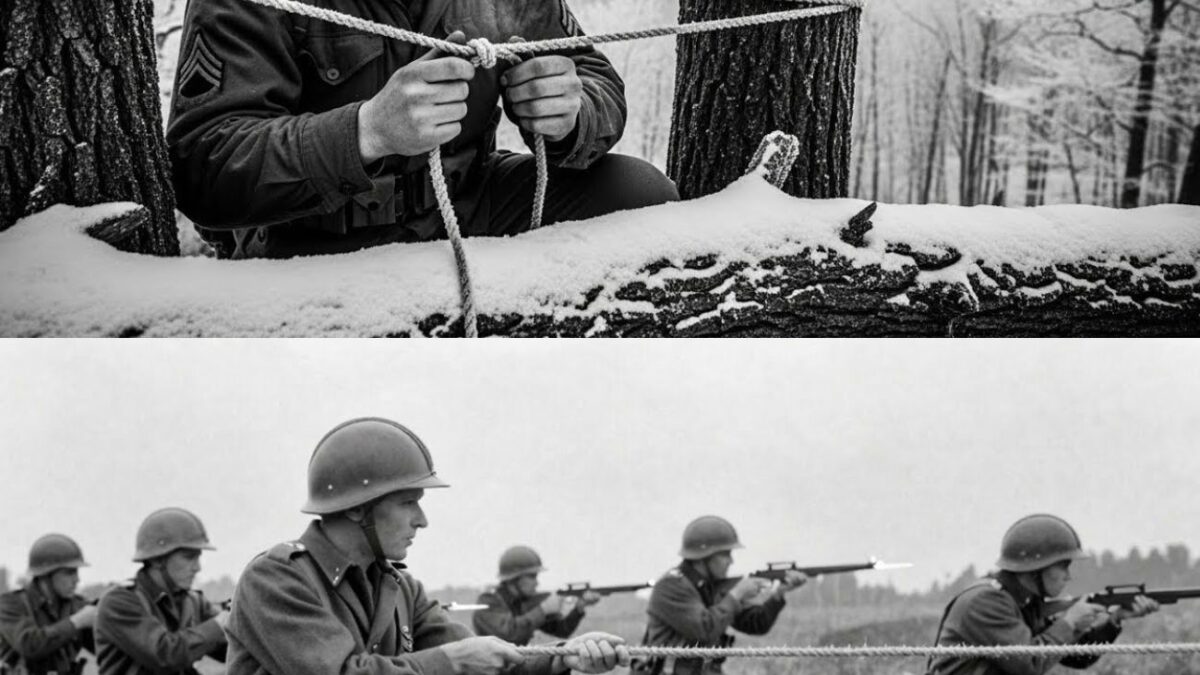
The dense, snowbound forests of the Ardennes region in Belgium stood utterly silent under a suffocating winter sky on the morning of December 15th, 1944. The bitter cold clung fiercely to the ancient pines, freezing the damp earth into solid stone and locking the quiet hillsides in pristine white slumber. At exactly 0600 hours, Corporal Thomas Mitchell crouched low inside a frozen foxhole that offered meager shelter against the biting, sub-zero European wind.
He was a soldier in the United States Army’s Second Infantry Division, hunkered down on a high ridge overlooking a sweeping valley masked in mist. Beside him, Private First Class Robert Jensen shivered beneath layers of coarse wool, blowing warm breath into stiff, cracked leather combat gloves. Both men believed, like the thirty other soldiers of their isolated platoon, that this sector was merely a peaceful posting intended for rest and recuperation.
They had endured brutal meat-grinder fighting across France ever since landing on the blood-soaked beaches of Normandy six exhausting months prior to this winter deployment. Their battalion had been pulled from the meat grinder of the Hürtgen Forest, battered and bleeding, to rest along what command called the ghost front. Yet nature itself felt unnervingly tense this morning, stripped of birdsong and wrapped in an oppressive gray fog that muffled every sound in the woods.
Mitchell peered over the frozen lip of his parapet, his dark eyes scanning the dense timberline that stretched eastward into the German frontier. At twenty-three years old, he carried himself with the quiet, deliberate composure of a man who had grown up in the rugged Allegheny Mountains. He was the second son of a coal miner from western Virginia, accustomed from childhood to hard labor, bone-chilling cold, and long days of solitude.
His father had taught him the art of deer hunting across the steep Appalachian ridgelines, where patience was the difference between feast and empty stomachs. He knew how to sit motionless for hours in a tree stand, tracking subtle shifts in the wind and reading the nervous twitches of distant game. Those years in the backcountry had gifted him with sharp eyesight, exceptional patience, and an instinctive ability to read the psychology of hunted prey.
Beside him, young Jensen gently scraped frost off the bolt mechanism of his standard-issue M1 Garand rifle to prevent the steel from freezing shut. Jensen was an Iowa farm boy, barely eighteen years old, whose round face still bore the youthful innocence of the Midwestern cornfields he missed. He had only joined the division three months earlier, arriving as a replacement during the miserable autumn rains that had bogged down the Allied advance.
Across an expansive frontage of eight hundred meters, First Platoon occupied hastily scraped positions scattered along the forward crest of the snow-covered ridge. They possessed only thirty-two men in total, thinly stretched along the wooded line with wide, vulnerable gaps separating their defensive fighting holes. Their platoon commander, Lieutenant Christopher Walsh, was a twenty-five-year-old graduate of the Virginia Military Institute who possessed sharp tactical instincts and deep devotion to his men.
Walsh operated his small command post out of a partially collapsed stone farmhouse situated roughly two hundred meters behind the forward rifle pits. Recent Allied intelligence reports handed down from division headquarters had repeatedly assured the officers that nothing consequential threatened their quiet sector. The German units across the line were supposedly shattered, consisting of old men and young boys lacking transport, ammunition, and offensive fighting spirit.
This intelligence assessment represented one of the most disastrous operational miscalculations in the entire history of the western military campaign. Just thirty minutes after dawn, as pale gray light filtered weakly through the bare branches, Jensen suddenly stopped his quiet, nervous humming. The young private froze, cocking his head toward the deep forest to the east while Mitchell instinctively raised his right hand for total silence.
Out of the deep mist rolled a low, rhythmic vibration, so faint at first that it seemed to originate from beneath the frozen bedrock. It sounded like the distant murmur of thunder, but the sky above was clear of storm clouds, leaving only the biting, motionless cold. Within seconds, the vibration grew in pitch and volume, transforming into the unmistakable mechanical roar of dozens of synchronized heavy internal combustion engines.
The ground began to tremble slightly beneath their combat boots, sending tiny tremors through the brittle crust of snow covering the foxhole. Mitchell lunged forward, grabbed the canvas-wrapped field telephone resting on a wooden ammo crate, and rapidly cranked the small brass magneto handle. Lieutenant Walsh picked up the receiver on the very second ring, his sharp voice cutting through the hollow hiss of the wire.
Mitchell kept his Appalachian drawl calm, although a cold knot of adrenaline instantly tightened within the pit of his churning stomach. “Lieutenant, we have heavy vehicle noises approaching directly from the east through the fog,” Mitchell reported, his eyes never leaving the gray horizon. “Multiple engines, sir, moving fast toward our line. It sounds massive, like an entire armored column pushing straight down the logging corridor.”
Neither the young corporal nor his commander could comprehend that they sat directly in the path of the colossal Ardennes Counteroffensive. Across an eighty-five-kilometer front, three entire German armies comprising over two hundred thousand men and a thousand tanks were launching a desperate winter strike. First Platoon’s tiny, isolated ridge was one of the critical forward gates the enemy intended to blow open within the opening hours.
By 0700 hours, a cold breeze began to strip away the thick curtain of ground fog that had masked the bottom of the valley. Mitchell raised his rifle, sighting down the black iron post toward the edge of the forest approximately six hundred meters down the slope. What materialized through the swirling vapors caused his mouth to go completely dry and his pulse to hammer against his temples.
Emerging from the evergreen timber were long, disciplined columns of German infantrymen advancing in loose tactical skirmish order across the snow. They moved with practiced efficiency, their gray-green greatcoats blending into the winter landscape as their rifles swung ready across their chests. Behind the foot soldiers lumbered the menacing, angular silhouettes of armored half-tracks and heavy tanks, their long cannon barrels protruding like lances.
Jensen leaned over the frozen parapet, his voice trembling slightly as he swallowed hard against the rising tide of sheer panic. “Dear God in heaven, Tom,” the farm boy whispered, his fingers trembling on the stock of his weapon. “Look at them. There are hundreds.” Mitchell squinted, rapidly counting squads, platoons, and armored support vehicles until the sheer mathematics of the enemy force became horrifyingly undeniable.
He estimated at least five hundred infantrymen advancing in the initial wave alone, backed by heavy armor and self-propelled artillery pieces. They were outmatched at least fifteen to one, holding an overextended perimeter with no artillery support and virtually zero anti-tank capability. Back in the ruined stone farmhouse, Lieutenant Walsh stared at his grease-pencil tactical map, fully recognizing the catastrophe bearing down upon his men.
Strict orders from battalion headquarters had arrived by courier the previous evening: First Platoon was to hold its designated ridge line at all costs. They were expected to buy precious time for division reserves and logistical units further west to organize an effective, coherent defensive perimeter. If First Platoon broke and fled immediately, an eight-hundred-meter breach would instantly tear open, exposing the battalion’s flanks to complete annihilation.
At 0715 hours, Walsh urgently summoned his three squad leaders to the farmhouse to make an agonizing operational choice under extreme battlefield pressure. Among them stood Technical Sergeant William Harrison, a grizzled thirty-one-year-old regular army veteran who had seen combat across North Africa and Sicily. Harrison’s weather-beaten face was deeply lined from years of field service, and his gravelly voice carried the weight of seasoned tactical experience.
“Sir, we cannot stop that force in a stand-up gunfight,” Harrison stated plainly, resting his calloused knuckles on the crude wooden table. “We don’t have the ammunition, we don’t have heavy bazookas, and we sure as hell don’t have the riflemen to hold this ridge.” He leaned closer to the map, pointing a blunt finger toward the heavily timbered hills rising steeply behind their current forward line.
“If we stay in these shallow holes, their armor will roll over us and crush us within thirty minutes,” Harrison continued with grim realism. “Our only chance to slow them down is to pull back into the rugged high ground, use the forest, and get completely creative.” Harrison proposed abandoning the fixed line immediately, breaking the platoon into independent squads scattered along the commanding forested ridges above the valley floor.
Walsh nodded solemnly, understanding that rigid military doctrine would mean the total destruction of his men without achieving any meaningful delay. He ordered each squad to displace uphill into prepared secondary ambush positions where they could exploit the broken terrain to harass the advance. Corporal Mitchell and Private Jensen were assigned directly to Second Squad, remaining under the immediate field command of Sergeant Harrison himself.
As the men scrambled through the half-ruined farmhouse gathering extra bandoliers of ammunition and fragmentation grenades, Mitchell noticed a forgotten supply cache. Lying amidst discarded ration crates was a heavy coil of olive-drab utility rope, roughly fifty meters long and rated for significant weight. Without fully understanding why, guided only by the ingrained instincts of a mountain hunter, Mitchell grabbed the coil and slung it across his shoulder.
The heavy hemp rope settled against his field pack, a peculiar piece of extra equipment for an infantryman fleeing an incoming armored juggernaut. At 0745 hours, Second Squad slipped out of the farmhouse and began climbing the steep, snow-draped hillside rising to the west. The ascent was punishing, the soldiers slipping on icy shale and buried tree roots while carrying heavy combat loads through thick briars.
They reached the crest at 0800 hours, breathing heavily, their lungs burning from the frigid air as they took up concealed positions. Mitchell dropped behind a massive fallen oak tree sixty meters above the natural valley road that funneled through the dense forest floor. Down below, the first scouts of the German vanguard cautiously entered the abandoned American foxholes, probing for defenders who had already vanished.
From his elevated vantage point, Mitchell peered through the screen of pine boughs and realized the staggering magnitude of the enemy spearhead. The force down in the draw was not merely a local patrol or a probing company; it was the vanguard of a massive regiment. Behind the initial wave of infantry stretched an endless serpent of armored fighting vehicles, supply trucks, half-tracks, and heavy towed artillery pieces.
He counted a dozen armored vehicles grinding their steel treads through the snow, their exhaust plumes rising like pillars of smoke into the gray. At 0845 hours, the miniature field radio strapped to Harrison’s pack crackled softly, bringing Lieutenant Walsh’s faint voice through the mountain static. The platoon leader gave the synchronized order: every squad was to initiate harassing sniper fire, then immediately displace before drawing return artillery.
The tactical objective was clear and desperate: provoke uncertainty in the enemy column, force their infantry to deploy, and bleed their momentum. Mitchell rested the walnut handguard of his Garand across the rough bark of the fallen oak, controlling his breathing with steady discipline. He selected his target with clinical care—an officer standing beside a staff car, map board in hand, directing the movement of a motorized company.
He gently squeezed the smooth steel trigger, feeling the sharp, familiar kick of the rifle butt against his padded wool field jacket. Six hundred yards down the slope, the German officer abruptly spun and collapsed into the snow as the sharp gunshot echoed off the ridges. Around the fallen officer, pandemonium erupted; German soldiers dived headlong into roadside ditches while armored machine gunners swiveled their turrets frantically.
The entire mechanised column ground to an unexpected halt, fearing they had walked into the kill zone of a fortified defensive position. Heavy return fire erupted seconds later, machine-gun rounds chewing through the upper canopy of pines and showering Mitchell with green needles and splinters. Harrison’s men kept up sporadic, disciplined rifle fire from multiple points along the crest, shifting their positions after every couple of aimed rounds.
For fifteen furious minutes, the small American squad maintained their harassing action, Mitchell methodically firing through clips and registering several confirmed hits. Yet the enemy was too professional and experienced to remain pinned by unseen skirmishers on an isolated hillside for very long. German non-commissioned officers soon organized two platoons of infantry to execute a textbook flanking assault up the steep, wooded slopes.
At 0915 hours, recognizing the imminent danger of encirclement, Sergeant Harrison blew a sharp whistle and ordered an immediate withdrawal westward. The retreat through the dense, trackless forest was chaotic, the Americans bounding backward through waist-deep snow drifts to break physical contact. Behind them, the shouts of German soldiers and the snapping of twigs grew dangerously close as the pursuit pushed hard into the timber.
Harrison guided his scattered, exhausted men toward a narrow, rocky ravine choked with tangled rhododendron bushes and thick mountain laurel undergrowth. Mitchell slid down the icy embankment, his rifle held high to protect the muzzle, landing heavily beside Jensen in the snow. When Harrison conducted a rapid headcount, his weathered face turned pale: of the nine men who began the retreat, only six remained.
Three soldiers had been separated in the dense woods during the scramble, and Harrison’s attempts to raise Lieutenant Walsh on the radio failed. The radio emitted only a continuous wash of harsh electromagnetic static; the jagged mountain terrain and distance had effectively severed their communications. They were entirely alone, isolated miles behind the newly formed enemy front line with limited ammunition and no hope of immediate reinforcement.
Harrison knelt in the freezing mud, his voice barely a rasp. “Listen to me. We work our way down this gully toward the west.” Before the sergeant could finish his sentence, Mitchell reached out and clamped a firm hand onto Harrison’s shoulder, shaking his head. Faint voices speaking rapid, urgent German drifted through the cold air from directly ahead, right along the floor of their planned escape route.
A patrol of twenty heavily armed German grenadiers walked in single file along the edge of the ravine, searching the thick brush. Mitchell and his squad pressed themselves flat into the freezing mud, holding their breath as the patrol passed less than thirty feet away. The enemy soldiers moved past without looking down into the tangled brush, but their tactical presence completely severed Second Squad’s only route of withdrawal.
They were hopelessly trapped within a pocket of enemy activity, completely surrounded by advancing formations and unable to move without immediate detection. For nearly an hour, the six Americans lay motionless in the snow, shivering violently as the temperature dropped and ice formed in their hair. Mitchell quietly inspected his remaining ammunition supply, counting four eight-round en-bloc clips of .30-06 ammunition—a meager thirty-two rounds in total.
At 1045 hours, the sounds of shouting and vehicle movements intensified dramatically in the clearing just beyond the mouth of their ravine. Crawling forward on his belly through the snow, Mitchell peered through a screen of evergreen shrubs and observed a massive tactical assembly. More than two hundred German soldiers were forming up into attack companies, supported by armored half-tracks and heavy mortar teams.
German officers stood over field tables unfolded on vehicle hoods, issuing final operational orders to unit commanders for the next phase of advance. This was a fresh assault battalion preparing to surge westward toward the secondary Allied lines, which were likely completely unprepared for the breakthrough. If this cohesive force struck the disorganized rear areas of the American division, thousands of unsuspecting support troops would be overrun.
Mitchell crawled backward until he was shoulder-to-shoulder with Sergeant Harrison, who was observing the assembly through a pair of scratched field binoculars. “Sergeant, we can’t let that force hit our boys down the road,” Mitchell whispered, his jaw set firm against the shivering cold. “If they roll out of this staging ground organized, they’ll punch right through to the supply depots before anyone knows what happened.”
Harrison lowered his binoculars and looked at his corporal with weary skepticism, his breath curling gray into the freezing woodland air. “Corporal, take a good look around you,” Harrison said grimly. “There are six of us, thirty rounds a man, and no radio.” “I admire the spirit, Mitchell, but we don’t have enough lead to give that battalion anything more than a brief headache.”
Mitchell shifted his gaze from the massed enemy soldiers back to the steep, wooded ridge rising directly above the assembly area. Then his eyes fell upon the fifty-meter coil of olive-drab rope still looped securely over the canvas straps of his field pack. A sudden, audacious plan began to take shape in his mind, forged from memories of hunting deer along the ridges of Virginia.
Back home, an experienced hunter never needed to be everywhere at once; he only needed to manipulate what the deer saw and heard. A deer, like any vigilant creature fearing danger, relied entirely on peripheral movement and unexpected sounds to detect the presence of predators. If you made a deer believe a hunter occupied every trail, its natural instinct was to freeze, seek cover, and refuse to move.
“Sergeant, what if we don’t engage them in a conventional fight?” Mitchell asked, his voice quickening with controlled excitement and quiet conviction. “What if we make those officers down there believe this entire ridgeline is crawling with an American counter-ambush force waiting to wipe them out?” Harrison frowned, his brow furrowing as he stared at the young corporal. “Keep talking, Mitchell. And it better make damn good sense.”
“The enemy down there is cautious, Sergeant,” Mitchell explained rapidly. “They know our platoon was up here, but they don’t know our numbers.” “If they think they are advancing straight into an entrenched battalion ambush with interlocking fire, their standard doctrine will force them to stop.” “They’ll halt the advance, deploy into defensive perimeters, and wait for heavy artillery support before sending their infantry into a suspected kill zone.”
Harrison stared at Mitchell, his veteran mind turning the proposal over. “And how do six freeze-dried riflemen convince two hundred men they’re a battalion?” Mitchell unslung the coil of rope, tossing the heavy hemp bundle lightly onto the snow between them like a winning card. “With this rope, the timber, and a little mountain theater,” Mitchell said with a faint grin. “We make the forest fight for us.”
Harrison stared at the rope, then up at the steep ridge overlooking the staging area, and finally back into Mitchell’s steady, determined eyes. “It’s completely insane, Mitchell,” Harrison murmured, a slow, predatory smile touching his chapped lips. “It’s insane enough that it just might work.” “You’ve got twenty minutes to rig your trap before those Krauts finish their briefings. Show the boys exactly what needs to be done.”
Moving with desperate haste, Mitchell divided the five remaining soldiers into distinct tactical sectors spaced widely along two hundred meters of ridge. He uncoiled the long rope, slicing it into multiple functional sections using his combat trench knife, his fingers numb from the biting cold. He identified three elevated clearings where narrow corridors through the pine canopy were directly visible to German lookouts below in the valley.
Between the trees in these visible clearings, Mitchell meticulously strung the lengths of rope, securing them around flexible pine saplings and thick branches. To the suspended lines he tied abandoned steel helmets, empty ration tins, heavy branches, and torn strips of canvas from broken supply crates. He tied long guide cords to the main lines, routing the operational ends back into concealed firing pits dug deep into the underbrush.
By pulling gently on a single guide cord, a hidden soldier could agitate dozens of yards of foliage and bob multiple steel helmets simultaneously. To an observer looking up through the gloom from hundreds of yards away, the effect mimicked soldiers moving cautiously through prepared firing trenches. Yet Mitchell knew visual deception alone would never withstand scrutiny without an equally convincing acoustic landscape to complete the terrifying illusion.
He instructed his squad mates to disperse at forty-yard intervals along the wooded crest and prepare to initiate a calculated symphony of chaos. They were to fire single, spaced rifle shots from different positions, shout contradictory platoon and company commands, and aggressively rattle dead brushwood. Every time a soldier fired, he was ordered to immediately crawl twenty yards to a secondary position before discharging another round into the trees.
At 1115 hours, as the German officers in the valley below folded their maps and shouted orders for the companies to mount up, Mitchell struck. From his concealed hollow, he gave a sharp, violent tug on the primary guide cord anchored to the center of his rope network. Fifty yards to his left, three steel helmets bobbed rhythmically through the snow-dusted brush, followed by the heavy crashing of shaken saplings.
Almost instantly, German lookouts in the valley spotted the sudden, coordinated movement along the commanding crest and began shouting urgent alarms. Jensen, positioned eighty yards to the south, squeezed off a single, sharp rifle round that kicked up snow near an armored scout car. Farther up the ridge, another soldier bellowed in English at the top of his lungs: “First squad, hold fire until they hit the road!”
The psychological impact on the German assembly area was immediate, profound, and entirely chaotic across every rank down in the valley floor. Expecting a smooth road march westward, the German battalion suddenly believed they were caught in the sights of an entrenched American counter-attack force. Whistles blew furiously across the clearing; officers barked frantic defensive commands, and marching infantrymen scrambled desperately for the protection of ditches.
Armored vehicles revved their engines in reverse, swinging their heavy machine-gun mounts upward to rake the tree line with wild, blind fire. Mitchell dropped flat as heavy caliber bullets chewed through the timber above him, spraying his wool coat with bark chips and snow. As soon as the burst ceased, he crawled ten yards to his right and gave a second cord a series of sharp, irregular tugs.
Another cluster of decoy helmets bobbed along a different sector of the ridge, accompanied by an empty ration tin clattering against a boulder. Private Jensen fired another round from his alternate foxhole, followed immediately by Harrison shouting fictional fire-control orders into the freezing wind. “Squad leaders, hold your heavy mortars for the main column!” Harrison roared, his booming voice echoing off the rocky outcrops of the ravine.
To the German commanders observing through binoculars from the valley floor, the ridge appeared alive with an aggressive, well-coordinated infantry force. Every shadow seemed to conceal an American rifleman; every rustling pine branch suggested an enemy heavy weapons squad preparing to unleash an ambush. The German battalion commander, cautious and mindful of protecting his armor in tight forest defiles, made a fateful operational decision on the spot.
Rather than pressing his mechanized advance westward down the exposed road, he ordered his entire battalion to halt and adopt defensive positions. Infantry companies were directed to fan out and dig protective trenches in the frozen mud around the clearing, facing the menacing ridge. Pioneers were ordered forward to establish roadblocks, while armored half-tracks formed a defensive perimeter to repel the assault they believed was coming.
From his perch behind the fallen oak, Mitchell watched with pounding heart and quiet astonishment as the massive enemy formation completely ground to a halt. The aggressive German offensive posture had vanished entirely, replaced by the bunker mentality of an army bracing for a devastating counter-stroke. For two grueling, nerve-shredding hours, Mitchell and his five companions maintained their elaborate psychological charade with flawless, relentless precision.
They shifted constantly through the waist-deep snow, pulling cords, tossing rocks into dry brush, and firing solitary, carefully timed rounds from unexpected angles. Six exhausted, freezing American soldiers were generating the operational footprint, noise, and defensive threat of an entire reinforced rifle company. Every time the German infantry probed forward with small scouting parties, Mitchell’s men would deliver accurate rifle fire and immediately vanish into the brush.
The ropes, swaying gently in the rising winter wind, continued to move helmets and branches on their own, drawing bursts of nervous German fire. By 1300 hours, Mitchell observed German engineers dragging heavy timber across the valley road to construct reinforced fighting bunkers and anti-tank barricades. They were no longer preparing to move; they were digging in deep, waiting for the heavy artillery support they deemed necessary to clear the ridge.
Sergeant Harrison crawled quietly into Mitchell’s hollow, wiping sweat and powdered snow from his soot-stained face with the back of his hand. A wide, genuine grin split the older soldier’s weathered features as he lowered his binoculars and looked at his young corporal in disbelief. “Mitchell,” the sergeant whispered, his gravelly voice thick with awe, “I’ll be damned if you didn’t just stop a whole battalion with a clothesline.”
Yet both men knew with absolute clarity that their miraculous deception was living on borrowed time along that frozen Belgian ridgeline. Their ammunition was down to less than a dozen rounds per man, their bodies were trembling from exposure, and daylight would eventually expose their trick. If the German commander decided to launch a determined, full-scale frontal assault up the slope, their bluff would collapse in bloody ruin.
At 1330 hours, an entirely new sound cut through the cold mountain air from the far western horizon, carrying over the snow-covered peaks. It was the deep, rhythmic drone of heavy American radial engines—the unmistakable, industrial roar of Sherman tanks moving at high speed. Peering through gaps in the western tree line, Mitchell caught glimpses of olive-drab armor and white identification stars deploying along a ridge two kilometers away.
Elements of the American Third Armored Division had arrived to seal the breakthrough, establishing the very defensive line First Platoon had bought time to form. Harrison understood the critical importance of the tactical moment: they held vital intelligence on the exact strength and location of the enemy force. If they could physically reach those incoming friendly units, they could transform their desperate delaying action into a devastating Allied counter-stroke.
The radio remained entirely dead, leaving physical movement through the contested forest as their only viable means of delivering the intelligence. Mitchell pointed toward the northern slopes of the ridge, proposing a wide flanking route through the deepest timber to bypass the German outposts. Harrison agreed instantly; at 1400 hours, Second Squad gathered their remaining gear and began their perilous trek through the dense, snowbound woods.
They deliberately left the rope network fully intact, allowing the bitter winter winds to continue agitating the decoys and maintaining the illusion. The next three hours tested every ounce of physical endurance, wilderness skill, and raw courage the six exhausted soldiers possessed. They moved like ghosts through the deep snow, freezing in place whenever German patrols crossed within earshot along adjacent logging trails.
At one point, they were forced to crawl on their bellies through freezing slush for two hundred yards to bypass a fortified German machine-gun nest. During the grueling crawl, Jensen stepped into a hidden crevice beneath the snow, badly spraining his ankle with an audible pop of ligaments. Suppressing a scream of agony, the young private collapsed, unable to bear weight on the swelling joint as tears froze on his cheeks.
Without hesitation, Mitchell hoisted Jensen’s arm over his broad shoulder, carrying half the farm boy’s weight as they limped through the drifts. They pushed forward through the gathering gloom of the winter afternoon, their breath rattling in their chests and their limbs numb with exhaustion. By 1645 hours, the dim light of dusk was fading into deep winter darkness as they finally approached the western wood line.
Suddenly, a sharp, authoritative voice barked from behind a snowbank fifty yards ahead: “Halt! Give the password or we open fire!” The unmistakable click of multiple Garand rifle bolts sliding home broke the evening silence; an American patrol had their weapons leveled at them. “Don’t shoot! Friendly! Second Infantry Division!” Harrison bellowed, raising his empty, calloused hands high above his head in the snow.
After tense moments of verification, the patrol from the Third Armored Division escorted the six ragged, frostbitten soldiers into their fortified command bunker. Harrison and Mitchell were brought immediately before a weary cavalry lieutenant, who listened with astonishment as they briefed him on the enemy positions. Mitchell unrolled a grease-stained field map, pointing out the precise coordinates where the German assault battalion sat entrenched in the valley clearing.
He provided exact landmarks, vehicle counts, fuel depot locations, and the defensive dispositions the enemy had adopted during the standoff. The cavalry lieutenant wasted not a single second, immediately picking up the direct line to the division artillery fire direction center. Within twenty minutes, the winter sky behind the American lines lit up with the blinding flash of dozens of heavy howitzers opening fire.
A devastating barrage of high-explosive artillery shells screamed over the treetops, slamming into the exact valley coordinates Mitchell had provided. The German battalion, trapped in the tight confines of the clearing where Mitchell’s deception had forced them to dig, was completely shattered. The concentrated artillery barrage destroyed armored vehicles, detonated fuel reserves, and broke the operational spine of the advancing German regimental spearhead.
Later that evening, inside a dimly lit field kitchen set up in an abandoned barn, Mitchell sat on a wooden crate holding a tin of coffee. The surviving members of Second Squad sat clustered around a small cast-iron stove, their frozen boots steaming as feeling slowly returned to their feet. The barn door creaked open, admitting a blast of frigid air along with Lieutenant Walsh, who had successfully withdrawn the rest of First Platoon.
Walsh looked like a man who had walked through the gates of hell and back; his face was gray with fatigue and his coat was shredded. He walked slowly across the straw-covered floor, looking down at Mitchell and the battered survivors of Second Squad with profound gratitude. “Corporal,” Walsh said quietly, placing a heavy hand on Mitchell’s shoulder. “I just spoke directly with the battalion commander at headquarters.”
“Intelligence estimates that the force you held pinned on that ridge today numbered over seven hundred front-line soldiers,” the lieutenant continued softly. “If that force had broken through this morning when our reserves were still twenty miles back, our entire division perimeter would have collapsed.” “The colonel wants you to know that your actions up on that ridge saved at least thirty American lives today—probably a great deal more.”
Mitchell looked down at the steaming black coffee in his tin cup, his thoughts drifting back to the cold ridges of western Virginia. “We weren’t trying to be heroes, Lieutenant,” Mitchell said with characteristic mountain modesty. “We were just trying to keep our skin in one piece.” “That business with the rope… that was just an old trick my daddy taught us for hunting white-tails back in the Appalachians.”
Walsh offered a tired, genuine smile, shaking his head at the magnificent audacity of the Appalachian coal miner’s son. “Well, Corporal,” Walsh replied, “you just used deer hunting tactics to stop an armored assault battalion cold in its tracks.” “I have a strong feeling the United States Army is going to write about your little hunting trick for a very long time.”
In the bloody, freezing weeks that followed, the Battle of the Bulge raged furiously across the frozen forests of the Ardennes. Yet the legendary story of Mitchell’s rope deception spread like wildfire through the ranks of the division, becoming an emblem of frontline ingenuity. Military intelligence officers interviewed Mitchell extensively, meticulously documenting how six men and fifty meters of utility rope had held a regiment at bay.
Official military after-action reports formally credited Second Squad’s actions with delaying the German operational timetable by seven critical hours. That delay provided the precious window needed for American armored reserves to rush forward and plug the catastrophic rupture in the line. Thomas Mitchell was subsequently promoted to the rank of sergeant and awarded the Bronze Star for valor in the face of overwhelming odds.
Yet whenever officers praised him for his gallantry, Mitchell adamantly insisted that every single man in Second Squad deserved equal credit for the stand. Of the thirty-two young men who had comprised First Platoon on that quiet morning of December 15th, twenty-four survived the brutal winter campaign. Lieutenant Walsh always maintained that without Mitchell’s audacious ruse, not a single man of his platoon would have lived through that first bloody day.
The utility rope itself was left behind in the silent, snowbound forest when Second Squad executed their withdrawal toward friendly lines. Mitchell often wondered in later years what had become of that simple length of hemp rope left suspended among the shattered pine trees. He wondered if German scouts had eventually cut it down, finally realizing with bitter humiliation how thoroughly they had been deceived by five farm boys.
In the grand historical tapestry of the Second World War, the skirmish on that unnamed ridge was officially recorded as a minor tactical footnote. Yet for the soldiers who lived to return home to their families, Mitchell’s ingenuity represented something timeless and profound about human nature under pressure. When the industrial machinery of war seemed all-powerful, a solitary hunter’s mind had proven that intellect and courage could conquer overwhelming steel.
Decades after the guns fell silent, Thomas Mitchell returned to his quiet mountain home in Virginia, raising a family and working the mines. He rarely spoke of the war, preferring the peaceful solitude of his native hills to the noisy celebrations of military veterans’ parades. Only in the twilight of his life did he finally share the full philosophy behind the miraculous deception that had saved his comrades.
“A hunted creature sees what it fears most,” Mitchell explained quietly to an interviewer many years later, looking out toward the blue ridges. “When men are frightened, their imaginations build monsters in every shadow; you only have to give the brush a little shake.” “A piece of rope didn’t stop that army,” he added with a soft smile. “Their own fear stopped them; we just pulled the string.”

