How a U.S. Sniper’s “Mirror Flash” Trick Eliminated 94 Japanese in One Week
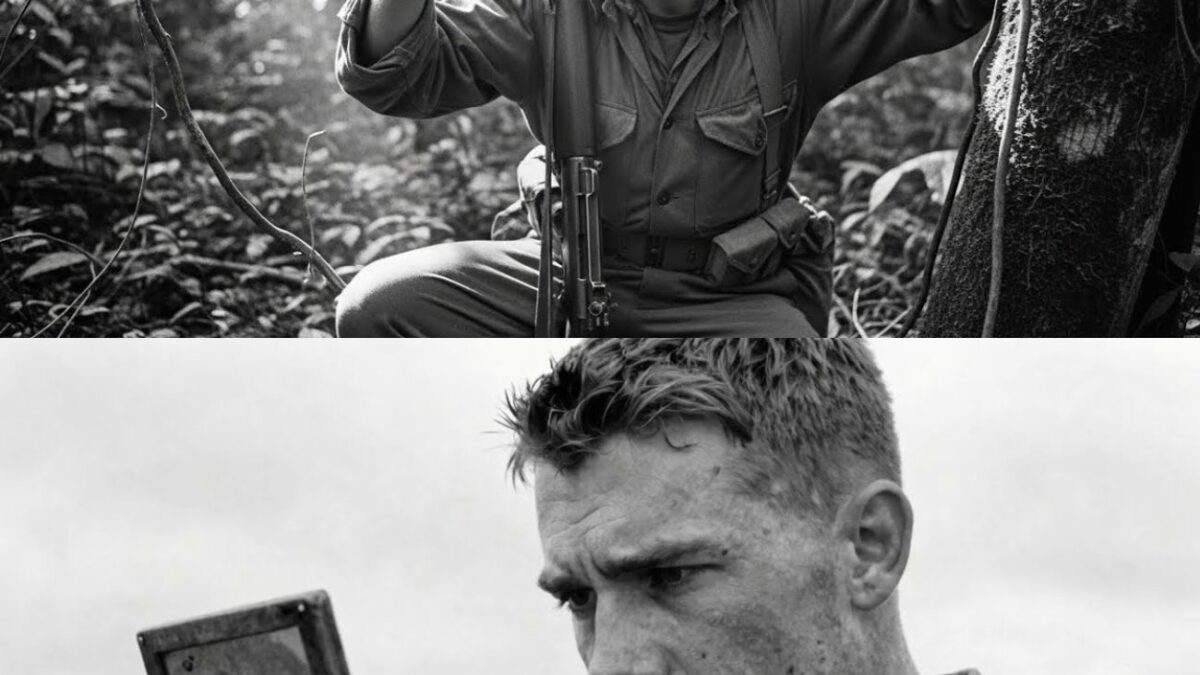
The island of Bougainville lay buried beneath an oppressive mantle of humidity, rotting vegetation, and ancient, towering trees in the early days of November 1943.
Corporal Thomas Brennan of the United States Marine Corps crouched silently within the dense, emerald undergrowth, feeling the slick dampness soak through his combat fatigues.
His trusty M1903 Springfield rifle rested steadily across a moss-covered fallen log, its cold steel receiver offering an anchor of reality against the vast, untamed wilderness.
Below his elevated vantage point along the ridgeline, the entrenched Japanese defensive perimeter stretched across the wide coastal plain like an immense, slumbering serpent.
American troops had entered this campaign believing they understood the brutal realities of jungle warfare after the grueling trials of Guadalcanal just months earlier.
Yet they were swiftly learning that blind courage and stubborn resolve were not enough to master the dense, claustrophobic green hells of the South Pacific theater.
Here, survival demanded far more than mere marksman training or standard military doctrine; it required an acute ability to innovate under the sheer pressure of annihilation.
What Corporal Brennan was destined to discover in the dense foliage of the Torokina River Valley would elevate him from an unassuming marksman into a legendary figure.
His improvised, highly unconventional approach would eventually become one of the most thoroughly analyzed and celebrated field methodologies in specialized sniper doctrine.
Brennan had stepped off an amphibious transport ship onto the blood-soaked beaches of Bougainville three weeks prior as an ordinary member of the Third Marine Division.
The twenty-four-year-old native of Montana had qualified as a marksman during his recruit training at Parris Island, but he had never been the fastest or flashiest shooter.
He was not the kind of natural deadeye celebrated in rifle competitions, nor did he boast the thunderous, swaggering bravado commonly associated with frontline infantry scouts.
His early life spent roaming the rugged, pine-studded mountains near Missoula had instilled within him an entirely different sort of discipline centered on stillness and patience.
He had spent uncounted autumns tracking elusive elk herds and whitetail deer across steep ridges, learning to decipher nature’s faintest cues and anticipate invisible paths.
To survive and hunt successfully in those northern highlands, one had to become part of the background, noticing every bent stalk of grass and subtle change of wind.
For months, these quiet backwoods instincts had seemed utterly obsolete amidst the deafening noise, mechanized violence, and institutional regimentation of the Marine Corps.
Yet within the tangled interior of this remote Solomon Island, where lines of sight were measured in inches, Brennan’s patient observational prowess discovered its true purpose.
His platoon leader, Sergeant Harold Mitchell, had initially assigned the quiet young corporal to conventional rifle squad maneuvers and defensive perimeter security.
Mitchell was a battle-hardened veteran who had already survived the terrifying meat grinder of Guadalcanal and carried himself with the grim, grounded poise of a survivor.
He possessed that rare, seasoned instinct common among veteran noncommissioned officers, knowing immediately which men cracked under pressure and which held steady reserves.
During their initial skirmishes through the coastal swamps, Mitchell had watched Brennan intently, noting how the young Montanan never fired blindly into the bush.
Instead, Brennan consistently searched the tangled canopy with a calm, analytical detachment, studying the shadows long after other men had depleted their ammunition in panic.
The operational mission facing their regiment along the perimeter was undeniably straightforward on paper, yet staggering in its actual tactical complexity and danger.
Allied intelligence reports indicated that roughly eight hundred veteran Imperial Japanese troops remained deeply entrenched in a fortified complex of underground earthworks.
These subterranean bastions and interconnected machine-gun nests were distributed with cunning symmetry along the marshy corridors of the Torokina River Valley.
The Allied landing force numbered roughly two thousand frontline Marines, giving them an apparent numerical advantage that evaporated completely within the suffocating landscape.
The natural geography heavily favored the dug-in defenders, who had mapped every clearing, charted every elevation line, and established interlocking fire across all avenues.
The opposing commander, whose rank and personal identity would only be uncovered weeks later from captured operational logs, managed his forces with lethal sophistication.
He had forbidden his soldiers from engaging in premature banzai charges, anchoring them instead to concealed pillboxes, sniper perches, and fortified earthen positions.
Every trail carved into the mud had become a pre-sighted kill zone where unwary American patrols were systematically cut down before they could locate the threat.
On the fourth morning of November, Brennan sat beneath the sprawling roots of a banyan tree, meticulously cleaning the bolt assembly of his Springfield rifle.
Beside him sat Private First Class Daniel O’Connor, a quick-witted field radioman from Boston whose headset buzzed with grim casualty reports from forward patrols.
O’Connor rubbed the grime from his bloodshot eyes and solemnly detailed the grim losses suffered by the battalion’s lead reconnaissance company over two brutal days.
Seventeen Marines had been shot dead during the previous forty-eight hours, each felled by a single, terrifyingly accurate gunshot originating from concealed positions.
What unnerved the forward platoons most was the uncanny, almost supernatural precision with which the Japanese defenders anticipated every American flanking maneuver.
The enemy never gave away their locations with sustained automatic fire; they picked off scouts and radio operators with surgical, single-shot lethality, then vanished.
As O’Connor recounted the grim timeline, he casually noted an eerie operational pattern that made Brennan pause his cleaning cloth mid-stroke across the rifle bolt.
The Boston radioman pointed out that these fatal engagements rarely took place in the damp darkness of dawn or during the twilight of late evening patrols.
The overwhelming majority of the sniper casualties occurred during the brightest hours of the day, particularly when the midday sun stood unobstructed at its zenith.
Most officers and senior sergeants concluded this was merely when Allied patrol activity reached its peak along the muddy trails cutting toward the river.
Brennan’s mind, shaped by years of stalking game across open mountain ridges where light dictated the behavior of predator and prey alike, viewed it differently.
He understood that bright sunlight was rarely an asset for a concealed woodsman; excessive illumination cast unforgiving shadows and transformed glass into blinding beacons.
If the Japanese snipers were achieving peak efficiency at noon, it meant they were not merely relying on their eyes to penetrate the deep gloom of the jungle floor.
They were actively utilizing the harsh celestial light of midday to their tactical advantage, employing some systematic mechanism to coordinate their devastatingly accurate fire.
That evening, amidst the buzzing swarms of mosquitoes and the humid murmur of the forward camp, Brennan approached Sergeant Mitchell with a radical proposal.
He requested formal authorization to depart the perimeter entirely alone, operating as an independent scout deep within the contested buffer zone for several days.
He wished to move entirely at his own deliberate pace, setting up concealed observation posts and selecting vantage points based on terrain logic rather than company movements.
Mitchell listened with stony skepticism, reminding Brennan that standard Marine Corps doctrine prioritized collective squad cohesion and mutual support over solo heroics.
Yet Brennan methodically laid out his analytical reasoning, explaining that conventional multi-man patrols were simply too loud, clumsy, and predictable for the dense foliage.
More importantly, Brennan shared his working hypothesis: he suspected the Japanese forward observers were utilizing optical signals to paint and verify targets before firing.
Intrigued by the corporal’s calm conviction, Mitchell agreed to grant the young marksman seventy-two hours of autonomous operation to prove his unconventional theory.
At first light the following morning, Brennan slipped past the outermost barbed-wire defenses of the American perimeter, stripped of all non-essential infantry gear.
He carried his beloved Springfield rifle, two hundred carefully inspected rounds of .30-06 ammunition, three canteens of chlorinated water, and emergency K-rations.
Tucked safely within his breast pocket was a four-inch square glass mirror salvaged from the charred debris of a destroyed Japanese command bunker days earlier.
Its silvered backing was slightly chipped along the edges, but the reflective glass remained clean, framed by scorched wood that offered an unobtrusive, non-metallic grip.
Before departing, Brennan had conferred briefly with First Lieutenant James Harrington, the company intelligence officer who painstakingly studied low-altitude aerial photographs.
Harrington confirmed that the enemy’s defensive strongpoints seemed to adjust their operational posture daily, suggesting a rotation of elite spotters between forward blinds.
This meant the Japanese network was not a static, rigid wall, but a fluid web of interconnected sentinels who constantly handed off target data across the valley floor.
Brennan spent his entire first day on his belly in a dense thicket of ferns, roughly eight hundred yards beyond the perimeter, completely motionless for hours.
He did not seek to fire his weapon; he merely peered through his magnified Unertl telescopic sight, studying the vibrant, treacherous theater of the tropical rainforest.
He observed how the hot tropical breeze ruffled the massive canopy leaves, how exotic birds darted between vines, and where natural shadows collected in deep hollows.
He watched the shifting geometry of sunlight filtering through the dense foliage, paying exquisite attention to how illumination bounced from puddles, bark, and wet stones.
By mid-afternoon, when the equatorial sun scorched the highest treetops, Brennan’s patient discipline was rewarded with the sudden revelation he had anticipated.
From three distinct, widely separated vantage points along the opposite ridgeline, brief, methodical flashes of concentrated sunlight blinked out across the green canopy.
The pulses were razor-sharp, rhythmic, and directed with absolute precision toward an overgrown junction where an American patrol was currently reconnoitering a creek.
Seconds after the third flash subsided, a sharp, distant rifle crack tore through the humid air, followed immediately by shouts of anguish from the ambushed patrol.
The Japanese forward observers were utilizing pocket mirrors and polished metal plates to communicate silently across the valley, directing snipers without making a sound.
It was an ingenious, silent signaling system that left no acoustic trace and required neither radio batteries nor conspicuous wire runs through the treacherous mud.
Yet as Brennan watched the distant reflections fade back into the emerald thicket, he recognized the fatal operational vulnerability inherent in their clever methodology.
A mirror depended entirely upon the external physics of light; if a signalman could project illumination forward, his own location was momentarily exposed in return.
The Japanese had built their entire forward targeting apparatus on the arrogant presumption that the Marines were blind to their silent, luminous communication network.
If an American scout could replicate their visual signals, he could invert their targeting cycle and transform their own communication net into a deadly trap.
On his second morning in the bush, Brennan abandoned the muddy forest floor and climbed thirty feet into the massive, moss-laden branches of an ironwood tree.
He positioned himself behind a thick screen of broad leaves, ensuring his silhouette was broken and his rifle barrel remained completely shrouded within deep shade.
From this elevated perch, he had a panoramic view of the enemy ridge while remaining completely undetectable from the regular trails below.
Reaching into his pocket, Brennan withdrew the small salvaged mirror, angling its face until it caught a stray beam of golden sunlight penetrating the upper canopy.
Aiming the focused beam with steady hands, he flashed a tight, two-second pulse of light toward a suspected sniper hideout nestled in a distant mahogany tree.
He deliberately calibrated the angle so the reflection would appear to originate from the muddy creek bed below, mimicking an American scout flashing equipment.
The psychological bait was taken with immediate, lethal eagerness; within five seconds, the foliage in the distant mahogany shifted slightly as a rifleman adjusted his stance.
The Japanese marksman, believing he had caught the careless reflection of an approaching American infantryman, leaned forward out of his shadow to line up his sights.
To any ordinary observer, the movement was imperceptible, appearing merely as the sway of a mossy branch stirred by an errant draft of equatorial wind.
Brennan’s childhood years spent tracking bighorn sheep across Montana’s barren crags had trained his eyes to register the slightest unnatural disruption in nature’s symmetry.
Through the high-powered glass of his rifle scope, he caught the dull olive curve of an enemy helmet parting two layers of natural camouflage netting.
Brennan held his breath, gently taking up the slack on the Springfield’s match trigger until the firing pin released with a sharp, echoing thunderclap.
The heavy .30-caliber slug traversed the seven-hundred-yard gap in a fraction of a second, tearing cleanly through the netting and instantly neutralizing the sniper.
The enemy soldier slumped forward over his wooden platform, his rifle tumbling through the branches to land with a distant thud in the undergrowth below.
Brennan did not linger to admire his handiwork; he immediately adjusted his cover, lowered his weapon, and slipped into the silent rhythm of the wild.
The revolutionary technique had proved its devastating efficacy on its very first trial, validating hours of exhausting stillness and complex ballistic calculation.
Later that week, Corporal Vincent Delacroix, a seasoned French-Canadian scout operating on the flank, crossed paths with Brennan and witnessed the method in action.
Delacroix was mesmerized, later recounting how Brennan’s optical feints systematically manipulated the enemy’s instincts, drawing their fire and attention into empty air.
It was not merely exceptional marksmanship; it was a profound synthesis of applied human psychology, optical deception, and lethal long-range rifle execution.
Over the next seventy-two hours, Brennan methodically perfected the intricate variables governing his improvised mirror technique through disciplined trial and error.
He determined that the optimal duration for a signal flash was strictly between one and three seconds; anything longer appeared artificial and aroused immediate suspicion.
He recognized that the peak operational window fell precisely between ten in the morning and three in the afternoon, when the sun’s angle provided optimal intensity.
He mapped the contours of the valley, cataloging dozens of dead zones and blind spots where he could project false flashes that appeared completely authentic.
By the evening of November 8th, Brennan had recorded twenty-three confirmed engagements, dismantling the forward tier of the Japanese observation network single-handedly.
When Brennan returned to the perimeter to restock his rations, Sergeant Mitchell read through his detailed field notebook with profound, wide-eyed astonishment.
Mitchell immediately escorted the corporal to the battalion command post, where Captain Robert Thornton reviewed the extraordinary operational log with intense interest.
Thornton recognized that Brennan was not engaging in reckless bravado; he was systematically executing an asymmetric intelligence and interdiction mission of staggering value.
The battalion commander granted Brennan unrestricted operational autonomy, authorizing him to range freely across the entire regimental front without squad constraints.
Private Eugene Walsh, an energetic nineteen-year-old Marine runner hailing from Philadelphia, was assigned the exclusive task of ferrying food, water, and ammunition to Brennan.
Walsh regularly reported back to headquarters with colorful accounts of the escalating panic and deep disorientation spreading through the enemy’s fortified valley.
Intercepted Japanese radio dispatches, deciphered by naval intelligence linguists at the landing beach, revealed growing hysteria among the forward defensive commanders.
The Japanese officers could not fathom how their concealed, masterfully camouflaged positions were being detected and eliminated with such mechanical, effortless efficiency.
The psychological devastation rapidly eclipsed the physical casualties as frontline soldiers began to suspect that their own officers’ mirror signals were American ambushes.
Units along the river refused to acknowledge optical signals, freezing in their foxholes and second-guessing every operational directive issued across the line.
Coordination between their defensive strongpoints slowed to an agonizing crawl, shattering the aggressive synergy that had previously halted the American advance.
A complex defensive fortress that had been engineered to withstand months of heavy naval bombardment was coming unglued because of a four-inch piece of broken mirror.
Captain Thornton remarked during an evening staff briefing that Brennan was generating the combat effects of an entire infantry company with a single rifle.
This was the ultimate realization of modern warfare: using the enemy’s established doctrine and technological habits as a direct weapon against their own survivability.
By the morning of November 12th, Brennan’s verified tally had climbed to an unprecedented sixty-one confirmed engagements across the Torokina River drainage.
Yet the raw casualty figures barely reflected the strategic transformation taking place along the contested perimeter of the island’s interior swamps.
Frightened by the deadly consequences of optical signals, the Japanese command abandoned mirrors entirely, reverting to foot messengers and shouted field orders.
This retrograde procedural shift degraded their communication speed by an estimated fifty percent, blinding their artillery spotters and paralyzing counterattack planning.
On November 13th, Lieutenant Colonel Frederick Hayes, the regimental executive officer, personally hiked out to Brennan’s elevated post to witness the phenomenon firsthand.
Hayes was a rigorous, highly decorated veteran of the European theater who had transferred to the Pacific to study the emerging tactical doctrines of jungle warfare.
The colonel spent six continuous hours sitting beside Brennan in the canopy, taking meticulous shorthand notes as the corporal manipulated the enemy’s visual environment.
In his comprehensive operational after-action dispatch, Colonel Hayes observed that Brennan had organically synthesized what theorists would later designate as signature exploitation.
The Japanese had inadvertently created a recognizable operational signature with their mirrors, and Brennan had weaponized that predictability to construct an infallible targeting mechanism.
On November 14th, the tropical sky grew dark with rolling, intermittent storm clouds, which Brennan initially feared would completely neutralize his reflective glass.
However, the hunter from Montana quickly adapted to the atmospheric volatility, realizing that broken cloud cover actually enhanced the deception tenfold.
When the sun broke intermittently through drifting cloud gaps, Brennan timed his flashes to match the natural, sporadic bursts of illumination across the wet canopy.
The resulting flashes seemed entirely organic, dissipating any lingering skepticism among the desperate Japanese sentinels still peering into the mist.
Sergeant Major William Patterson, the senior-most enlisted Marine in the battalion and an eighteen-year veteran of the Old Corps, had initially expressed doubt.
Patterson had seen dozens of battlefield gimmicks fail under the unforgiving heat of sustained combat, and he suspected Brennan’s tallies were wild exaggerations.
Yet when he sat beside Brennan on November 15th, watching the corporal drop three camouflaged snipers in ninety minutes, his cynicism turned to absolute reverence.
Patterson later described Brennan’s discipline as inhuman, noting how the young corporal could remain motionless for two full hours, barely blinking behind his optics.
He watched Brennan project a faint glimmer of light, wait ninety seconds with frozen composure, and calmly eliminate an enemy scout who peered outward.
The entire sequence was characterized by a surgical, emotionless rhythm that resembled a laboratory experiment more than the chaotic savagery of infantry combat.
By November 16th, the official company ledger recorded eighty-three successful engagements attributed directly to Brennan’s lone-wolf interdiction operations.
The tally was so extraordinary that Captain Thornton dispatched Lieutenant Harrington, an intellectual Yale graduate, to maintain an official, legally verified operational record.
Harrington brought the skeptical scrutiny of an academic to the jungle, verifying line-of-sight trajectories, recording environmental conditions, and logging each shot taken.
Over forty-eight hours of intense observation, Harrington independently certified eleven additional successful engagements conducted via Brennan’s signature optical decoy method.
In his formal intelligence submission, Harrington wrote that Brennan had pioneered an entirely new operational paradigm bridging biological perception and kinetic precision.
The technique succeeded because it hijacked the human central nervous system; when an enemy soldier saw a flash, his evolutionary reflexes bypassed conscious reasoning.
By the time the soldier’s brain could consciously evaluate whether the light was a friendly signal or an enemy trick, he had already exposed his position.
The corporal did not defeat his adversaries with overwhelming firepower; he defeated them by mastering the physical limitations of their own visual biology.
On the morning of November 18th, while perched above a narrow limestone defile, Brennan observed a rare and unexpected target entering his visual sector.
A high-ranking Japanese officer, distinguished by his polished leather boots, immaculate tunic, and ceremonial katana, was striding aggressively along the enemy reserve trenches.
This commander was moving from pillbox to pillbox, visibly reprimanding his men and violently gesturing toward the canopy to warn them of the American deception.
Brennan realized in an instant that this dynamic officer was the central nervous system of the remaining organized resistance in the Torokina River sector.
The target was positioned approximately nine hundred yards away—a monumental distance through thick tropical air and shimmering, humid heat mirages.
A missed shot at that extreme range would instantly alert the Japanese command, compromising Brennan’s hidden perch and destroying his operational advantage forever.
Yet allowing this officer to successfully educate the defensive line would permanently neutralize the optical stratagem, putting American assault patrols back in deadly jeopardy.
Brennan carefully calculated the heavy humidity, the gentle left-to-right crosswind drifting up the valley, and the slight downward angle of his perch.
He adjusted the elevation drum on his Unertl scope, settled his cheek firmly against the walnut stock, and began his steady breathing cycle.
As the officer paused near an earthen bunker entrance, Brennan smoothly squeezed the trigger, sending a single match-grade round screaming across the chasm.
The Springfield’s sharp report cracked like lightning across the ravine, and through his optic, Brennan watched the distant enemy commander collapse instantly into the trench.
The psychological impact of the long-range strike was profound and instantaneous; the surrounding soldiers scattered in blind panic, abandoning their defensive discipline entirely.
The cohesive defensive posture that had stalled the Third Marine Division for weeks disintegrated into fragmented pockets of terrified, leaderless survivors.
That evening, when Private Walsh delivered fresh water, he beamed with excitement, reporting that American infantry companies had pushed forward half a mile without casualties.
Captured Japanese documents later verified that Brennan’s nine-hundred-yard shot had killed Captain Kenjiro Sato, the operational coordinator for the entire valley defense.
The following day, torrential monsoon rains lashed the island, turning the Torokina River into a raging torrent and rendering optical mirrors entirely useless.
Brennan used the mandatory operational pause to huddle beneath a poncho-rigged lean-to, cleaning his rifle and reflecting on the surreal violence of the past two weeks.
He had evolved from an obscure country marksman into an apex predator of modern warfare, yet the rapid transformation weighed heavily upon his quiet nature.
Sergeant Mitchell slogged through the knee-deep mud to visit the corporal’s shelter, carrying two canteen cups of scalding, black instant coffee.
The two Marines sat in companionable silence for a long time, watching grey curtains of rainwater cascade through the dripping ceiling of leaves.
Mitchell quietly asked how the young hunter managed the heavy moral weight of his mission—the cold calculation of luring men to their deaths with deception.
Brennan cradled the warm tin cup in his calloused hands, his eyes distant as he listened to the steady drumming of rain on canvas.
He replied softly that every Japanese spotter he eliminated from the trees was an enemy who would never fire upon O’Connor, Walsh, or Mitchell.
He explained that the mirror was never an instrument of sport or personal vanity; it was a shield forged to keep his brothers alive.
Mitchell nodded silently, understanding that in the horrific calculus of total war, true mercy often took the form of lethal, unrelenting efficiency.
The monsoon clouds finally parted on November 20th, allowing shafts of hot sunlight to pierce the steaming undergrowth once again as operations resumed.
However, the Japanese defensive doctrine had undergone another desperate adaptation in the wake of their coordinator’s death and the loss of static positions.
The surviving defenders had largely abandoned fixed fortifications, splintering into small, nomadic squads that relocated through the brush with frantic irregularity.
This frantic mobility diminished the effectiveness of the mirror technique, but it simultaneously destroyed their capacity to mount an organized, coordinated defense.
American infantry divisions surged forward across the dried riverbanks, systematically securing the ridges that had claimed so many lives during the landing’s opening days.
On November 21st, Brennan recorded his ninety-first successful engagement, eliminating a machine-gun spotter attempting to set an ambush near an abandoned jungle runway.
Captain Thornton immediately initiated official paperwork recommending Corporal Thomas Brennan for the Congressional Medal of Honor, citing his singular valor and tactical brilliance.
While the citation was eventually revised downward through administrative channels to a Silver Star, Brennan’s reputation among the frontline infantry became legendary.
To the exhausted Marines fighting through the muddy swamps of Bougainville, the quiet corporal from Montana was a guardian angel who owned the jungle canopy.
By November 23rd, Brennan’s documented combat total stood at ninety-four confirmed engagements, making him one of the most effective marksmen in military history.
The vast majority of these precision strikes had occurred during that astonishing seven-day operational window when his mirror deception functioned at its zenith.
By November 24th, the campaign entered an entirely new phase as American forces compressed the remaining Japanese forces into the rugged interior mountains.
The thick rainforest canopy thinned into rocky, scarred ridges where conventional artillery batteries and massed infantry maneuvers superseded solitary scouting operations.
Recognizing that his specialized interdiction window had closed, Brennan quietly packed his salvaged mirror into his haversack and returned to standard rifle duty.
Sergeant Major Patterson would later write that Brennan had proven that intellect, observation, and adaptability were the ultimate force multipliers on any battlefield.
The bloody battle for Bougainville would drag on for several more grinding months, but the Japanese forces along the Torokina perimeter never recovered their footing.
They remained isolated, starved, and strategically impotent within the mountainous interior until the final, unconditional surrender of the Japanese Empire in 1945.
Total American casualties during the Torokina operation numbered 423—far below the pre-invasion estimates that had grimly predicted upwards of a thousand casualties.
Military intelligence analysts unanimously agreed that a substantial portion of this casualty reduction was directly attributable to Brennan’s one-man psychological campaign.
Colonel Hayes officially calculated that Brennan’s methodical dismantling of the Japanese observation apparatus had preserved between fifty and one hundred and fifty American lives.
Following the successful conclusion of the Bougainville campaign, Brennan participated in the brutal amphibious assault on Guam and subsequent operations throughout the Philippines.
He survived the ferocious conflagration of the Pacific War without physical wounds and returned home to the quiet, majestic mountains of western Montana.
Like so many quiet heroes of the Greatest Generation, he rarely spoke of his extraordinary wartime experiences, preferring peaceful civilian obscurity to public acclaim.
He enrolled in university on the G.I. Bill, earning a degree in education and spending the next thirty-five years working as a beloved high school biology teacher.
He taught generations of young students how to observe the natural world with wonder, patience, and rigorous scientific precision,

