How a U.S. Sniper’s “Helmet Decoy” Fooled 87 Germans Into Revealing Their Positions
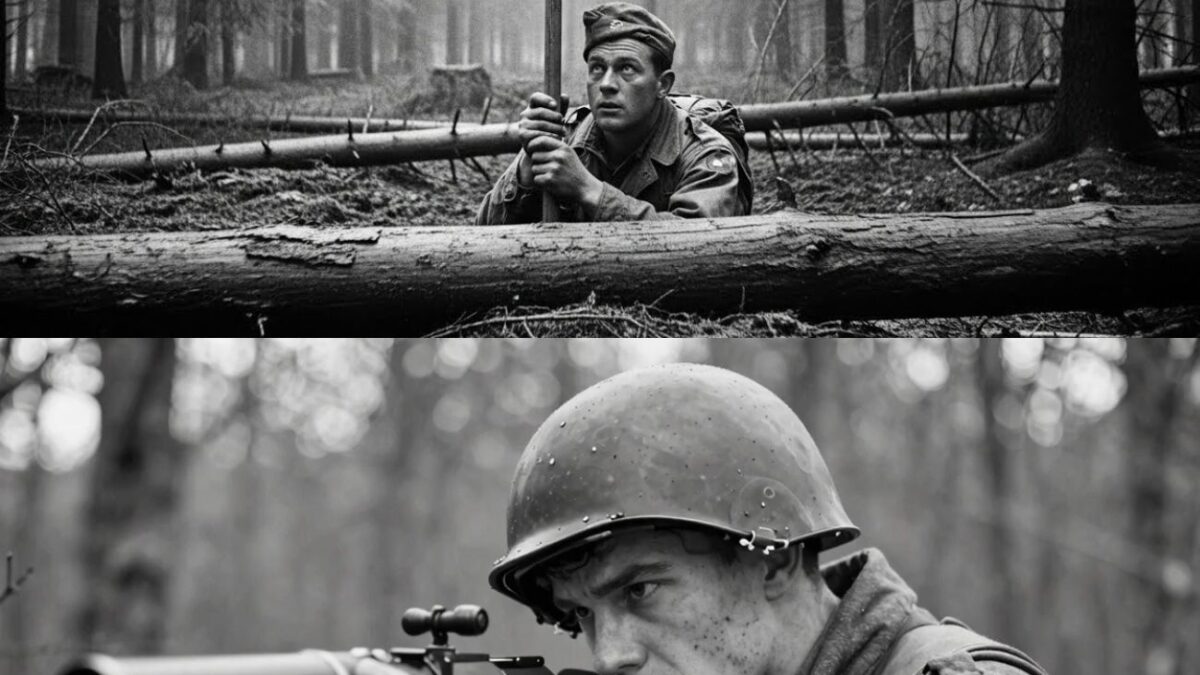
The morning fog hung thick and suffocating over the Hürtgen Forest on November 14, 1944. Corporal Jack Mercer of the 28th Infantry Division pressed his torso flat against the frozen earth. His shallow breath crystallized into brittle white vapor that dissolved into the freezing, sulfur-tainted air.
He had remained motionless in that exact depression for nearly six agonizing hours without shifting. His reddened eyes stayed fixed on the jagged tree line three hundred meters ahead in the gloom. Somewhere in that tangled lattice of spruce and pine, German marksmen were waiting with lethal patience.
Mercer understood his mission with the stark simplicity common to front-line infantrymen in combat. He had to locate the concealed shooters, silence their rifles, and clear a bloody path forward. His battered company desperately needed to traverse a cursed woodland that had swallowed so many lives.
He could not foresee that his improvised tactic would redefine counter-sniper warfare across Europe. Over the next three days, his backwoods survival instincts would turn desperate men into cunning hunters. He was about to prove that ancient tracking wisdom could outmatch modern military doctrine in the forest.
What Jack discovered in those frozen German timberlands elevated him to a quiet regimental legend. The raw technique of raising a steel helmet on a stick was destined for after-action military dossiers. Within weeks, soldiers would whisper his name from the shattered Siegfried Line to the banks of the Rhine.
Jack Mercer was raised in the rugged, timber-covered ridges of eastern Tennessee along the Nolichucky River. His father scratched out a living farming tobacco and relied on hunting to put meat on the table. Jack learned early that woodsmanship was an absolute necessity for survival during the Great Depression.
By the time the boy turned twelve, he could drop a grey squirrel at seventy yards with open sights. He carried his father’s battered bolt-action rifle through briars, learning the subtle language of the forest. By sixteen, he slipped through autumn hardwoods unnoticed, providing venison for his family during hard winters.
When Mercer enlisted in the autumn of 1942, army instructors immediately noticed his remarkable shooting. Basic training at Camp Croft in South Carolina merely polished the instincts he had honed as a boy. He completed advanced marksmanship courses before boarding an Atlantic troop transport for England in 1944.
Yet nothing Jack had seen in training or France prepared him for the horrors of the Hürtgen Forest. The ancient evergreen canopy choked out daylight, casting an eerie twilight that played tricks on vision. The forest floor was a lethal tangle of rotting timber, hidden ravines, and knee-deep, freezing mud.
Worse than the terrain were the German defenders of the 275th Infantry Division entrenched within it. They had transformed every ridge into a fortress with interlocking fields of machine-gun fire. Pre-registered mortars zeroed every trail, while camouflaged snipers ruled the gloom with absolute mastery.
Mercer’s company in the 109th Infantry Regiment entered the Hürtgen on November 10 with 143 men. Four days later, relentless shelling and invisible riflemen had reduced their effective strength to 97. They had crawled forward less than eight hundred meters across ground soaked in the blood of their friends.
Invisible German marksmen harvested a terrible toll while giving away nothing of their hidden positions. An American squad would advance cautiously through a clearing when a single sharp rifle report cracked out. A soldier would collapse into the pine needles before the sound had even finished rolling through the trees.
By the time squadmates scrambled behind mossy boulders to return fire, the shooter had vanished. The dense timber swallowed muzzle flashes, and echoing tree trunks distorted the origin of the sound. Men were growing jumpy, second-guessing every order and staring into the gloom with hollow, exhausted eyes.
Lieutenant Robert Chen, Mercer’s platoon leader, brought a sharp engineering mind to their tactical nightmare. Before the war, Chen had studied structural engineering at the prestigious University of California, Berkeley. On the evening of November 13, he gathered his weary squad leaders inside a deep, frozen shell crater.
Mercer remembered every detail of that desperate council as if it were etched permanently in glass. Chen spread a tattered, mud-stained topographical map across his knees and illuminated it with a red-lensed flashlight. The young officer looked at the grim faces of his sergeants and spoke with quiet, controlled urgency.
“We have an unsustainable problem, gentlemen, and I need functional solutions right now,” Chen began. “Over the last ninety-six hours, nineteen of our men were cut down by snipers alone in this draw. Not artillery shrapnel, not sweeping machine-gun fire, but single, deliberate rounds from shooters we cannot locate.”
Chen tapped the map with a dirty fingernail, pointing to the contour lines where squads were trapped. “Standard counter-sniper doctrine tells us to spot the muzzle flash, fix the coordinates, and suppress with overwhelming firepower. In this damn timber, the sound bounces off every trunk, flashes are invisible, and the shooter is gone instantly.”
Sergeant William Hayes, a hard-bitten veteran of North Africa, rubbed his stubbled chin thoughtfully. “In Tunisia, sir, we handled snipers by moving exclusively under cover of night or behind artillery,” Hayes grumbled. “When the big guns laid down a rolling barrage, the noise gave us enough cover to slip past their perches.”
Chen shook his head slowly, his breath misting into the red glow of his covered field torch. “Division won’t give us artillery assets, and they want this sector cleared within forty-eight hours,” Chen replied grimly. “We have to advance in daylight across open draws, and we must find a way to eliminate those riflemen.”
Mercer sat silently against the crater’s muddy rim, turning an old memory over in his mind. He recalled crisp November mornings in the Great Smoky Mountains tracking wary whitetail bucks with his father. He cleared his throat softly, his Appalachian drawl cutting through the cold tension of the crater.
“Lieutenant, what if we stop straining our eyes to find them and make them show themselves instead?” Mercer asked. Chen turned his flashlight toward the young corporal, his brow furrowed with curiosity in the dim light. “Go on, Jack. Explain what you’re thinking,” the lieutenant said, leaning forward across the map.
“Back home, when a buck gets spooked in the laurel, he won’t move an inch while you’re looking,” Jack said. “My daddy used to hang a white cloth on a branch and twitch it with a piece of fishing line. That deer would stare at the cloth, trying to figure it out, giving us time to find his outline.”
Mercer adjusted his field jacket against the bitter draft that crept over the lip of the crater. “We give those German shooters a target they think is real, but won’t cost us a man when they fire. We make them believe an American soldier made a sloppy mistake and poke his head out of cover.”
Sergeant Hayes chuckled skeptically, muttering that a German sniper wouldn’t be fooled by some backwoods hillbilly trick. Chen held up his hand to silence the sergeant, his analytical eyes widening as he grasped the physics. “A helmet on a stick,” Chen said softly, his mind breaking the concept down into mechanics and angles.
“We raise an M1 helmet where a scout’s head would naturally appear over a parapet,” Chen reasoned. “When the sniper takes the bait, our observers watch the tree line for movement, smoke, or muzzle flash. The entire trap depends entirely on having dedicated observers in position before the decoy is ever exposed.”
Over the next two hours, the men huddled together and meticulously transformed the hunting trick into doctrine. They agreed to use standard steel pots rather than wood carvings to maintain authentic silhouettes and glint. The decoy operator had to elevate the helmet with fluid, cautious movements that mimicked genuine human behavior.
Most crucially, they established an interlocking observation network with high-powered binoculars covering specific forest grids. When the German marksman fired, multiple pairs of trained eyes would scan the tree line for telltale signs. Even in damp cold, a rifle discharged a faint wisp of vapor, disturbed branches, or exposed a silhouette.
Before dawn on November 14, Mercer crawled out through the pine needles to his selected decoy position. He tucked himself behind a massive fallen spruce trunk that provided complete protection from direct fire. Using wire and tape, he lashed an empty M1 helmet securely to the end of a broken tent pole.
Lieutenant Chen concealed three observers thirty meters apart along the embankment to flank Mercer’s position. Each scout held binoculars steady, their bodies wedged tightly into the roots of ancient, towering evergreens. They divided the dense tree line ahead into three distinct overlapping fields of visual observation.
At 0730 hours, as grey dawn filtered through the canopy, Mercer slowly levered the stick upward. The helmet rose an inch above the bark, tilted cautiously, held still for five seconds, and withdrew. Nothing happened except the dripping of melting frost from the needle-covered boughs high above his head.
Jack waited two full minutes, his heart thumping a steady rhythm against the damp, frozen ground. He moved four feet down the log and pushed the helmet up again, angling it toward a draw. Again, the woods remained deathly silent, the enemy marksman demonstrating the iron discipline of a veteran.
Jack smiled faintly beneath his woolen scarf, recognizing the patient standoff he had practiced in Tennessee. A seasoned hunter never rushed a shot, and a master sniper would wait hours for an unquestionable kill. He waited patiently, altering the intervals between appearances to avoid creating any recognizable tactical rhythm.
At 0843 hours, during Mercer’s seventh attempt, the quiet of the morning forest was violently shattered. A sharp, deafening whip-crack echoed across the clearing as a high-velocity 7.92mm round found its mark. The bullet punched through the steel pot, the violent kinetic energy nearly ripping the pole from Mercer’s grip.
Jack dropped flat, his ears ringing as the helmet clattered harmlessly against the frozen spruce log. Spruce bark rained down around his neck while his pulse hammered furiously against his temples. “Did anyone catch him?” Mercer hissed through clenched teeth, keeping his face pressed into the dirt.
Private First Class Thomas Novak, hidden twenty-eight meters to the right, responded with an urgent whisper. “Movement! Massive oak tree about two hundred and seventy meters out, eleven o’clock from your log!” “Top branches shook hard right after the crack—I saw the foliage part when he cycled the bolt!”
Lieutenant Chen, observing from a reserve position, verified the coordinates and quickly radioed the mortar crews. Six minutes later, three sixty-millimeter high-explosive mortar rounds screamed overhead and detonated across the oak’s crown. Shrapnel shredded the upper boughs, sending splinters and severed limbs showering down onto the forest floor.
When the smoke cleared, Mercer’s squad advanced under covering fire, their weapons raised toward the tree. High in the fork of the oak, they discovered a platform constructed of spruce saplings and telephone wire. A rope ladder dangled toward the forest floor, its rungs stained with fresh, bright-crimson arterial blood.
A distinct trail of crimson droplets led eastward into the undergrowth, showing the wounded sniper had fled. At the base of the trunk, half-buried in needle litter, lay a water-resistant canvas document pouch. Inside was an oilcloth-wrapped notebook containing hand-drawn range cards marked with American patrol routes.
The range cards documented exact distances to every stump, boulder, and trail intersection in their sector. Chen forwarded the intelligence notebook directly to regimental headquarters, but the tactical victory belonged to Jack. Word of the successful counter-sniper operation rippled through the company trenches before the afternoon had ended.
Commanders of neighboring units, desperate to stem their own casualties, requested Mercer’s practical instruction. Over the following seventy-two hours, Jack moved from platoon to platoon, training marksmen in the technique. He taught them that an effective decoy required discipline, theater, and an absolute understanding of human nature.
By November 17, squads using Mercer’s observation method had uncovered forty-three German sniper hides in their sector. Artillery strikes destroyed heavily fortified perches, while maneuvering infantry flanked positions where snipers hid in root systems. Many German snipers simply abandoned their prepared hides once they realized their concealment had been systematically unmasked.
Mercer constantly drilled into his men that patience was more critical than marksmanship during a stalk. “Don’t yank that stick up like a jack-in-the-box,” he instructed a nervous squad from Company B. “A real man moves his head slow, checks his flanks, and ducks back down when he smells danger.”
He instructed the observers to never look at the decoy when it emerged from behind the logs. “Keep your glass glued to your sector,” Jack barked softly, demonstrating how to brace binoculars against elbows. “The moment the rifle cracks, your eyes must be searching for muzzle smoke, not checking the helmet.”
Private First Class David Zimmerman, who trained under Mercer, captured the philosophy in a letter home. “Corporal Mercer doesn’t view this as typical military business; he views it like tracking timber bucks,” Zimmerman wrote. “You set up bait the quarry can’t ignore, exploit his natural instincts, and wait for him to slip.”
As the days passed, American front-line units introduced clever variations to Jack’s original decoy setup. Soldiers tied light cords to helmets, tilting them sideways to simulate an infantryman peering around a boulder. Others operated two decoys simultaneously, raising them in alternating sequence to mimic a two-man scout team advancing.
By late November, Captain Ernest Aldrich, the battalion operations officer, compiled a formal evaluation of the technique. His data proved that Mercer’s unconventional method had altered the casualty ratios across the entire regiment. Between November 14 and November 28, eighty-seven German sniper positions were identified using the helmet decoys.
Sixty-one positions were destroyed by artillery, mortars, or rifle assaults, while twenty-six were abandoned by fleeing snipers. Daily sniper-related casualties in the division dropped from eleven per day to an average of three. The simple wooden pole and steel helmet had shattered the psychological supremacy of the German marksmen.
Mercer continued operating as a roving counter-sniper specialist through the brutal freezes of early December. On December 2, he was attached to the 110th Infantry Regiment, which had been pinned down for days. An unseen German sniper had killed four American soldiers, shooting only when visibility conditions were completely flawless.
Jack spent four hours raising decoys across the frozen brush, but the enemy rifleman refused the bait. Frustrated soldiers grumbled that the shooter had displaced, but Jack’s hunting experience told him otherwise. He checked his watch and noted that the previous casualties had all occurred when sunlight slanted horizontally.
The German was a professional who used the blinding low sun to mask his perch and silhouettes. Jack waited patiently until the afternoon sun reached the exact angle that cast blinding glare toward American lines. He pushed the helmet into an amber shaft of light illuminating a ridge behind a deadfall.
Thirty seconds later, an enemy bullet tore through the decoy, sending the steel pot spinning backward. Two observers instantly shouted coordinates, spotting a flash deep inside a brush-covered ravine two hundred yards out. A concentrated barrage of high-explosive mortar shells pulverized the ravine, smothering the position in smoke and fire.
Advancing scouts later discovered the body of Oberreiter Klaus Reinhardt, a veteran marksman of the Stalingrad campaign. Reinhardt had survived the bloodiest urban battles in Russia, only to fall to an Appalachian hunting ruse. The fact that Mercer’s fieldcraft neutralized an Eastern Front veteran proved the universality of his technique.
Beyond locating enemy shooters, the helmet trick unleashed devastating psychological warfare against the German marksmen. Captured German diaries revealed that snipers grew terrified of firing at exposed helmets along American lines. Uncertainty paralyzed them; every target they lined up in their scopes looked like an American trap.
This hesitation cost the German defenders their primary tactical advantage of immediate, decisive lethality. German riflemen delayed their trigger pulls, second-guessed their angles, and surrendered control of the forest floor. A simple piece of Appalachian fieldcraft had successfully degraded the confidence of the most disciplined snipers in Europe.
Lieutenant Chen, later promoted to captain, highlighted this psychological shift in his official military doctrine report. “The success of Corporal Mercer’s method lies in understanding that our enemy remains entirely human,” Chen wrote. “A sniper possesses pride and professional instinct; by exploiting that instinct, we turn his greatest weapon against him.”
By January 1945, instructions detailing the decoy technique were included in training packets across the Allied armies. Urban assault teams adapted the method by propping helmets through shattered second-story windows to spot snipers in rubble. Armored infantry in open country used helmets raised on radio antennas to draw fire across hedgerows.
Military historians later noted that rudimentary decoys had been deployed in the trenches of World War I. However, Mercer transformed a desperate, sporadic trick into a disciplined, integrated system supported by trained observer networks. He had bridged the gap between Appalachian folk hunting traditions and modern, coordinated small-unit fire support.
Jack Mercer survived the brutal winter campaigns and boarded a troopship bound for home in October 1945. He returned to his family’s timber farm in Tennessee, wearing a Bronze Star medal tucked inside his pocket. The citation praised his tactical merit, though it never explicitly described the stick and the holed helmet.
Like millions of his generation, Jack spoke very little about the horrific violence of the European war. He married, worked the red dirt of his farm, and taught his own sons to track game carefully. He hung his battered hunting rifle above the hearth, grateful for the peace of his quiet mountain hollows.
In the 1980s, a military historian researching the Hürtgen Forest campaign finally tracked Mercer down for an interview. Jack was then in his sixties, his hair silver, his hands still calloused from hard farm labor. He seemed genuinely bemused that scholars wanted to study what he considered simple, common-sense backwoods woodcraft.
“I didn’t invent anything new; I just remembered what my daddy taught me about hunting deer,” Jack reflected quietly. “If you want to survive the woods, you have to think like the game and exploit its habits. Those German boys were skilled soldiers, but they were still flesh and blood, prone to the same mistakes.”
Jack paused, looking out over the misty ridges of the Smokies, his eyes clouded with distant memories. “I applied what I learned hunting squirrels to hunting men, and that ain’t something I brag about,” he said. “War makes you do unnatural things, but it brought our boys home, and that was all that mattered.”
Mercer kept the dented, bullet-punctured M1 helmet tucked away on a shelf in his workshop for decades. When the historian asked to preserve the artifact, Jack gladly donated it so future generations might learn. Today, that helmet rests in the National Infantry Museum at Fort Moore, Georgia, beneath clean gallery glass.
Visitors often pause before the modest olive-drab steel pot with its jagged entry and exit puncture holes. A clean museum placard recounts how this simple piece of gear saved dozens of American lives in 1944. It stands as a testament to battlefield ingenuity, proving that human resourcefulness remains the ultimate weapon in war.
In the autumn of 1992, Jack received an unexpected letter bearing German stamps and delicate handwriting. It came from Wilhelm Schrader, a former infantryman who had defended the Hürtgen trenches against Mercer’s company. Schrader had read an article about the decoy technique in a military history journal and felt compelled to write.
Schrader confirmed that German snipers had grown terrified of the American helmet tricks during that freezing November. He expressed profound respect for the tactic and shared the lingering sorrow he felt over the war’s waste. The two old men exchanged letters for years, finding healing in their shared survival of that nightmare forest.
“War forces young men to do things they never dreamed of doing,” Schrader wrote in one memorable letter. “You hunted my friends, and we hunted yours, yet I feel no bitterness toward you across the years. We were both swept up in madness, and it is a grace that we lived to become old friends.”
Jack Mercer passed away peacefully in 1998 at the age of seventy-six, surrounded by his loving family. His funeral in rural Tennessee was attended by neighbors, family, and dozens of veterans from across the nation. An officer from the United States Army Sniper School attended in full dress uniform to honor his memory.
The officer presented Jack’s widow with a commemorative letter praising his lasting contributions to small-unit tactical doctrine. “Corporal Mercer’s innovations remain part of our modern syllabus,” the instructor wrote with profound professional respect. “Every young sniper who studies decoy evasion and counter-sniping carries forward the fieldcraft pioneered by Jack Mercer.”
The legacy of those seventy-two hours in the Hürtgen Forest lives on across modern infantry manuals and training ranges. It proved that expensive technology and industrial firepower can never entirely replace individual initiative and sharp observation. When soldiers find themselves in desperate situations, survival often hinges on the simplest, most human insights of all.

