Her Stepmother Forced Her to Marry a Poor Farmer, Unaware He Was a Billionaire’s
The morning sun hung low over the capital, casting pale, geometric shadows across the polished parquet floors of the grand estate on Rue d’Amandier. Down in the drafty rear wing near the kitchen scullery, Séraphine Duval stood with fine white flour clinging to the knuckles of her chapped hands. She worked rhythmically, folding the dense dough across a scarred butcher block, focusing entirely on the warmth of the yeast rather than the cold venom in the air.
Behind her, leaning against the doorframe in an embroidered silk dressing gown, Odile Duval examined her freshly buffed fingernails with deliberate, theatrical boredom. Her voice cut through the early quiet of the house, flat, shrill, and carrying that peculiar brand of unearned authority she had wielded for over a decade. “Do you honestly imagine your weeping will alter my resolve, child?” Odile murmured, not even bothering to lift her gaze to meet the girl’s steady grey eyes.
“You will marry him precisely when and where I say, because this matter has already been settled beyond appeal,” Odile continued with a dry, clipped snap of her tongue. “Not even your late father, resting six feet deep in the cathedral cemetery, could raise a single finger to unravel what I have decreed for you.” “In six weeks’ time, you shall belong entirely to the dirt fields of Karasi, married off to a nameless farmer who knows nothing beyond soil and cattle.”
A soft, spiteful titter drifted from the corridor where Camille leaned against the painted wainscoting, holding a porcelain cup of steaming black coffee. At twenty-six, Camille had inherited all of her mother’s sharp, predatory vanity, along with the idle cruelty that wealthy society women so often mistook for poise. “Just imagine her out there in the heat, scrubbing grease from an iron skillet,” Camille drawled, taking a languid sip while letting her eyes rake over Séraphine’s faded cotton apron.
“You will grow ragged and destitute out past the provinces, bearing ugly, sunburnt brats for a husband who smells of rotting silage,” Camille added with another high laugh. “Both of you deserve nothing more, no matter how grand you held yourself while your dear father still had breath to shield your arrogance.” “You always walked these hallways believing you were superior to us, Séraphine, but at the end of the day, you remain the daughter of absolute nobody.”
Séraphine did not answer, nor did she allow the tremor in her throat to reach the surface of her calm, composed face. From the adjacent dining room, Julien’s muffled chuckle echoed through the open transom, followed by the dry rustle of the morning newspaper he had never paid for. Twenty-four and utterly incapable of earning an honest living, Julien spent his afternoons drinking vermouth at private clubs on borrowed coins he had pilfered from Séraphine’s modest trust.
For three unbearable years following her father’s death, Séraphine had absorbed every petty humiliation like dry stone absorbing cold mountain rain. She wiped the flour from her forearms with a damp linen towel, smoothed her apron against her skirts, and kept her spine perfectly straight, exactly as her father had taught her. Théodore Duval had been a man of steel and granite, an engineer whose hand-drawn blueprints had bridged the great gorges of the southern valleys with undeniable dignity.
“Shoulders back, my little star,” he used to tell her in the sunlit study while tracing bridge spans across drafting paper smelling of turpentine and cedar. “A Duval does not crumble before the storm; we anchor ourselves into bedrock and let the wild winds blow themselves out to sea.” Théodore had sheltered his only child for eight fragile years after bringing Odile and her two spoiled offspring into the white-shuttered house on Rue d’Amandier.
When Séraphine had been twelve, Odile had crossed the threshold not as a loving stepmother, but as an occupying general eyeing an estate she intended to usurp. She viewed the quiet, dark-haired girl with the late mother’s thoughtful eyes as an unsightly blemish upon a gown, an obstacle to be scrubbed out or cut away. Then, on an ordinary Tuesday when Séraphine was barely twenty, Théodore’s overburdened heart had failed him at his desk, leaving his daughter entirely defenceless before Odile’s calculating greed.
Within weeks of the funeral, where Odile’s handkerchief had remained pristinely dry beneath the black veil, the true dismantling of Théodore’s legacy began. Odile’s pack of predatory barristers quickly tangled the engineering patents and family holdings in fictitious debts, stripping Séraphine of every centime she was owed. Camille promptly evicted Séraphine from the spacious, jasmine-scented second-floor bedroom that overlooked the courtyard, relegating her to the cramped maid’s quarters beside the scullery.
Julien had taken what remained of her liquid allowance under the guise of an urgent family loan, laughing loudly when she dared ask for repayment six months later. Séraphine had survived by working grueling ten-hour days as an anonymous seamstress in an atelier across town, mending silk gowns for the very debutantes who ignored her on the boulevard. Every scrap of income she earned was squirrelled away beneath the loose floorboards of her tiny room, nourishing a silent, stubborn dream of eventual escape.
Yet Odile had no intention of allowing her stepdaughter to linger within the provincial capital as an uncomfortable reminder of the fortune she had stolen. For two years, the matriarch had searched society for a match, attempting to offload Séraphine onto elderly widowers, broken merchants, and obscure town clerks. Every prospective suitor, seeing the girl’s refined beauty and graceful bearing, had demanded a substantial dowry commensurate with her breeding, a notion Odile found intolerable.
Odile refused to part with a single franc of Théodore’s money, reserving every gold coin for Camille’s lavish balls and Julien’s mounting baccarat debts at the club. The solution to her dilemma had arrived unexpectedly through the casual gossip of a high-end salon hairdresser, who had a cousin working the wholesale produce docks. Word reached the parlor of an isolated young man named Gabriel Renard, who tilled a remote tract of maize and cassava two hours outside the city near Karasi.
By all accounts, this Gabriel was a sullen, solitary creature of the soil who kept his mouth shut, possessed no influential family, and held zero prospects. He was, in the dismissive vocabulary of the provincial capital, an utter nobody who survived entirely upon whatever meager coins his twice-weekly harvest fetched at market. To Odile’s cold, transactional mind, the peasant sounded like an act of divine providence wrapped in dirty burlap and delivered directly to her doorstep.
A poor farmer would not dare demand a dowry; indeed, a laborer scratching a living from stones would be groveling with gratitude for any capable, compliant hand. Séraphine could bake, clean, and mend; she would be shipped past the paved boulevards, out beyond the electric streetlamps, into the suffocating dust of the hinterlands. Best of all, once wed to a rural laborer, she would cease to exist as a legal claimant against the estate, leaving Odile entirely unburdened by her conscience.
The repulsive transaction was handled through Madame Ferrand, a pinched, sharp-nosed matchmaker who operated out of an unventilated back office near the fish markets. Within three brief weeks, the final contracts were drafted and stamped without Séraphine ever having been consulted on the matter in the slightest degree. “The ceremony shall take place right there in the dirt path outside his village,” Odile had declared that morning, curling her thin lips into a cruel sneer.
“For that is precisely the kind of wretched ditch where individuals of that vulgar class belong,” she added, tossing her tea napkin onto the table with finality. Séraphine listened to the memory of those words echo through the quiet room as she gathered her tin basin, pouring cold well water over her hands. She walked slowly down the narrow hallway, stepping over the frayed runner, and pushed open the thin pine door to her tiny cell beside the pantries.
Sitting upon the edge of the hard mattress, she allowed herself precisely ten minutes of silent, stinging tears for the father who was no longer there to protect her. She wept for the grand white house that had become a prison, for the childhood stolen away by callous hands, and for the sheer helplessness of her youth. Then, as the clock on the chapel tower struck eight, she lifted her chin, dried her cheeks with the hem of her sleeve, and drew breath into her lungs.
She knew nothing of Gabriel Renard, but she knew that even a hovel surrounded by maize was preferable to living beneath the same roof as Odile Duval. If her fate was to plant seeds in the red earth and bake loaves over iron woodstoves, she would do so with her father’s unbroken dignity intact. What Séraphine could not possibly have known, however, was that two hours east of the capital, the man called Gabriel Renard was living an entirely different truth.
Far beyond the last gasworks and the grand stone gates of the provincial capital, the road to Karasi dissolved into broad swathes of golden savannah and clay hills. At the center of a wide parcel of rolling land stood an unadorned timber cottage with whitewashed walls, broad eaves, and an expanse of green fields. To the market vendors and the dusty teamsters who passed through the village, the tall man in the straw hat was simply Gabriel Renard, a quiet and tireless farmer.
Yet Gabriel had not been born to the plow, nor was he bound to the soil by the bitter chains of agricultural poverty. His father was Armand Castellon, a name that made bank directors straighten their neckties and caused cabinet ministers to speak in hushed, reverent whispers. The elder Castellon commanded iron mines, ocean freight fleets, the provincial power grid, three daily newspapers, and the absolute majority of the National Provident Bank.
Armand was, by every metric acknowledged by men of commerce, the undisputed titan of the republic, wielding wealth that dwarfed the treasuries of neighboring states. Gabriel had spent the first twenty-two years of his life enclosed within the gilded, suffocating terrarium of the Castellon empire on the heights above the city. He had been raised in cavernous limestone salons where his youthful footsteps echoed against cold Italian marble, guarded by armed sentries posing as childhood tutors.
He had watched every acquaintance, every companion, and every prospective bride reveal the same ravenous calculation the instant his famous surname was spoken aloud. He had watched his delicate mother wither inside that hundred-room mausoleum, neglected by a husband who measured devotion strictly in corporate balance sheets and quarterly yields. When she died quietly in her sleep during his sixteenth year, Gabriel looked around the vast dining hall and saw nothing but hollow transactions and predatory smiles.
At twenty-two, after an explosive confrontation that shook the chandeliers of the boardroom, Gabriel walked away from the Castellon dynasty with nothing but his mother’s maiden name. He refused the trusts, the luxury penthouses, and the endless line of sycophants, buying a neglected parcel of Karasi soil with a small inheritance from his maternal grandfather. For four years, he rose before the morning mist cleared, clearing roots, digging irrigation ditches, and discovering the profound, redemptive honesty of physical labor.
In the village of Karasi, people respected him because he lent his strong shoulders to raise barn rafters and shared his crop surpluses during unseasonable dry spells. He was Gabriel the neighbor, Gabriel the farmer, a man valued for his integrity rather than the terrifying weight of his family’s checking ledger. His father had initially threatened him with total disinheritance, raging against what he viewed as youthful lunacy and ungrateful rebellion against the family dynasty.
Yet twice a year, an unmarked black saloon would quietly pull up the dusty track, and the aging industrialist would sit awkwardly on the wooden porch. Armand Castellon did not comprehend his son’s agrarian life, but in his weary old age, he could not deny that Gabriel possessed something he had never achieved: peace. It was during one of those tense, quiet visits that Armand had learned of the curious arrangement being negotiated by the matchmaker Madame Ferrand.
Gabriel had agreed to meet Séraphine Duval at the crowded Tuesday market in Karasi, expecting the usual haughty society castoff looking for an easy escape. Instead, he had seen a young woman standing beside the vegetable stalls, her posture immaculate despite the humiliation of being appraised like an ox at a fair. She wore a simple, faded cotton dress that had clearly been mended by her own careful hands, yet she carried herself with the bearing of a sovereign.
When Madame Ferrand introduced them, Séraphine had looked directly into his eyes, not with disgust, nor with the pity high-born women reserved for laborers. She saw a man with sunburned skin, dirt beneath his fingernails, and a worn denim shirt, and she had addressed him with absolute, unfeigned human respect. There was neither calculation in her voice nor malice in her glance; there was only a profound, dignified sorrow that mirrored the quiet ache within his own chest.
Gabriel went back to his cabin that evening, unable to erase the memory of her steady grey eyes from his thoughts while the crickets sang outside. Quiet inquiries through trusted acquaintances in town soon revealed the full horror of her life under Odile Duval’s thumb following her engineer father’s tragic passing. He understood with fierce clarity that this proposed marriage was an act of disposal, a calculated attempt by a wicked stepmother to crush a girl’s spirit forever.
He decided then and there that he would marry Séraphine Duval, not to acquire a servant for his fields, but to give her the freedom she had been denied. He deliberately concealed his true name, determined that she should know him first as Gabriel the farmer, unclouded by the immense distortion of the Castellon fortune. He wanted, for the first time in his existence, to build a union founded upon simple, honest truth rather than the gravitational pull of billions.
A week before the ceremony, he picked up the receiver of the village telephone exchange and placed a direct call to the Castellon corporate headquarters. “I am taking a wife this Saturday on the road outside Karasi,” Gabriel said evenly into the receiver, hearing the sudden, heavy silence on the line. His father did not ask about dowries or social standing; after a decade of missed milestones, the old titan said simply, “I shall be there.”
“If you come, do not bring a single journalist, but feel free to bring appropriate transport,” Gabriel remarked with dry amusement, underestimating his father’s dramatic nature. Back in the provincial capital, the final six weeks had transformed the grand house on Rue d’Amandier into an unrelenting theater of cruelty directed at Séraphine. Odile flatly refused to spend even a modest sum on a bridal gown, ordering Camille to rummage through the attic trunks for whatever discarded rags could be found.
Camille returned with an old ivory lace frock from a failed engagement of a distant cousin, the fabric yellowed at the seams and frayed around the collar. “It is far too good for a mud-dweller’s hut, but charity suits my complexion today,” Camille sneered, tossing the rumpled garment onto Séraphine’s narrow cot. Odile also refused to arrange an automobile, informing the seamstress that she could walk the final league along the Karasi trail to acclimate herself to her station.
“You will be tramping through ditch-water for the remainder of your miserable existence,” Odile declared over the rim of her afternoon porcelain cup with venomous delight. “There will be no guests from our circle, of course; why should people of quality waste an afternoon watching an orphan take vows with a clodhopper?” Through every petty torment, Séraphine remained silent, sewing late into the night by candlelight to repair the frayed seams of the yellowed gown.
Her father’s memory was her impenetrable armor; whenever Camille threw a cruel remark or Julien muttered an insult, she pictured Théodore standing beside the grand river bridges. She held fast to the singular memory of the market at Karasi, remembering how Gabriel’s calloused hand had felt warm and steady during their brief introduction. He had not looked upon her as a burden to be discarded; he had looked upon her as a person possessing value, an equal soul worthy of consideration.
On the morning of the wedding, the sky over Karasi broke into a vault of pure, cloudless cerulean, casting a luminous sheen across the dry countryside. Séraphine stepped out of the borrowed, rattling motorcar hired by Madame Ferrand’s nephew, her fingers lightly steadying the veil she had bleached and mended herself. The dry country lane was already bordered by dozens of local villagers, dressed in their Sunday cottons, their weathered faces alight with warm, curious neighborliness.
Behind her, a second luxury cabriolet arrived carrying Odile, Camille, and Julien, who stepped down into the dust while gingerly holding their silk skirts above their ankles. “Good heavens, the stench of goat manure is utterly overpowering,” Camille whispered loudly, pressing a perfumed handkerchief over her nose with exaggerated disgust. Odile glanced around the rustic settlement with cruel triumph, her sharp eyes searching for the humble laborer she had bought to bury her husband’s daughter.
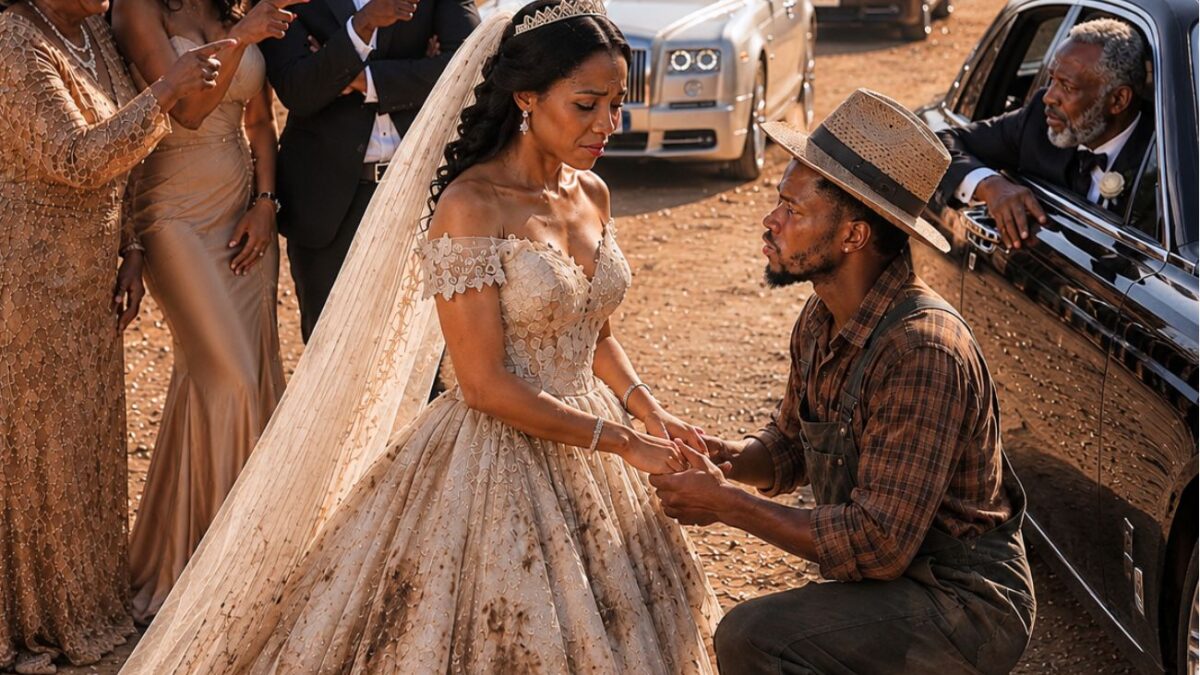
Down the path from the modest timber cottage walked Gabriel, his stride long and unhurried beneath the brilliant glare of the morning sun. He wore a simple plaid cotton shirt, sturdy twill trousers dusted with dry earth, and an old straw hat pushed back from his broad, handsome forehead. To the Duval family, he looked the part of a destitute peasant; to Séraphine, he looked like the only solid, uncorrupted thing she had seen in years.
He stopped directly before her, his warm hazel eyes softening as he took in her mended dress, her pale cheeks, and her courageous, unwavering gaze. Without an instant’s hesitation, Gabriel dropped onto one knee into the red dust of the road, offering both of his calloused hands up to hers. “Séraphine,” he murmured, his voice rich and deep, carrying a profound gentleness that made the breath catch in her throat. “Will you have me?”
A shrill, braying shriek of laughter shattered the tender silence as Odile lunged forward, clutching Camille’s arm while pointing at the tableau in delight. “Look at them! Just look at this magnificent spectacle!” Odile proclaimed, projecting her voice so that every villager along the fences could hear her clearly. “A beggar kneeling in the dirt to claim an orphan! Look how naturally she takes to the mud! Oh, this is far richer than I dreamed!”
Camille joined in with high, theatrical giggles, while Julien stood with his hands stuffed into his trouser pockets, smirking like a satisfied schoolyard bully. “Make sure you teach her how to muck the stalls properly, farmer!” Julien called out, drawing amused glances from his sister. “She has had twenty years of practice!” Séraphine felt the hot blood rush to her temples, but she did not drop her head, nor did she withdraw her hands from Gabriel’s firm grasp.
“Are you truly prepared for this, Séraphine?” Gabriel whispered, ignoring the shrieking hyenas behind them as his thumbs traced the smooth arches of her knuckles. “I am here,” Séraphine answered softly, her voice trembling slightly with emotion but ringing with unmistakable resolve. “And that is enough for me.” “Then it is more than enough for both of us,” Gabriel said, offering her a smile so calm and assured that her racing heart suddenly settled into peace.
Before the mocking laughter of the Duval women could resume, a distant, rhythmic rumble vibrated through the parched soil beneath their leather-soled shoes. It was not the dry crackle of thunder, but the deep, synchronized purr of heavy, multi-cylinder engineering climbing the gentle grade from the capital boulevard. The villagers along the road gasped, turning their heads in unison toward the western bend where a plume of pale dust rose against the midday sky.
First came a gleaming, two-tone silver Rolls-Royce Phantom, its polished chrome grille parting the dusty air like the prow of a majestic ocean liner. Behind it rolled four matching obsidian sedans, long, bulletproof vehicles with tinted plate glass and chrome wire wheels that glided effortlessly over the ruts. The procession looked entirely impossible, a fleet of sovereign elegance descending upon a forgotten agricultural crossroad where only farm carts dared to tread.
Odile’s mocking laughter died in her throat, her lips remaining parted in a grotesque parody of amusement as the phantom halted inches away. Camille lowered her perfumed handkerchief, her eyes bulging with disbelief as the heavy, precision-weighted door of the lead automobile swung silently outward on oiled hinges. A liveried chauffeur stepped into the dirt, extending a gloved hand to assist an elderly gentleman whose countenance was recognized across the length of the republic.
Armand Castellon stepped onto the soil of Karasi, his silver hair catching the sunlight above a tailored black coat cut from the finest British wool. A spray of fresh white orchids was pinned to his lapel, and in his right hand he carried an ivory-headed walking stick that he barely needed. The villagers parted before his presence instinctively, bowing their heads in silent awe as the living legend of national commerce walked into their midst.
Gabriel rose from the dirt, his strong fingers remaining firmly laced with Séraphine’s, a faint, wry smile touching the corners of his lips. “You promised you would bring appropriate transport, Father,” Gabriel remarked dryly across the quiet road. “I had not anticipated you would bring the entire garage.” The formidable tycoon stopped before his son, his weathered face softening into an expression of rare, paternal affection that transfixed every spectator on the road.
“A man’s only son takes a bride precisely once, God willing,” Armand said, his voice deep, gravelly, and commanding without the slightest effort. “I was certainly not going to permit the future mistress of the Castellon holdings to enter holy matrimony from the back of an unwashed village hackney.” Beside the lead car, a slender gentleman with wire-rimmed spectacles and a heavy leather portfolio stepped forward, flanked by two discreet, stone-faced security officers.
Séraphine stood frozen, her eyes darting between the towering silver-haired industrialist, the fleet of gleaming automobiles, and the calm farmer holding her hand so tenderly. The world seemed to tilt beneath her feet; the names, the faces, and the sheer impossibility of the moment collided within her racing mind. “Gabriel,” she whispered, her voice barely louder than the dry rustle of the surrounding maize stalks. “Who… who is this man?”
Gabriel turned to face her, and for the first time since they had met, she saw genuine remorse and vulnerability softening his strong jawline. “Séraphine, forgive me,” he said gently, his hazel eyes searching hers with profound earnestness. “This is my father, Armand Castellon.” The name dropped like a granite millstone into the middle of the quiet provincial path, instantly silencing even the chirping of the afternoon crickets.
Camille’s jaw went completely slack, her coffee cup slipping from numb fingers and shattering onto the dry earth between her expensive leather shoes. Julien stumbled backward against the wooden fencing of the cattle pen, his arrogant smirk melting into a sickening, green mask of sheer, unadulterated terror. And Odile—Odile Duval, who had prided herself for forty years on her sharp social cunning—turned the dreadful, bloodless color of cold fireplace ash.
Her trembling hand rose slowly to her throat, her fingers clawing at the pearls she had purchased with Séraphine’s stolen inheritance as understanding crushed her. “Castellon?” Odile rasped, her voice reduced to a dry, croaking squeak that held none of its former theatrical venom. “Castellon… as in… the mines?” “As in the provincial railway, the shipping lines, and the National Provident Bank, madam,” the bespectacled lawyer stated smoothly, adjusting his legal folios with precise satisfaction.
“Of which Mr. Gabriel Castellon remains the sole direct heir and principal director upon his choosing,” the attorney added, nodding slightly toward the bridegroom. Armand Castellon did not look at the lawyer; his sharp, obsidian eyes were fixed entirely upon Odile Duval, peeling away her pretensions like rotten bark. He stepped forward, his leather boots crunching into the dry dirt, every line of his ancient, aristocratic frame radiating cold, absolute authority.
“Four years ago, my son departed my household to discover whether he could build an honest life with his own two hands,” Armand addressed the assembly. “He sought to know if a man could be valued for his character, his labor, and his soul, rather than the monstrous shadow of his fortune.” “In this village, he found good, honest people who loved him for who he was, never asking what dividends he could deposit into their pockets.”
Armand paused, his voice dropping into a register of icy, razor-sharp contempt as he turned his full attention onto the trembling matriarch before him. “It appears, however, that you approached this sacred union with a very different ledger, Madame Duval,” the industrialist continued without raising his voice. “You sought to cast off an inconvenient orphan onto what you believed was an impoverished peasant, revelling in the cruelty of her anticipated destitution.”
Odile tried to speak, her painted lips trembling spastically, but not a single coherent syllable emerged from her dry, paralyzed throat. Beside her, Camille suddenly broke, rushing toward Séraphine with her arms outstretched, a desperate, hysterical smile plastered over her panic-stricken features. “Séraphine! Dearest sister!” Camille cried, her shrill voice cracking with frantic desperation. “You know we were only teasing! We are family, after all!”
Séraphine did not pull away, but she fixed her step-sister with a look of such absolute, regal composure that Camille froze dead in her tracks. “Had you known his name an hour ago, Camille,” Séraphine said with quiet, devastating clarity, “you would have scratched out your mother’s eyes to take my place.” Camille’s mouth snapped shut; she recoiled as though struck across the face, sinking back toward Julien, who was already desperately looking for an escape route.
“Madame Duval,” Armand spoke again, cutting off any further pathetic entreaties with a dismissive flick of his gloved fingers. “Hear me well.” “I have spent forty years dealing with ruthless men, but I have rarely witnessed malice as naked and petty as that which you displayed here today.” “I have zero interest in seeing your face near my son, nor near this courageous young woman who deserved a mother’s protection rather than your contempt.”
“She is welcome at my table, within my home, and inside our family for as long as she lives,” the old titan declared, nodding respectfully to Séraphine. “As for your standing in this province, understand that every bank note, every social circle, and every commercial credit you enjoy exists solely at my discretion.” “My staff has documented this shameful display in its entirety, and before sunset, every salon in the capital shall know precisely what you are.”
Odile Duval swayed where she stood, the dry heat of the road suddenly suffocating as she realized the total, irreversible ruin of her social standing. Within a week, the story of the wedding at Karasi was being whispered, laughed over, and dissected in every parlor, bank, and social club in the province. The proud socialite who had schemed to dump her stepdaughter into rural squalor had publicly crowned her as the wealthiest prospective bride in the entire nation.
The invitations that had once filled Odile’s silver salver disappeared overnight; doors were shut in her face, and her credit accounts were ruthlessly canceled by lenders. Camille’s wealthy banker suitor quietly broke off their engagement without an explanation, his prominent family refusing to be associated with such grotesque provincial notoriety. Julien found himself barred from his usual gaming houses, pursued by merciless creditors who were no longer willing to wait on a ruined family’s fortunes.
The real wedding of Séraphine and Gabriel took place two weeks later, far from the malicious eyes and theatrical pretenses of the provincial capital. It was celebrated beneath the ancient, fragrant cedar trees of the Castellon country estate, surrounded only by those individuals who possessed genuine goodwill in their hearts. The villagers of Karasi were transported in comfortable motor coaches, dressed in their finest attire, dining alongside the few close friends Armand had kept over a lifetime.
Séraphine wore a gown of hand-stitched ivory satin that draped her slender form with majestic elegance, tailored precisely to her wishes rather than constrained by cheapness. Yet when the festivities concluded, Gabriel and Séraphine did not take up residence in the gilded palaces of the capital’s upper-class districts. They returned together to the modest timber cottage in Karasi, where Gabriel continued to rise at dawn to tend the maize fields he loved with his soul.
They established a comfortable compromise between the two worlds, visiting Armand regularly to bring him the quiet, undemanding companionship he had lacked for decades. In his final years, the hardened billionaire found in Séraphine the daughter he had never known, listening with genuine fascination to her memories of her bridge-building father. When Armand passed away peacefully in his sleep two years later, he left the bulk of the Castellon estate to Gabriel and Séraphine without fear or reservation.
They accepted the immense fortune not to purchase jewels or build grand monuments to their own vanity, but to pour life back into the forgotten province. They funded modern clinics, built trade academies, and endowed agricultural schools where the children of laborers could learn advanced engineering and farming methods. At Séraphine’s personal and unyielding insistence, the very first project completed was the paving of the Karasi roadway with smooth, high-grade stone and modern culverts.
She ensured that never again would a young woman be forced to drag her bridal skirts through red dirt to reach the threshold of her new life. Odile Duval spent her remaining bitter years confined to the decaying house on Rue d’Amandier, abandoned by her resentful children and forgotten by the society she worshipped. Three years after the wedding, a single letter arrived at the Karasi post office addressed to Séraphine in Odile’s cramped, trembling hand, begging for financial relief.
Séraphine read the missive once while sitting on her wide wooden porch, listening to the evening breeze sweep through the green rows of flourishing maize. She did not write back in anger, nor did she feel the urge to draft a triumphant response celebrating her stepmother’s miserable, self-inflicted downfall. She simply folded the parchment, placed it inside an old drafting ledger belonging to her father, and walked out to the garden gate to meet her husband.
Gabriel was walking up the path from the fields, his straw hat tipped back, dirt on his forearms, and a tired, luminous smile illuminating his face. Théodore Duval, she knew with absolute certainty, would have looked upon the man who knelt in the dust and recognized a builder of true bridges. For their love had not been forged by the grand motorcade, the family billions, or the public ruin of those who had sought to destroy them.
It had been born in the stillness of a dusty crossroad, where two wounded souls recognized each other’s worth before the world ever learned their names.

