Her Family Chose the Rich Groom—Then She Refused to Let Them Shame Her Husband
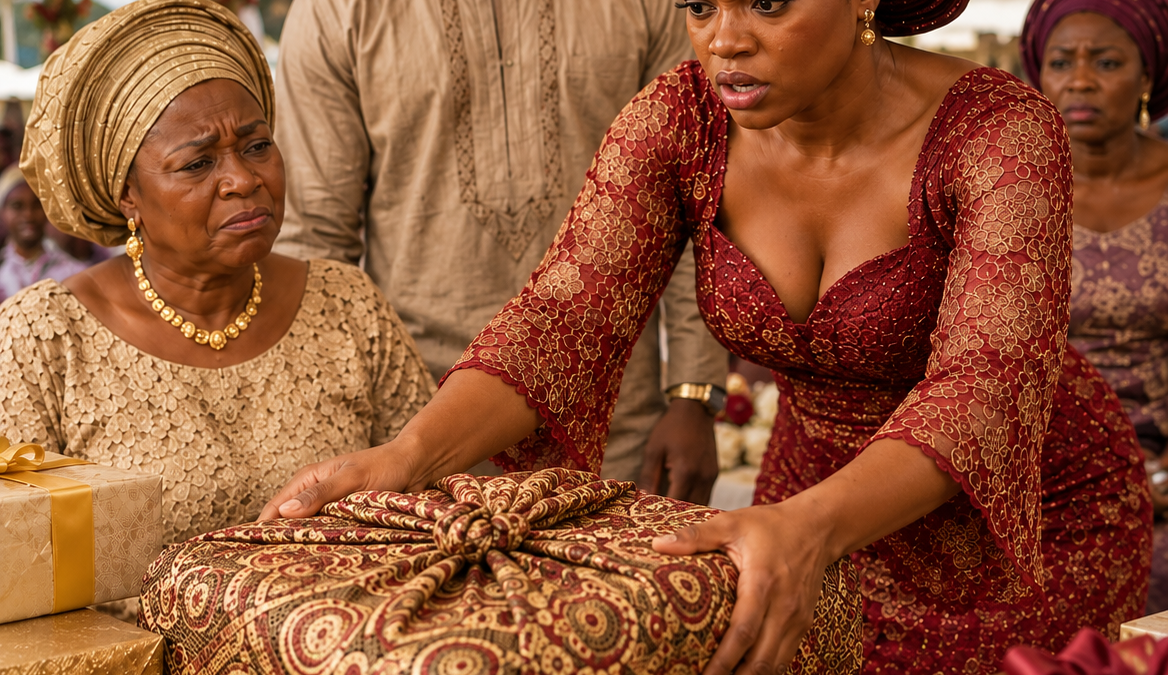
The iron gates of the ancestral compound swung open with an oily screech as Dayo’s polished obsidian SUV parted the afternoon haze. A chorus of ecstatic praise rose instantly from the assembled relatives, several younger cousins lifting camera phones before the heavy tires had even settled into the gravel. Dust billowed around the mirrored rims, settling onto the decorative silk canopies like a fine curtain of powdered rust, yet nobody dared complain about the intrusion of wealth.
Only five minutes later, a sputtering 2004 Toyota Corolla pulled through the very same gate, its faded beige roof bleached dull by long harmattan seasons. Kelechi stepped out from behind the steering wheel, his dark linen shirt unadorned, turning immediately to offer both hands to his widowed mother, Mama Ngozi, as she gingerly touched the earth. Standing nearby beneath the shade of an almond tree, Auntie Eunice leaned over Amara’s shoulder, her breath smelling of spiced chin-chin and sharp disdain.
“Look at that display,” Auntie Eunice whispered loudly enough for three adjoining chairs to hear, her fingers tapping Amara’s bare wrist with false pity. “Your sister Nneka walked into true abundance, my dear; she married a man who arrived with daylight. You, on the other hand, insisted on marrying struggle, and now your family must sit here and watch it arrive.”
Amara did not blink, nor did she pull her arm away in a flustered fit of temper; instead, she reached out and closed her fingers firmly around Kelechi’s calloused hand. Kelechi had heard the poisonous remark clearly, his dark eyes shifting smoothly from the aunt’s powdered cheek to his mother’s quiet posture, and finally coming to rest directly on his bride’s unwavering face. In that measured glance, he sought neither vengeance nor defense, weighing Amara’s loyalty as if her quiet steadiness were the only currency in the crowded yard that retained any value.
Amara took a single decisive step forward, her chin tilted high beneath the golden embroidery of her gele, pulling him gently into the gathering without loosening her grip by an inch. Across the courtyard, Dayo’s entourage had already turned the ceremony into an elaborate public exhibition, unloading towering stacks of designer gift boxes tied with metallic ribbons. Cousins and distant nephews jostled for prime angles against the gleaming car hood, eager to capture a sliver of borrowed prestige before the food arrived.
Kelechi moved in complete contrast to the spectacle, carrying two simple, neatly bound packages wrapped in modest brown paper toward the elder men seated under the palm fronds. He bowed low, greeting each patriarch by his traditional title, inquiring after their aching joints and rainy-season harvests before turning back to guide his mother toward a shaded plastic chair. Several aunts walked past them without a nod, their eyes completely fixed on the glistening gold watch flashing around Dayo’s animated wrist.
Noticing the quiet exclusion, Amara deliberately picked up a sturdy wooden armchair from the veranda and dragged it into the front row beside her own mother, Mama Beatrice. With an air that invited no protest, she smoothed her skirts and motioned for Mama Ngozi to take the seat of honor beside the family elders. Mama Ngozi sat down with a quiet smile, reaching into her woven shoulder bag to produce a flat parcel wrapped in ancient, carefully preserved indigo akwete cloth.
“This belonged to Kelechi’s late grandmother,” Mama Ngozi explained in a voice soft as river water, offering the bundle with both palms toward the central ceremonial gift table. “She wove this pattern herself before the civil war; she asked that it be given to the woman who would carry our family name into the next generation.”
Before the woven fibers could touch the white linen tablecloth, Mama Beatrice snapped her fingers toward an attendant standing by the drinks cooler. “Take that parcel to the side bench under the stairs,” she commanded briskly, waving her hand as if clearing away a stray moth. “We must keep the central table looking proper and unified for the visiting dignitaries and their cameras.”
The young attendant hurried forward, snatching the vintage heirloom away to make room for Dayo’s imported whiskey cartons and gilded crystal vases. Kelechi watched the boy take his grandmother’s legacy, noticing how his mother’s hands tightened against her lap until her knuckles showed white beneath thin skin. Yet Mama Ngozi’s polite smile never slipped from her weathered lips, her head held entirely upright despite the public humiliation stinging the back of her throat.
Amara did not wait for an apology to materialize from the air; she stood up, crossed the open courtyard, and retrieved the wrapped parcel from beneath the stairs. Walking back into the center of the pavilion, she set it directly beside the crystal decanters and turned her steady gaze toward her mother. “Anything given with genuine respect and an honorable name belongs in the center of this family, Mama, not tucked beneath the dust of the staircase.”
Kelechi observed the confrontation in total silence, noting the sudden flush of red across Mama Beatrice’s cheeks and the sudden awkward coughing of nearby elders. He made a quiet mental inventory of every face present, identifying those who looked ashamed of the cruelty and those who simply looked annoyed that an unimportant woman had spoken. He said nothing, adjusted his collar, and took his seat beside Amara, his heart recording the exact weight of her courage.
The afternoon celebrations surged forward on the brassy notes of a highlife band, the courtyard filling with the steam of jollof rice and roasted goat meat. Relatives circulated through the heat like wandering traders, constantly circling back to where Dayo stood dispensing foreign cigars and expansive promises of overseas contracts. Dayo was a whirlwind of practiced charm, slapping senior uncles on the back and reciting the names of state commissioners as though they shared breakfast every Tuesday.
Kelechi remained stationed primarily beneath the green canopy, speaking only when addressed and attending to the drinks of his mother and Amara. When a retired bank manager from the village finally stopped to ask about his profession, Kelechi looked up from his plate with an easy, unassuming demeanor. “I work in civil engineering,” he replied plainly, offering neither an impressive title nor an exaggerated list of achievements to cushion the modest sound of it.
“Site work?” Uncle Jude interjected, frowning over the rim of his beer glass as he assessed Kelechi’s lack of gold jewelry and understated leather shoes. “Standing under the hot sun mixing sand and gravel? Can a man truly secure a modern woman’s future on the fluctuating wages of daily site construction?”
Kelechi parted his lips to answer, but Amara placed her hand over his forearm, speaking before the older man could deliver another cutting observation. “He works diligently, he plans with discipline, and he keeps his promises without fail; that is the only kind of lasting security I care to build a home upon.”
Kelechi looked at her again, the subtle warmth in his dark eyes deepening as he listened to her defend his honor before a crowd of skeptical kin. This was the third time that afternoon she had thrown herself in front of a barbed insult without hesitation, completely unaware that she was being measured against an invisible standard. She loved him for what she could see: an honest, humble man with calloused palms and quiet integrity.
Later in the evening, as the music softened into repetitive drum patterns, Nneka found Amara standing alone near the washing basins behind the kitchen wall. Her elder sister’s wrists jangled with thin gold bangles, her tailored lace gown smelling of expensive French perfume that seemed out of place among the woodsmoke. She took Amara’s elbow with a familiar, patronizing intimacy that felt more suffocating than comforting.
“You know I am not mocking your choices, Amara,” Nneka said softly, smoothing down an imaginary crease on Amara’s shoulder. “I only want you to be comfortable, truly. We both watched Mommy break her back after Daddy’s transport business collapsed; we saw what unpaid rent does to a woman’s dignity, and I swore I would never tie myself to a question mark.”
Amara looked into her sister’s anxious, carefully painted eyes and saw the lingering ghost of their childhood poverty haunting every stitch of her luxury lace. “I understand your fear, Nneka, truly I do,” Amara replied gently, stepping away from the sink. “But building your life around the illusion of absolute wealth does not mean you have escaped uncertainty; it only means you have bought a more expensive disguise.”
Out by the perimeter wall, where the shadows stretched long across the weeds, Mama Ngozi found Kelechi leaning quietly against the rusted bumper of his Corolla. The village night was falling rapidly, the crickets beginning their shrill chorus in the damp elephant grass beyond the iron gate. She stood beside her only son, feeling the residual tension radiating from his broad shoulders like heat escaping warm stone.
“Do not carry the venom of today’s courtyard into the house you are building with that girl,” his mother cautioned, her voice firm with ancient wisdom. “People worship the sun when it shines, Kelechi; you cannot blame blind men for failing to notice the stars when a halogen lamp is turned on in their eyes.”
Kelechi sighed, running a hand over his close-cropped hair as he looked toward the noisy veranda. “I knew they were shallow, Mama, but I did not expect them to treat you like a beggar asking for scraps simply because my car was old.”
“Then you have learned what you needed to learn about vanity,” Mama Ngozi said, tapping his chest with a single, firm finger. “Take the lesson, my son, but do not turn your wife into an unending examination she never signed up to take; she has already proven her heart is pure.”
A week after the family gathering, Amara packed her modest belongings into two cardboard boxes and moved with Kelechi into a small rented bungalow in an older suburb. The neighborhood was quiet, lined with dusty neem trees and paved with fractured asphalt, far removed from the gated islands where the newly rich congregated. There was no hidden palace waiting behind a secondary gate; the four-room house had worn linoleum floors, plain wooden furniture, and a narrow western veranda.
The kitchen had a single gas cylinder and small windows that trapped the heavy afternoon heat until the walls felt like an oven by four o’clock. Yet Amara never sighed when scrubbing the scorched pots, nor did she treat their modest surroundings as an unfortunate delay on the road to better things. She planted yellow bell peppers in recycled paint buckets along the veranda rail, humming quietly to the radio while she swept the front stoop every morning before dawn.
Kelechi departed every morning at six o’clock, dressed in heavy steel-toed work boots, faded cotton shirts, and carrying a scuffed white safety helmet in his back seat. To any neighbor watching from their window, he was merely another industrious site supervisor grinding out a living on the chaotic, expanding fringes of the growing metropolis. Their routines settled into a peaceful, rhythmic domesticity, built on shared morning tea, mutual chores, and quiet evenings spent reading by the low light of a table lamp.
However, as the weeks rolled into a second month, small anomalies began to pierce the smooth surface of their ordinary domestic life. Amara began to notice the strange, urgent nature of the telephone calls that reached Kelechi while he sat at their kitchen table reviewing grease-stained structural schematics. Men with cultivated, senior accents—men who clearly commanded large enterprises—spoke to him not with the dismissive tone used on field workers, but with an unmistakable, deferential caution.
One Tuesday evening, while Amara was stirring a pot of egusi soup on the stove, Kelechi’s phone buzzed insistently on the wooden counter beside the cutting board. He answered on the second ring, listening in silence for nearly three full minutes while an agitated voice on the other end rambled about project deadlines and municipal inspectors. Kelechi did not raise his voice, but the sudden shift in his posture seemed to instantly alter the atmosphere of the modest kitchen.
“Listen to me carefully, Harrison,” Kelechi said, his voice dropping into a register of icy, absolute finality that Amara had never heard him use before. “You will not sign off on that revised pouring schedule until the structural integrity report and the worker safety modifications are placed on my desk together; halt the entire southern sector until I review it.”
He disconnected the call without waiting for an acknowledgment, tapping the glass screen against his thumbnail with his brows knit in severe concentration. Amara turned slowly from the stove, a wooden stirring spoon balanced lightly in her hand, her eyes studying the hard, unyielding lines of his jaw. “The supervisors on your site seem to ask permission with an incredible amount of humility, Kelechi,” she observed, her tone half-teasing, half-probing.
Kelechi looked up, the commanding executive dissolving instantly back into the mild-mannered husband with sand dust clinging to his cotton collar. “It is a complicated infrastructure contract,” he replied with a practiced, easy smile. “I carry more personal liability for structural failures on this bridge project than the average site engineer does, that is all.”
It was a plausible explanation, perfectly constructed to satisfy a curious spouse without technically uttering an outright lie to her face. Amara did not press him, nor did she demand to see his employment contract; she merely smiled, nodded, and scooped a generous portion of meat into his bowl. But she filed the moment away in her memory beside several others, quietly aware that love did not require a woman to pretend she was completely blind.
Across town, in the gleaming glass towers overlooking the lagoon, Nneka’s new married life resembled a continuous series of glossy promotional brochures. Dayo had secured a penthouse apartment with floor-to-ceiling panoramic windows, imported Italian marble floors, and an expansive balcony that offered breathtaking views of the city’s yacht clubs. Every evening brought reservations at exclusive restaurants, where Dayo would casually toss his black credit card onto silver platters while snapping photographs for his booming social media followers.
Their mother, Mama Beatrice, visited the penthouse weekly, returning with glowing accounts that she weaponized against Amara during their Sunday afternoon telephone calls. “Your sister Nneka is truly living like a queen,” their mother boasted over the crackling line, her voice practically vibrating with triumphant validation. “She has two housekeepers, a personal driver, and a husband who buys her jewelry simply because the sun rose; that is what a real man provides.”
Amara sat on her narrow veranda, watching Kelechi in the gravel driveway below as he patiently patched a small leak in the garden hose with electrical tape. “I am very happy for Nneka, Mommy,” Amara answered calmly, her fingers brushing the green leaves of her potted pepper plants. “And as for me, I have a home filled with peace, and I can breathe without having to ask permission from a crowd.”
She ended the call before her mother could unleash another sharp comparison, refusing to let her family’s shallow measuring tape determine the value of her peace. Yet even as she defended her quiet life, the whispers of the world had a way of creeping into the cracks of everyday routine. She knew her family viewed her as the sister who had settled for second best, an object of polite pity at every future holiday gathering.
Nneka’s first profound moment of doubt did not arrive in an explosive domestic argument, but in the humid, dimly lit concrete bowels of a commercial parking garage. She had taken an elevator down to surprise Dayo at his commercial office building, carrying an expensive silk shirt she had picked up from the dry cleaner. As she turned the corner near his reserved bay, she found Dayo standing toe-to-toe with two burly, unsmiling men in worn leather jackets holding clipboards.
Dayo was gesturing frantically with both hands, his face slick with sweat, his voice dropping to a desperate, strangled pitch as he begged for another two weeks. When the men finally walked away with photocopied documents, Nneka stepped from behind a concrete pillar, her voice trembling slightly in the echoing garage. “Who were those men, Dayo, and why were they threatening to take the keys to the SUV?”
Cornered against the gleaming black fender, Dayo laughed nervously and wrapped his arms around her, kissing her forehead with desperate theatrical warmth. “It is nothing to worry your pretty head about, sweetheart,” he insisted, though his eyes darted nervously toward the exit ramp. “Just a minor administrative delay with an equipment financing company; one of my commercial property acquisitions had a temporary liquidity freeze, but the funds are coming next week.”
“Why didn’t you simply tell me we had financing payments due?” Nneka asked, pulling back slightly so she could look directly into his shifting eyes. “I am your wife, Dayo; I am not a guest in this apartment.”
Dayo gave her waist an affectionate squeeze, ushering her toward the glass elevator doors while changing the subject to their dinner reservations with an offshore oil broker. Nneka allowed herself to be guided into the cabin, but a cold, heavy stone settled into the bottom of her stomach and refused to dissolve. It was not the reality of car payments that frightened her; it was the chilling ease with which her husband could look into her eyes and decide what she was allowed to understand.
A few days later, a heavy afternoon downpour turned the dirt roads surrounding Amara’s neighborhood into thick, sluggish streams of red clay. Kelechi had rushed out early that morning for an emergency meeting, leaving his thick leather document binder lying abandoned on the kitchen counter beside the breadbox. Recognizing the company logo embossed on the cover, and knowing he had an important site review, Amara decided to deliver it to him herself.
She took a commercial bus across the bridge, wrapping the binder in two plastic shopping bags to protect the heavy papers from the driving rain. When she finally arrived at the sprawling regional engineering compound, the perimeter guards did not stop her once they saw the red corporate badge stamped on the leather. She walked through the polished glass corridors of the administrative headquarters, searching for the modest site office Kelechi had vaguely described on several occasions.
Instead of a cramped portable cabin smelling of damp timber and wet cement, the receptionist directed her toward the executive boardroom on the top floor. The heavy double doors of the conference hall stood slightly ajar, revealing a massive room dominated by a gleaming mahogany table and twenty plush leather executive chairs. Standing at the head of the long table, surrounded by gray-haired directors and international development consultants, was Kelechi.
He was dressed in a sharp, tailored charcoal suit, his scuffed white helmet resting casually on the polished wood beside an open blueprint measuring six feet across. An older European engineer was speaking rapidly about municipal soil tests, but stopped instantly the moment Kelechi raised a single, calm index finger into the air. “We will reroute the entire western bypass through the rocky ridge before we pour the foundation,” Kelechi stated, his voice cutting through the room with absolute, unyielding authority.
“The redesign will cost us nearly two million dollars in delay penalties, Mr. Sterling,” the older engineer pointed out, his tone utterly respectful, almost deferential. “Are you prepared to authorize that expenditure from the primary capital allocation fund?”
“I will assume full personal responsibility for the board’s authorization,” Kelechi replied without a flicker of hesitation. “Safety and structural permanence will always supersede quarterly dividends in this firm; proceed with the diversion.”
Not a single soul in that vast room questioned his right to make the multi-million-dollar decision, each director nodding in silent agreement as they noted his command. Amara stood frozen in the doorway, the damp plastic bags rustling faintly against her skirt, her heart hammering against her ribs like a trapped bird. When Kelechi glanced toward the doorway and caught sight of his wife standing among the shadows, the commanding authority vanished instantly, replaced by sheer, paralyzed panic.
The drive back to their rented bungalow was suffocatingly quiet, the steady slap of the windshield wipers the only sound breaking the heavy silence inside the old Corolla. Amara sat in the passenger seat with the forgotten leather binder resting squarely on her lap, her eyes fixed entirely on the gray asphalt ahead. Kelechi kept both hands locked at the ten-and-two position on the steering wheel, his jaw clenched so tightly the muscles knotted beneath his skin.
“What exactly do you do for a living, Kelechi?” Amara asked quietly, her voice devoid of tears, carrying only the terrifying weight of absolute calm. “Because site engineers on regular wages do not dismiss two-million-dollar corporate penalties with a wave of their finger while thirty directors sit in absolute silence.”
“I am an infrastructure engineer, Amara,” he answered softly, keeping his eyes glued to the rain-streaked road. “Everything I told you about my professional training and my daily work was true.”
Amara turned her head slowly, looking at his profile with an expression of sharp disappointment that cut deeper than any screaming accusation ever could. “That tells me the name of your profession, Kelechi; it tells me what you studied in university. I am not asking about your profession; I am asking who you are.”
Kelechi opened his mouth to reply, but found no convenient words waiting to bridge the widening chasm between them; he drove the rest of the way in total, agonized silence. When they reached the house, he hurried to unlatch the front door, attempting to start their evening routine as if a simple meal could restore normalcy. He reached for the gas igniter to light the stove, but Amara walked past him and firmly twisted the brass knob back to the off position.
“Do not light the stove, Kelechi,” she said, her voice dropping into a register of cold, deliberate clarity that filled the small kitchen. “I stood in the dirt of my mother’s compound and held your hand while my entire family called you a failure to my face. I stood beside you because I believed with every fiber of my being that I knew the honest man I was marrying.”
Kelechi reached out to touch her arm, but she took a measured step backward, refusing to let him soften the boundary she had just drawn. “Do not let me discover tonight that while I was loving you with an open heart, you were secretly deciding which parts of yourself I had earned the right to see.”
“I never lied to you about my identity, Amara,” he insisted, his voice cracking with genuine distress. “My name is Kelechi Sterling; I have never given you a false name, and I have never spent money that was not earned through sweat.”
Amara crossed her arms, her eyes piercing through his defensive posture. “You can hide behind technically true sentences until dawn if you wish, Kelechi, but you are speaking to your wife now. Am I your partner in this life, or am I merely a naive village girl you are watching from behind a one-way mirror to see if she passes your tests?”
Kelechi lowered his hands, the weight of her words striking him with the force of a falling beam; the small kitchen suddenly felt terribly confining. He pulled back a wooden chair, its legs scraping against the linoleum, and sat down with his elbows resting heavily on his knees. “You are completely right,” he said softly, offering neither an excuse nor a theatrical justification to hide behind.
He looked up at her, his eyes carrying the accumulated exhaustion of a man who had guarded a fortress for far too long. “My late father started this infrastructure firm thirty years ago with two rented dump trucks and a concrete mixer,” Kelechi began, his voice steadying as the long-hidden truth emerged. “He spent his life building it into one of the largest engineering consortiums in the country, and I worked beside him from the age of sixteen, earning my degrees while working in the mud.”
“When my father passed away eighteen months ago, he left the controlling shares and the operational leadership of the entire enterprise to me,” he continued, watching her face carefully. “The public announcement of my appointment as executive managing director has been scheduled for the regional infrastructure summit next month.”
Amara stood motionless, processing the immense scale of the reality he had kept locked behind his modest linen shirts and dusty work boots. “And the old Corolla? This tiny rented house with the leaking roof and the hot kitchen?” she asked, her voice trembling slightly. “Was all of this merely an elaborate piece of theater designed to test my greed?”
“No,” Kelechi said adamantly, shaking his head with fierce conviction. “The car is mine; I bought it five years ago when I was supervising the northern railway extension. This house is mine; I rented it because I hate the ostentatious, hollow lifestyle of the elite compounds, and I wanted a home that felt real.”
“I was not pretending to be poor, Amara,” he pleaded, reaching across the table to touch her fingers. “I lived simply because it keeps me grounded in reality, but I deliberately let your family—and you—assume I had no influence and no wealth. I let you believe the struggle was permanent.”
“Strangers are one thing, Kelechi,” Amara said, her voice dropping to a whisper that cut straight through his soul. “A cautious man has every right to protect his inheritance from gold-diggers and opportunistic relatives at a party. But you brought me into your bed, you took my vows before God, and you left me living inside that very same humiliating assumption.”
Kelechi looked down at the table, remembering the painful scene at the wedding courtyard with sickening clarity. “After watching how your mother treated my mother over a simple woven cloth, and how quickly your uncles fawned over Dayo’s rented splendor, I became terrified,” he admitted. “I saw how people changed their entire morality based on money, and I wanted to see… I wanted to watch who would stay.”
“And what did you find, Kelechi?” Amara asked, her dark eyes flashing with sudden, sharp indignation. “Did I pass your little family examination? Did I prove myself worthy of your hidden millions by smiling while your aunt called me a beggar’s wife?”
“You were never supposed to be taking a test, Amara,” he whispered, his mother’s warning echoing in his ears with brutal, unrelenting accuracy. “My mother told me that very night not to turn you into an examination, and I failed to listen; I let my fear of being used override my duty to honor you.”
“There will be no more tests,” Kelechi declared, looking directly into her wounded eyes with complete, unreserved surrender. “No more half-truths, no more omitting details to see how you react, and no more hiding behind carefully phrased sentences.”
Amara did not rush into his arms, nor did she pretend the sting of his deception had magically evaporated in the warmth of his confession. “Good,” she replied firmly, pulling her hands back to her sides. “Then sit there and tell me everything: the true name of the company, the extent of your debts, your real income, your legal responsibilities, and every single thing that will touch the life we are going to build together.”
They sat at that modest kitchen table until the morning light broke through the small window, peeling away every layer of secrecy until nothing remained hidden. Trust was not instantly restored with the sunrise, but the foundation of their marriage underwent a profound, permanent shift from cautious performance to deliberate transparency. The following evening, Kelechi placed his private financial ledgers and upcoming corporate appointment papers openly on the living room table before Amara could even ask.
A week later, he invited her to sit in on a private consultation with his estate planning attorneys, ensuring her signature was attached to every major marital asset. He did not buy her diamond necklaces to apologize, nor did he suddenly lease a mansion to impress her relatives; he gave her the one thing his fear had previously stolen: total inclusion in the reality of his existence. Transparency became their daily practice, built through small, deliberate conversations over morning tea and quiet evenings spent planning their actual future together.
Across the city, within the echoing marble halls of the luxury penthouse, Nneka was discovering the terrible cost of living inside a gilded fiction. Dayo’s promised commercial property transaction had collapsed entirely when an international investment consortium discovered his documentation had been heavily embellished. One Thursday evening, Nneka returned from a charity luncheon and stopped dead in the hallway outside their master bedroom suite.
The ornate glass-and-mahogany display case that Dayo had proudly filled with limited-edition luxury watches was standing open, its velvet compartments strangely vacant. His most prized possession—a gold chronograph he claimed had cost forty thousand dollars—was conspicuously missing from its custom leather stand. When Dayo returned home that night, smelling faintly of cheap scotch, Nneka pointed directly at the empty velvet case.
“Where is the gold watch, Dayo?” she asked, her voice remarkably steady despite the cold panic rising in her throat. “And do not tell me it is at the jeweler’s for routine cleaning, because I called their boutique an hour ago, and they haven’t seen you in six months.”
Dayo stood frozen in the doorway of the bedroom, his shoulders sagging as the carefully maintained façade of effortless wealth fractured before her eyes. He did not speak for a long time, the heavy silence confirming what Nneka had feared since the afternoon in the parking garage. The watch had been sold at a significant discount to pay off an overdue line of credit from an aggressive private lender.
Over the days that followed, Nneka began to notice other subtle disappearances throughout the lavish penthouse like details vanishing from an old photograph. The high-end German sound system had vanished from the living room; two antique leather armchairs had been collected by an interior decorator who claimed they were on consignment; and several designer handbags Dayo had gifted himself had mysteriously disappeared. None of the missing items seemed fatal on its own, but together they painted a horrifying picture of a sinking ship throwing its cargo overboard.
The final, devastating collapse arrived on a bright Tuesday morning when Nneka walked down to the building’s secure basement garage to run an errand. The designated parking space reserved for the obsidian SUV was completely empty, marked only by a fresh oil stain on the bare concrete floor. Standing near the pillar was a uniformed bailiff holding a clipboard, speaking quietly with the building’s head of security while securing an official notice to the wall.
Dayo came down the stairs five minutes later, his face gray with humiliation, finally admitting that the luxury vehicle had been seized by the financing institution. “I can turn this around, Nneka, I swear to God I can,” he stammered, grabbing her hands with sweaty palms. “I just need another thirty days for an agricultural commodities deal to clear; I can borrow enough to keep the apartment until the commission arrives.”
“How much money do we actually owe, Dayo?” Nneka asked, her voice flat, her eyes scanning the official legal notice affixed to the concrete pillar. “Do not give me a projection; do not tell me about next month’s deals. How much debt is attached to our name right at this second?”
Dayo could not answer the question without opening several encrypted accounting folders on his phone, his trembling fingers revealing a catastrophic web of personal loans, overdue leases, and unpaid luxury credit accounts. Looking at the staggering figures, Nneka finally saw the truth: Dayo was not a wealthy man who enjoyed luxury; he was a terrified performer trapped inside a prison of his own making. He had borrowed frantically to maintain the illusion of success for his peers, his business associates, and most of all, for the woman whose family demanded a prince.
“I thought if I looked established long enough, the real business would eventually catch up with the image,” Dayo whispered, burying his face in his hands like a scolded child. “Your mother looked at me like I was a king, Nneka; I couldn’t bear to let her see that I was just another man trying to stay afloat.”
Nneka looked at her weeping husband, feeling a strange mixture of profound pity and absolute emotional detachment settling over her heart. “You were terrified of looking ordinary,” she said softly, “so you forced me to become an unwitting accomplice in an elaborate financial fraud.”
She turned around, walked up the stairs to the penthouse, and packed two modest suitcases with her personal clothing and basic essentials, leaving the expensive jewelry on the dresser. Walking back to the foyer, she looked at Dayo standing near the door. “I am going to my sister Amara’s house; I am not divorcing you today, Dayo, but I will never sleep in a home built on a stage set again.”
She hailed a street taxi and called Amara from the backseat, her voice trembling as the sprawling city rushed past the smeared window. “Amara,” she whispered through the receiver, swallowing down a mouthful of bitter pride. “Please… please do not tell me that you warned me about him.”
Amara answered on the first ring, her voice warm, completely devoid of triumph or vindication. “I never warned you about anything, my sister; get out of the taxi and come inside; the front door is already unlocked.”
When Nneka stepped onto the narrow veranda of the small bungalow, carrying her two battered suitcases, Amara did not interrogate her on the porch. She pulled her elder sister into a deep, silent embrace, took the bags inside, and led her into the guest room where clean sheets had already been laid over the mattress. She brewed a pot of ginger tea, set out a plate of warm biscuits, and sat quietly on the edge of the bed until Nneka was ready to speak.
“Mommy called me an hour ago,” Nneka said between ragged sobs, clutching the warm ceramic mug with both hands. “She heard from Auntie Eunice that Dayo’s car was taken by bailiffs; she is already telling the relatives that she always suspected Dayo was unreliable. She is erasing everything she ever said about him, Amara; she is acting as if she never forced me into his arms.”
Amara shook her head, reaching out to gently squeeze her sister’s trembling knee. “Then do not allow yourself to inherit her shame, Nneka; she lives for the opinions of an audience that does not pay her bills.”
“What do I do now?” Nneka asked, looking around the modest, immaculate bedroom with a profound sense of exhaustion. “My entire life was built on an illusion.”
“You stop running,” Amara answered gently. “You sit down with Dayo and an independent accountant, you uncover every single debt, and you decide whether the man beneath the luxury suit is someone worth saving or someone who will drag you to the bottom of the sea.”
Over the six weeks that followed, Dayo’s public life underwent a radical, painful dismantling that stripped away every shred of manufactured prestige. He abandoned his social media platforms, broke the lease on the glass penthouse, and moved into a tiny, two-room flat on the mainland while taking a salary-based job at a commercial logistics firm. He met with debt counselors twice a week, sending Nneka full, unedited bank statements every Friday without offering a single excuse or grand promise.
Nneka remained in Amara’s guest room, finding an unexpected sense of internal peace in the simple routines of her sister’s modest household. She helped Amara tend the yellow peppers on the veranda, learned how to prepare meals within a disciplined budget, and discovered that quiet dignity did not require an imported marble countertop. Dayo was working diligently to clear his debts, and while Nneka had not yet moved back in with him, the fragile seeds of authentic honesty were finally beginning to sprout between them.
During that same month, a set of thick, gold-embossed invitations arrived at the homes of both extended families, bearing the official seal of the Federal Ministry of Works and Infrastructure. The invitation requested the presence of the family at the ceremonial launch of the Coastal Rail and Highway Project, a multi-billion-dollar national development initiative. Attached to the card was a handwritten note from Kelechi, stating that he had arranged a dedicated transport bus and prime reserved seating for Amara’s relatives.
“He wants us there because his new corporate position will be publicly recognized at the podium,” Amara explained to her mother during a brief telephone call. “He wants the family to be present to witness the transition, but he is not doing this to score points against anyone; he is doing it because you are our family.”
Mama Beatrice agreed to attend with an unusual, subdued tone, the recent public scandal surrounding Dayo’s financial collapse having knocked the haughty arrogance entirely out of her speech. The family bus departed the village at dawn on the day of the summit, carrying thirty relatives through the sprawling metropolis toward the national convention center. When they arrived at the grand complex, the sight that met them was entirely unlike the chaotic courtyard of their village gathering.
The grand exhibition hall was a sea of dark suits, international trade delegates, military liaisons, foreign ambassadors, and banks of television cameras positioned on elevated platforms. A massive, illuminated architectural model of the coastal bridge project dominated the main rotunda, flanked by towering corporate banners bearing the insignia of the Sterling Infrastructure Consortium. Amara’s relatives were guided by uniformed ushers to the second row of the VIP family section, directly behind the diplomatic corps.
Mama Beatrice sat stiffly in her velvet chair, smoothing down the edges of her traditional wrappers while casting nervous glances around the intimidating room. Several rows away, she spotted Mama Ngozi sitting quietly beside an elder cousin, wearing the very same indigo akwete cloth she had carried in that humble brown parcel at the village wedding. For a brief moment, Mama Beatrice looked as though she wanted to shrink beneath the plush carpeting to avoid meeting the older woman’s eye.
Gathering her remaining courage, Mama Beatrice stood up, smoothed her skirts, and walked across the aisle toward the quiet widow. She stood before Mama Ngozi, bowed her head with deep, traditional humility, and greeted her by her family title, her voice shaking slightly with genuine remorse. Mama Ngozi looked up, met her gaze without a trace of malice, and offered her a warm, gracious nod of welcome that allowed both women to breathe again.
Nneka sat beside Amara in the second row, dressed in a simple, elegant dark blue linen dress devoid of flashy jewelry, looking noticeably more relaxed than she had in months. “Dayo signed the debt consolidation agreement with the bank this morning,” Nneka whispered into Amara’s ear, a small, genuine smile touching her lips. “He is working sixty hours a week at the warehouse, but last night he told me he slept soundly for the first time in five years.”
Amara reached over and took her sister’s hand, giving it a warm, firm squeeze that carried the understanding of a lifetime. “True peace never arrives in a rented vehicle, Nneka; it arrives when you no longer have to spend your days running away from the truth.”
The house lights dimmed across the vast auditorium, and the company chairman—a distinguished elder statesman with silver hair and an impeccable reputation—stepped to the podium. He delivered an eloquent address outlining the national significance of the coastal project, detailing the complex engineering challenges and the decade of strategic planning required to realize the vision. He spoke at length about the founding principles of the firm, emphasizing that real leadership was forged in the mud of actual job sites rather than behind comfortable desks.
“For the past eighteen months, our enterprise has navigated a critical generational transition following the untimely passing of our revered founder,” the chairman announced, his voice reverberating through the high-fidelity sound system. “During this transitional period, our executive operations have been quietly and brilliantly guided by a man who possesses both the rigorous technical mastery of an engineer and the unyielding moral integrity of a statesman.”
Mama Ngozi sat completely still in the row ahead, her hands folded serenely over her indigo cloth, her eyes reflecting the soft glow of the stage lighting. “He has spent his career in the trenches, working alongside our laborers, refusing personal vanity, and placing the durability of our public trust above short-term applause,” the chairman continued, his voice rising with pride. “It is my profound professional honor to present the newly appointed Chief Executive Officer and Managing Director of the Sterling Infrastructure Consortium—Engineer Kelechi Sterling.”
A collective gasp rippled through the row occupied by Amara’s relatives, the sudden intake of air so sharp it seemed to drain the oxygen from their corner of the room. Mama Beatrice froze in her seat, her hand frozen midway to her mouth, her eyes widening until they seemed ready to leap from her face. Auntie Eunice slumped back into her chair as if she had been struck with a wooden stave, her mouth opening and closing like a landed fish.
Every head in the hall turned toward the side curtains of the stage, expecting a procession of security guards and suited executives to emerge from the greenroom. Instead, a chair shifted quietly in the second row of the guest seating, directly beside Amara and Nneka. Kelechi stood up smoothly, dressed in an impeccably tailored charcoal three-piece suit that fit his broad frame with effortless perfection.
He buttoned his jacket with a single fluid motion, turned to place a gentle, reverent hand on his mother’s shoulder, and bent to kiss Amara softly on the cheek. He had been sitting among them the entire morning, completely indistinguishable from an ordinary family guest, carrying no entourage and demanding no specialized attention. Uncle Jude stared at him in utter disbelief, remembering his own arrogant words about sand and fluctuating daily wages with a sickening wave of internal mortification.
Kelechi climbed the stairs to the stage, the bank of television cameras swiveling in unison to track his ascent as the room erupted into thunderous, sustained applause. Standing at the central podium, illuminated by the bright television lights, he appeared completely transformed from the modest site supervisor with dust on his boots, yet his demeanor remained rooted in the same calm, unhurried humility. He adjusted the microphone, waited for the room to settle into respectful silence, and began his address with an easy, commanding grace.
He spoke passionately about the responsibilities of modern engineering, the vital importance of transparent governance, and the duty of corporate leaders to protect the lives of the workers who labored on their scaffolding. Not once did his speech veer into personal self-congratulation; not once did he mention his wealth, his family inheritance, or the petty insults he had endured in the dust of a village compound. He carried the authority of absolute competence, a man who possessed no need to shout because the foundations he built spoke for him.
As he reached the conclusion of his formal address, he lowered his prepared notes onto the lectern and turned his gaze directly toward the second row of the VIP family pavilion. “Before I conclude this morning, there is someone who must join me here on this platform,” Kelechi said, his voice softening with deep emotion. “Someone whose integrity and clarity of spirit made this day possible long before any corporate title was placed upon my shoulders.”
He extended his hand toward the aisle, his eyes locking onto Amara with a warmth that drew the attention of every camera in the auditorium. Amara hesitated for a single, fleeting heartbeat, feeling the weight of hundreds of eyes shifting from the stage to her seat in the second row. Nneka gave her hand a firm, joyful push forward, whispering, “Go on, my brave sister; that place was prepared for you before the world even saw it.”
Amara stood up, smoothing the lines of her modest dark blue dress, and walked gracefully down the carpeted stairs and up to the elevated platform. Kelechi took her hand the instant she reached the final step, holding her fingers with the exact same firm, protective grip she had offered him in the village compound months ago. He stepped slightly to the side, adjusting the microphone downward so she could stand at the center of the stage beside him.
“This remarkable woman chose to link her life to mine when she believed I had nothing to offer beyond an old car and a pair of dusty work boots,” Kelechi announced to the silent, rapt audience. “She defended my dignity before a skeptical world when there was no public honor or social reward attached to standing by my side.”
“A title is merely an administrative assignment given by a committee,” Kelechi continued, looking into her eyes with fierce devotion. “Her choice was an act of profound, unconditional faith; and that choice deserves far more honor than anything I could ever construct out of steel and stone.”
He handed the microphone to Amara, taking a deliberate step backward so the bright lights rested entirely upon her, refusing to use her presence as a prop for his own reputation. Amara looked out over the vast sea of dignitaries, foreign ambassadors, and the stunned faces of her extended family sitting frozen in the second row. She took a slow, deep breath, her fingers steady around the metal stem of the microphone as she prepared to address the room.
“I need to say one simple thing before anyone allows this morning to become the wrong kind of story,” Amara said, her clear voice carrying through the immense hall without a tremor. “I did not choose Kelechi because I secretly knew an executive title was waiting behind the veil; I knew nothing of this company, and I expected nothing beyond an honest life.”
She paused, looking directly at her mother, whose eyes were filled with shining, silent tears of shame and wonder. “And if this day had never arrived—if Kelechi were still only the site engineer who came home with red dirt on his sleeves and sand in his pockets—I would stand before God and marry him all over again today.”
When the formal ceremonies concluded and the international press corps began their interviews, the family pavilion transformed into a chaotic rush of ecstatic relatives. Cousins who had ignored Kelechi at the village celebration now pushed forward with wide, ingratiating smiles, eager to claim kinship with the new corporate titan. Kelechi received each of them with impeccable politeness, shaking every hand with equal warmth, refusing to humiliate anyone while maintaining a firm, impenetrable boundary of internal detachment.
Mama Beatrice did not join the clamoring circle of praise; she slipped quietly around the perimeter of the exhibition floor, her footsteps slow and deliberate. She walked over to the quiet alcove where Mama Ngozi sat waiting with a glass of water, the older woman watching the celebration with serene, peaceful eyes. Mama Beatrice stood before her for a long, silent moment, the heavy burden of her past pride breaking across her face like shattered glass.
“At the wedding in my compound, I moved your mother’s gift because I foolishly believed its simplicity diminished the dignity of our family,” Mama Beatrice whispered, her voice cracking with deep, genuine grief. “I humiliated an honorable woman before her relatives, and I judged a righteous man solely by the dust on his shoes; I was completely blind, and I beg for your forgiveness.”
Mama Ngozi looked at her for a long time, allowing the profound weight of the apology to settle into the earth without offering a cheap, dismissive comfort. Then, with the slow, deliberate grace of a queen, she reached out and placed her warm, calloused palm over Mama Beatrice’s trembling fingers. She spoke no grand speech of absolution, but in the quiet closing of her hands, the long, bitter war of appearances came to an absolute end.
Three days later, the morning sun rose bright and clear over the quiet veranda of the modest rented bungalow on the outskirts of the city. Kelechi sat at the small linoleum kitchen table, wearing a comfortable cotton shirt, his scuffed work boots resting by the back door as usual. His thick executive briefing papers, detailing multi-million-dollar municipal allocations, lay neatly stacked beside an ordinary ceramic mug of black coffee.
Amara walked into the kitchen carrying a plate of warm flatbread, setting it down between them before reaching over to tap the thick corporate documents with her knuckle. She looked down at him with an arched eyebrow and a quiet, knowing smile that carried the shared history of their journey. “Is there anything else hiding inside those thick folders that might change the course of my life, Engineer Sterling?”
Kelechi smiled, reaching across the table to wrap his calloused fingers around her wrist, pulling her close until her eyes met his in the golden morning light. “Not a single thing, Amara,” he whispered, his heart entirely anchored in the quiet truth between them. “From this morning until the end of our days, you have seen every single room in this house.”

