He Needed a Wife Before the First Snow — She Agreed, Unaware of What Waited at His Ranch
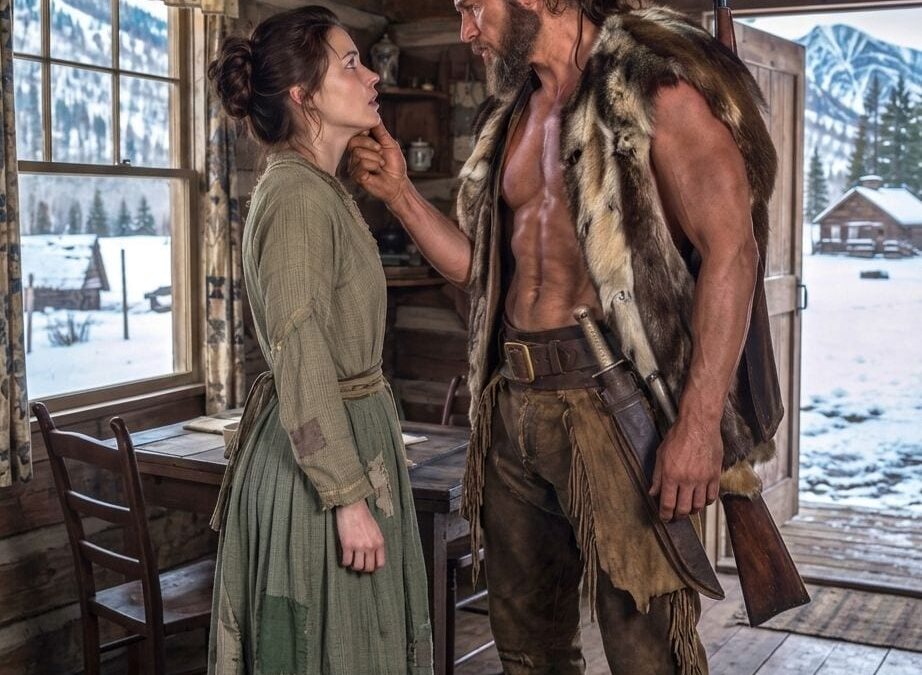
The telegram was blunt. “Need a wife by winter. Must endure the mountain. No questions asked.”
For Josephine, a desperate woman fleeing a shattered life, it was a lifeline.
But as the Wyoming snow began to fall, she realized she hadn’t just married a stranger.
She had walked into a trap.
The Union Pacific train rattled and hissed, coughing black soot into the crisp, unforgiving air of the Wyoming territory.
Josephine Miller pressed her forehead against the chilled glass of the carriage window, watching the endless rolling plains give way to the jagged teeth of the Wind River Range.
She was 24 years old, clad in a faded wool dress that had once been the height of Philadelphia fashion, now mended in three places and reeking of coal smoke.
Two months ago, Josephine had been the pampered daughter of an affluent shipping merchant. Then came the crash.
Her father’s sudden heart failure had revealed a mountain of hidden debts.
The creditors had descended like vultures, stripping away the house, the servants, the carriages, and finally her reputation.
Left with exactly $12 and no family, she had seen the advertisement in the back of the Gazette: “Wanted a woman of strong constitution to wed a mountain rancher before the first snow.
Must be willing to work. Must not mind the quiet. Travel paid to Lander, Wyoming. Ask for Thaddeus Boone.”
She had sent a telegram the very same day.
Now, stepping off the train and onto the muddy wooden platform of the frontier town, the reality of her decision settled over her like a suffocating blanket.
Lander was a rough-hewn settlement, a chaotic mix of prospectors, trappers, and desperate men looking for a second chance.
The wind howled through the dusty street, biting through her thin coat. “You, the mail-order bride!” A gravelly voice barked.
Josephine turned, startled.
Standing by a mud-splattered buckboard wagon was a man who looked as though he had been carved directly from the mountain granite.
Thaddeus Boone was a giant of a man, easily standing 6′ 4″.
He wore a heavy canvas coat lined with sheepskin, his broad shoulders blocking the weak autumn sun.
A thick, dark beard obscured the lower half of his face, but his eyes—a piercing, storm-cloud gray—locked onto hers with an intensity that made her breath hitch.
A long, jagged scar ran from his left temple down into his beard—a violent testament to a hard life.
“I am Josephine Miller,” she said, forcing her voice to remain steady.
She lifted her chin, refusing to let him see her tremble. “Mr. Boone, I presume?” Thaddeus didn’t smile.
He merely gave a curt nod and reached for her single leather valise. “You’re smaller than I reckoned.
The winter up at the ridge is harsh. You sure you can handle it?”
“I have survived worse than cold, Mr. Boone,” she replied smoothly, though her heart hammered against her ribs.
“We’ll see,” he grunted, tossing her bag into the back of the wagon as if it weighed nothing.
“We haven’t got time to dawdle. The frost is already creeping down the timberline.
Judge Hiram is waiting at the saloon. We’ll marry there, load the supplies, and ride out before noon.” Josephine blinked.
“At the saloon?”
“It’s where he drinks, and it’s the only place with a fire today,” Thaddeus said, offering a large, calloused hand to help her into the wagon.
His grip was firm, surprisingly gentle, yet radiated a heat that startled her.
The ceremony was a blur of absurdity and dread.
Inside the dim, whiskey-soaked tavern, surrounded by the stares of unwashed cowboys and miners, Josephine stood beside Thaddeus.
Judge Hiram, a rotund man smelling strongly of cheap rye, slurred his way through the vows.
When Thaddeus slid a simple, heavy gold band onto her finger, it felt like a shackle snapping shut.
He didn’t kiss her.
He merely tipped his hat to the judge, handed over a silver dollar, and steered her back out into the biting wind.
As they loaded 50-lb sacks of flour, salted pork, and ammunition into the wagon, Josephine noticed the way the townsfolk looked at Thaddeus.
It wasn’t just respect; it was fear. The whispers hissed through the general store like venom.
“Taking another one up there, is he?”
An old woman muttered to the clerk, her eyes fixed on Josephine with a mixture of pity and horror.
“Poor little bird. Doesn’t know about the first one.” Josephine stiffened, turning to ask the woman what she meant.
But Thaddeus suddenly appeared, dropping a heavy crate of nails onto the counter. The room went dead silent.
“We’re leaving,” Thaddeus ordered, his voice echoing in the quiet store. The ride up the mountain took seven grueling hours.
The wagon lurched and groaned over a trail that was little more than a pair of deep ruts carved into the rock and dirt.
The pine trees grew denser, their dark green needles framing a sky that was rapidly turning a bruised purple.
The silence between them was deafening, broken only by the snorting of the draft horses and the crack of Thad’s leather reins.
“Mr. Boone,” Josephine finally ventured, the cold seeping into her bones. “I could not help but overhear.
The woman in the store mentioned a first wife.” Thaddeus’s jaw tightened.
He didn’t look at her, keeping his eyes fixed firmly on the treacherous road ahead.
“People in town have too much time and too little sense.
My first wife, Sarah, died of the fever three years ago. It’s a hard country. It takes its toll.”
His tone brooked no further questions, leaving an icy wall between them.
As the twilight deepened, the outline of a massive, sprawling structure emerged from the gloom.
It was a formidable log cabin, built heavy and low to withstand the high-altitude winds.
But as they drew closer, Josephine frowned.
Thick, iron-reinforced shutters barred the windows, and the main door looked thick enough to withstand a battering ram.
It didn’t look like a homestead. It looked like a fortress.
And as Thaddeus lifted her down from the wagon in the freezing dusk, Josephine couldn’t shake the chilling realization that she didn’t know if the walls were built to keep something terrible out or to keep her in.
The first two weeks at the Ridge were an exercise in endurance and unspoken rules.
The cabin was vast, smelling of wood smoke, cured leather, and pine.
Josephine, determined to prove she wasn’t a fragile city girl, threw herself into the relentless labor of frontier survival.
She learned to knead heavy sourdough, to chop kindling without taking off a toe, and to skin the rabbits Thad brought back from his early morning hunts.
Thad was a ghost in his own home. He provided.
He worked from dawn until dusk, reinforcing the roof and chopping a mountain of firewood, but he rarely spoke.
At night, they sat by the roaring hearth in a silence so profound it made Josephine’s ears ring.
He would whittle pieces of hickory wood, his massive hands moving with surprising delicacy, while she mended his torn shirts.
He never touched her. Their marriage was purely a transaction of survival.
Yet the sprawling cabin held secrets that gnawed at her sanity.
At the far end of the long, drafty hallway was a heavy oak door.
Unlike the rest of the house, which was open and functional, this door was secured by a massive, rusted iron padlock.
“What is in that room?”
Josephine had asked on her third day, pausing with a broom in her hand as Thad walked past.
He had stopped, his broad back stiffening. “Storage. Old things. Nothing you need concern yourself with, Josephine.
I’ll ask that you leave it be.” But the mystery of the locked room was only the beginning.
Thaddeus kept irregular hours.
Josephine would often wake in the dead of night to find his bedroll by the fire empty.
She would hear the soft creak of the floorboards down the hall, the heavy, muffled sound of his boots, and sometimes a strange, low murmuring that sounded almost like a lullaby.
When she asked him about it the next morning, he would simply claim he had been checking the perimeter for wolves.
Her unease reached a boiling point.
On a freezing Tuesday afternoon, Thad had ridden out to the lower pasture to track a stray calf, leaving her alone.
Josephine went out back to fetch water from the icy stream.
As she returned, a glint of white caught her eye near a copse of silver birch trees behind the cabin.
She waded through the knee-high, frostbitten grass to find a small mound of earth. It was a grave.
But it wasn’t old, and it wasn’t neglected.
The soil was freshly turned, and at the head of the mound sat a beautiful, hand-carved wooden marker.
There was no name, only a date: The 12th of October 1883. Josephine’s blood ran cold.
October 12th was just three weeks ago. It was the week before Thad had sent the telegram to the Gazette.
The town had said his first wife died three years ago. So who was buried here?
Panic, sharp and metallic, tasted like blood in her mouth. She backed away from the grave, her mind racing.
Was Thad a murderer, a madman who lured women to the mountains only to bury them when he tired of them?
She ran back to the cabin, her breath coming in ragged gasps. She had to get inside that locked room.
If there were clues, if there were answers, they were behind that oak door.
She searched frantically through Thad’s workbench, her trembling hands overturning boxes of nails and horseshoes, until she found a heavy iron crowbar.
She marched down the hall, wedging the cold metal beneath the heavy padlock. She threw her weight against it.
The wood groaned, but the lock held firm. “What do you think you’re doing?”
The voice cracked like a whip in the silent hall. Josephine screamed, dropping the crowbar with a clatter.
Thaddeus stood at the end of the corridor, his face a mask of absolute, terrifying fury.
His gray eyes were dark as thunderheads, and his chest heaved beneath his heavy coat.
“I, I,” Josephine stammered, backing up against the wall. “I found the grave, Thaddeus. Who is buried out there?
The date—it was just weeks ago. What are you hiding in this room?”
Thad crossed the distance between them in three long strides. He towered over her, radiating a dangerous, wild energy.
For a moment, Josephine closed her eyes, bracing for a blow.
Instead, he slammed his massive fist into the wall beside her head, the impact shaking the dust from the rafters.
“I told you,” he snarled, his voice trembling with a terrifying mix of rage and sorrow.
“I told you to leave it be.” “I am your wife!” Josephine shouted back, surprising herself with her sudden ferocity.
Her fear melted into a desperate, fiery anger.
“You bought me like a sack of grain, brought me to the edge of the world, and you expect me to live blindly in a house full of ghosts?
If I am to die on this mountain, Thaddeus Boone, I will know why!”
Thad stared at her, the fury in his eyes slowly cracking, revealing something profound and deeply exhausted beneath.
He looked away, his massive shoulders slumping as if a heavy weight had just been dropped upon them.
“You aren’t going to die here, Josephine,” he said quietly, his voice hollow.
“But if you don’t start doing exactly as I say, we both will.” Before she could respond, the cabin shuddered.
A strange, unearthly howling began to echo outside, drowning out the silence of the mountain.
Josephine turned toward the barred windows.
The sky, which had been a crisp blue just an hour ago, had turned an apocalyptic shade of charcoal.
The temperature plummeted so rapidly that the condensation on the inside of the windowpanes instantly froze into intricate ferns of ice.
“It’s here,” Thad whispered, looking at the window. The argument was instantly forgotten, replaced by a grim, primal urgency.
“What is?” she asked. “The first snow.”
Within minutes, the world outside was erased, swallowed by a blinding, shrieking wall of white.
The blizzard hit with the force of a freight train, trapping them together in the fortress of wood and secrets.
Josephine realized with a sinking dread that the road back to Lander would be buried until spring.
She was entirely at the mercy of the mountain man and the ghosts he kept locked away.
For three days, the storm raged without ceasing.
The snow piled up against the cabin walls, burying the lower half of the windows and sealing the heavy front door shut.
The wind screamed down the chimney, fighting the roaring fire that Josephine and Thad kept feeding day and night.
Inside, the tension was a physical thing, thick enough to choke on.
Since her attempt to pry open the door, Thad had retreated entirely.
He slept in a chair by the fire, a loaded Winchester rifle resting across his knees.
Josephine watched him, her mind spinning endless, terrifying theories. On the fourth night, the wind suddenly died.
The abrupt silence was jarring, heavier than the noise of the storm.
Josephine was in the kitchen area slicing the last of a hardened loaf of bread when a sound fractured the quiet.
Thump, thump, thump. Someone was pounding on the heavy oak door outside.
Josephine froze, the bread knife slipping from her hand. No one could have survived that storm.
No one could have made it up the mountain trail in waist-deep snow.
Thad was out of his chair in a heartbeat, the rifle leveled at the door.
He motioned for Josephine to stay back, his eyes wide and alert. “Who’s there?”
Thad bellowed, his voice echoing in the cavernous room. “A freezing man in need of Christian charity!”
A voice called back from the other side, muffled by the thick wood and snow.
“My horse broke her leg in a drift two miles down. Saw your chimney smoke.” Thad hesitated.
The code of the frontier demanded that one never turn away a traveler in a storm.
Doing so was a death sentence. But Thad didn’t lower the rifle.
He gestured for Josephine to move behind the heavy kitchen counter.
Slowly, he unbarred the door and pulled it inward, clearing the packed snow.
A man stumbled inside, bringing with him a flurry of freezing wind.
He fell to his knees on the hearth rug, shivering violently, covered head-to-toe in white.
“Much obliged, mister,” the man wheezed, pulling off his frozen hat and shaking his coat.
As the snow melted away, Josephine got a clear look at the stranger.
He was tall and lean, dressed in expensive but trail-worn clothes.
Despite his shivering, his eyes—a pale, icy blue—were sharp and assessing, darting quickly around the room, noting the fortified shutters, the rifle in Thad’s hands, and finally, Josephine.
He wore a silver-studded gun belt, the holster tied low on his thigh.
“Name’s Wyatt,” the stranger said, offering a stiff, cold smile. “Wyatt Caldwell. Nearly met my maker out there.”
Thad didn’t smile back. He didn’t offer his hand. “Thaddeus Boone. That’s my wife, Josephine. Get by the fire.”
Over the next hour, Josephine served the stranger hot coffee and a bowl of salted stew.
Caldwell ate with ravenous precision, but his eyes never stopped moving. The atmosphere in the cabin felt highly combustible.
“Mighty isolated spot you got here, Boone,” Caldwell said, leaning back and lighting a thin cigarillo.
“Can’t imagine why a man would build a fortress this far up the Ridge unless he was expecting trouble.”
“I like the quiet,” Thad said flatly. He hadn’t put the rifle down.
“Quiet is nice,” Caldwell mused, taking a drag of smoke. “But a man’s past makes a lot of noise.
Tends to catch up with him, even in the snow.” Caldwell’s pale eyes shifted to Josephine.
“You’ve been married long, ma’am?” “Not long,” she said tightly, her instincts screaming at her.
This man was not a lost traveler. He was a predator who had finally cornered his prey. “Fascinating,” Caldwell smiled.
“See, I’m a man who travels a lot, looking for people who don’t want to be found.
A few weeks ago, I was down in Colorado tracking a gang of rustlers who made the mistake of stealing from my employer.
Men named Silas and a fellow who went by the name of Boone.
You wouldn’t happen to have a brother, would you, Thaddeus?” Thad’s knuckles went white on the rifle stock.
“My brother is dead.” “Oh, I know,” Caldwell laughed softly, a terrifying, humorless sound.
“I’m the one who put the bullet in his chest.
But before he died, he managed to hide a strongbox full of bearer bonds.
And he hid something else, something my employer wants back to tie up loose ends.” Josephine’s heart stopped.
She looked at Thad, whose face had gone pale beneath his beard.
“I don’t know what you’re talking about,” Thad growled.
“Don’t insult my intelligence, mountain man,” Caldwell sneered, standing up slowly, his hand hovering near his silver-studded holster.
“I tracked his horse up to this ridge. I found the fresh grave out back.
I assume that’s where you buried your brother after he dragged himself up here and bled out on your doorstep.
But he didn’t come alone. Where is the boy, Boone?” Josephine gasped. “The boy? Get out of my house!”
Thad said, raising the rifle. But Caldwell was impossibly fast.
Before Thad could level the barrel, Caldwell drew his revolver and fired. The gunshot was deafening in the enclosed space.
Thad roared in pain, dropping the rifle as a bullet tore through his shoulder, spinning him backward against the heavy dining table.
“Thad!” Josephine screamed. Caldwell swung the smoking gun toward her. “Quiet, lady. Move and you’re dead.”
He stepped over to Thad, kicking the dropped rifle away.
“Now I’m going to ask you one last time: Where is the boy?”
Suddenly, a sound echoed from the dark hallway: the heavy metallic clatter of the iron padlock hitting the floorboards.
Caldwell spun around, raising his gun toward the shadows. Josephine stared in shock.
The heavy oak door at the end of the hall was open.
Standing in the doorway was a small boy, no older than seven.
He was pale, with wide, terrified eyes, holding a massive Colt revolver with both hands.
It was far too heavy for him, the barrel shaking violently as he aimed it at Caldwell.
“Well, well,” Caldwell chuckled, though he kept his gun raised. “Look what we have here. The missing piece.
Put the gun down, kid. You don’t even know how to pull the hammer back.”
Thad, bleeding heavily on the floor, locked eyes with Josephine. His gray eyes were pleading, desperate.
In a flash of pure clarity, the scattered puzzle pieces in Josephine’s mind snapped together.
The fresh grave belonged to Thad’s outlaw brother. The locked room wasn’t to keep a monster inside.
It was a safe room, a panic room designed to hide and protect this child from the men hunting him.
The late-night pacing, the murmuring—Thad was comforting a traumatized, orphaned nephew. And the marriage. Thad hadn’t wanted a wife.
He needed a mother for the boy.
In case Caldwell ever found him and killed Thad, he needed a legal guardian, a cover story of a normal family, to throw off suspicion.
He had trapped her here, not out of malice, but out of desperate, protective love for his brother’s child.
Caldwell took a step toward the boy. “Come here, you little rat.” Josephine didn’t think.
The heavy iron skillet she had used to fry the salted pork was still sitting on the stove behind her.
With a primal scream that tore from her throat, she grabbed the cast-iron handle, lunged across the kitchen space, and brought the skillet down with all her might onto the back of Caldwell’s skull.
There was a sickening crunch.
Caldwell’s gun discharged wildly into the ceiling, raining splinters of wood down on them before his eyes rolled back and he collapsed to the floor, motionless.
The cabin plunged back into a ringing silence, save for the crackling of the fire.
Josephine stood panting, the heavy skillet slipping from her hands.
She looked down at the unconscious gunman, then at the bleeding giant on the floor, and finally at the small, shaking boy in the hallway.
The boy dropped the heavy revolver and ran, not to Thad, but to Josephine, burying his face in her skirt and clinging to her with a desperate, silent terror.
Thad clutched his bleeding shoulder, looking up at her from the floorboards, a look of profound awe and shame washing over his rugged face.
“Josephine, I—” “Save your breath, Thaddeus,” she said, her voice shaking but laced with a newfound steel.
She dropped to her knees, pulling the boy into a fierce, protective embrace while reaching for the medical supplies in the cabinet.
The terrified city girl who had stepped off the train in Lander was dead.
The woman who remained was the lady of the mountain.
“We need to stop this bleeding, because when this snow clears, we have a body to bury, and I am going to need you alive to explain everything.”
The heavy, acrid stench of gunpowder hung in the cabin air, mixing with the metallic tang of blood.
Josephine’s hands were stained crimson as she worked frantically, ripping the fine linen of her petticoats—a lingering relic of her former Philadelphia life—into long, makeshift bandages.
On the floor, Thaddeus gritted his teeth, his massive frame shuddering in agony as Josephine pressed a wad of cloth hard against his shoulder.
Beside the hearth, Wyatt Caldwell lay motionless, a dark pool spreading beneath his head. He was dead.
The cast-iron skillet had fractured his skull on impact.
“Samuel,” Josephine said, her voice remarkably steady though her insides felt like spun glass.
She looked at the small boy who was backed against the flour barrels, his eyes wide and fixed on his bleeding uncle.
“Fetch me the whiskey from the top shelf, the dark bottle.”
The boy scrambled to obey, his small hands trembling as he dragged a wooden stool to the counter and retrieved the bottle.
He brought it to her, his wide gray eyes, so like Thaddeus’s, filled with unshed tears.
“Good boy,” she whispered, offering him a fleeting, reassuring smile before turning back to her husband.
“Thaddeus, you must drink this. The bullet is still in there.
I have to get it out before the infection sets in.”
Thad took a long, desperate pull from the bottle, coughing as the harsh liquor burned down his throat.
He leaned his head back against the floorboards, sweat beading on his forehead, despite the freezing draft leaking through the bullet hole in the ceiling.
“I never meant for you to be part of this,” Thad rasped, his voice ragged.
“I needed a wife, a legal guardian.
If they killed me, the law would have sent Samuel to an orphanage or, worse, back to the very men hunting him.
An adopted mother, a widow. On paper, she could take him and disappear.”
Josephine sterilized a pair of iron tongs in the roaring fire.
“You are an absolute fool, Mr. Boone,” she said softly, kneeling beside him. “Hold still.
Bite down on this leather strap.”
The next 20 minutes were a nightmare of blood, sweat, and muffled roars of pain. But Josephine did not flinch.
The pampered merchant’s daughter was gone, forged by the brutal Wyoming winter into something entirely unbroken.
With a sickening scrape, she pulled the lead slug from his flesh, tossing it into a tin cup where it rattled like a macabre coin.
She poured whiskey directly into the wound, stitched it with boiled thread, and bound his shoulder tight.
Only when Thad finally slumped into a feverish, exhausted sleep did Josephine allow herself to collapse into a rocking chair, pulling Samuel into her lap.
Over the next three days, as the blizzard raged outside, sealing them away from the rest of the world, Josephine nursed Thaddeus through a raging fever.
In his delirium, he spoke to ghosts. He apologized to his late brother Arthur.
He cursed men with names she didn’t know.
When the fever finally broke on the fourth morning, the cabin was eerily quiet.
The storm had passed, leaving behind snowdrifts that reached the eaves of the roof. They were completely snowed in.
No one could leave. And, more importantly, no one else could arrive until the spring thaw.
Thad sat by the fire, his arm in a sling, watching Josephine as she braided Samuel’s hair.
The boy had finally spoken his first words to her that morning, asking for oatmeal with honey.
“My brother Arthur didn’t just steal from common outlaws,” Thad said quietly, breaking the long silence.
The firelight danced across his scarred, exhausted face. “He stole from Frank Canton.”
Josephine paused, the brush hovering in the air.
Even in Philadelphia, she had read the dime novels and newspaper accounts of the West.
Frank Canton was a real name, a terrifying reality.
He was the chief enforcer for the Wyoming Stock Growers Association, a ruthless regulator who operated under the guise of the law but answered only to the wealthy cattle barons.
To cross Canton was a guaranteed death sentence.
“Arthur got tangled up in Canton’s rustling ring,” Thad continued, his voice heavy with grief.
“When Arthur found out Canton was going to wipe out a group of homesteaders to take their water rights, he tried to run.
He stole Canton’s lockbox full of bearer bonds—thousands of dollars—thinking he could buy his way to California with his boy.
Canton’s men shot him in the back outside Cheyenne.
He managed to ride all the way up this mountain, handed me Samuel, and died.” “Where are the bonds?”
Josephine asked. Thad pointed a calloused finger toward the heavy oak door of the safe room.
“Buried beneath the floorboards in there. I couldn’t spend them. It would draw Canton’s attention.
I locked the room to keep Samuel from going in there, to keep him from remembering what his father died for.”
He looked at her, his gray eyes swimming with a profound vulnerability that pierced her heart. “I bought you, Josephine.
I tied you to a dead man walking. I have no right to ask anything of you.
But when the snow melts, Canton will send more men looking for Caldwell.
I will hold them off at the pass. You will take the boy, take the bonds, and run.”
Josephine stood up, walked slowly across the room, and knelt beside his chair.
For the first time since the day they met, she reached out and gently traced the jagged scar on his cheek.
Thad closed his eyes, leaning into her touch with the desperation of a starving man given bread.
“I ran from my debts in Philadelphia,” Josephine whispered fiercely, her dark eyes locking onto his.
“I am done running, Thaddeus. You needed a wife to be a shield.
But I think, Mr. Boone, you have finally found a partner.”
The winter was a crucible that burned away the last remnants of their former lives, forging a fierce, undeniable bond between the three of them.
Confined to the sprawling cabin, they became a family.
Thad taught Josephine how to shoot the heavy Winchester rifle, his good arm wrapping around her waist, his chest pressed flush against her back.
The physical proximity, once entirely absent from their marriage, became a constant, electrifying current.
They stole glances over the dinner table.
One deep winter night, while Samuel slept peacefully in the loft, Thad finally broke the physical barrier between them.
He took her hands in his massive, scarred ones, pulling her into his lap by the fire.
He didn’t ask for permission. He looked into her eyes and saw the same consuming fire that burned within him.
When he kissed her, it wasn’t the tentative brush of a stranger, but the desperate, passionate claiming of a man who had finally found something worth living for.
They made love on the heavy bearskin rug as the wind howled harmlessly outside, sealing the true vows of their marriage, not with ink or silver dollars, but with devotion.
But the snow could not last forever.
By late April, the icicles melting from the eaves sounded like a ticking clock.
The impenetrable white fortress turned into a landscape of slick mud and exposed granite.
The road to Lander was open again. Josephine knew it was time. It happened on a crisp Tuesday morning.
The warning came not from a shout, but from the sudden, panicked flight of crows lifting from the timberline.
Thad was instantly at the window, the Winchester cocked and ready. “Riders,” he said grimly. “Half a dozen wearing dusters.
They’ve got the high ground on the ridge.” Josephine’s heart hammered, but her hands were perfectly steady. She didn’t cower.
She walked to the kitchen table, where she had laid out Canton’s lockbox.
During the long winter nights, she hadn’t just been reading to Samuel.
She had been formulating a plan, utilizing the shrewd, calculating mind of the merchant’s daughter she used to be.
“They don’t want us, Thad,” she said, wrapping the heavy iron box in a burlap sack.
“I won’t let them take you,” Thad growled, moving toward the door.
“They won’t take anyone,” she replied, picking up Caldwell’s silver-studded revolver and sliding it into her apron pocket.
Before Thad could stop her, Josephine unbarred the heavy front door and stepped out onto the muddy porch.
The morning air was sharp. At the edge of the clearing, six men sat heavily armed on horseback.
At their center was a man with cold, dead eyes and a badge pinned to his coat that mocked the law it represented.
“Mrs. Boone, I presume?” the leader called out, resting a hand on his rifle. “We’re looking for Wyatt Caldwell.
And we’re looking for Frank Canton’s property.”
“Mr. Caldwell met with a terrible accident during the blizzard,” Josephine called back, her voice ringing clear and authoritative across the clearing.
“As for Mr. Canton’s property, I have it right here.” She held up the burlap-wrapped box.
The men shifted, greedy eyes locking onto the package.
“Bring it here, little lady, and maybe we’ll let your mountain man live,” the leader sneered.
“I am a businessman’s daughter,” Josephine yelled back, stepping off the porch and walking slowly toward the center of the muddy yard.
Behind her, she knew Thad had his rifle trained on the leader’s chest from the cracked window.
“And I know a bad investment when I see one. You kill us, the U.S.
Marshals in Cheyenne—the real Marshals, not Canton’s lackeys—received the letters I sent down with the spring post rider yesterday, letters detailing every rustling operation Canton runs, written by Arthur Boone himself before he died.”
It was a bluff. There were no letters. But the absolute, freezing conviction in her voice made the leader hesitate.
“If you want this box,” Josephine continued, stopping 10 yards from the horses, “you will take it and you will ride back to Canton.
You will tell him the Boone family is dead, wiped out by the winter fever.
If he ever sends a man up this mountain again, those letters go to the territorial governor.”
She tossed the heavy iron box into the thick, sucking mud at the horse’s feet.
The men looked at each other.
They were mercenaries paid to retrieve the money, not to start a territorial war that could hang them all.
The leader weighed his options, his eyes darting to the fortified cabin, sensing the rifle aimed at his head.
With a spat of chewing tobacco, the leader dismounted, snatched the muddy box, and remounted his horse.
“You’ve got brass, lady, I’ll give you that. But if I ever see your face in Lander, you’re dead.”
“Then it is a good thing I prefer the mountains,” Josephine replied coldly.
She stood her ground, watching as the riders turned their mounts and spurred them back down the treacherous trail.
She didn’t move until the sound of their hoofbeats was entirely swallowed by the whispering pines.
When she turned around, Thaddeus was standing on the porch, his rifle lowered.
He looked at his wife standing in the spring mud, a revolver in her apron, having just stared down the deadliest men in Wyoming without blinking.
A slow, deeply reverent smile spread across his bearded face.
He walked out into the mud, pulling her into his arms, burying his face in her hair.
“You gave away a fortune,” he murmured against her neck.
“I gave away dirty paper,” Josephine corrected, wrapping her arms around his broad shoulders, breathing in the scent of pine and survival.
She looked past him toward the cabin, where little Samuel was peeking out the door.
Safe and alive, “I kept the only treasure on this mountain that actually matters.”
The snow was gone, and the fortress was just a home again.

