He Mistakenly Thrown His Bag Of Diamonds, And Slapped The Poor Girl Who Returned It Unaware…
Part 1
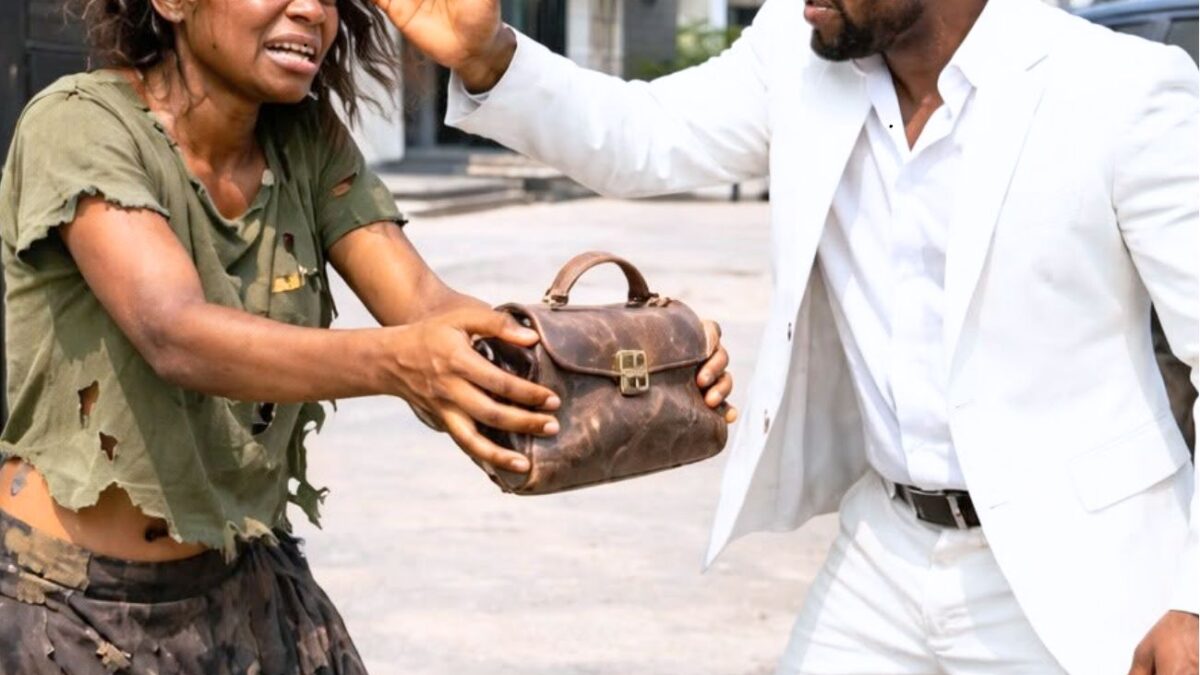
The slap landed so hard that Zainab almost dropped the bag that was worth more than every house on her street combined.
She staggered backward outside the tall black gate of Chief Kola Aderemi’s mansion in Lekki Phase 1, one hand pressed to her burning cheek, the other clutching a dusty brown leather pouch against her chest. The security lights were bright. The compound behind the gate was brighter. White walls, glass balconies, polished cars, flowers trimmed like a hotel garden. Everything looked clean, expensive, untouchable.
And there stood Chief Kola, billionaire real estate king, owner of half the luxury apartments people whispered about from Victoria Island to Banana Island. His white kaftan was spotless. His wristwatch glittered. His face was cold.
—Get away from my gate before I call the police.
Zainab’s lips trembled.
—Sir, please, I followed your car from Oshodi. This fell from your window.
He looked at her bathroom slippers, her faded Ankara skirt, the sweat on her forehead, and the dust on her blouse.
—You people have started again. Small girl, big lie.
The head guard, Daniel, shifted uneasily beside the gate.
—Sir, maybe we should check what she is holding.
Chief Kola turned sharply.
—Daniel, did I ask you to advise me?
Daniel lowered his eyes.
Zainab lifted the pouch with both hands.
—Sir, I did not open it fully. But I think it is something important.
Before she could unzip it, Chief Kola snatched his hand through the air again, not to slap her this time, but to point at the road.
—Leave.
The second guard grabbed her arm. Zainab pulled back.
—Please, just look inside.
The guard shoved her. She fell hard beside the gutter, her knee scraping the concrete. The pouch rolled in the dust, and Zainab threw herself over it as if it were a baby about to be stolen.
People passing on the road slowed down. A pepper seller stopped. An okada rider laughed. Someone whispered that the billionaire had caught a thief.
Zainab heard it all.
Thief.
The word pierced deeper than the slap.
She was 19. She had been called poor, orphan, house girl, market rat. But never thief. Her parents had died 5 years earlier in a bus accident on the Lagos-Ibadan Expressway, leaving her with nothing but a leaking bungalow in Ikorodu and one stubborn lesson from her father: a poor person who loses honesty has nothing left.
That afternoon, she had been carrying cartons for traders at Oshodi Market when Chief Kola’s black SUV slowed near a pothole. A small brown pouch flew from the half-open window and landed beside a pile of sachet water nylons. She had picked it up, opened it a little, and seen stones shining like cold fire inside black velvet.
Diamonds.
So many diamonds that her breath disappeared.
She could have hidden it under her wrapper. She could have run. She could have changed her life before sunset. Instead, she chased the SUV through traffic, shouting until her throat hurt.
And this was her reward.
Daniel bent toward her, his voice low.
—Sister, go home. This place is not safe for you now.
Zainab rose slowly. Dust covered her palms. Tears shone in her eyes, but she refused to let them fall.
—Tell your oga that pride can blind a man more than darkness.
Chief Kola heard her from the entrance and froze, but he did not turn back. He walked into his mansion as if she had said nothing.
Zainab held the pouch tighter and walked away.
By the time she reached Ikorodu, night had settled over the sandy streets. Her small house smelled of old wood, kerosene, and rain trapped in the ceiling. She placed the pouch on her plastic table and opened it again.
The diamonds glittered.
For the first time in years, she imagined school fees paid, roof repaired, food in the kitchen, respect in people’s eyes.
Then she touched her swollen cheek.
At that same hour, inside Chief Kola’s mansion, his younger brother Kunle burst into the study with his wife, Morenike, behind him. Their faces were pale.
—Brother, where is the pouch?
Chief Kola frowned.
—Which pouch?
Kunle’s voice shook.
—The diamonds for tomorrow’s investors. The 400 million naira stones.
Chief Kola stood up slowly, and the room seemed to tilt.
Then Daniel entered with fear in his eyes.
—Sir… the girl at the gate was holding a brown pouch.
Morenike’s mouth opened.
Kunle grabbed the edge of the desk.
And Chief Kola whispered the truth that made everyone go silent.
—God… I slapped the girl who came to save me.
Part 2
By midnight, Chief Kola’s mansion had turned into a battlefield. Kunle shouted that the investors would ruin them by morning, Morenike cried that the family name would be dragged through every blog in Lagos, and Chief Kola’s eldest son, Femi, accused him of trusting strangers more than blood. But beneath Femi’s anger was fear, because he was the one who had begged his father to use the diamonds as collateral for a secret development deal after gambling away company funds in Abuja. If the pouch vanished, Femi’s theft would no longer stay hidden. Daniel called the Oshodi traders and asked about the girl. By 1 a.m., they had a name: Zainab Bakare, orphan, market helper, living alone in Ikorodu. Chief Kola ordered the driver to bring the SUV, but Kunle blocked the door and said they should go with police vans and arrest her before she sold anything. Morenike agreed, saying poor people only respected force. For the first time that night, Chief Kola shouted at his own family. He said the girl had chased his car, not escaped from it, and if she wanted to steal, she would never have come to his gate. Femi laughed bitterly and said honesty was a fairy tale rich people told when they were not desperate. Those words exposed something rotten in the room. Chief Kola stared at his son and understood that the missing pouch was not the only thing God had forced him to see. Meanwhile, in Ikorodu, Zainab sat awake beside the plastic table, fighting the ugliest temptation of her life. Her neighbor Mama Tola had come earlier to borrow salt and noticed her swollen cheek. Zainab lied that she had fallen, but Mama Tola did not believe her. After the woman left, Zainab opened the pouch again and cried silently. 400 million naira sat before her, while her own kitchen had only garri, half a cup of beans, and an empty oil bottle. At 2 a.m., a loud knock shook her wooden door. Zainab froze. Another knock came, harder. Through the cracked window, she saw headlights and men standing outside her compound. Neighbors began opening doors. A child shouted that a big man’s car had arrived. Zainab quickly hid the pouch inside an old rice sack under her bed before stepping out. Chief Kola stood in the sandy compound, his white kaftan stained with sweat and dust from the road. Daniel stood behind him. Kunle, Morenike, and Femi came too, their faces tight with suspicion. The neighbors gathered, whispering. Before Chief Kola could speak, Kunle pointed at Zainab and accused her of theft. Morenike called her a clever market girl. Femi threatened to bring police if she did not confess. Zainab’s eyes filled with pain, but she did not answer them. She looked only at Chief Kola. He lowered his head, then did what shocked the entire compound. He knelt in the sand before her. Gasps rose from the neighbors. Mama Tola covered her mouth. Chief Kola’s family stared as if he had gone mad. He apologized for the slap, for the insult, for treating her poverty like a crime. Zainab’s tears finally fell. But before she could go inside for the pouch, Femi pushed past Daniel and stormed toward her door, shouting that he would search the house himself. Zainab blocked him. In the struggle, the old rice sack tore open, and the brown pouch fell onto the floor for everyone to see. Femi grabbed it first, unzipped it, and his face changed completely. The diamonds were still inside. But hidden under the velvet was a folded company document with Femi’s signature on it, proving he had secretly mortgaged his father’s assets without permission.
Part 3
For a few seconds, nobody moved. The diamonds shone under Zainab’s weak bulb, but Chief Kola was no longer staring at the stones. He was staring at the document in Femi’s trembling hand. The truth entered the room quietly and destroyed everything loudly. Femi had not only lost money; he had used his father’s name, forged approvals, and planned to cover the debt with the diamonds before the investors arrived. That was why he wanted Zainab arrested quickly. A poor girl was the perfect scapegoat. Kunle stepped back as if the document had burned him. Morenike stopped crying. Chief Kola took the pouch from Femi, then took the paper, and his voice came out broken but firm. He told his son that poverty had not tempted Zainab into stealing, but privilege had tempted him into betrayal. Femi fell to his knees, begging, blaming pressure, friends, shame, and fear, but Chief Kola did not shout anymore. He simply looked tired, like a man seeing the failure inside his own house for the first time. In front of the whole compound, he turned to Zainab and thanked her, not only for returning the diamonds, but for returning his sight. Zainab wiped her face and said she had almost kept the pouch because the slap made her feel less than human. The compound went silent. Chief Kola bowed his head and accepted the wound in her words. He promised that no police would touch her, no family member would insult her again, and the whole neighborhood heard him. Then he asked what she wanted as a reward. People whispered that she should ask for money, land, a shop, a car. Zainab looked at the leaking ceiling, the cracked wall, the photograph of her dead parents, and answered that she wanted to finish school. That answer broke something open in Chief Kola’s heart. He paid her school fees, repaired her parents’ house, and placed her under a proper scholarship with legal papers, not empty rich-man promises. Femi faced the consequences inside the company and was removed from every financial role until he repaid what he had stolen. Kunle and Morenike stopped visiting Ikorodu with their proud mouths, because the story had already spread: the billionaire’s family tried to shame a poor orphan, but she had more honor than all of them. 4 years later, Zainab graduated from the University of Lagos with a degree in accounting. Chief Kola attended quietly, sitting at the back, not as a savior waiting for praise, but as a man still paying for one slap with a lifetime of humility. When Zainab later joined his company, she passed the interview like every other candidate. Within 2 years, she became the most trusted finance officer in the firm. Whenever investors asked why Chief Kola trusted her with bigger accounts than relatives, he always gave the same answer: he had once seen her hold 400 million naira in one hand and her conscience in the other, and she chose the thing money could not buy. And in Ikorodu, Mama Tola still told children the story whenever they complained that honesty was for fools. She would point toward Zainab’s repaired house and say that one night, a poor girl returned diamonds to a man who slapped her, but God returned her dignity in front of everyone who thought poverty meant weakness.

