“Get in My Wagon,” Whispered the APACHE WIDOWER to the RUNAWAY BRIDE — And Changed Them Both
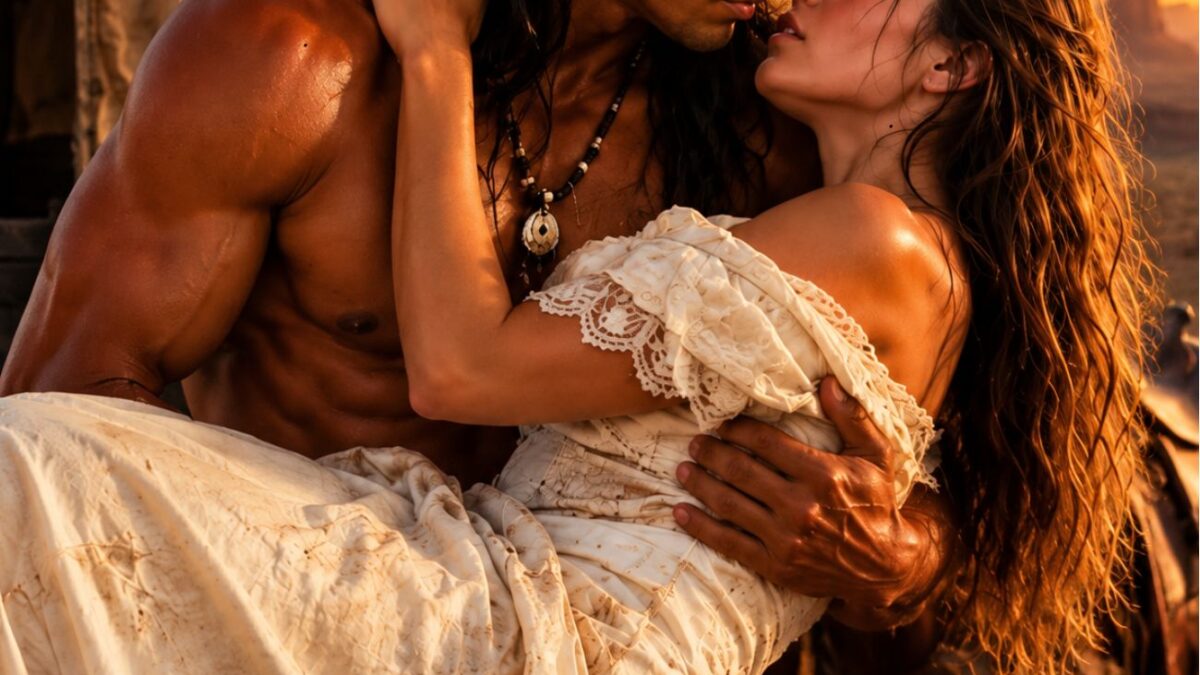
She fled her own wedding in the rain, and the stranger who hid her from the men chasing her would end up asking the very question she thought she was running from.
The bells were still ringing when Rosamund Pierce tore the veil from her hair and ran.
She would remember later that it was the sound that broke her, not the words, not the lawyer’s voice reading the marriage contract to her uncle in the vestry, not the casual mention of her mother’s land and the mining rights beneath it, not the number attached to her name as if she were a parcel of goods already sold.
It was the bells, bright, cheerful, indifferent bells, ringing to announce a wedding that had never once asked what she wanted, ringing as she pressed her back against the cold stone wall outside the vestri door, and understood all at once that the man waiting for her at the altar had priced her before he had ever loved her.
She did not remember deciding to run.
She remembered only that her feet were moving, that the satin slippers her aunt had chosen were slipping on wet cobblestones, that the rain had begun sometime during the ceremony, and no one inside the church had noticed because no one inside the church was paying attention to the weather.
They were paying attention to the bride price.
Rosamund pressed a hand to her stomach, gathered the soaked hem of her gown, and ran down the alley behind the church as though the devil himself were reading her wedding vows.
Perhaps he was.
Perhaps the devil wore expensive boots and had a voice like warm honey, and had asked her uncle three weeks earlier what her mother’s inheritance was worth before he had asked Rosamund a single question about herself.
The town blurred past her, storefronts with their shutters closed for the Sunday ceremony, a dog barking at her from beneath a porch, an old woman staring from a window with her mouth open in shock at the sight of a bride running full tilt through the mud.
Rosamund did not stop to explain herself.
She did not have an explanation that would fit in the time it would take to give one.
She only ran past the edge of town, past the last building, out onto the open road where the rain came down harder and the world opened into a gray, wet, endless plain.
She heard shouting behind her, distant still, but coming.
Her name called in her uncle’s furious voice, and beneath it, threading through the rain, the voice of the groom, no longer honeyed, no longer patient.
She had perhaps two minutes before the men on horseback caught up to a woman on foot in a ruined wedding gown, and she had nowhere to go and no plan beyond the simple animal certainty that she could not go back.
That was when the wagon slowed beside her.
It was a covered freight wagon, canvas top dark with rain, drawn by two heavy horses that steamed in the cold air.
The driver sat with the ease of a man who had spent more nights beneath the open sky than under any roof.
Broad shoulders draped in a rain-slicked coat, black hair loose past his collar, and threaded with a single strip of red-dyed leather at the temple.
He looked at her only once, a single assessing glance that took in the torn veil in her fist, the mud on the hem of white satin, the wild hunted look in her eyes, and the sound of horses coming fast behind her.
He did not ask her name.
He did not ask what she had done or who she was running from.
He reached back, pulled the canvas flap aside with one powerful arm, and said four words in a low, unhurried voice that carried more command than any shout could have.
Get in my wagon.
Rosamund did not hesitate for more than a single heartbeat.
She grabbed the side rail, hauled herself up with a strength she did not know her body possessed, and dove into the dark, dry space beneath the canvas, just as the wagon lurched forward again, wheels turning through mud, putting distance between her and the men who would soon reach the spot where she had vanished from the road.
She lay curled against crates of dried goods and bolts of cloth, breathing hard, her heart slamming against her ribs, and listened as the driver called something low and even to his horses, urging them not to a gallop which would draw attention, but to a steady, purposeful trot that a farmer or trader might use on any ordinary Sunday.
Through a gap in the canvas, she watched the road behind them.
She saw three riders emerge from the rain, reining in hard at the place where her tracks disappeared into puddled mud, turning in confused circles, shouting to one another.
None of them looked twice at a freight wagon rolling calmly toward the horizon.
They did not find her.
It was several minutes before Rosamund trusted herself to breathe normally, and several more before she trusted herself to speak.
When she finally sat up, wrapping her arms around her knees, she found the driver watching her in the small round mirror mounted beside his seat, his dark eyes steady, unreadable, waiting.
Thank you, she said, and her voice came out smaller than she intended, stripped of all the fire that had carried her out of that church.
He said nothing for a long moment.
When he did speak, his voice was deep and unhurried, each word placed with the same deliberate care a man might use setting stones into a wall that needed to last.
You are welcome to ride as far as the next station, he said.
After that, you find your own road.
I don’t need charity, Rosamund said, some of her spine returning to her now that the immediate danger had passed.
I can pay for the ride.
I did not ask you to pay.
He did not look back at her again.
His attention had returned to the road, to the horses, to the rhythm of the rain against the canvas.
I asked nothing of you at all.
That more than anything unsettled her.
Every man she had known in the past year had wanted something from her, her hand, her land, her obedience, her silence.
This stranger who had just risked his own safety to hide a fleeing bride from armed men wanted nothing.
What is your name? she asked.
Nashan.
Just Nashan.
It is enough of a name to answer to.
A pause, and then without turning: You are the bride who did not want to be married.
It was not a question, and Rosamund found she did not have the strength to deny it.
How do you know that?
White satin, torn veil, men on horseback shouting a woman’s name into the rain.
His mouth did not smile, but something in his voice carried the faintest trace of dry humor.
I have hauled freight across this territory for nine years.
I have seen weddings go wrong before.
Not like this one.
Perhaps not, he agreed, and let the subject drop the way a man drops a stone he has already decided is not his to carry.
Rosamund studied him properly for the first time since diving into his wagon.
He was Apache.
That much was clear from his bearing and the cut of his clothing, though he wore a rancher’s coat over it, weathered and practical.
He was tall, even seated, and broad through the shoulders and chest in the manner of a man who had spent a lifetime lifting freight, wrestling stubborn animals, and surviving a land that did not forgive softness.
His forearms, visible where he had rolled his sleeves against the heat of the horse’s exertion, were corded with muscle, the kind built by labor rather than vanity, though it would have made any vain man in her uncle’s parlor look soft and pale by comparison.
His profile, half turned toward her, was carved and severe, a strong jaw shadowed with the first hint of stubble, a straight nose, dark eyes that missed nothing.
He was, she realized with an unwelcome jolt low in her stomach, entirely too beautiful for a man who had just saved her life without asking why.
Where are you taking me? she asked, mostly to interrupt her own thoughts.
I’m taking myself to Valverde Crossing.
You’re welcome to still be in my wagon when I arrive.
He glanced back once more, brief and assessing.
Or you may climb down whenever you wish.
I will not stop you either way.
That’s not much of an answer.
It is an honest one.
Rosamund pulled her knees tighter to her chest and looked out at the rainswept plains sliding past the canvas gap, and found to her own surprise that she believed him.
Honesty was not something she had been offered often, not by her uncle who had smiled at her for weeks while quietly negotiating her worth, and not by the groom who had called her lovely in the same breath he used to discuss mineral rights.
This stranger with the unreadable eyes had told her in the space of a single wagon ride more truth than she had received in a year of careful lies.
Valverde Crossing, she repeated.
How far is that?
Four days if the weather holds.
Longer if it does not.
Four days.
Four days in a stranger’s wagon, in a ruined wedding gown, with no money beyond what was sewn into her petticoat hem, and no plan beyond staying away from the men who wanted to sell her like livestock.
It should have terrified her.
Instead, sitting in the dry dark of the wagon, with the rain drumming steady overhead and a man beside her who wanted nothing from her at all, Rosamund felt something she had not felt in longer than she could remember.
She felt free.
They made camp that evening in a shallow draw where a stand of cottonwoods broke the worst of the wind.
Nashan moved with an economy of motion that fascinated her despite herself, unhitching the horses, building a fire from wood that had somehow stayed dry beneath a tarp in the wagon bed, setting a pot to heat with the same unhurried competence he brought to everything.
Rosamund, still in her ruined gown, felt entirely useless standing at the edge of the firelight, arms wrapped around herself against the evening chill.
Sit, he said without looking up from the fire.
You are cold, and you are making me cold by watching you shiver.
She sat.
The wet satin of her gown clung uncomfortably to her legs, and the veil, torn and mud-streaked, still hung around her shoulders like some grotesque parody of the joy it was meant to represent.
She pulled it free at last and let it fall into the dirt beside her, staring at it as though seeing it for the first time, proof of a life she had almost been forced into, discarded now like a snake’s shed skin.
You do not want it back? Nashan asked, following her gaze.
I never want to see it again.
He reached into the wagon bed and produced a folded wool blanket, offering it to her without comment.
She took it, grateful, and wrapped it around her shoulders over the ruined satin.
Tell me your name, he said, settling across the fire from her since you have not yet offered it.
Rosamund.
Rosamund Pierce.
Rosamund, he said it slowly, testing the shape of it, and something in the low, careful way he pronounced her name sent an unexpected warmth through her chest that had nothing to do with the fire.
And the man you did not marry, did he have a name, or only a price?
The bluntness of the questions startled a short, surprised laugh out of her, the first laugh she had managed in weeks.
Both, I suppose, though I confess I am no longer certain which mattered more to him.
A foolish man then, to have both a woman like you and a fortune, and to lose the first while chasing the second.
Rosamund looked up sharply, but Nashan’s expression gave nothing away, his dark eyes fixed on the fire, his face carved from the same patient stone it had been all day.
She could not tell if he had meant the words as a simple observation or something warmer, and the not knowing left a strange, restless heat low in her belly that she did not examine too closely.
You speak plainly for a man who claims to want nothing, she said instead.
I want nothing from you, he corrected.
That does not mean I have no eyes.
She did not have an answer for that.
She only pulled the blanket tighter and watched the fire, aware in a way she had not been aware of anything in a very long time of the man seated across from her, of his stillness, his size, the quiet strength that radiated off him even at rest, and the unsettling fact that for the first time since she had run from that church, she did not feel like prey.
She felt instead like a woman who had been offered, however briefly, the dangerous luxury of being simply seen.
The second day brought harder rain and a road turned to thick, sucking mud that slowed the wagon to a crawl.
By mid-afternoon, Nashan called a halt at a wide ford where the water ran high and brown, testing the depth with a long pole before committing the horses to the crossing.
Stay inside, he told her.
The current is stronger than it looks.
Rosamund, who had spent two days growing steadily more restless with inactivity, ignored him and climbed down to help hold the lead horse steady while he checked the wagon’s undercarriage for damage from the ruts.
The water came to her knees, shockingly cold, tugging at the ruined hem of her gown with surprising force.
She gritted her teeth and held the bridle firm, murmuring low, steady nonsense to the horse the way she had once calmed her father’s temperamental hunters as a girl.
You are stubborn, Nashan observed, straightening from beneath the wagon, rain streaming down the plains of his bare forearms where he had pushed his sleeves past the elbow.
I have been told it is not a complaint.
He studied her for a moment longer than the task required, water dripping from his jaw, his dark eyes unreadable in the gray afternoon light.
Get back in the wagon before the current takes your feet out from under you.
She meant to argue.
She found instead that she did as he said because there was something in his voice when he was concerned for her safety that made arguing feel like a waste of both their time.
They cleared the ford without incident, though the wagon lurched hard over a submerged rock partway across, throwing Rosamund off balance where she stood bracing herself just inside the canvas opening.
She pitched forward with a startled cry, and Nashan’s arm shot out, catching her around the waist and hauling her against his side, even as he kept the reins steady in his other hand, guiding the horses through the last stretch of current with the same unhurried competence he brought to everything.
For a moment, longer than a moment, Rosamund found herself pressed against him, one hand fisted in the wet fabric of his coat, her cheek nearly against his chest, close enough to feel the solid heat of him even through soaked wool, close enough to hear the steady, unhurried beat of his heart beneath her ear.
He did not release her immediately once the wagon steadied.
His arm remained banded around her waist a moment longer than safety required.
His head bent slightly toward hers, and for one suspended breath, neither of them moved at all.
You may let go of my coat now, he said finely, his voice lower than before, rougher at the edges.
You may let go of my waist, she returned, though she made no move to step away.
And neither for several long seconds did he.
When he finally released her, guiding her gently back to a seated position on the crates, his hand lingered at her elbow a moment longer than the task strictly demanded, and Rosamund found herself watching the water bead and run along the strong line of his jaw with an attention that had nothing to do with concern for the weather.
Thank you, she said once she had recovered enough breath to speak, for catching me.
I would not have let you fall.
He said it simply as though it were an obvious fact of the world, like the current or the rain, and returned his attention to the horses, though Rosamund noticed, she could not help but notice, that his hands were not quite as steady on the reins as they had been before.
That night, camped in the lee of a rock outcropping that broke the wind, Rosamund found sleep elusive.
The wagon bed, divided by a hanging canvas partition Nashan had rigged for her privacy, felt smaller than it had the night before, every creak of wood and shift of canvas magnified in the darkness.
She could hear him on the other side of the partition, could hear the low, even sound of his breathing, and found herself listening for it the way she might listen for music, some part of her cataloging the rhythm of a stranger’s breath as though it were a thing worth memorizing.
She thought of the church she had fled, of the man she had nearly married, of the bells that had rung out over a transaction dressed up as love.
She thought too of a low voice saying, Get in my wagon.
Of an arm banding around her waist in flood water, of dark eyes that saw her, actually saw her, in a way no one in her old life ever had.
Four days, he had said, and two of them were already behind her.
Rosamund lay in the dark, listening to the rain and to the steady breathing of the man on the other side of the canvas, and found herself, for reasons she was not yet ready to examine, dreading the moment those four days would come to an end.
By the third morning, Rosamund had stopped counting the hours until Valverde Crossing and started, without quite admitting it to herself, dreading them.
The rain had finally broken sometime before dawn, leaving the plain washed clean and gleaming under a hard, bright sky, the road firming beneath the wagon wheels for the first time since she had climbed aboard.
Nashan drove with the reins loose in his hands, scanning the horizon out of habit rather than concern, and Rosamund sat beside him on the wagon seat now instead of hiding in the shadowed bed behind, a small shift in arrangement that had happened so naturally over the past two days that neither of them had remarked on it.
You are quiet this morning, he said after nearly an hour of comfortable silence.
I am thinking about the church.
About after the church.
She pulled her knees up onto the seat, wrapping her arms around them, watching the empty land roll past.
About what comes next.
I have very little money and no family who will take me back after this.
My uncle will call it scandal.
My aunt will call it ruin.
Neither of them will ask whether I had good reason to run.
Did you?
You already know I did.
I know what I saw, Nashan said.
A man does not chase a woman through the rain shouting her name unless he believes he still owns something of hers.
I have seen enough marriages built on ownership to recognize the shape of one from a distance.
He glanced at her, brief and steady.
I did not ask if you had reason.
I asked you to tell me because I think you have not said it aloud yet, not even to yourself.
Rosamund opened her mouth to deflect the observation, the way she had deflected every well-meaning question from every relative and acquaintance for the past month, and found to her own surprise that she did not want to deflect this one.
He negotiated my mother’s land three weeks before the wedding, she said quietly.
Not with me.
With my uncle over brandy while I was fitted for a gown I had not chosen the fabric for.
I found the papers by accident tucked behind the household ledger.
He had already sold the mineral rights to a company in Denver, sold them before I had even said my vows, as though my agreement to marry him was merely a formality standing between him and a payment already promised.
And no one told you?
No one thought I needed telling.
I was the bride.
My only task was to arrive on time and look pleased.
Her voice caught, and she was furious at herself for it, furious that even now, days and miles away from that church, the old humiliation could still find her throat and close around it.
I have spent my whole life being told what a good arrangement was being made on my behalf.
No one ever once asked if I wanted the arrangement at all.
Nashan was quiet for a long moment, the wagon wheels turning steady beneath them, the horse’s hooves striking a soft rhythm on the drying road.
I will not ask what you want, he said finally.
I will only tell you that no one is negotiating anything on your behalf in this wagon.
You are here because you chose to climb in, and you will stay for as long as choosing to stay serves you, and not one moment longer for my sake or anyone else’s.
It was, Rosamund thought, the strangest and most affecting thing anyone had said to her in a very long time.
Not a promise of protection, which she had received before and learned to distrust, but a simple acknowledgement of her right to decide her own path.
She studied his profile, the strong line of his jaw, the dark eyes fixed steady on the road ahead, and felt something in her chest loosen that had been clenched tight since the moment she had seen those papers behind the ledger.
Why did you stop for me? she asked.
That first day, you did not know me.
You had no reason to risk trouble with armed men for a stranger in a wedding gown.
Nashan was quiet long enough that she thought he might not answer at all.
When he finally spoke, his voice had dropped into something lower, more careful, the tone of a man choosing each word as though it cost him something to spend it.
My wife died four years ago, he said.
Fever in a hard winter in a cabin two days from the nearest doctor.
I have driven this road alone every season since, and in four years I have stopped for exactly no one, because stopping means caring what happens to a person, and I decided a long time ago that I would not do that again.
He paused, his jaw tightening almost imperceptibly.
I do not entirely know why I stopped for you.
I only know that when I saw you running, I thought of her, and I thought that if anyone had opened a door for her when she needed one, perhaps she would still be here to walk through it.
Rosamund’s chest ached with a sympathy so sudden and complete it startled her.
I’m sorry, she said softly, for your wife.
Her name was Tess.
He said the name the way a man might set down something fragile with great care in a place where it would not be disturbed.
She was quick with her hands and quicker with her tongue, and she would have found you very amusing, I think, running from your own wedding in the rain.
I am glad someone finds amusement in my humiliation.
It was not humiliation.
His voice hardened just slightly, just enough that she heard the conviction beneath it.
It was courage.
There is a difference, Rosamund, and I think you have spent so long being told the first that you have forgotten the second exists.
She did not have a response for that.
She only sat beside him in the brightening morning, the wind pulling loose strands of hair across her face, and allowed herself, for the first time since the church bells had rung, to consider that what she had done was not shameful.
It was brave.
They stopped for the midday meal beside a shallow creek lined with willows, and Rosamund, restless with two days of enforced idleness, insisted on helping gather wood despite Nashan’s protest that her hands, softened by a life of gloves and needlework, were not suited to the task.
I am not made of porcelain, she informed him, snapping a dry branch over her knee with more force than the task required, mostly to prove her point.
I did not say porcelain, Nashan said, watching her with something that might on a less guarded face have been the beginning of a smile.
I said soft.
There is no shame in it.
You were not raised to gather firewood.
I was not raised to run from my own wedding through a rainstorm either.
And yet here I am, apparently capable of a great many things I was not raised for.
That did earn a smile from him, brief, real, transforming his carved, serious features into something that made Rosamund’s breath catch unexpectedly in her throat.
He was beautiful when he was solemn.
He was devastating when he smiled.
Fair, he conceded, and reached to take the bundle of branches from her arms, his fingers brushing hers in the transfer, warm and calloused, and lingering a fraction longer than the task required.
Rosamund felt the touch travel up her arm like a spark finding dry kindling, and judging by the way his gaze flicked to her face, checking her reaction, she was not the only one who had noticed.
They built the fire together, working in a silence that had stopped being awkward sometime during the previous night and become instead comfortable in a way that unsettled her more than any awkwardness could have.
She was aware of him constantly now, the breadth of his shoulders when he bent to arrange the kindling, the corded strength in his forearms as he struck the flint, the low murmur of his voice when he spoke to the horses in a language she did not understand but found herself wanting to learn regardless.
What language was that? she asked as he returned from tending the animals.
Apache.
I told them they are fat and lazy and eating better than I am.
Do you speak it often out here alone?
To the horses mostly.
Something shadowed crossed his face, brief and private.
There are not many left who speak it with me anymore.
My mother’s band moved north two winters ago to land the government has not yet decided to take from them.
I visit when the roads allow, but the visits grow shorter each year and the silence in between grows longer.
That sounds lonely.
It is.
He said it without self-pity, a simple fact stated and set aside the way he set aside most difficult things.
I have been lonely for four years, Rosamund.
I had grown accustomed to it.
I did not expect a runaway bride in a ruined wedding gown to make me notice the accustoming had never actually made the loneliness comfortable, only familiar.
The admission hung in the air between them, heavier than either of them seemed prepared for.
Rosamund found herself moving half a step closer without entirely deciding to, close enough to see the small scar above his left eyebrow, close enough to smell wood smoke and rain and something underneath both that was simply him.
I know something about accustoming yourself to unhappiness, she said quietly.
I had gotten very good at it before your wagon slowed down beside me.
Nashan’s dark eyes moved over her face with an intensity that sent heat curling low in her stomach, lingering on her mouth for one unguarded moment before he caught himself and looked away, busying his hands with the fire that did not need tending.
We should eat, he said, his voice rougher than before.
We have distance to cover before dark.
But his hand, when he passed her a portion of bread and dried meat a moment later, brushed hers for longer than the exchange required, and neither of them commented on it, and neither of them pulled away first.
The fourth day brought them into hill country, the flat plain giving way to rocky rises and narrow passes that forced the wagon to slow to a careful crawl.
Nashan grew more watchful here, scanning the ridge lines with the weary attention of a man who had learned the hard way that beautiful country could turn dangerous without warning.
What is it? Rosamund asked, noticing the shift in him.
This pass has a reputation.
Rockslides mostly, though men use the terrain for worse purposes sometimes.
He kept the horses to a slow, steady pace, his hands sure and alert on the reins.
We will be through it before dark if the weather holds.
Now, the weather did not hold.
A sudden squall rolled down off the higher peaks an hour later, turning the narrow trail treacherous with loose gravel and running water, and the wagon lurched hard over a shifting patch of scree, tilting at an angle sharp enough to throw Rosamund from her seat with a cry she could not swallow in time.
Nashan’s reaction was instant.
He caught her mid-fall with the arm not occupied by the reins, hauling her against his chest and holding her there through the worst of the lurch, his body braced and solid as stone while he brought the horses back under control with quiet, commanding words.
When the wagon finally steadied on level ground, he did not immediately release her.
For a long, charged moment, Rosamund remained exactly where she had landed, pulled fully into his lap, one hand fisted in the front of his coat, her face turned up toward his, close enough to feel the warmth of his breath against her cheek, close enough to see the dark centers of her eyes widen almost imperceptibly as his gaze dropped helplessly to her mouth.
You are not hurt, he said.
It was not quite a question, his voice low and rough in a way she had not heard from him before.
No, she managed.
You caught me.
I seem to be making a habit of it.
Neither of them moved.
The rain fell steady around the halted wagon, the horses shifting restlessly in their traces, and Rosamund was aware, with a clarity that startled her, of every point where their bodies touched, his arm banded firm around her waist, her palm flat against the solid heat of his chest, his breath warm and unsteady against her temple.
She could feel the fast, hard beat of his heart beneath her hand, could see the careful control it was costing him to hold himself still.
Nashan, she said softly, and did not entirely know what she meant to say after his name, only that she wanted to say it again, wanted the shape of it in her mouth.
Whatever might have happened next dissolved as a fresh gust of wind tore through the pass, spooking the lead horse into a sharp sideways step that jolted the wagon and broke the moment as surely as a struck bell.
Nashan set her back on the seat with visible effort, his hands lingering at her waist a beat longer than necessary before he forced himself to release her entirely and turn his full attention back to the frightened horses.
We should find shelter, he said, his voice rougher than the wind alone could account for, before the storm worsens.
Rosamund nodded, unable to trust her own voice, and watched him guide the wagon toward a shallow overhang in the rock wall ahead, her heart still hammering from something that had very little to do with the near accident and everything to do with the look she had seen in his eyes in the moment before the wind broke it apart.
Whatever this was becoming between them, she thought, gripping the seat rail as the wagon rolled toward shelter, it was no longer something either of them could pretend not to notice.
The overhang proved deeper than it first appeared, a shallow cave carved by centuries of wind into the rock face, wide enough to shelter both the wagon and the horses from the worst of the storm.
Nashan worked quickly and in silence, unhitching the team, rubbing them down with a length of dry cloth, checking the wagon’s axle where it had struck the shifting scree, and Rosamund understood without being told that the silence was not distance, but restraint, the careful, deliberate quiet of a man giving himself something to do with his hands so they would not wander toward thoughts he had decided not to entertain.
She busied herself as well, unpacking dry blankets from the crate where they were kept, arranging them near the small fire she coaxed to life from kindling stored beneath the wagon seat, grateful for a task that gave her hands something to do besides remember the exact pressure of his arm around her waist.
You’ve done this before, he observed, watching her build the fire with more competence than she had shown on the first night.
Build a fire?
My father taught me before he died.
He said a woman who could not build her own fire had no business calling herself independent, no matter how many servants stood ready to do it for her.
She struck the flint again, coaxing a stubborn spark into flame.
My uncle did not share his views on the matter.
He preferred a niece who required assistance for everything, since a woman who requires assistance is easier to arrange a marriage for.
Your father sounds like a man I would have respected.
He would have liked you, Rosamund said, and then flushed slightly at the easy familiarity of the words, as though she had known Nashan for years rather than four days.
He never trusted men who talked more than they worked.
You do very little talking and a great deal of work.
Talk is cheap on the frontier.
Actions keep you alive.
He settled across the fire from her, close enough now that their knees nearly touched in the narrow shelter, close enough that she could feel the warmth radiating from him even without touching.
Though I confess you have gotten more words out of me in four days than most people manage in four years.
Is that a complaint?
No.
The single word carried more weight than a longer answer might have, his dark eyes steady on hers across the small fire, something unguarded flickering in them before he mastered it.
It is not a complaint at all.
Outside, the storm intensified, wind driving rain in hard sheets across the mouth of the overhang, the sound of it a steady roar that made the small pocket of firelight feel private in a way the open camps of the previous nights had not.
Rosamund pulled a blanket around her shoulders, aware of the chill finally catching up with her now that the danger had passed and her body had stopped running on urgency alone.
You’re cold, Nashan said, watching the small shiver she could not quite suppress.
I am well enough.
You are not.
He reached for another blanket without asking permission, crossing the narrow space between them to settle it around her shoulders himself, his hands lingering at the edges of the wool a moment longer than the task required, his face close enough to hers that she could see the individual raindrops still caught in his dark hair, could feel the warmth of his breath against her cheek in the cold cave air.
Neither of them moved to widen the distance.
Nashan, she said again, his name becoming, she realized, something of a habit, a word she reached for whenever the air between them grew too charged to bear in silence.
Rosamund.
He said her name the way he always did, slow and deliberate as though testing its weight, and this close, with the firelight catching the sharp planes of his face and the storm roaring beyond the shelter of the overhang, she found herself wondering, with a boldness that would have scandalized her a week ago, what it might feel like if he closed the last small distance between them entirely.
He did not.
He drew back instead with visible effort and busied himself checking the fire that did not need checking.
And Rosamund understood he was exercising a discipline that had less to do with propriety and more to do with a heart already broken once, unwilling to risk breaking again.
She did not push, but she did not look away either, and long after he had settled across the fire and pulled his own blanket close, she remained awake, watching the firelight move across his profile, understanding that whatever grew between them in this stone shelter was no longer something either of them could outrun.
The storm broke sometime before dawn, leaving the mountain pass washed clean and treacherous, boulders and loose gravel scattered across the trail where the rain had loosened the hillside overnight.
Nashan surveyed the damage with the flat, assessing calm of a man who had faced worse and would face worse again, and declared that they would need to press on through a lower route, one that would add half a day to their journey but avoid the risk of further rockslides.
The lower route ran along the edge of a swollen creek that had sometime in the night overflowed its banks entirely, turning a stretch of the trail into standing water nearly two feet deep.
We will need to cross on foot beside the wagon, Nashan said, studying the flooded stretch with narrowed eyes.
The wheels alone cannot be trusted to find solid ground beneath all that water.
I need someone at the lead horse’s head to keep her steady while I manage the brake.
I can do it, Rosamund said immediately.
He looked at her for a long moment, at the ruined satin of her gown still stained despite her best efforts to clean it, at the delicate slippers that had never been made for anything sturdier than a ballroom floor.
It will ruin what remains of your dress.
The dress is already ruined.
It has been ruined since the moment I ran from that church, and I have been mourning it far less than I expected to.
She climbed down before he could argue further, wading into the cold water without waiting for his permission, gasping softly at the shock of it against her legs.
Tell me what you need me to do.
Something in his expression shifted, not quite a smile, but something adjacent to pride, quiet and warm, gone as quickly as it appeared beneath his customary composure.
Take the lead horse’s bridle.
Keep her calm.
Keep her walking straight.
If she startles, do not let go, but do not fight her either.
Guide her.
Rosamund did as he instructed, gripping the wet leather of the bridle, murmuring low and steady to the horse the way she had once murmured to her father’s hunters, and together they began the slow, careful crossing, Nashan at the brake, guiding the wagon through water that tugged at the wheels with surprising force, Rosamund walking beside the horse’s head with water climbing past her knees, soaking what remained of her gown, the current pulling insistently at the ruined satin.
Halfway across, the wagon lurched hard against a submerged rock, and the lead horse startled sideways with a sharp whinny, nearly pulling free of Rosamund’s grip.
She held fast, bracing her feet against the current, murmuring urgently until the animal settled, and by the time the wagon finally cleared the flooded stretch and rolled up onto solid ground on the far bank, she was soaked from the waist down, shivering, triumphant, and thoroughly drenched.
You did well, Nashan said, securing the brake and climbing down to check the horses, his gaze moving over her with something that was no longer quite so carefully guarded as it had been the night before.
Better than well.
Most people panic in moving water.
You did not.
I have decided panic is a luxury I no longer have time for.
She wrung water from the ruined hem of her gown, laughing despite the cold, despite the exhaustion, feeling more alive in that single moment of shared victory than she had felt in a year of careful, well-arranged safety.
But the cold set in quickly once the adrenaline faded, her teeth beginning to chatter as the wind found the wet satin clinging to her skin, and Nashan’s expression sobered instantly, the pride giving way to something more urgent.
You need dry clothes, he said, already moving toward the wagon bed.
Now, before the chill sets in properly.
He returned with one of his own shirts, soft cotton faded from years of wear, and held it out to her.
It will be too large.
It will also be dry, which matters considerably more at present.
Rosamund took the shirt gratefully, her fingers clumsy with cold as she fumbled with the ruined laces of her gown.
I need a moment.
Privacy, of course.
Nashan turned immediately, presenting her his broad back, moving several deliberate steps toward the horses to occupy himself with their care, giving her what privacy the open trail could offer.
She struggled out of the sodden gown behind the questionable shelter of the wagon, pulling his shirt on over her shift, the fabric warm from where it had been packed near his own body heat, smelling of wood smoke and rain and unmistakably of him.
It fell to her mid-thigh, the sleeves swallowing her hands entirely, and she rolled them back with numb fingers, aware in a way that sent unexpected warmth curling through her chilled body that she was standing on an open trail wearing nothing beneath a stranger’s shirt but her own bare skin.
I am decent, she called finally, and Nashan turned back toward her.
He went very still.
Rosamund watched something move behind his dark eyes, not quite shock, not quite hunger, something caught in the narrow space between the two, his gaze traveling once helplessly from her bare legs to the shirt clinging damp at her shoulders to her wet hair falling loose around her face before he wrenched his attention away entirely, his jaw tight, his hands curling briefly into fists at his sides before he forced them open again.
The man who faces bandits and flood water without flinching, Rosamund said softly, taking a step closer despite every instinct telling her that closing the distance was dangerous, is he afraid to look at me now?
I am not afraid to look at you.
His voice had dropped low, rough, stripped of its usual careful control.
I am afraid of what I will want to do after I have looked.
The admission hung between them, raw and unguarded, in a way nothing he had said in four days of careful restraint had been.
Rosamund closed the last of the distance between them, close enough now to feel the heat radiating from his body despite the cold wind, close enough to see the fine tremor of restraint in the hand he held rigid at his side.
She reached out and laid her palm flat against his chest over the fast, unsteady thunder of his heart, and felt him go absolutely rigid beneath her touch, his breath catching audibly in his throat.
Turn around, she said quietly.
Rosamund.
Turn around, Nashan.
He obeyed slowly, some visible war waging behind his controlled expression, and when he was fully facing her, close enough that she had to tilt her head back to hold his gaze, Rosamund found she was no longer entirely certain what she meant to do, only that four days of stolen glances and lingering touches and careful, deliberate distance had brought them to a precipice neither of them seemed inclined to step back from.
I told myself I would not want anyone again, Nashan said, his voice low and rough, his eyes moving over her face as though memorizing it.
I told myself the wanting died with Tess, and that I preferred it that way, because wanting is what breaks a man when the wanted thing is taken from him.
And now, now I cannot remember why I believed I preferred it.
His hand rose finally, achingly slow, to cup her jaw, his calloused thumb tracing the line of her cheekbone with a tenderness that made her breath catch.
You have undone four years of careful discipline in four days, Rosamund Pierce, and I find I am not entirely sorry for it.
She rose onto her toes, closing the last small distance between them, and when his mouth finally met hers, it was nothing like the careful, deliberate man she had come to know over four days of shared road.
The kiss was slow at first, testing, almost reverent, his hand cradling her jaw as though she were something precious he had not expected to be permitted to hold.
And then her fingers curled into the front of his coat, pulling him closer, and something in his careful restraint finally broke entirely, his arms banded around her, lifting her half off her feet, the kiss deepening into something hungrier, more urgent, four days of stolen glances and careful distance collapsing into the desperate press of his mouth against hers.
Rosamund felt the solid heat of him against every inch of her body, felt the fine tremor that ran through his powerful frame as he held himself in check even now, even with her hands fisted in his shirt and her mouth opening beneath his, and understood with a clarity that startled her that this man who had spent four years disciplining himself into solitude was holding himself back even now, even in the very moment of surrender, out of some deep, ingrained fear of wanting something he might lose.
Nashan, she breathed against his mouth when he finally drew back far enough to press his forehead to hers, both of them breathing hard, the cold wind forgotten entirely between them, I am not going anywhere tonight.
Something in his expression cracked open at that, relief, want, the raw edge of a hope he had clearly not expected to feel again, and he kissed her once more, slower this time, deliberate, before drawing back with visible effort.
Then let us find shelter before the sun sets, he said, his voice rough, because I find I’m no longer certain I can trust myself around you in an open field, Rosamund, and you deserve better than a hillside for what I intend eventually to say to you properly.
They found a hollow beneath an outcropping of rock an hour before dusk, sheltered from the wind, close enough to a stream for water, and Nashan built the fire with hands that were, Rosamund noticed with quiet satisfaction, not entirely steady.
She had changed back into her own gown once it dried by the fire, though she found herself missing the warm, familiar weight of his shirt against her skin, the scent of him that had clung to the fabric.
They did not speak much as evening fell, the silence between them charged now in a way that made every small motion feel weighted with meaning, the brush of his hand against hers as he passed her a portion of the evening meal, the way his gaze kept returning to her mouth when he thought she was not looking, the careful, deliberate distance he maintained even as every line of his body seemed to strain against it.
When the fire had burned down to embers and the stars had opened wide and brilliant overhead, Rosamund crossed the small space between their bedrolls without announcing her intention and settled beside him, close enough that their shoulders touched, close enough to feel the sharp intake of his breath at the contact.
Rosamund, her name low and warning, though he made no move to put distance between them.
I told you, she said softly, tilting her face up toward his in the darkness, I am not going anywhere tonight.
What followed was not spoken of again the next morning, not directly, only in the new ease between them, the way Nashan’s hand found the small of her back without hesitation as he helped her into the wagon, the way Rosamund leaned into his side at the fire without needing an excuse to do so, the fire between them banked now but no longer denied, glowing steady beneath the surface of every ordinary exchange, waiting only for the next quiet moment to catch fully alight again.
The night had been slow and reverent and far too brief, the kind of night that rewrote quietly and completely everything either of them had believed about what they were still capable of feeling, and if the details of it belonged to no one but the two of them, the change it left behind was unmistakable to anyone who saw them together in the pale light of the following dawn.
They rose late by Nashan’s usual standards, the horses grazing unhurried in the pale gold light while he sat with his back against the rock outcropping and Rosamund’s head resting against his shoulder, neither of them in any particular rush to return to the road.
She could feel the steady rise and fall of his breathing beneath her cheek, could feel too a kind of stillness in him that had not been there four days earlier, not the guarded stillness of a man holding the world at arms’ length, but something quieter, something closer to peace.
You are thinking too loudly, she said, tracing an idle pattern against the back of his hand where it rested on his knee, I can hear it.
I am thinking that Valverde Crossing is only a day and a half away now.
His voice was carefully even, but she felt the small tension that moved through him as he said it, the way his hand went still beneath her fingers.
And that I do not know what happens after we arrive.
What do you want to happen?
That is a dangerous question to ask a man who spent four years believing he did not want anything at all.
He turned his head, pressing a slow kiss to her hair, and for a moment he said nothing further, only held her against him as though the silence itself might delay the answer he was not yet ready to give.
I want you to stay.
I am also aware that wanting a thing and having the right to ask for it are not always the same, and I will not be the second man in a month to decide your future for you without asking what you actually wish for yourself.
That is considerably more thoughtful than most proposals I have received.
I have not made you a proposal.
Something dry crept into his voice, though his arm tightened around her all the same.
I am informing you of a fact about my own wanting.
What you choose to do with that information is entirely yours to decide.
Rosamund tipped her head back to look at him properly, at the careful vulnerability he was allowing her to see, at the man who had spent four years disciplining himself into solitude now sitting in the morning light with his heart laid open on his own terms, however cautiously.
You are a very strange man, Nashan.
I have been told.
I meant it as a compliment.
Then I will accept it as one.
He kissed her again, unhurried, and for a while neither of them spoke of Valverde Crossing at all, content to let the morning stretch a little longer before the road demanded its due.
They broke camp reluctantly and pressed on through hill country that gradually softened into rolling grassland, the terrain easing as they drew nearer to the crossing, though something in Nashan’s manner grew steadily more guarded with every mile that passed.
Rosamund noticed it in the way his answers grew shorter, in the way his gaze lingered on the horizon rather than on her, in the careful, deliberate space he began without explanation to reintroduce between them on the wagon seat.
You are pulling away from me, she said finally as the afternoon light began its long slide toward evening.
I can feel it happening, even if you will not say it aloud.
I am not pulling away.
But he did not look at her when he said it, his jaw set in the same hard line she remembered from their first day together before the road had softened him.
I am remembering what happens to things I allow myself to want.
I am not Tess.
I am not going to be taken from you by fever in a hard winter.
You are not, he agreed, but you are a woman with an inheritance to reclaim and a life to rebuild.
And Valverde Crossing has a stage line that will take you anywhere in the territory you wish to go, and I have no right to ask you to choose a freight wagon over whatever life you are capable of building for yourself now that you are free to build one.
His hands tightened almost imperceptibly on the reins.
I told myself when I stopped for you that I was offering you an escape, nothing more.
I did not intend to become something you might feel obligated to stay for.
Obligation has nothing to do with what I feel for you.
Perhaps not now, but gratitude has a way of disguising itself as something deeper, and I will not have you discover the difference only after it is too late to change your mind.
He said it evenly, but Rosamund heard beneath the careful composure the old fear reasserting itself, the same fear that had kept him solitary for four years finally finding its familiar footing again now that the crossing loomed close enough to touch.
We will reach the station tomorrow.
What you decide once we arrive is entirely your own choice to make, free of anything that has passed between us on this road.
Rosamund said nothing further, though the words settled uneasily in her chest, a small cold seed of doubt planted in ground that had until that moment felt entirely solid beneath her.
She had spent her whole life being told what her choices were before she had a chance to make them herself.
She had not expected the next man to make that same mistake, to be the one who had taught her over four days and one unforgettable night what it felt like to be truly free.
Valverde Crossing announced itself first as a smudge of smoke on the horizon, then as a scattering of rooftops, then finally as a real and solid town with a stage office, a mercantile, and a small hotel with lace curtains in the windows, the first proper civilization Rosamund had seen in five days and the last place she wanted, with a fierceness that surprised her, to arrive.
Nashan drove the wagon straight to the stage office without comment, his profile set and distant in a way that had not softened since the previous evening’s conversation, and Rosamund understood with a sinking heart that he intended to make good on his word, to deliver her safely, to step back, to let her choose without the weight of his own wanting pressing on the decision.
The eastbound stage leaves in two days, he said, helping her down from the wagon with careful formal courtesy that felt after five days of growing intimacy like a door quietly closing.
It will take you to Prescott.
From Prescott you can reach a proper city, hire a lawyer, begin reclaiming what your uncle sold without your consent.
You have thought this through carefully.
I have had a day and a half to think of little else.
He retrieved her small bundle of belongings from the wagon bed along with a folded stack of bills he pressed into her hands before she could protest.
This should be enough to see you through until you can access your own funds.
I will not have you arrive in Prescott with nothing.
Nashan, you are free, he said, and something in his voice cracked just slightly on the word, though his composure held.
That was always the promise of the wagon, Rosamund, not that I would keep you, only that I would give you the chance to choose your own road, whatever road that turned out to be.
She stared at him, at the careful, deliberate distance he had built back into his posture, at the money in her hands that felt suddenly, absurdly like a payment, the very thing she had run from a church to escape, offered now by a man who could not possibly understand that it wounded her precisely because it echoed the language of the life she had fled.
You are doing it again, she said, her voice rising with an anger that surprised them both.
You are deciding what is best for me without asking what I actually want.
I am giving you a choice.
You are giving me an exit and calling it a choice because it is easier for you to send me away than to risk asking me to stay and hearing me say no.
Her hands closed tight around the bills, crumpling them, her eyes stinging with a fury that had nowhere else to go.
I ran from one man who decided my future without consulting me.
I did not travel five days through rain and flood water to arrive at the arms of another.
That is not what I am doing.
Is it not?
You have spent the last day and a half retreating behind every wall you spent four years building, and now you stand here handing me money and a stagecoach schedule and you call it freedom when what it actually is, Nashan, is fear wearing freedom’s clothes.
Her voice broke on the last words and she hated that it did, hated that he could see the hurt beneath the anger as clearly as she could feel it.
You are not protecting me from anything.
You are protecting yourself from the risk of asking me to stay and discovering that I might actually want to.
Nashan said nothing for a long moment, his jaw tight, his dark eyes fixed on some point past her shoulder, and Rosamund understood with a grief that settled cold and heavy in her chest that she had spoken the truth too plainly for him to answer it honestly.
Take the money, he said finally, quietly.
Whatever else is true between us, you should not go into your new life with empty hands.
She took it because refusing would accomplish nothing beyond wounded pride, and because some part of her, some small and frightened part she did not want to examine too closely, understood that if she stayed standing in front of him a moment longer she would beg, and she had already spent one lifetime asking men to want her enough to keep her, she would not spend another.
Goodbye, Nashan, she said, and turned and walked into the hotel without looking back, though it cost her everything she had left not to.
The two days that followed were the longest of Rosamund’s life.
She took a room at the small hotel, washed the last traces of the road from her skin, and sat at the window overlooking the street, watching for a wagon that did not come, telling herself firmly that she did not want it to.
She used part of the money Nashan had given her to send a telegram to a lawyer in Prescott, a name recommended by the hotel’s proprietor, outlining the theft of her mother’s mineral rights and requesting representation to reclaim what had been taken.
She ate meals she did not taste, slept poorly in a bed too soft and too still after five nights on hard ground, and found with mounting frustration that freedom without him beside her felt considerably less like triumph than she had expected it to.
On the morning of the second day, boarding the eastbound stage with her small bundle of belongings and her chin held high, Rosamund told herself she was proud of the woman she had become on that road, a woman who had crossed flood water and mountain passes and her own fear, a woman capable of building a life entirely on her own terms.
She told herself this for three days across three towns through the slow grinding work of consulting the lawyer in Prescott, filing the necessary papers, discovering that her mother’s mineral rights had not yet been fully transferred and could with sufficient legal pressure be reclaimed.
She told herself this as she found modest lodging, took in fine needlework to support herself while the legal proceedings unfolded, and built, piece by careful piece, precisely the independent life she had once believed she wanted more than anything.
It was, by every measure she had once used to judge success, a triumph.
It also felt unmistakably like living in a house with all the furniture removed, technically complete, entirely functional, and hollow in a way she could not seem to furnish with anything else.
Nashan drove the road back toward the mountains alone, and found within the first hour that the wagon had never once, in four years of solitary travel, felt so unbearably empty.
He told himself it would pass.
He had grieved before, had learned the shape of loss well enough to know its edges, to know that time would eventually sand them smooth.
But the grief of losing Tess had come without warning, sudden and total, a fever taking her in the space of a single hard week.
This grief was different, self-inflicted, chosen, the direct result of his own careful, deliberate cowardice, and it refused stubbornly to sand smooth at all.
He thought of Rosamund constantly, of her stubbornness in the flood water, of her laughter at his jokes, of the particular way she said his name when the space between them grew too charged for silence.
He thought most of all of the anger in her voice outside the stage office, the accusation that had lodged itself in his chest and refused to leave, fear wearing freedom’s clothes.
She had not been wrong.
He had told himself for four years that his solitude was a form of respect for Tess’s memory, a refusal to risk the kind of loss that had hollowed him out once already.
He understood now, driving an empty road with an emptier heart, that it had never been respect at all.
It had been fear dressed carefully in the language of honoring the dead, and it had cost him in the end exactly the thing it had been designed to protect him from losing.
He drove three weeks of his usual routes, delivering freight, exchanging brief courtesies with the traders and station keepers who knew him along the way, and found that every single one of them, without exception, remarked on some change in him he could not quite name himself.
You look like a man carrying something heavier than freight, an old station keeper told him on his second pass through a familiar crossing.
I am carrying nothing at all, Nashan said.
That is precisely the problem.
The station keeper, a weathered man who had buried two wives of his own, only laughed, not unkindly.
Then go put something back in the wagon, son.
Emptiness is not a burden a man is required to keep carrying if he has the sense to set it down.
Nashan thought about those words for three more days, driving a route he no longer had any real reason to keep driving alone, and on the fourth day, without entirely deciding to, he turned the wagon toward Prescott.
He found her modest lodging house by asking with careful discretion at the lawyer’s office she had visited on her first day in the city, and stood outside her door for a long moment before he found the courage to knock, rehearsing words that felt against the weight of everything he had gotten wrong entirely insufficient.
Rosamund opened the door and went very still.
You came back, she said, her voice carefully neutral, though he could see the pulse fluttering fast at her throat.
I came back, he agreed, not to rescue you.
You have made it entirely clear in the three weeks since I let you walk into that hotel that you require no rescuing from anyone, least of all me.
He turned his hat over in his hands, an old, nervous habit he had not indulged in years.
I came back to ask a question I should have asked before I ever handed you that money and called it freedom.
Ask it then.
Would you get in my wagon again?
His voice roughened, the careful composure of the past weeks finally visibly cracking.
Not because you are running from anything this time.
Not because armed men are chasing you down a rain-soaked road.
I’m asking if you would choose it.
Choose me with nothing forcing your hand at all, because I spent three weeks discovering that I would rather risk losing you slowly, one shared mile at a time, than spend one more year protecting myself from a loss that has already happened regardless.
Rosamund’s eyes filled, though she did not let the tears fall, standing very straight in the doorway of the small, hollow life she had built with such determined independence.
You let me walk away.
I did.
It was the worst decision I have made in four years, and I have had three weeks and considerably too many empty miles to sit with exactly how wrong it was.
He took a step closer, close enough now that she had to tilt her head back to hold his gaze the same way she had on the trail in the wet dawn light in the moment everything between them had first cracked open.
I am not offering you an escape this time, Rosamund.
I am offering you a life, my road, my wagon, my name, for as long as you will have it and me both.
I am asking you to choose it fully with every alternative available to you, because I do not want you beside me out of gratitude or obligation or the simple absence of a better option.
I want you there because you want to be, and I am prepared to wait and to ask again as many times as it takes until the answer is entirely freely yours.
Rosamund looked at him for a long, suspended moment, at the man who had once told her with such careful conviction that he wanted nothing from her and who now stood on her doorstep offering her everything he had spent four years refusing to risk again.
I already have an independent life, she said slowly.
A lawyer working to reclaim my inheritance, lodgings of my own, needlework that pays my way.
I built all of it myself with no one’s help but my own two hands.
I know.
I am not asking you to give any of it up.
I’m not finished.
A small, unsteady smile broke across her face despite the tears finally spilling free.
I built an independent life, Nashan, and discovered every single day of it that independence without you in it felt like a house with all the furniture removed.
I do not want to choose between the life I built and the man who taught me I was capable of building it.
I want both.
I want my inheritance and your wagon.
I want a lawyer in Prescott and a husband who speaks to his horses in a language I’m determined to learn.
I want everything, and I am done apologizing to anyone, including you, for wanting all of it at once.
Nashan’s composure broke entirely then, something raw and unguarded flooding his features as he closed the last distance between them and gathered her against his chest, his mouth finding hers with a tenderness that carried the full weight of three empty weeks and one enormous, hard lesson about the difference between protecting a heart and simply refusing to use it.
Marry me, he said against her mouth when he finally drew back far enough to speak.
Not because I am rescuing you, and not because you are grateful.
Marry me because four years of solitude taught me nothing except how to survive, and five days on the road with you taught me finally how to actually live.
Yes, Rosamund said, laughing and crying at once, her hands fisted in the front of his coat exactly as they had been on that first flooded crossing.
Yes, Nashan.
I will get in your wagon again.
I will get in it every single day for as long as you will let me.
Two weeks before the wedding, a letter arrived at Rosamund’s Prescott lodgings bearing her uncle’s familiar cramped handwriting, and she sat with it unopened in her lap for the better part of an hour before she found the courage to break the seal.
Her uncle had heard through channels she did not particularly wish to trace of the lawyer’s efforts to reclaim the mineral rights and of the man she had taken up with along the road, a freight driver he wrote with evident distaste as though the word itself were an accusation.
He urged her, in tones that shifted uneasily between wounded affection and thinly veiled threat, to reconsider before she attached her name and whatever remained of her reputation to a match so far beneath the standing her mother’s family had once held.
Rosamund read the letter twice, then folded it carefully and set it aside, and found to her own quiet satisfaction that it no longer had the power to wound her it once would have carried.
She wrote back a single page in response, measured, unhurried, entirely her own.
She informed her uncle that the lawyer’s efforts had succeeded, the mineral rights improperly transferred without her consent were being restored to her name by order of the territorial court, and the funds already promised to the Denver company would be returned in full.
She informed him further that she was to be married within the fortnight to a man who had asked what she wanted before deciding anything on her behalf, a courtesy she noted that her uncle himself had never once extended her in twenty-five years.
She did not ask for his blessing.
She did not need it.
Nashan read the letter over her shoulder that evening, his jaw tight with an anger he did not bother concealing on her behalf, and when she had finished folding it away, he took her hand in both of his, turning it over to press a slow kiss to her palm.
You did not have to answer him at all, he said quietly.
I know.
I wanted to.
There is a particular satisfaction in being gracious to a man who spent a year deciding I did not deserve a say in my own life.
She curled her fingers around his, steady and sure.
He will not trouble us again.
He has nothing left to bargain with.
And I have finally learned that his opinion of my choices was never worth the weight I once gave it.
They were married three weeks later in a small ceremony that bore no resemblance whatsoever to the one Rosamund had fled.
No negotiated contracts, no mineral rights discussed over brandy, no groom who valued her inheritance above her heart.
Only Nashan, steady and solemn in his wedding clothes, and Rosamund in a simple gown she had chosen entirely for herself, and a handful of friends made along the roads and stations of a territory that had in the end given her back everything her old life had tried to take.
They took the wagon east afterward toward Nashan’s usual routes, Rosamund seated beside him on the wagon bench exactly where she had first insisted on sitting five weeks earlier, her hand resting easy in his over the reins.
Where are we going? she asked as the horses settled into their familiar rhythm and the road opened wide and golden before them in the late afternoon light.
Nashan glanced at her, at the woman who had climbed into his wagon a stranger and left it weeks later as everything he had once believed himself too broken to want again, and smiled the rare, full smile she had come to treasure above every other expression he owned.
Wherever the road takes us, he said, and together this time, that is the only direction I intend to travel from now on.
Rosamund settled against his shoulder, watching the endless golden plain unfurl before them, and understood with a certainty that settled warm and permanent in her chest that she had finally found the one thing her old life with all its careful arrangements and negotiated contracts had never once managed to offer her.
A road worth choosing, and a man beside her who would never again mistake protecting her for letting her go.

