Forced To Marry A 53-Year-Old Chief — Then She Entered The Wrong CEO’s SUV
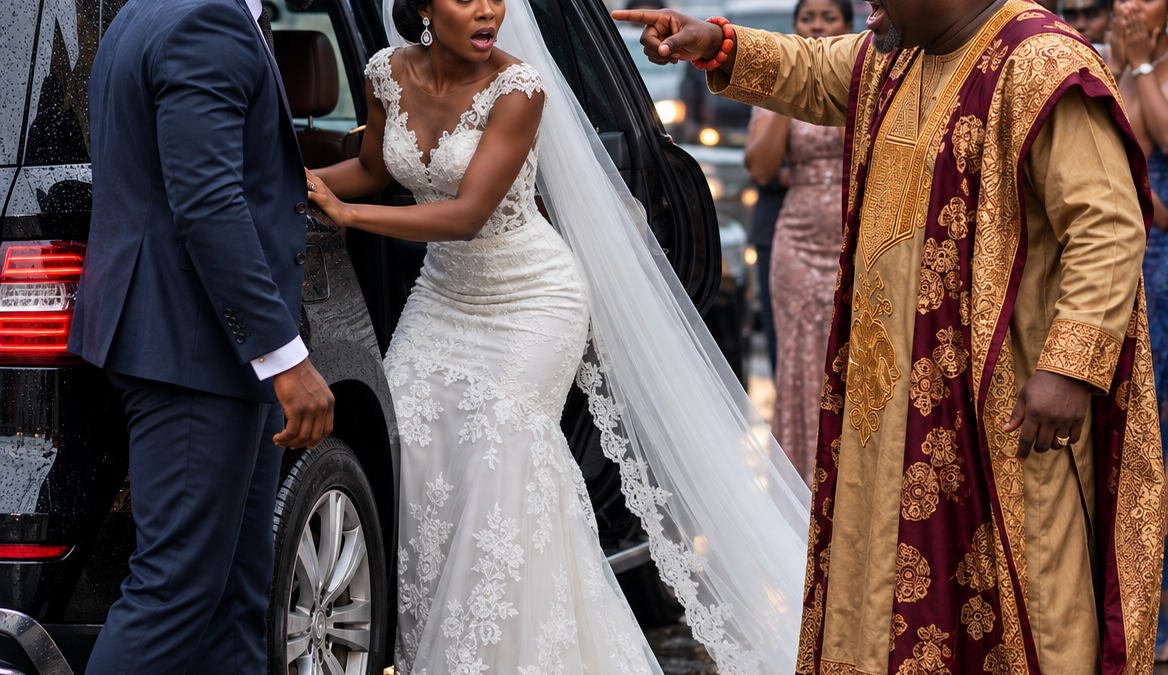
She wore the veil like a condemned woman walking toward her own quiet burial. In the suffocating dimness of a crumbling Lagos room, Adesuwa sat motionless upon the edge of an old wooden frame. Her wedding gown was borrowed from a distant cousin, smelling faintly of camphor, damp cupboards, and unchosen fates.
Her slender fingers gripped the stiff netting of the skirt, trembling with a fury she was forbidden to voice. Through cracked louvers and peeling walls, the thunder of talking drums vibrated straight through the floorboards beneath her feet. It was the sound of an elaborate street carnival being staged entirely upon the silent ruins of her youth.
She was twenty-four years old, and before morning broke, her entire life had been measured and signed away. Her mother had bartered her existence to settle a mountain of debts left behind by a father who died penniless. The bride price was heavy, paid in crisp bank notes, crates of gin, and cows meant to feed an insatiable neighborhood.
“You should fall on your knees and thank God,” her mother had snapped earlier, dabbing talcum powder across her damp face. “Chief Emeka Nwosu is a man of substance, an elder with three concrete houses and a fleet of private buses. He eats fresh meat every afternoon of his life, while girls in this compound starve on garri and dried fish.”
Adesuwa had held her tongue, biting down hard on the inside of her cheek until the copper taste filled her mouth. She had learned from girlhood that a daughter’s voice inside these crowded courtyards carried less weight than dry leaves. In her family, girls were never nurtured to discover their own souls; they were merely seasoned, polished, and presented.
They were trained to sweep red dirt, taught to kneel before harsh elders, and prepared for men they never chose. Yet on this scorching July afternoon, heavy with exhaust fumes and thunderclouds, something wild and untamed waited in the shadows. None of the chattering women adjusting her veil could have foreseen that she was about to vanish into another world.
Before the dusk settled over the city, she would step blindly into a stranger’s car and cross an impossible divide. She would walk down an aisle she had never rehearsed and face the most elusive corporate titan in West Africa. Adesuwa was the firstborn child of the late Ezekiel Okafor, a man whose proud heart far outmeasured his empty pockets.
Being the first daughter in Mushin meant your childhood ended the very day your smaller siblings learned to cry for food. It meant your hands grew calloused from carrying firewood and water basins long before you ever touched a secondary school textbook. When her father passed away two years prior, he left behind four younger children, unpaid landlords, and persistent loan sharks.
The unspoken weight of that entire wreckage collapsed onto Adesuwa’s shoulders without a single formal word being exchanged. Her mother never had to command her directly; the demand was written in every exhausted groan and bitter glance over dinner. Chief Emeka Nwosu was fifty-three years old, thick-necked, arrogant, and already commanding two wives in his sprawling Surulere residence.
He had spotted Adesuwa carrying sacks of dry grain at her uncle’s shop and decided her quiet beauty belonged to him. He dispatched emissaries with baskets of kola nuts, sweet palm wine, and an envelope fat enough to wipe their shame away. No elder in the family cared to ask the girl if her heart could bear the touch of a boastful patriarch.
The date was fixed with hurried precision, locked into a sweltering Saturday when the Lagos sky hung low with storm clouds. Across the lagoon, beyond the toll gates and past the murky water, an entirely different battle unfolded in Victoria Island. Tobe Chukwuemeka Adeyemi sat in the leather interior of his imported vehicle, watching rain streak across tinted privacy glass.
At thirty-one, he was the chief executive officer of the Adeyemi Group, a multi-billion-naira conglomerate built from trade and logistics. He had spent his twenties in London lecture halls and European trading pits, mastering high finance to honor his late father. In three brief years at the helm, he had expanded the company’s ports and doubled its earnings through sheer, sleepless willpower.
Yet, despite his triumphs, he remained trapped inside an ancient machine operated by ruthless family elders who demanded absolute compliance. His uncle, Chief Biodun Adeyemi, the patriarchal kingmaker holding the company’s largest legacy voting bloc, had orchestrated an arranged union. The chosen bride was Sewa Banwo, an aristocratic socialite from an influential northern dynasty with vast government connections in Abuja.
The board believed that an alliance with the Banwo family would secure their transport corridors through the northern states. Tobe had met Sewa twice over formal, stiff dinners at private clubs, exchanging pleasantries that felt like rehearsed diplomatic cables. She was poised and beautiful, yet between them lay an emotional wasteland where not even a flicker of curiosity existed.
“You will marry her without further debate,” his uncle had stated flatly, tapping a heavy gold signet ring on the boardroom mahogany. “A young bachelor heading a maritime empire makes foreign investors nervous; the board requires a man anchored to steady domestic ground.” Tobe had locked eyes with the old man, calculating the votes and realizing a public rebellion would splinter his father’s life work.
He bowed his head, swallowed his bitter independence, and agreed to play his assigned part in the grand political farce. By a bizarre quirk of Lagos geography, both ceremonies were scheduled within minutes and miles of one another in the mainland district. Adesuwa’s traditional handover was arranged at a crowded public pavilion, while Tobe’s high-society spectacle occupied the Grand Prestige Hall.
The two venues sat separated by only a single labyrinthine street choked with idling buses, food vendors, and rain-filled potholes. Both brides wore brilliant white lace, both had their faces veiled under dense layers of fabric, and both were miserable. Outside, highlife music from an old brass band competed violently with the bass-heavy speakers hired by the Adeyemi security detail.
As the oppressive heat mounted inside the holding chamber, Adesuwa felt the walls closing in like a suffocating stone crypt. Her heart hammered against her ribs, her breath catching in her throat as the women outside began ululating for her entrance. She slipped out through a rusted side door into the narrow service lane, desperately seeking one private gasp of unfiltered air.
Tears burned behind her eyes, hot and stubborn, blurring the greasy sheen of the rain-drenched pavement beneath her silver slippers. She did not notice the sleek black SUV parked along the curb, its heavy passenger door left open by an inattentive attendant. She only saw a dark, quiet sanctuary shielded from the deafening drums, and she stepped into the deep backseat, pulling the door shut.
The chauffeur, an eleven-year company veteran named Kingsley, sat at the wheel under strict orders to deliver the veiled VIP. He assumed this solitary, veiled figure in couture lace was Miss Sewa Banwo, who had supposedly stepped away to avoid the crowd. Without glancing backward through the partition, Kingsley shifted the heavy transmission into drive and eased smoothly into the chaotic traffic.
Adesuwa leaned against the soft leather, trembling as the roar of her mother’s compound began to fade into the background. It took four long minutes for the strange reality of her surroundings to penetrate the haze of her mounting panic. She felt the whisper of ice-cold air conditioning, smelled polished wood and expensive sandalwood cologne, and noticed the total silence.
She lifted the bottom hem of her veil with shaking fingers and stared out at the passing streetscape through darkly tinted glass. They were not heading toward the local parish where Chief Emeka was waiting with his entourage and his boastful friends. They were gliding swiftly onto the highway, moving toward an unfamiliar district lined with manicured palms and high corporate towers.
On the headrest directly in front of her, an embossed gold crest caught the light: Adeyemi Group – Integrity and Power. “Excuse me, please,” she whispered, her voice cracking against the quiet hum of the luxury engine as she leaned forward. “Where are you taking me? This is not the road to Surulere; there has been a terrible mistake with this car.”
Kingsley merely smiled into the rearview mirror, his posture steady and completely unbothered by what he assumed were bridal jitters. “We are arriving at the Grand Prestige Hall now, madam,” he replied courteously, navigating smoothly past two private security checkpoints. “Mr. Tobe is already at the altar, and the family protocol officers are waiting at the VIP entrance to receive you.”
Before Adesuwa could find the breath to protest, the SUV swept into an enormous paved driveway illuminated by brass lanterns. Footmen in matching black uniforms rushed forward, shielding the open car door with large umbrellas as flashbulbs exploded across the wet courtyard. Dozens of handlers surrounded her immediately, guiding her forward with practiced urgency into the cool, magnificent interior of the grand ballroom.
More than four hundred dignitaries filled the vaulted space, dressed in rich damask, shimmering silks, and towering, jewel-encrusted geles. A twelve-piece orchestra played soft jazz near the floral arches, and the air smelled of imported lilies, vintage champagne, and absolute wealth. Adesuwa moved down the endless white runner like a ghost, her heart racing so violently she feared she would collapse mid-stride.
At the end of that aisle stood Tobe Adeyemi, magnificent in a bespoke midnight-blue traditional tunic cut with sharp modern lines. He watched her approach with the guarded, analytical detachment of an executive attending a forced merger he could not prevent. Yet, as she drew closer, his sharp eyes caught subtle details that did not match the polished woman he expected.
This bride hesitated on the runner, her shoulders tense, her steps cautious and searching, like someone walking across a fragile rope. She did not glide with the practiced, aristocratic entitlement of Sewa Banwo; she carried herself like a survivor navigating hostile terrain. Tobe had spent his life reading human weakness across negotiation tables, and he knew instantly that this woman was running on raw survival.
The officiant raised his hands, chanting ancient prayers and corporate blessings over the bowed heads of the gathered corporate elite. Adesuwa stood beneath her heavy veil in the middle of this gilded theater, terrified that a single movement would expose her. If she cried out, her mother’s debts would remain unpaid, Chief Emeka would hunt her down, and this wealthy family would destroy her.
The solemn moment finally arrived when the minister instructed the groom to lift the veil and gaze upon his partner. Tobe stepped close, the scent of rain and subtle vanilla wafting from the shivering figure standing before him on the dais. He reached up with steady hands, grasped the delicate white lace, and swept it back over the tall crown of her head.
Time seemed to freeze under the blazing crystal chandeliers as their eyes locked in sudden, breathtaking, absolute shock. He looked into the fierce, terrified, liquid-brown eyes of a complete stranger whose jaw was set in rigid, defiant defense. She looked upon a powerful young man whose sharp features softened into total bewilderment, his dark eyes wide with sudden realization.
Neither spoke, neither breathed, while four hundred high-society guests smiled warmly, unaware that the universe had just slipped its gears. Tobe did not raise his voice; he did not summon his security guards or betray the catastrophe through his iron composure. Years of surviving hostile boardroom takeovers had taught him never to reveal panic to an audience eager for his downfall.
He gently smoothed the veil down over her shoulders, leaned close to her ear, and whispered, “Walk with me right now.” Turning smoothly to his astonished protocol director, he announced with absolute calm, “Excuse us; the bride requires five minutes of quiet.” Without waiting for an answer, he gripped Adesuwa firmly by the elbow and guided her swiftly through a concealed side exit.
They entered a deserted administrative corridor lined with circuit breakers, spare chairs, and heavy steel fire doors. The instant the heavy acoustic door latched shut behind them, Tobe released her arm and spun around to face her directly. “Who in God’s name are you?” he demanded, his voice low, controlled, and trembling on the edge of a deep fracture.
“My name is Adesuwa Okafor,” she answered, surprised by the steady, unyielding resonance that rose from her own chest. “I stepped into your vehicle by accident when I walked out to get air; my wedding was taking place across the road.” She smoothed her borrowed lace dress with trembling palms, lifted her chin, and added, “I am terribly sorry for your ceremony.”
Tobe stared at her in the dim industrial light, taking in her humble dress, her cheap jewelry, and her unvarnished defiance. Then, to her utter astonishment, the severe lines of his face broke, and he let out a short, genuine bark of laughter. It was not mocking or cruel, but the breathless, exhausted sound of a man who had suddenly found an unexpected escape hatch.
“So, you have no interest in marrying me either?” he asked, running a hand through his hair and leaning against the painted brick. “I do not know you from any man in the market,” she retorted sharply, her defensive walls rising against his casual tone. “Good,” he muttered, unbuttoning the stiff high collar of his tunic. “Because my actual bride has spent the last half-hour hiding in a cloakroom.”
He pulled a vibrating smartphone from his pocket, showing dozens of frantic, missed messages from Sewa Banwo refusing to go through with the alliance. He looked back at Adesuwa, his gaze penetrating, stripped of corporate calculation, suddenly seeing the raw human being standing before him. “Tell me the truth,” he said softly, his voice dropping into quiet sincerity. “What were you running from out there in that alley?”
Nobody in her twenty-four years of life had ever asked Adesuwa what she was fleeing, or what her heart truly desired. Not her weeping mother, not her transactional uncles, and certainly not the proud old chief who had bought her like an imported trinket. The question pierced straight through her defenses, cracking open the reservoir of grief and quiet dignity she had buried for survival.
“I am running from an old man who bought me to pay my father’s foolish debts,” she whispered, her voice tightening with quiet steel. “He is fifty-three years old, he already has two wives, and nobody in my family asked if I wanted to live that life. I stepped into your car because I could not breathe, and though I have nothing, I would rather starve than return to that room.”
Tobe remained utterly silent, his eyes lingering on her proud posture, her clear gaze, and the stubborn courage radiating from her frame. Beyond the heavy door, the dull rumble of four hundred expectant guests, the clinking of crystal, and the restless jazz band continued. He thought of his arrogant uncle waiting to claim victory over his personal freedom, and he thought of his own late father’s wisdom.
His father had once told him on an empty shipping dock that an empire built on compromises is merely a gilded prison for its owner. “Do not go back there,” Tobe said firmly, stepping away from the wall and standing tall in the quiet industrial passage. “What do you mean?” she asked, her eyes narrowing with suspicion as she gripped the fabric of her borrowed white skirt.
“I will have Kingsley take you directly to the airport or the interstate motor park; go wherever you have family who truly love you. I will give you enough cash to start fresh, and nobody from your compound will ever trace you through the Adeyemi network. My own family disaster, I will settle right now on that stage, in front of every shareholder who thought they owned my life.”
He paused at the fire exit, turning back to look at her one last time with an expression she would never forget. “What you did today, walking out of that compound into the unknown, was the bravest act I have witnessed in thirty-one years.” Within ten minutes, Kingsley had spirited Adesuwa away through the rear service bay, handing her a heavy manila envelope from Tobe’s private briefcase.
Inside the ballroom, Tobe walked back onto the stage alone, stepped up to the microphone, and looked out over the stunned audience. Without flinching, he announced that the strategic union was permanently cancelled due to mutual incompatibility, wishing the Banwo family well. He took full responsibility, ignored his uncle’s furious purple face in the front row, and walked out of the hall a completely free man.
The scandal that erupted across Lagos over the following weeks was monstrous, loud, and devoured by every society rag in the nation. Chief Emeka raged through Mushin, demanding the return of his bride price, his kola nuts, and the dry gin he had distributed. Adesuwa’s mother wailed from morning till night, claiming her firstborn had been struck with sudden madness and cursed by village spirits.
Chief Biodun Adeyemi convened an extraordinary board meeting to strip Tobe of his chief executive title for disgracing the family’s public standing. Tobe entered that high-floor boardroom armed with forensic audit reports, three new continental contracts, and an exclusive European partnership. He placed the documents on the table and declared he would lead the corporation on his own merit or take his investors elsewhere.
Faced with his unmatched brilliance and the loss of their primary profits, the board voted nine to three to retain him unconditionally. His uncle slammed his leather portfolio shut, walked out into early retirement, and never challenged his nephew’s authority over the empire again. Meanwhile, eight hundred miles away in Port Harcourt, Adesuwa stepped down from an overnight bus into the humid, oil-scented morning air.
She carried one small duffel bag, the quiet address of a distant maternal aunt who asked no questions, and forty thousand naira in small bills. She refused to touch the substantial sum of money Tobe had placed in the car envelope, keeping it locked safely in an old tin box. She wanted to know, with absolute certainty, what she was capable of creating entirely with her own hands, her own mind, and her own will.
She found humble employment as an assistant bookkeeper in an industrial spare-parts warehouse near the crowded commercial docks. Within six months, she had redesigned the company’s inventory ledgers, uncovering massive leaks and saving the owner millions in lost stock. She bought a battered, second-hand laptop, set it up on a plastic folding table in her tiny studio room, and began studying night and day.
In the quiet hours after the city fell asleep, Adesuwa discovered that her mind possessed a rare, brilliant affinity for complex mathematics. Where other people saw boring columns of numbers, she saw dynamic structures, hidden risks, and invisible currents of capital flow. Local traders began seeking her out on weekends to balance their messy accounts, calculate tax obligations, and negotiate vendor contracts.
Two years slipped away in a blur of endless work, self-directed study, professional certification exams, and profound, unshakeable peace. She officially registered her own boutique financial consultancy, Okafor Advisory Services, operating out of a tiny, freshly painted commercial suite. She signed her first corporate logistics client, then a regional shipping firm, working eighteen hours a day until her reputation spread across the south.
She had transformed completely from the frightened, veiled girl trapped in that Mushin compound into an authoritative, razor-sharp corporate executive. She wore tailored suits, spoke with quiet authority, and walked into bank boardrooms without a trace of hesitation in her measured stride. She had earned something far more valuable than wealth; she had forged an unyielding inner sovereignty that no patriarch could ever buy.
Tobe, too, had transformed the Adeyemi Group into an agile, innovative powerhouse, divesting from stagnant monopolies and backing modern infrastructure. Yet, in the quiet evenings in his high-rise Ikoyi apartment, staring out over the black waters of the lagoon, her memory remained. He never hired investigators to locate her, believing she had earned her total freedom without the shadow of his immense privilege hanging over her.
He simply remembered the fierce, unvarnished fire in her eyes when she said, I would rather starve than return to that room. That memory had become his private benchmark for courage whenever he faced corrupt politicians, treacherous competitors, or paralyzing corporate crises. In the third year of her independence, the prestigious West Africa Commerce Summit convened at an ultra-modern convention resort in Lagos.
The Adeyemi Group was the principal sponsor of the international gathering, drawing ministers, venture capitalists, and industry pioneers from across the continent. Okafor Advisory had been selected as a finalist for the Emerging Enterprise Award, and Adesuwa was invited to present her regional logistics model. The journey back to Lagos was heavy with emotion, but she flew into the city as a respected founder, not an escaping fugitive.
Disaster struck thirty minutes before her panel when her assistant realized their technical presentation kit had been left at the airport transit hotel. With her laptop battery sitting at seven percent and the presentation room filling rapidly, Adesuwa hurried toward the corporate executive suites. A conference manager directed her toward the headline sponsor’s private suite, mentioning they kept high-powered universal power banks for speakers.
She entered the quiet executive office, her heels clicking softly against the deep carpet, her eyes fixed on the presentation notes in her hand. At the far side of the room, standing beside a floor-to-ceiling glass window overlooking the harbor, stood a tall man in a bespoke gray suit. He turned casually at the sound of the opening door, lowering his phone from his ear as his dark, discerning eyes met hers.
The air vanished from the space between them in an instant, the heavy hum of the air conditioning fading into absolute silence. Three years of time, struggle, growth, and separate victories evaporated as their gazes locked across the sunlit, carpeted floor. He did not see the trembling girl in the borrowed lace, and she did not see the overwhelmed heir trapped by his family’s manipulation.
They stood as two autonomous architects of their own destinies, recognizing the silent battle scars that each had carried and overcome. “You need a charger,” Tobe said finally, his voice deep, gravelly, and steady, breaking the spell with an easy, appreciative smile. “I need a charger,” Adesuwa confirmed, her chin lifting slightly, a slow, radiant smile transforming the composed planes of her face.
He pulled a heavy power adapter from his desk, walked across the room, and placed it directly into her open, waiting hands. Their fingers brushed briefly, a spark of electric warmth passing between them that sent a subtle tremor through both their chests. “You are presenting on the emerging logistics corridor,” he said quietly, his eyes lingering on her sharp suit and confident posture.
“Okafor Advisory,” she replied, meeting his intense gaze without flinching. “I built something of my own, just as I promised.” “You vanished into thin air,” he said softly, the words carrying no accusation, only the lingering weight of three years of unspoken wonder. “I had to build my own foundation before I could stand before anyone as an equal,” she answered, stepping back toward the door.
“Go take your stage, Adesuwa,” he whispered, speaking her name for the very first time with a reverent, unmistakable warmth. “I will be sitting in the front row watching you show this entire city what real power looks like.” Her presentation was a masterclass in clarity, intelligence, and visionary financial design that held the five-hundred-person auditorium in complete silence.
She spoke without relying on notes, breaking down complex trade tariffs and port logistics with effortless authority and brilliant, incisive solutions. Tobe sat in the audience, completely ignoring urgent calls from international bankers, his eyes fixed solely on the woman commanding the stage. When she finished, the room erupted into thunderous applause, and venture capitalists swarmed her podium with cards and multi-million-naira proposals.
Tobe waited patiently near the sunlit atrium fountain, holding two simple paper cups of black coffee until the final delegate had departed. As the crowd dispersed, Adesuwa turned, spotted him leaning against the polished marble balustrade, and walked over with a light, easy step. “That was brilliant,” he said, handing her a warm cup. “Far better than any presentation my senior directors have given this year.”
“Thank you,” she said, savoring the rich warmth of the coffee. “It feels surreal to be back in this city without looking over my shoulder.” “I have spent three years wanting to tell you something,” Tobe said, his voice dropping into that deep, earnest tone that commanded total honesty. “I wanted to tell you that watching you refuse that forced marriage in the corridor gave me the strength to break my own chains.”
He looked directly into her eyes, stepping closer until the bustling sounds of the conference lobby faded into background noise. “I did not search for you because I knew you needed time to build your life without anyone’s shadow cast over your name. But not a single week passed where I did not wonder where you were, or if our paths would ever cross again under better skies.”
Adesuwa looked down at the coffee in her hands, her throat tightening with an emotion that felt entirely sweet, safe, and unhurried. “You were the first person who ever asked me what I was running from,” she whispered, meeting his steady, waiting gaze once more. “Every other person in my life only told me what I was supposed to endure, or what debt I was expected to pay.”
She took a slow breath, feeling the solid ground beneath her feet and the absolute freedom that now belonged entirely to her soul. “I built my company so that I would never have to run from any man, any debt, or any circumstance ever again. And standing here today, looking at you as an equal partner in this city, I realize that I am finally ready to stop running.”
Tobe smiled, a slow, breathtaking smile that reached his dark eyes, and offered her his arm with deep, unhurried respect. “Then let us walk forward together, Miss Okafor, not because anyone arranged it, but because we both freely choose the path.” Their reunion was not met with immediate ease by the traditional circles of Lagos, but neither of them cared for society’s approval.
Adesuwa’s mother required months of difficult, honest conversations before she finally understood that her daughter was not a commodity to be traded. Chief Emeka had long since taken another young wife, his pride soothed by local status, completely oblivious to the powerhouse Adesuwa had become. The Adeyemi elders attempted to raise objections about background and lineage, but Tobe simply reminded them who held the company’s controlling shares.
When the two firms collaborated on the massive Lekki logistics expansion, industry insiders assumed a massive corporate merger was imminent. Yet Adesuwa flatly refused to merge Okafor Advisory into the Adeyemi Group, insisting that her firm remain fiercely independent and autonomous. Tobe supported her stance without hesitation, respecting her professional boundaries with the quiet admiration of a man who loved a true equal.
They became each other’s most trusted confidants, challenging each other’s strategies over late-night dinners and celebrating their hard-won corporate milestones. Years later, on a breezy December evening, they stood together on the private balcony of their home, looking out over the sparkling Lagos coastline. Below them, the distant hum of traffic moved through the sprawling metropolis, a city of twenty million souls chasing impossible dreams through rain and dust.
Adesuwa rested her hand over his on the balcony railing, feeling the cool ocean wind lift the hem of her dark silk dress. She thought back to that sweltering July afternoon, the suffocating borrowed veil, the desperate escape down the alley, and the open car door. She had learned through the long, demanding years that true liberation was never merely the escape from cruelty or confinement.
True liberation was the hard-won power to choose your own labor, speak with your own voice, and love with your whole heart. Lagos rarely offered second chances to the poor and forgotten daughters weeping behind compound walls on hot, dusty afternoons. Yet sometimes, amidst the heavy rains and the roar of traffic, the ancient city offered something infinitely rarer and more divine.
It offered a brand-new destiny, disguised as an impossible wrong turn into the open door of a waiting, unmarked car. The daughters of that vibrant, enduring land were never born merely to be prepared for the comfort and vanity of others. They were born to endure the storm, shatter every gilded cage, and arrive entirely on their own magnificent terms.

