For Ten Years, I Told My Grandson I Didn’t Know Who His Father Was. Then a Stranger at My Daughter’s Grave Told Me He Was Still Alive.
Ten years after my eighteen-year-old daughter died giving birth, I thought grief had already taken everything it could from me.
I was wrong.
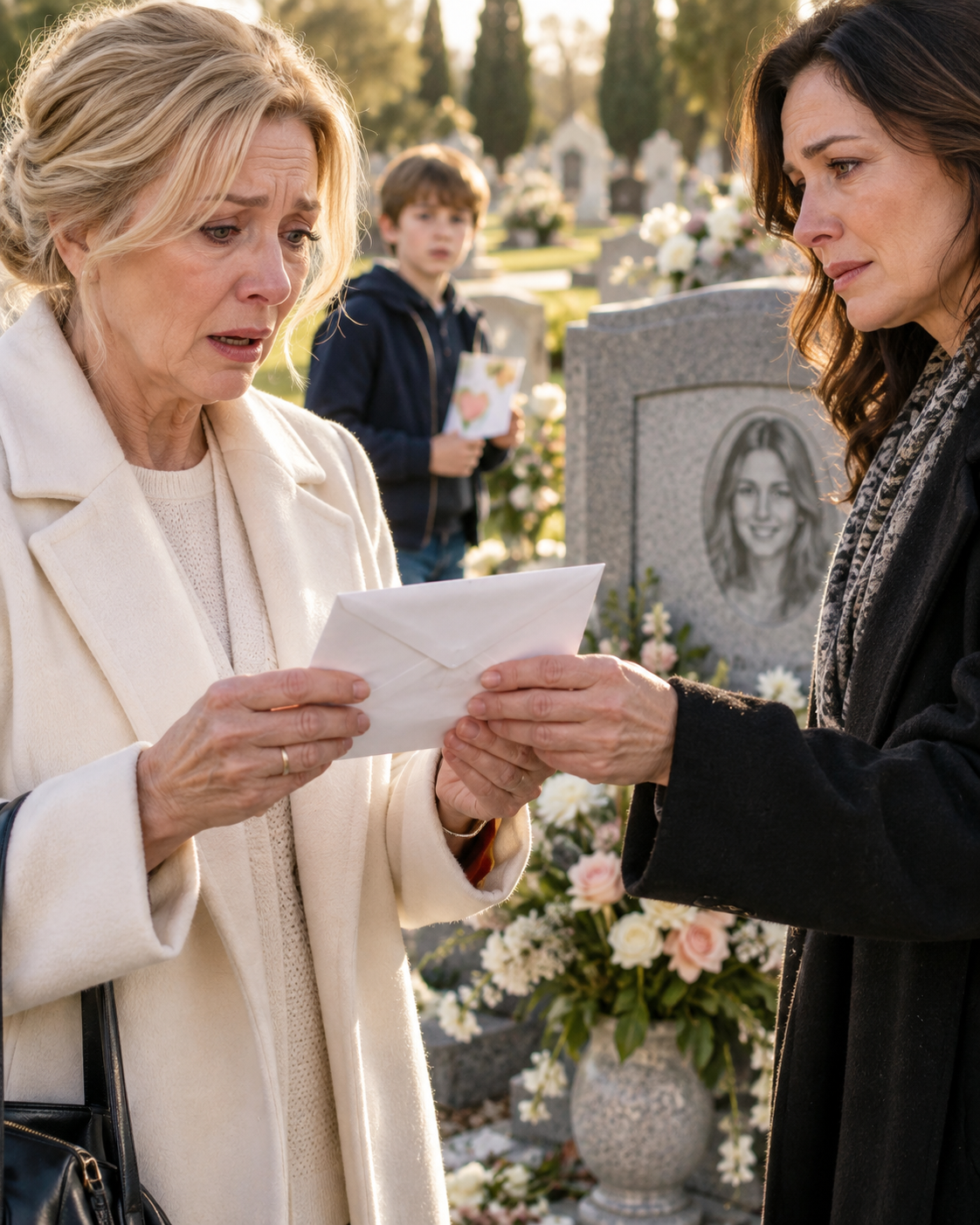
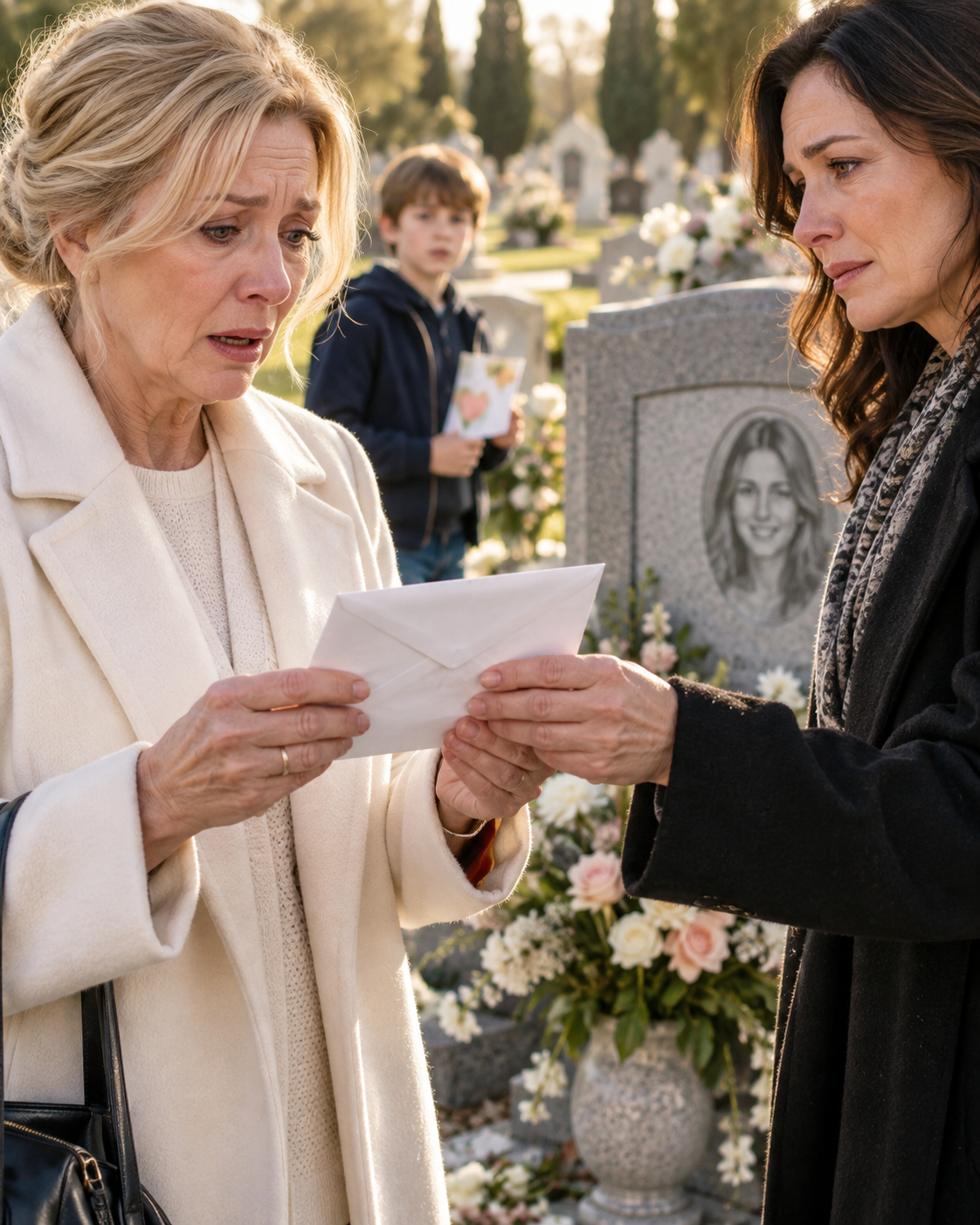
Because one October afternoon, while I stood beside Emily’s grave with the little boy she never got to raise, a woman I had never seen before appeared beside the headstone and handed me an envelope.
My name was written across the front.
In my dead daughter’s handwriting.
Before I could open it, the woman said five words that changed everything.
“I made Emily a promise.”
I stared at her.
“What promise?”
Her eyes shifted toward my grandson, Noah, who was jogging back from the parking lot with a handmade card in his hand.
Then she whispered, “The truth about his father.”
For ten years, that question had haunted our house.
And it had started when Emily was barely eighteen.
I still remembered the night she told me she was pregnant.
She stood in our kitchen wearing an oversized gray sweatshirt, both hands buried inside the sleeves. Dinner sat untouched between us.
“Mom,” she said.
Something in her voice made me set down my fork.
“What happened?”
She swallowed.
“I’m pregnant.”
The room went silent.
At first, I thought I had misunderstood.
“You’re what?”
Tears filled her eyes.
“I’m having a baby.”
I wish I could say I reacted perfectly.
I didn’t.
I was scared. Shocked. Angry at the situation.
Emily had plans. College applications were sitting on her desk. She worked weekends at a bookstore. She talked about becoming an elementary school teacher.
And suddenly everything had changed.
But after the first shock passed, only one question remained.
Who was the father?
“Does he know?” I asked.
Emily stiffened.
“Mom, please.”
“Please what?”
“I can handle it.”
“Emily, you’re eighteen.”
“I know how old I am.”
“Then tell me who he is.”
She looked away.
“No.”
That became her answer for the next several months.
I tried everything.
I asked gently.
I got angry.
I waited until she was relaxed.
I asked during doctor appointments.
I asked while we folded tiny onesies in the living room.
“Does he know?”
“Yes.”
“Is he helping you?”
No answer.
“Did he leave you?”
Silence.
“Did he hurt you?”
Her head snapped up.
“No.”
“Then why won’t you tell me his name?”
She pressed both hands against her stomach.
“Because telling you won’t fix anything.”
Once, late at night, I found her sitting alone on the back porch crying.
Her phone was in her hand.
I sat beside her.
“Do you love him?”
She stared into the darkness for a long time.
Finally she whispered, “That doesn’t matter anymore.”
I believed there would be time to understand.
There wasn’t.
Emily went into labor six weeks later.
At first, everything seemed normal.
She squeezed my hand through every contraction and threatened to blame me personally if the baby inherited our family’s terrible eyesight.
I laughed.
She laughed.
Between contractions, she looked at me and said, “You’re going to spoil him.”
“Absolutely.”
“Mom.”
“What?”
“I’m serious.”
“So am I.”
She smiled.
That was the last real smile I ever saw on my daughter’s face.
Several hours later, the atmosphere changed.
Doctors began speaking faster.
A nurse moved me into the hallway.
“What’s happening?” I demanded.
“We need some room.”
“For what?”
No one answered.
I stood outside those doors feeling completely helpless.
Then a doctor walked toward me.
I knew before he said anything.
“I’m so sorry.”
My knees nearly gave out.
“What happened?”
“There were complications. We did everything we could.”
I couldn’t understand the words.
They sounded far away.
Then one thought cut through everything.
“The baby?”
The doctor nodded.
“He’s alive.”
I covered my mouth.
“He’s stable.”
Then he added quietly, “He’s going to need you.”
My daughter never came home.
My grandson did.
His name was Noah.
Emily had chosen it.
For ten years, Noah and I became our own strange little family.
I was his grandmother on paper.
In every other way, I became Mom.
I packed lunches.
I attended parent-teacher conferences.
I sat through Little League games in folding chairs with terrible coffee.
I learned which dinosaur was apparently superior to every other dinosaur.
Every Sunday morning, we made pancakes.
Emily used to love pancakes.
By the time Noah was six, he had started asking the question I knew would eventually come.
“Grandma?”
“Yeah?”
“Who’s my dad?”
I froze.
“I don’t know, sweetheart.”
“Mom never told you?”
“No.”
“Why?”
That question was worse.
“I wish I knew.”
As Noah got older, the questions became harder.
Was his father alive?
Did he know Noah existed?
Did he look like him?
Had he abandoned Emily?
All I could ever say was the same thing.
“I don’t know.”
Sometimes I hated the unknown man.
Other times I imagined he might have been another terrified teenager.
Mostly, I hated myself for not forcing Emily to tell me.
Every year, Noah and I visited her grave on her birthday and on the anniversary of her death.
He talked to her like she could hear him.
He told her about school.
Baseball.
Girls he thought were annoying.
Teachers he thought were unfair.
One October afternoon, when he was ten, he placed flowers beside Emily’s headstone and suddenly slapped his forehead.
“My card.”
“What?”
“I left it in the car.”
He ran toward the parking lot.
I was brushing leaves away from Emily’s headstone when I noticed the woman.
She stood perhaps twenty feet away.
Dark hair.
Black coat.
Early fifties.
She wasn’t looking at another grave.
She was staring directly at Emily’s.
“Can I help you?” I asked.
She looked up.
The moment she saw my face, something changed in hers.
Recognition.
Fear.
“You must be Emily’s mother.”
My heart began beating faster.
“Who are you?”
She glanced toward Noah.
Then back at me.
“My name is Margaret Whitmore.”
The name meant nothing to me.
“Did you know my daughter?”
She nodded.
“Yes.”
“How?”
Her eyes filled with tears.
“Better than you were ever told.”
I stepped closer.
“What does that mean?”
She reached into her purse.
“I made your daughter a promise.”
Then she pulled out the envelope.
I recognized Emily’s handwriting immediately.
My fingers shook as I opened it.
Inside were several pages.
The first sentence nearly broke me.
Mom, if you’re reading this, something happened to me before I could tell you myself.
I stopped.
“What is this?”
Margaret whispered, “Keep reading.”
So I did.
Emily wrote about a boy named Daniel.
Daniel Whitmore.
She said they had met the previous year at a bookstore café downtown.
He came in every Tuesday.
At first, they talked about books.
Then music.
Then everything.
She had fallen in love with him.
And Daniel had fallen in love with her.
When Emily discovered she was pregnant, Daniel hadn’t run.
He had proposed.
I looked up.
“She was engaged?”
Margaret nodded.
“Secretly.”
“Why?”
“Because of Daniel’s father.”
Richard Whitmore owned one of the largest property-development companies in the state.
He had plans for Daniel.
College.
Graduate school.
Eventually the company.
An eighteen-year-old pregnant girl from an ordinary family did not fit those plans.
According to Emily’s letter, Richard had threatened her.
Not physically.
Financially.
Legally.
He told her Daniel would lose his inheritance.
He said he would make sure Daniel never saw the baby.
Daniel refused to obey him.
He told Emily they would leave.
They planned to marry after the baby came.
Then, three weeks before Noah was born, Daniel disappeared.
No calls.
No messages.
Nothing.
Emily believed Richard had sent him away.
Then came the paragraph that made me stop breathing.
Mom, Daniel didn’t abandon me. Whatever happens, please don’t teach our son to hate him. I know Daniel. If he isn’t here, something has happened.
At the bottom, Emily had written his full name.
Daniel Michael Whitmore.
I looked at Margaret.
“You know him?”
Her face crumpled.
“He’s my son.”
I felt the ground shift beneath me.
Noah was walking toward us now.
Margaret removed an old photograph from her purse.
Emily stood beside a young man.
They looked happy.
Really happy.
I stared at his face.
Brown hair.
Deep-set hazel eyes.
A crooked smile.
My stomach tightened.
I’d seen that smile every morning for ten years.
On Noah.
“Where is Daniel?”
Margaret began to cry.
“He’s alive.”
My entire body went cold.
“What?”
“Daniel is alive.”
“Then where has he been for ten years?”
Margaret looked toward the ground.
And suddenly I realized there was something else.
Something she hadn’t told me.
“What did you do?”
Her head snapped up.
“I—”
“What did you do, Margaret?”
Noah had nearly reached us.
She lowered her voice.
“Not here.”
“No. You’re going to tell me now.”
Noah approached holding his card.
“Grandma?”
I forced myself to smile.
“Sweetheart, could you give me five minutes?”
He looked at Margaret.
Then the photograph in my hand.
His expression changed.
“Who’s that?”
I couldn’t lie.
“Someone who knew your mom.”
Noah stared at Daniel’s face.
Then at me.
“Grandma…”
He pointed.
“Why does he look like me?”
Margaret covered her mouth.
That was how Noah learned his father’s name.
Not the way I would have chosen.
Not gently.
Not at home.
At his mother’s grave, standing between two adults who had failed him in very different ways.
Margaret asked us to meet her the next morning.
I nearly refused.
Then she said, “There’s more you need to know.”
We met at my house.
Noah sat beside me clutching the photograph.
Margaret placed a thick folder on our kitchen table.
Medical records.
Letters.
Photographs.
Documents.
Then she told us what had happened ten years earlier.
The night Daniel disappeared, he had fought with his father.
Daniel had learned Richard had offered Emily money to leave town.
He was furious.
He drove away intending to go to Emily.
He never arrived.
His car hit a guardrail during a storm.
Daniel suffered a severe traumatic brain injury.
He survived.
But he spent months in hospitals and rehabilitation centers.
“Why didn’t anyone tell Emily?” I demanded.
Margaret stared at her hands.
“Richard wouldn’t allow it.”
“You were his mother.”
“I know.”
“You could have called.”
“I know.”
Her voice cracked.
And then she said the words that changed the story again.
“Richard wasn’t the only one who kept them apart.”
I stared at her.
“What does that mean?”
Margaret began crying.
“When Daniel woke up, he had memory problems. Huge gaps. He remembered Emily’s name, but everything around the accident was confused.”
She inhaled shakily.
“Richard told him Emily had ended the pregnancy and moved away.”
My stomach turned.
“And you?”
Margaret closed her eyes.
“I confirmed the lie.”
Noah went completely still.
I stood so fast my chair scraped backward.
“You did what?”
“I was afraid.”
“Afraid of what?”
“Richard.”
I laughed bitterly.
“No. You were afraid of losing money.”
She flinched.
“Maybe part of me was.”
For the first time, she stopped defending herself.
“I thought Daniel was broken. I thought if he learned everything immediately, he’d spiral. Richard kept saying we needed to protect him.”
“So you destroyed my daughter’s life to protect your son?”
Margaret whispered, “Yes.”
I wanted her out of my house.
Then Noah spoke.
“Did my dad forget about me?”
Margaret turned toward him.
“No.”
Her answer came instantly.
“He never knew you were alive.”
Noah looked down at the photograph.
Margaret opened the folder.
Inside were dozens of letters.
All addressed to Emily.
All written by Daniel.
None had been mailed.
Emily, I don’t know why you left.
Emily, please tell me what happened.
Emily, I keep dreaming about you.
Some were shaky, almost illegible.
Others became clearer over the years.
Margaret explained that Daniel eventually rebuilt his life.
He became a physical therapist after his own rehabilitation inspired him to help others recovering from neurological injuries.
He moved several states away.
He still asked about Emily.
Richard always gave him the same answer.
She had moved on.
Then Richard died four months earlier.
While settling his estate, Margaret found a locked file cabinet in his private office.
Inside were Emily’s letters.
Ultrasound photographs.
A copy of Noah’s birth record.
And the envelope addressed to me.
Richard had kept everything.
Margaret hadn’t known the documents existed.
But she had known enough.
Far more than she had ever admitted.
“I came here three times,” she said.
“What?”
“After Emily died.”
She stared at me through tears.
“The first time, Noah was six months old. I sat outside your house for almost an hour.”
My skin crawled.
“You watched us?”
“I couldn’t make myself knock.”
“The second time?”
“He was three.”
“And the third?”
“His seventh birthday.”
I felt sick.
“You could have ended this years ago.”
“I know.”
“You let that child believe his father didn’t want him.”
Margaret looked at Noah.
“I have no excuse.”
Then she slid another envelope across the table.
“This is why I’m here now.”
It was addressed to Daniel.
Emily’s handwriting again.
Margaret had not opened it.
“Where is he?” I asked.
She hesitated.
Then looked through my kitchen window.
A black sedan was parked across the street.
My heart stopped.
“No.”
Margaret whispered, “He came with me.”
Noah stood.
I grabbed his hand.
“You don’t have to do anything.”
He looked up at me.
“Is that my dad?”
“I think so.”
For a ten-year-old boy, he suddenly looked much younger.
“Does he know I’m here?”
Margaret nodded.
“He found out about you three days ago.”
Noah’s lips parted.
“And he came?”
“He got on the first flight.”
For several seconds, nobody moved.
Then Noah whispered, “I want to see him.”
Margaret texted someone.
The driver’s door opened.
A man stepped out.
He was thirty.
Tall.
Brown hair.
There was a slight stiffness in his left leg when he walked.
He stopped halfway up the driveway.
Through the window, I could see his hands shaking.
Noah stood beside me.
Daniel looked through the glass.
The resemblance was devastating.
Not just the eyes.
Not just the smile.
Even the way they tilted their heads when nervous was identical.
Daniel entered slowly.
He looked at me first.
“Mrs. Carter?”
I couldn’t answer.
Then he saw Noah.
Every bit of color left his face.
“Oh, God.”
His knees nearly buckled.
Noah stared at him.
Daniel didn’t rush forward.
Didn’t try to hug him.
Didn’t call himself Dad.
He simply said, “Hi.”
Noah swallowed.
“Hi.”
Daniel’s eyes filled with tears.
“I’m Daniel.”
“I know.”
Silence.
Then Noah asked the strangest possible question.
“Do you like baseball?”
Daniel laughed through his tears.
“Yeah.”
“What team?”
When Daniel answered, Noah’s expression changed.
“That’s my team.”
For the first time all morning, my grandson smiled.
Daniel sat at the kitchen table.
He opened Emily’s letter.
His hands shook so badly he had trouble unfolding it.
He read silently.
Halfway through, he covered his face.
Then he handed it to me.
Emily had written:
Daniel, if you’re reading this, then somehow the truth finally found you.
I never stopped loving you.
Our son will be born soon. I named him Noah because Noah means rest, and I hope someday he gives you peace after everything your family has taken from us.
If I’m not there when you find him, don’t try to replace me.
Just love him.
And please forgive yourself for something that was never your fault.
Daniel broke down.
So did I.
But Margaret was still sitting across from us.
And there was one final truth left.
Daniel looked at his mother.
“Why did Emily write that your family took something from us?”
Margaret closed her eyes.
Richard’s medical files contained something she had not told Daniel.
After his accident, Daniel had improved faster than his parents claimed.
Within six weeks, he had remembered Emily.
He had asked to see her.
Repeatedly.
Richard refused.
But one night, Daniel tried to leave the rehabilitation center.
His father had him transferred to a private facility three states away.
Margaret had signed the admission papers.
She had personally authorized the separation.
Daniel stared at her.
“You knew I remembered her?”
Margaret whispered, “Yes.”
“You told me later those memories were confused.”
“Yes.”
“You let me believe she’d rejected me.”
“Yes.”
Daniel stood.
For a long moment, he couldn’t speak.
Then he said quietly, “You don’t get to call what you did protection.”
Margaret began sobbing.
“I know.”
“No. I don’t think you do.”
She looked at Noah.
“I came because I wanted to make it right.”
Daniel shook his head.
“You can’t.”
Then Noah said something none of us expected.
“Maybe she can’t.”
Everyone turned toward him.
“But she can stop making it worse.”
Margaret stared at him.
Noah continued, “Grandma always says when you break something, saying sorry doesn’t fix it. You have to do something different.”
I almost laughed because I had, in fact, said that about a lamp he broke when he was eight.
Margaret wiped her face.
“What would different look like?”
Noah shrugged.
“Tell the truth.”
So she did.
Margaret gave Daniel every document.
She signed a sworn statement describing what she and Richard had done.
She surrendered control of the family trust Richard had left her.
A portion of it legally belonged to Daniel.
Another provision, discovered by attorneys, designated Daniel’s biological children as beneficiaries.
Noah was entitled to more money than I could comprehend.
But the money wasn’t what mattered.
Daniel moved closer.
Not into our house.
Not into Noah’s life overnight.
He rented an apartment fifteen minutes away.
He attended baseball games.
He learned the sacred rules of Sunday pancakes.
He never asked Noah to call him Dad.
For the first several months, Noah called him Daniel.
Then one afternoon, after a baseball game, Noah shouted across the parking lot:
“Dad! Catch!”
Daniel froze.
The ball hit him directly in the chest.
Noah burst out laughing.
Daniel picked up the ball.
He was crying.
So was I.
A year after Margaret appeared at Emily’s grave, the four of us returned.
Yes, Margaret came too.
I had not forgiven her completely.
Maybe I never would.
Daniel hadn’t either.
But forgiveness, I learned, wasn’t always a door you opened once.
Sometimes it was a road you walked slowly.
Noah placed a baseball beside Emily’s headstone.
Daniel placed the old photograph next to it.
Then he rested his hand against the stone.
“I found him,” he whispered.
Noah slipped his hand into Daniel’s.
I looked at my daughter’s name carved into the granite.
For ten years, I had believed Emily left behind a mystery.
A secret.
An unanswered question.
But standing there, I finally understood.
Emily had never been trying to hide Noah’s father from us.
She had been trying to protect the man she loved from a family powerful enough to erase the truth.
And she had left behind letters because some part of her believed that lies, no matter how carefully buried, could not stay buried forever.
Noah leaned against me.
“Grandma?”
“Yeah?”
“Do you think Mom knows?”
I looked at Daniel.
At Margaret.
At the boy Emily had given her life bringing into this world.
Then I looked at her grave.
“I think she does.”
Noah smiled.
We began walking toward the car.
Daniel stayed behind for one final moment.
He touched Emily’s name.
Then he whispered something only I was close enough to hear.
“I kept my promise. I found our boy.”
And for the first time in ten years, when I walked away from my daughter’s grave, I didn’t feel as though I was leaving her behind.
Because Emily had not left us a tragedy.
She had left us a trail.
A photograph.
A name.
Two letters.
A child with his father’s eyes.
And finally, after ten years of silence, the truth had followed that trail all the way home.

