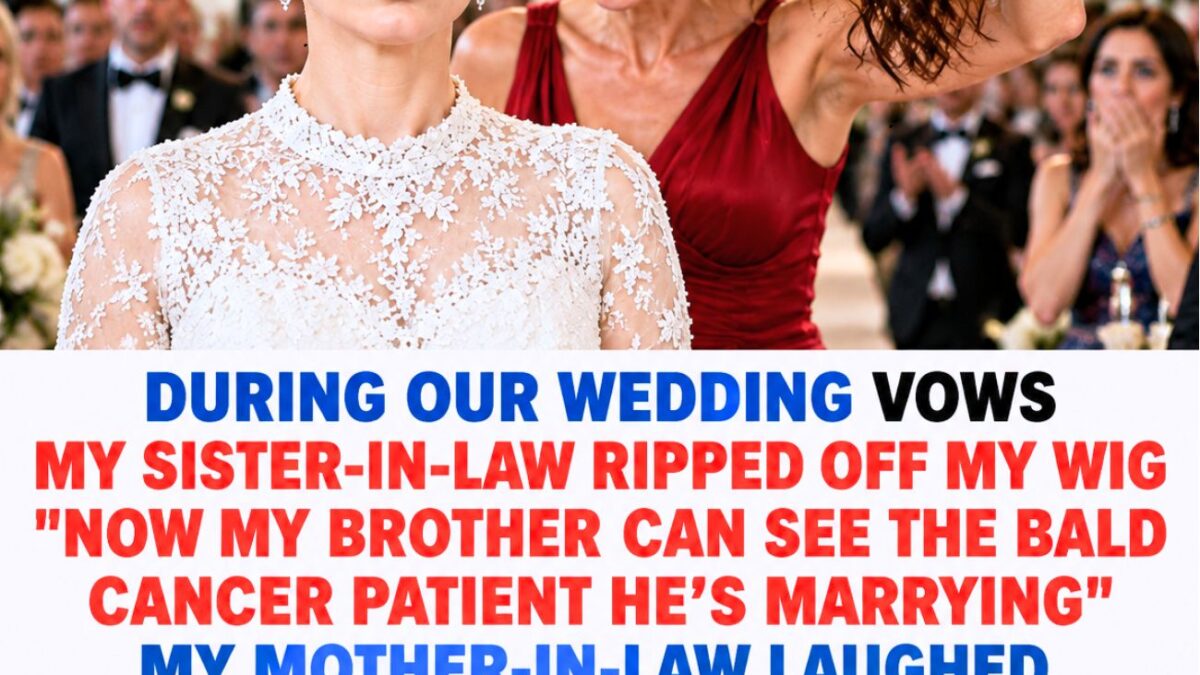
During Our Wedding Vows, My Sister In Law Tore Off My Wig “Now Your Husband Sees Who He’s Marrying..
The morning light filtered through the stained glass windows of the bridal suite, painting the antique floorboards in soft pools of amber and rose. Outside, the world was alive with early summer, warm and indifferent to the quiet dread that had followed me into that room. I sat before the mahogany vanity, staring into the silvered glass at a face I barely recognized after eight brutal months of illness.
Chemotherapy had taken my hair strand by strand until there was nothing left to salvage. It had stripped away my strength, carved hollows beneath my cheekbones, and left my skin pale and paper-thin. For months, my life had been measured in intravenous drips, anti-nausea tablets, and sleepless nights where pain pressed down like a physical weight.
Yet against every odd, my body had fought its way back toward survival. The oncology team had finally given me the words I dreamed of hearing, telling me the cancer had receded. Standing beside Nathan had kept me tethered to the earth when giving up would have been easier, but stepping back into the open remained terrifying.
I reached out and lightly brushed the fibers of the custom lace-front wig resting on a porcelain stand beside my makeup brushes. It was dark chestnut, cut into soft, familiar waves that cascaded just past my shoulders. For weeks, I had debated whether wearing it was cowardly, wondering if covering my smooth, bare scalp was an admission of shame.
Nathan had never treated me like an invalid or looked at my changing reflection with anything less than devotion. When I had broken down sobbing in his living room, asking if wearing a wig at our wedding made me a fraud, he had drawn me into his arms. He kissed my smooth temple and whispered that I should wear whatever made me feel like myself.
His mother, Patricia, had never possessed an ounce of his gentle grace. To her, appearances were currency, social standing was paramount, and sickness was an embarrassing inconvenience. From the moment my diagnosis was confirmed, she had treated my very presence as a blight on her family’s manicured reputation.
Madison, Nathan’s younger sister, took after her mother with cruel precision. During the long months of treatment, both women had repeatedly suggested postponing the ceremony until I looked healthy again. They disguised their venom beneath layers of counterfeit concern, claiming a grand wedding was simply too strenuous for someone in my condition.
Nathan had shut down every barb and silenced their whispers before they could reach my ears. He made it fiercely clear that the wedding date was non-negotiable and that his devotion would not be delayed. I had foolishly convinced myself that their silence during rehearsal dinner meant they had finally accepted defeat, but I had fundamentally underestimated their malice.
My maid of honor pinned the delicate veil over the wig, checking every clip to ensure it was secure. Taking a long, unsteady breath, I smoothed the ivory silk of my gown and stepped out toward the sanctuary doors. The organ music swelled, shaking the stone threshold as the double doors parted to reveal the crowded chapel.
Nathan stood at the altar beneath an archway woven with white gardenias and eucalyptus. His eyes never left mine as I walked down the aisle, his expression so filled with love that the nervous tremble in my chest subsided. When my father placed my hand into his, Nathan squeezed my fingers tightly, grounding me completely in the sacred promise of the moment.
The officiant spoke words of endurance, love, and unity, leading us toward our personal vows. Nathan recited his first, his deep voice carrying through the vaulted hall without a hint of hesitation. He promised to stand beside me through darkness and light, through sickness and recovery, loving the soul beneath my skin forever.
When it was my turn to speak, I turned slightly toward him, clutching my paper with shaking hands. I cleared my throat, ready to promise him my life, when the air behind me shifted. Soft footsteps rustled on the carpet, followed by the faint scent of Madison’s sharp floral perfume drifting past my shoulder.
Before I could turn my head, sharp fingernails dug into the base of my scalp. A violent jerk ripped the pins from my hairpins and tore the lace cap upward. The cool air of the sanctuary slammed against my bare scalp, and my veil fell crumpled at my feet.
Gasps tore through the sanctuary, sharp and violent, cutting through the music and the stillness. Madison stepped back toward the edge of the altar, raising the dark chestnut wig high into the air like a prize. Her eyes sparkled with vicious triumph, her cheeks flushed with the thrill of her staged ambush.
“Now my brother can see the bald cancer patient he’s marrying!” she announced to the silent room. Her voice rang off the high stone arches, carrying to every single guest sitting in the pews. For a heartbeat, the sanctuary hung suspended in disbelief, stunned by the sheer calculated ugliness of her spectacle.
Then, breaking the horrified silence, someone laughed. Patricia was sitting in the front row, her hands lifting to cover her mouth, but the amusement in her eyes was unmistakable. She didn’t look shocked; she looked entirely satisfied, watching my humiliation unfold as if it were the punchline to a long-awaited joke.
I froze where I stood, pinned beneath hundreds of staring eyes, completely exposed. Blood roared in my ears, making my vision blur around the edges as my hands began to shake violently. The exposed skin of my head felt scorched, every ounce of progress and recovery stripped away in a single, devastating second.
Madison smiled, waiting for the crumble, waiting for Nathan to recoil in horror from his sick bride. Nathan didn’t look away from me, nor did his expression hold even a trace of disgust. Slowly, deliberately, he handed his paper of vows to the bewildered officiant and turned around.
He walked across the altar toward his sister, his boots echoing with terrifying finality against the marble steps. Madison’s smirk faltered slightly as he closed the distance between them, towering over her with cold stillness. He reached out, peeled the wig from her rigid fingers, and walked back toward me.
With immense care, Nathan set the wig down beside my bridal bouquet of ivory roses. Nobody in the sanctuary dared to move or breathe, the air thick with suffocating tension. Nathan picked up the silver microphone from its stand, his eyes sweeping across the front row.
He looked first at his mother, whose manufactured smile had faded, and then directly at Madison. “Thank you,” he said quietly into the microphone, his voice cutting through the heavy silence. The simple words landed like a physical blow against the sanctuary walls.
Madison blinked, stepping back defensively. “What decision?” she stammered, her voice suddenly thin. Nathan didn’t answer her directly; instead, he stepped closer to my side, his hand wrapping firmly around my icy fingers.
He turned toward our guests, his posture tall and completely unyielding. “My wife survived eight months of treatment, four surgeries, and more fear than most people in this room will ever understand,” he said clearly. His voice cracked once with raw emotion, then steadied into cold, resolute iron.
“She never asked anyone here to pity her,” Nathan continued, the words echoing through the cavernous space. Tears slipped silently down my cheeks, hot and heavy, burning against the cold skin of my face. Nathan’s gaze traveled slowly back down to Patricia, his jaw set in stone.
“But apparently, some people mistook her kindness for permission to humiliate her,” he said. Patricia stood up abruptly from the polished pew, smoothing her designer dress with hurried hands. “Oh, don’t be dramatic, Nathan,” she snapped. “Madison made a stupid joke.”
“A joke ends when everyone laughs,” Nathan replied, his tone chillingly level. “Nobody is laughing now.” He turned his eyes toward the venue coordinator standing near the sanctuary doors.
“Please have security escort my mother and sister out,” Nathan said without raising his voice. Patricia’s face shifted instantly from irritation to pure outrage, her aristocratic composure shattering. “You wouldn’t dare,” she hissed, taking a step into the aisle.
“I already asked them this morning to be prepared,” Nathan said simply. The words caught me completely off guard, cutting through the fog of my humiliation. Madison looked equally stunned, her hands dropping uselessly to her sides.
“Why would security be prepared for us?” Madison demanded, her voice cracking with indignation. Nathan reached inside his tuxedo jacket and calmly pulled out his phone. He unlocked the screen and held it steady, his thumb resting against the display.
“Because yesterday I received screenshots,” Nathan said, his voice dropping an octave. Patricia went completely pale, the color draining from her cheeks in seconds. Madison stopped breathing, her eyes darting between her brother and the phone in his hand.
Nathan explained to the quiet room that an anonymous contact had forwarded him messages from a private family chat. It was a chat that excluded him and me, created exclusively by Patricia and Madison weeks earlier. The messages detailed my illness, mockingly dissected my appearance, and outlined an explicit plan to rip off my wig.
Their goal was to test whether Nathan would still marry me if everyone saw what I really looked like underneath. Hearing the calculated cruelty laid bare made my stomach drop into a bottomless void. This hadn’t been an impulsive act of cruelty; it had been planned, rehearsed, and anticipated.
Nathan looked directly at his sister, his eyes dark with absolute betrayal. “You weren’t supposed to touch Amelia today,” he said, each word deliberate and sharp. Then his gaze snapped to his mother. “And you promised me she wouldn’t.”
The chapel plummeted into dead silence as the reality settled over the gathered relatives. Patricia was no longer laughing or attempting to look amused; she looked cornered, trapped by her own calculated deceit. She tried to stammer a defense, insisting the messages were taken entirely out of context.
Madison started crying, but there was no remorse in her tears. She was crying because two broad-shouldered venue security officers were stepping down the aisle toward her. “This is my brother’s wedding!” she shrieked, backing away from the altar steps.
“Exactly,” Nathan said without a flicker of hesitation. The guards stepped between Madison and the platform, gesturing firmly toward the exits. Patricia turned her head toward me, her eyes gleaming with sharp, desperate venom.
For half a second, I thought she might offer an apology to salvage her standing. Instead, her mouth twisted into a bitter sneer that revealed everything she truly was. “Are you really going to let cancer separate him from his family?” she spat across the aisle.
Something inside me went completely still, freezing over the last remnants of my hurt. Before I could find my voice to answer her, Nathan cut through the room like thunder. “Cancer didn’t do this,” he said, pointing toward the heavy exit doors. “You did.”
Every relative and friend watched in breathless silence as Patricia and Madison were escorted down the long aisle. The heavy oak doors swung shut behind them with a muffled thud, cutting off Madison’s wails. The chapel was left in an echoing stillness that felt almost sacred.
Nathan turned back to me, the fury completely draining from his eyes as he looked at my face. He stepped closer, his warm hands gently cradling my shaking cheeks. “We don’t have to finish today, Amelia,” he murmured softly. “We can leave right now.”
I looked around the sanctuary, taking in the scene around us. My mother was weeping quietly into a lace handkerchief, while my father looked ready to tear the doors off their hinges. My bridesmaids stood furious and protective, and the officiant waited patiently with open scriptures.
On the small table beside my white bouquet, the wig sat resting in the soft afternoon light. For months, I had dreamed of walking down the aisle with long, perfect hair, desperate for one day untouched by sickness. Madison had stolen that illusion from me, ripping away the safety net I had built.
Standing there beneath the vaulted ceiling, I realized that letting them stop the ceremony meant handing them victory. Madison had stolen my choice to wear the wig, but she could not steal my survival. I refused to let her cowardice dictate the happiest day of my life.
I stepped away from Nathan for a moment and walked to the table. I picked up the synthetic hair, walked to the edge of the altar, and handed it to my mother. “Keep it, Mom,” I said softly, meeting her tearful eyes with a steady gaze.
Nathan watched me, his eyes shining with unshed tears and profound respect. I walked back to his side and took my place at the altar with my bald head held high. It was no longer an exposure of weakness; it was a testament to endurance, chosen by me.
“Let’s continue,” I whispered to the officiant, smiling through the dry salt on my cheeks. The officiant nodded gently, cleared his throat, and raised his hands to resume the liturgy. When Nathan finished speaking the remainder of his vows, there was not a dry eye in the chapel.
Just as the officiant asked for the rings, the heavy double doors at the back groaned open. Patricia and Madison were not there, knowing better than to challenge security. Instead, Nathan’s uncle, Robert, slipped quietly into the room, holding his phone tightly against his chest.
Robert hurried down the side aisle, avoiding the center runner, and reached the steps of the altar. “Nathan,” he whispered urgently, his breathing shallow from running across the grounds. “You need to see what your mother just posted.”
Nathan took Robert’s phone, his eyebrows furrowing as his eyes scanned the bright screen. His jaw clenched so violently that I could see the muscles corded in his neck. He turned the screen toward me so I could read what Patricia had done.
Patricia had uploaded a photograph of me standing exposed and bald at the altar just moments after Madison grabbed the wig. Beside the image was a lengthy caption painting herself and Madison as grieving, concerned victims. She claimed Nathan had banished them simply because they expressed worry about him marrying a terminal patient.
Worse than the words was the undeniable reality of the picture itself. The angle was direct and framed perfectly, captured within seconds of Madison stripping the wig away. Someone in the pews had been instructed to take the photo the exact moment it happened.
“Where did she get this?” Nathan asked, his voice shaking with tightly controlled rage. “Madison uploaded it to the extended family group chat right before security took her phone,” Robert explained grimly. The poison was already circulating through social networks and extended family circles.
I felt the walls of the chapel pressing in on me, my breath hitching in my chest. Nathan saw the panic flickering in my eyes and immediately addressed our guests. He instructed everyone present not to share, engage with, or comment on any posts coming from his mother.
He turned back to face me, taking both of my trembling hands into his own. “Amelia, we can walk away,” he whispered, searching my face with endless devotion. “We can stop this right now and deal with them.”
I looked down at our joined hands, feeling the silver band waiting on his finger. “No,” I said, my voice gathering strength as I looked into his eyes. “We finish our vows.”
We stood before God and our chosen witnesses, exchanging the rings that symbolized an unbroken circle. Nathan slipped the platinum band onto my finger, and I slid his onto his hand, sealing our promises. When the officiant declared us husband and wife, the applause that erupted was deafening.
For the first hour of our reception, the outside world faded into soft music and warm smiles. Nathan held me close beneath strings of fairy lights, kissing my temples as if I were the only woman alive. For a brief pocket of time, Patricia’s venom was pushed beyond the edges of my mind.
As the dinner plates were being cleared, Robert quietly pulled Nathan aside near the balcony. His expression was no longer marked by anger; instead, deep, unsettled concern darkened his features. Nathan gestured for me to follow him, unwilling to keep any secrets between us.
Robert explained that he had stayed in the family group chat to monitor what Patricia was saying. While watching the thread, he noticed Patricia frantically deleting messages from weeks before the wedding. Sensing something suspicious, Robert had taken screenshots of the entire message history before she could scrub it clean.
One specific exchange caught Robert’s attention, completely unrelated to wigs or cancer treatments. Three weeks earlier, Patricia had texted Madison: “If he marries her, she’ll eventually control everything.” To which Madison had coldly replied: “Not if we make him doubt her first.”
Nathan read the lines twice, his brow furrowed in total bewilderment. “Control what?” Nathan asked, looking at his uncle for answers. “What is my mother talking about?”
Robert took a deep breath, looking around the noisy reception hall before answering. “Did your mother ever tell you what your grandfather actually left you?” he asked quietly. The question seemed to hang suspended between them, strange and entirely out of place.
Nathan blinked, shaking his head slightly. “My grandfather left me his gold pocket watch and some sentimental tools,” Nathan said. “That’s all there was.”
Robert shook his head with a grim, sorrowful expression. “No, Nathan,” Robert said. “Patricia gave you his watch. Your grandfather left you an estate.”
Robert led us out of the reception hall and into a private, wood-paneled conference room down the hall. He closed the heavy door, shutting out the joyous noise of the party, and sat us down at the table. What he unraveled sounded like a fiction fabricated to tear a family apart.
Nathan’s grandfather had been a shrewd investor who owned commercial properties alongside Robert for decades. Before passing away, he had structured his estate plan to place a significant portion of those properties into an irrevocable trust for Nathan. Patricia had been named the trustee to manage the funds while Nathan was still young.
“I’m thirty-four years old, Robert,” Nathan said, his voice flat with disbelief. “Why would she still be managing a trust from my childhood?”
“Because when you turned thirty, the trust terms dictated that full control and financial oversight transferred to you,” Robert explained. “Patricia was supposed to hand over the accounts and file final paperwork four years ago, but she never did.”
Nathan had never questioned the arrangement, trusting his mother implicitly with family matters. Robert pulled up an old email thread on his tablet, showing correspondence from the original estate attorney. The messages referenced annual financial statements that were legally required to be delivered directly to Nathan.
Nathan had never seen a single page, a single ledger, or a single balance sheet. Suddenly, Patricia’s desperate messages in the family chat took on a terrifying, calculated clarity. If Nathan married me, Patricia feared I would review his finances and uncover what she had hidden for years.
“We cannot jump to conclusions about theft just yet,” Robert cautioned, tapping the table. “We need official documentation from the firm before making accusations, but you need to know what you’re facing.”
Nathan stared at the mahogany table, completely silent as the pieces of his life rearranged themselves. My phone vibrated on the table, breaking the heavy silence with a sharp buzz. The screen lit up with an incoming text from Madison.
There was no apology, no regret, only a single vicious sentence: “Ask your husband why mom pays his taxes.” Nathan reached over and picked up my phone, reading the screen with a pale, hollow face.
For years, Patricia had insisted on filing his personal and inheritance taxes through her private accountant. She claimed the paperwork involved complex family property depreciation that was too tedious for him to navigate. Trusting her blindly, Nathan had signed whatever documents she placed in front of him without reading the fine print.
Robert did not waste another second; he immediately dialed the personal number of the estate attorney. The attorney picked up on the third ring, recognizing Robert’s voice instantly. When Robert asked why Nathan had never received his mandatory trust documentation, the attorney sounded thoroughly bewildered.
“Nathan, I have personally mailed the annual accounting packets to your address every December,” the attorney insisted over the line. Nathan leaned over the speakerphone, his voice tight. “What address do you have on file?”
The attorney read out the street address smoothly. It was Patricia’s gated residence on the other side of town, an address Nathan hadn’t lived at in over a decade. Patricia had intentionally directed all legal and financial correspondence to her own mailbox, keeping Nathan entirely in the dark.
The attorney promised to freeze any pending authorizations and deliver complete copies of the trust records directly to Nathan the following morning. We stepped out of the conference room and returned to our wedding guests, attempting to pretend the world wasn’t crumbling. Nathan took my hand and led me back to the center of the dance floor beneath the warm canopy lights.
He pulled me against his chest, burying his face into the curve of my neck. For three minutes, the stolen inheritance, the cruelty, and the viral photograph vanished into the melody. We held each other like survivors clinging to a raft in the middle of a storm.
Later that evening, Nathan’s phone began vibrating relentlessly in his pocket. It was Patricia, calling repeatedly as the reality of her legal exposure began to dawn on her. Nathan declined the first six calls without looking at the screen, letting them roll to voicemail.
On the seventh attempt, Nathan handed the vibrating phone to Robert, giving him permission to answer. Robert pressed the speaker button, and Patricia’s screeching voice tore through the quiet hallway outside the ballroom. She accused Robert of poisoning her son against her and ruining her family’s good name.
“That trust was supposed to stay inside this family!” Patricia screamed, her voice bordering on hysterical. Robert looked down at me, his eyes cold and unwavering. “So Amelia isn’t family?” he asked into the receiver.
A suffocating silence fell over the other end of the line, heavy with unspoken truth. Then the call abruptly ended with a sharp click as Patricia severed the connection. The truth was out, and there was no turning back from the war she had started.
Two days after the wedding, a courier delivered thick legal binders containing years of trust statements to our apartment. Nathan and I sat around our kitchen table with an independent attorney and a certified forensic accountant. As the pages were turned, the true scale of his grandfather’s generosity was laid bare.
The commercial properties had thrived, generating substantial rental revenue and investment dividends over the years. The trust was worth millions—substantially more than Nathan could have ever conceived. But as the accountant turned to the distribution logs, the numbers told a much darker story.
While legitimate taxes and property maintenance had been paid, massive sums had been diverted away from the trust principal. Millions of dollars had been funneled over five years into a holding company Nathan had never heard of before. A quick search of corporate records revealed Patricia was the sole director and shareholder of that entity.
Nathan looked devastated, his head resting in his hands as he stared at the financial records. Our attorney advised patience, explaining that every transaction had to be legally audited before filing criminal complaints. Then, the forensic accountant turned to a specific authorization form dated eighteen months prior.
It was an emergency transfer approval directing one hundred and eighty-five thousand dollars directly to Patricia’s personal account. The form bore Nathan’s signature at the bottom, crisp and clearly legible on the line. Nathan pulled the page toward his face, his eyes widening in shock.
“That isn’t my signature,” Nathan whispered, running a trembling finger over the ink. He looked at the date stamped in the corner: October fourteenth. “I was in Singapore for work that entire week. I wasn’t even in the country.”
Nathan didn’t call his mother to demand an explanation; he authorized our attorney to file an immediate injunction. Within hours, formal notices of dispute and demands for full accounting were delivered to Patricia’s residence. The legal machinery began to turn, freezing every account she had spent years quietly plundering.
By mid-afternoon, heavy banging rattled our front door, shaking the brass knocker violently against the wood. Nathan opened the door just enough to see his mother standing on the porch, her face flushed with fury. I stood quietly in the hallway behind him, watching through the narrow opening.
“You’re investigating your own mother?” Patricia shrieked, clawing at the doorframe to keep it from closing. “After everything I sacrificed to raise you?”
“You hid my grandfather’s trust from me for four years,” Nathan replied, his voice dead and emotionless. “You stole from me, Patricia.”
“I managed it for you!” she shouted, her voice echoing down the suburban street. “You were too irresponsible to handle that kind of wealth!”
“Then explain the Singapore transfer,” Nathan demanded, his eyes boring into hers. “Explain why my name was forged on a distribution for nearly two hundred thousand dollars.”
Patricia’s face twisted, the indignant anger faltering into frantic calculation. She stammered that accountants made paperwork errors and that the money was simply reimbursement for family expenses. When Nathan pressed her to name a single expense that justified that sum, she fell completely silent.
Her eyes drifted past Nathan’s shoulder, catching my reflection standing quietly in the hallway. Her face darkened into pure, concentrated hatred, pointing a manicured finger directly at my chest. “She did this to us,” Patricia hissed. “Before you brought that diseased woman home, you trusted me!”
That sentence, spoken with such venomous conviction, finally cleared away the remaining fog. My illness had never truly disgusted Patricia; it had merely presented her with a convenient weapon. She knew that if Nathan married, his wife would inevitably discover the financial theft she had hidden.
If she could publicly humiliate me and convince Nathan I was an emotional burden, she could fracture the marriage. Breaking us apart would preserve her absolute control over his fortune for years to come. Nathan looked at his mother with utter disgust, whispered goodbye, and quietly shut the door in her face.
Over the weeks that followed, forensic examiners dismantled Patricia’s fraudulent enterprise piece by piece. The court formally stripped her of every remaining trustee power and appointed an independent administrator. Nathan took his rightful seat as the sole controller of his grandfather’s commercial legacy.
Then, late one evening, my phone rang with an unrecognized local number. When I answered, the trembling, broken voice of Madison came through the speaker. “Amelia, please don’t hang up,” she begged, sounding completely stripped of her wedding-day arrogance.
“Why shouldn’t I?” I asked, keeping my hand steady against the kitchen counter. Madison choked back a sob before speaking words that sealed her mother’s fate forever. “Mom promised she would pay off my sixty thousand dollars in credit card debt if I made Nathan leave you.”
Patricia had leveraged Madison’s financial desperation, promising to clear her debts if she drove me away. Madison provided text messages, voice notes, and bank receipts documenting the entire extortion scheme to our legal team. The wedding attack had been Madison’s theatrical idea, but Patricia had funded and orchestrated every detail.
Madison’s confession did not absolve her of the cruelty she had inflicted upon a recovering cancer patient. She had chosen to execute a vicious public humiliation for money, and the consequences of that choice remained hers alone. Nathan severed all contact with both of them, refusing to offer forgiveness to the people who had tried to break his wife.
The court proceedings moved swiftly, bolstered by an overwhelming mountain of incontrovertible evidence. Patricia was ordered to repay every cent diverted from the trust, forcing her to liquidate her personal assets to avoid prison. Stripped of the wealth she had spent a lifetime coveting, she was left isolated and thoroughly disgraced.
Madison received no financial salvation from her mother’s ruined estate, forced to manage her mounting debts alone. The family empire Patricia had sought to protect through cruelty had completely disintegrated under the weight of truth. The world moved forward, leaving both of them behind in the wreckage of their own deceit.
As the months passed, the quiet peace of our home restored what sickness and betrayal had tried to take. Slow, soft patches of hair began to sprout across my scalp, delicate and fine like down feathers. The morning I looked into the mirror and ran my fingers through actual hair, I wept tears of pure relief.
Nathan walked into the bathroom, wrapped his arms around my waist, and kissed my head just as he always had. He loved me when I was sick, he loved me when I was bald, and he loved me as I healed. Our bond had not been broken by the fire; it had been forged into something entirely indestructible.
On our first wedding anniversary, Nathan and I sat together on our sofa with two glasses of champagne. The videographer had long since delivered the complete, unedited footage of our ceremony, which had remained unopened in its velvet case. I reached for the remote, determined that we would finally face the memory together.
We watched the entire scene unfold on the screen: Madison grabbing the wig, Patricia laughing, and the silence in the room. We watched Nathan hand his vows away, walk across the altar, and gently pick up the microphone to defend me. Looking at his face on the screen, I finally understood why his first word had been “thank you.”
They had believed that exposing my sickness to the world would make him ashamed of me. Instead, in their blinding arrogance, they had exposed their own grotesque souls to everyone who mattered. They had handed Nathan the clarity he needed to cut the rot out of his life forever.
Cancer had taken my hair for a season, but it had never possessed the power to touch my dignity. Patricia had tried to weaponize my most vulnerable chapter to protect her stolen wealth, and she had failed completely. The bald bride she had mocked at the altar was the woman who watched her entire empire fall.

