“Don’t sit with Big Josie.” The warning came with laughter as she sat alone at the far end of the table. Then Oak Haven’s richest new rancher ignored the seat saved for him, walked straight toward her—and said something no one expected.
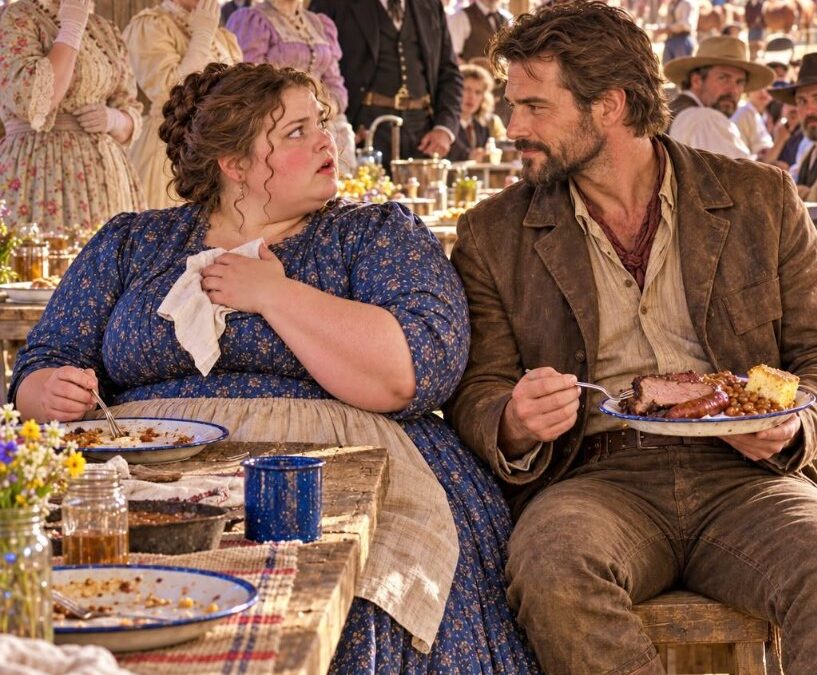
“Why are you sitting here?” “Looked like the best seat in the house.” The dusty saloon went dead silent.
The town’s wealthiest bachelors had already made their rounds, carefully stepping around the corner table where a heavy-set, quiet woman sat entirely alone.
But when a rugged stranger walked in, he bypassed every painted smile, grabbed his plate, and headed straight for her.
The unforgiving Texas sun beat down on the booming cattle town of Oak Haven in the summer of 1888.
It was a place where fortunes were made in the dust and reputations were forged or broken on the sharp tongues of the local society.
For 32-year-old Josephine Miller, Oak Haven was both her sanctuary and her daily purgatory.
Josie was a woman of substantial build, carrying a soft, heavy frame that made her the target of relentless whispering cruelty in a town that prized delicate, corseted belles.
She was the daughter of the late Arthur Miller, a hardworking but luckless prospector who had left her nothing but a small, drafty bakery on the edge of Main Street and a seemingly useless deed to a dried-up parcel of land called Miller’s Hollow.
To the townsfolk, Josie was an enigma they were happy to exploit but refused to embrace.
From before the sun crested the horizon until long after dusk, she stood over hot cast-iron stoves.
Her apron dusted white with flour. She was the lifeblood of Oak Haven’s mornings.
The ranch hands, the merchants, and even the wealthy cattle barons lined up for her flaky biscuits, her rich sourdough, and her legendary blackberry cobblers.
They would smile, hand over their coins, and praise her golden crusts.
But the moment she stepped out from behind the counter, the warmth vanished.
In the eyes of Oak Haven society, her weight was a moral failing, a sign of gluttony or laziness, despite the fact that she outworked every man in the county.
The ringleader of this silent excommunication was Abigail Preston, the daughter of the local bank manager.
Abigail was slender, sharp-featured, and possessed a voice that dripped with condescending sweetness.
Whenever Josie walked down the boardwalk, Abigail and her gaggle of parasol-twirling friends would suddenly find the storefronts fascinating, deliberately turning their backs.
They called her Big Josie when they thought she couldn’t hear and sometimes cruelly when they knew she could.
The isolation was a heavy cloak that Josie wore every day.
She had learned to make herself as invisible as a large woman could be.
She kept her eyes glued to the wooden planks of the boardwalk, spoke in hushed, apologetic tones, and never, ever attended social gatherings.
Until the annual Oak Haven Founders Day picnic.
Mayor Thomas Higgins had made it explicitly clear that every business owner was expected to contribute to the town’s grandest celebration.
Josie, bound by duty and the desperate need to keep her bakery in good standing with the local government, had spent three sleepless nights baking 60 pies, hundreds of rolls, and roasted honey-glazed hams.
The picnic grounds at the center of town were a riot of color and noise.
Fiddles whined in the humid air.
Children chased hoops and sticks through the grass, and long wooden trestle tables groaned under the weight of the communal feast.
Josie arrived early, quietly arranging her baked goods at the end of the main pavilion.
She wore her best dress, a simple dark blue calico that she had tailored herself to accommodate her wide hips and heavy bust.
It was modest, clean, and entirely unremarkable next to the bright silks and ruffled taffetas of the other women.
When the dinner bell rang, a chaotic rush ensued. Families, cowboys, and businessmen grabbed tin plates and piled them high.
Josie, exhausted and aching from the heat, took a modest portion of beans and a slice of brisket.
Retreating to the far end of the longest table, she sat down on the wooden bench, her heart pounding with a familiar, dreadful rhythm.
She watched as the table filled up. First, a family of four sat a good 10 feet to her left.
Then two ranch hands took seats opposite them. The spaces beside Josie remained glaringly empty.
As more people arrived, they would approach her end of the table, spot her sitting there, and immediately pivot, suddenly deciding they would rather squeeze into a crowded spot at the other end or sit on the grass.
Abigail Preston glided by on the arm of a young deputy.
She glanced at the vast empty space surrounding Josie, offered a tight, pitying smile that didn’t reach her eyes, and loudly proclaimed, “Oh, let’s sit by the band, William.
It feels a bit crowded over here.” Josie’s cheeks burned with a fiery, humiliating heat.
She stared down at her plate, her vision blurring with unshed tears.
The physical space around her was a visible, undeniable statement of her rejection.
She was an outcast, quarantined by her own body.
She gripped her fork, praying for the meal to end so she could flee back to the solitary safety of her flour-dusted kitchen.
She took a slow breath, willing herself not to cry in public.
And then the heavy, rhythmic thud of spurred boots approached.
He was a stranger, and in a town like Oak Haven, strangers were dissected immediately. His name was Wyatt Callahan.
He had ridden into town three days prior, purchasing the old, dilapidated Henderson spread on the North Ridge, a property most considered cursed with bad soil.
Wyatt was a man who looked like he had been carved out of saddle leather and canyon rock.
He was tall, broad-shouldered, and moved with a deliberate, quiet confidence.
A fading, jagged scar ran along his jawline, disappearing into a coarse, dark beard.
His eyes were the color of slate, missing nothing.
From the moment Wyatt walked onto the picnic grounds, the town’s eligible women had been in a flutter.
He was rugged, mysterious, and, as the bank records showed, possessing a substantial amount of gold to buy the Henderson place outright.
Abigail Preston had spent the better part of an hour trying to position herself in his line of sight, laughing loudly and adjusting her lace collar.
Wyatt grabbed a plate, his massive hands dwarfing the tin, and piled it with a mountain of Josie’s roasted ham and a massive slice of blackberry cobbler.
He turned away from the serving line and surveyed the grounds.
Abigail stepped forward, patting the empty space on the bench beside her.
“Mr. Callahan,” she called out, her voice cutting through the fiddle music.
“We saved you a seat right here in the shade.” Wyatt paused.
He looked at Abigail, then at the crowded table she sat at.
His slate eyes drifted across the pavilion, scanning the sea of faces until they landed on the far end of the longest table.
He saw the striking perimeter of empty wood surrounding a woman in a dark blue calico dress whose head was bowed so low her chin touched her chest.
He saw the subtle, cruel glances shot her way. He didn’t say a word to Abigail.
He simply adjusted his grip on his plate, walked past the mayor, past the bewildered deputy, and past Abigail’s outstretched hand.
The heavy thud of his boots grew louder. Josie heard them approaching but didn’t dare look up.
She assumed it was someone walking past to get to the cider barrels.
Then the harsh, grating sound of a heavy wooden chair being dragged across the dirt floor echoed under the pavilion.
The noise was so sudden and loud that the fiddle players actually faltered for a half-second.
“Mind if I rest my boots here, Ma’am?” a deep, gravelly voice asked.
Josie’s breath hitched. She slowly turned her head. Wyatt Callahan was standing right beside her, holding his plate.
He wasn’t looking at her with pity, and he wasn’t looking at her with the thinly veiled disgust she was so accustomed to.
He was looking at her like she was the only person sitting at the table.
“I, I,” Josie stammered, her voice barely a whisper. “There’s plenty of room.”
Wyatt set his plate down and lowered his large frame onto the bench, sitting so close that the rough denim of his jeans brushed against the soft cotton of her dress.
The physical contact sent a shockwave through Josie. No one had sat this close to her in years.
A heavy, suffocating silence fell over that section of the pavilion. Dozens of eyes were locked on them.
“Wyatt Callahan,” he said, pulling off his worn Stetson and resting it on his knee.
He extended a calloused, scarred hand toward her.
Josie stared at his hand for a long moment before wiping her own palm on her apron and tentatively reaching out.
His grip was firm, rough, and surprisingly warm. “Josephine,” she murmured. “Josephine Miller.”
“Well, Josephine Miller,” Wyatt said, picking up his fork. He pointed it at the slice of pie on his plate.
“I’ve traveled from Montana down through the belly of Colorado, and I can say with absolute certainty that this cobbler is the best thing I’ve put in my mouth in five years.”
A tiny, involuntary smile broke through Josie’s shock. “Thank you, Mr. Callahan. I baked it.” “Did you.”
He turned to face her fully, his eyes studying her features: her soft, rounded cheeks, her deep brown eyes, the nervous flutter of her eyelashes.
“Then, I reckon I sat next to the most important person in Oak Haven.”
Across the pavilion, Abigail Preston’s face had turned the color of sour milk.
Unable to handle the perceived slight, she stood up, grabbed her parasol, and marched over to their end of the table.
“Mister Callahan,” Abigail said, her voice dripping with artificial concern. “I believe you’ve gotten turned around.
You really shouldn’t be sitting down here in the dust. Come join us. There’s much better company to keep.”
She didn’t even look at Josie as she said it. Josie instantly shrank inward, the brief spark of joy extinguishing.
She moved to slide away to give him an out, but Wyatt’s large hand shot out, gently but firmly grasping her wrist to stop her from leaving.
Wyatt didn’t stand up. He didn’t even raise his voice.
He just looked up at Abigail with a gaze so cold it could have frozen a river.
“Miss,” Wyatt said slowly, his voice carrying clearly over the quieted crowd.
“I pick my own company, and right now I’m sitting with a lady who knows how to bake a proper pie and who possesses the grace to let a dusty stranger share her table.
Unless you’ve got a better cobbler hidden under that parasol, I suggest you step out of my sunlight.”
Someone in the crowd gasped. The deputy choked on his cider. Abigail’s mouth opened and closed like a landed trout.
She spun on her heel and stormed off, her parasol practically vibrating with rage.
Wyatt casually released Josie’s wrist, picked up a massive piece of ham, and chewed thoughtfully.
“Towns are the same everywhere,” he muttered more to himself than to her.
“Too many people talking, not enough people working.” He turned back to Josie, his expression softening.
“Now, Josephine, tell me how you get the crust this flaky.”
For the rest of the afternoon, the outcast of Oak Haven and the intimidating stranger sat shoulder-to-shoulder.
They talked about the weather, about the stubbornness of prairie soil, and about the quiet hours of the early morning.
And for the first time in her adult life, Josephine Miller felt seen, not as a weight to be judged, but as a woman.
The scraping of that chair reverberated through Oak Haven long after the picnic ended.
Over the next month, a routine developed that left the town gossips utterly baffled.
Every morning at 5:00 AM, before the sun even thought about rising, the bell above Josie’s bakery door would chime.
Wyatt Callahan would walk in, bringing the smell of pine, horse, and leather into the yeast-scented warmth of the shop.
He never asked for favors. He paid full price for a loaf of bread and a black coffee.
Then he would lean against the counter and talk with Josie for 20 minutes while she kneaded dough.
Slowly, the heavy walls Josie had built around her heart began to crack.
She found herself laughing, a deep, rich sound she had almost forgotten she possessed.
She learned that Wyatt had lost his brother in a mining collapse up north, that he hated the taste of overly sweet coffee, and that he was pouring every ounce of his sweat into turning the dead soil of the Henderson Place into a working horse ranch.
In return, Wyatt learned the cadence of her voice.
He noticed how gentle she was with the stray dogs that begged at her back door.
He saw the quiet, steady strength it took for her to endure the sneers of the townsfolk without ever turning bitter.
He found her beautiful, not in spite of her size, but as part of the whole magnificent sum of who she was.
But their blossoming connection did not go unnoticed, and it certainly did not go unpunished.
Mayor Thomas Higgins was a man who operated Oak Haven like a personal chessboard.
He was a portly, sweaty man with grand ambitions of bringing the new railway spur through the town, a move that would make him unfathomably rich.
To do that, the town needed a massive, reliable water supply for the steam engines.
The only viable water source was the deep underground aquifer that surfaced at the edge of town.
The problem: the access point was a rocky, sunken basin known as Miller’s Hollow.
It was the worthless piece of dirt Arthur Miller had left his daughter, Josie.
For years Higgins had ignored the land, believing it dry.
But recent geological surveys secretly commissioned by the mayor proved otherwise. Higgins needed that land.
He had assumed it would be easy to swindle the isolated, socially awkward baker out of the deed for pennies.
But then Wyatt Callahan showed up. Wyatt’s newly purchased Henderson spread bordered Miller’s Hollow directly to the north.
If Wyatt and Josie were to unite those two parcels of land, they would control the water rights to the entire county.
Higgins realized with mounting panic that the rugged rancher was not just a threat to the town’s social hierarchy, but to his own greedy empire.
One sweltering Tuesday afternoon, Higgins intercepted Wyatt outside the hardware store.
The mayor chewed on an unlit cigar, his face a mask of false camaraderie.
“Callahan,” Higgins boomed, slapping Wyatt on a broad shoulder.
“Good to see you settling in, although I must say the town is quite intrigued by your choice of companionship lately.”
Wyatt stopped, his eyes narrowing, meaning. Higgins chuckled, a wet, unpleasant sound. “Oh, come now, man to man.
We all know Big Josie isn’t exactly the prize of the county, but she does hold the deed to that little dirt patch next to your property.
Smart play, Callahan. Romance the lonely fat girl. Get her to sign over the rights and expand your borders.
I admire your ruthlessness.
But, but if you’re looking to sell once you’ve got it, the town can offer you a handsome sum.”
Before Higgins could finish his sentence, Wyatt moved. It was a blur of motion.
In a fraction of a second, Wyatt had closed the distance.
His massive hand wrapped tightly around the lapels of the mayor’s expensive suit, slamming him backward into the wooden wall of the hardware store.
The cigar fell from Higgins’ mouth. The mayor gasped for air, his feet practically lifting off the boardwalk.
“Listen to me very carefully, you pathetic little man,” Wyatt snarled, his voice a low, terrifying rumble.
His face inches from Higgins.
“If you ever speak of Josephine with disrespect again, or if I find out you’re trying to swindle her out of what’s hers, I won’t bother with lawyers or the sheriff.
I will drag you out to the badlands and leave you for the vultures. Do we have an understanding?”
Higgins, sweating profusely and pale with terror, nodded frantically.
Wyatt released him, letting the mayor slump against the wall, and stalked off without a backward glance.
But a cornered rat always bites. Higgins, terrified of Wyatt but desperate for the railway money, changed his tactics.
If he couldn’t intimidate the rancher, he would break the baker. He enlisted the willing help of Abigail Preston.
Two days later, Josie was in the mercantile picking up sacks of sugar.
She was standing behind a tall aisle of canned peaches when she heard Abigail’s voice on the other side, talking loudly to the store owner’s wife.
“It’s honestly just tragic,” Abigail sighed dramatically. “The poor massive thing actually believes he cares for her.
Mayor Higgins told my father just yesterday, Mr. Callahan confessed it all to the mayor.
He’s only courting her for the deed to Miller’s Hollow.
He needs her land to access the water for his horses.
Once he has her signature, he’ll drop her faster than a hot horseshoe. I mean, honestly, look at her.
Why else would a man like him look twice at someone of her…?” Josie stopped breathing.
The heavy sack of sugar slipped from her fingers, hitting the floorboards with a dull thud.
The world tilted on its axis.
The cruel words bypassed her defenses and struck the deepest, most vulnerable core of her insecurities.
It made horrific, agonizing sense. Why would a handsome, strong man like Wyatt choose the town outcast?
Why would he brave the whispers and the sneers? He was a rancher building an empire in the dust.
He needed land. He needed water. She was just the obstacle holding the deed.
Tears, hot and blinding, spilled over her cheeks. She didn’t stay to pick up the sugar.
She fled the mercantile, running as fast as her heavy frame would carry her, ignoring the startled shouts of the clerk.
She locked herself in the bakery, slid down the wall until she hit the flour-dusted floor, and wept until her chest physically ached.
The fairy tale was over. The brutal reality of Oak Haven had returned.
When the bell above the door chimed the next morning at 5:00 AM, Josie didn’t greet him with a smile.
She stood behind the counter, her eyes red and swollen, her posture rigid.
On the counter between them sat a freshly baked loaf of bread, and beside it, the yellowed, crinkled deed to Miller’s Hollow.
Wyatt stepped in, shaking the morning dew from his hat.
He stopped dead in his tracks when he saw her face. “Josie, what’s wrong? Who hurt you?”
His voice was laced with immediate, dangerous protective instinct.
“You don’t need to pretend anymore, Mr. Callahan,” Josie said, her voice trembling but resolute.
She pushed the deed across the wooden counter. “I went to the assayer’s office yesterday afternoon, after, after I heard.
I know about the aquifer. I know you need the water.”
Wyatt looked at the paper, then back up at her, genuine confusion knitting his brow.
“Josie, what are you talking about?” “Don’t!” she cried out, the pain finally breaking through her stoic facade.
“Please, just don’t lie to me. It’s cruel enough as it is. Abigail and the mayor, they told everyone.
You just want the land. I’ve signed it over to you.
I’m selling it to you for whatever you have in your pocket right now. Just take it.
Take it and leave me be. Go be with the women you actually want to be seen with.”
Wyatt stared at her, the pieces slowly snapping together in his mind: the mayor’s greasy ambush, Abigail’s toxic tongue.
He saw the absolute devastation in the eyes of the woman he had come to deeply care for.
He didn’t take the deed. Instead, he walked around the counter.
Josie shrank back, expecting him to take the paper and leave. But Wyatt didn’t look at the paper.
He stepped directly into her space, his towering presence overwhelming.
He reached out his rough, scarred hands, gently cupping her face, forcing her to look up into his slate-gray eyes.
“Josephine,” he said, his voice cracking with a raw, fierce emotion she had never heard before.
“I have enough money in the bank in Denver to pipe water from the damn Mississippi River if I wanted to.
I don’t give a damn about this dirt.”
He swept his arm, knocking the deed off the counter so it fluttered harmlessly to the floor.
“I bought the Henderson place because I wanted to be alone,” he continued, his thumbs gently wiping the fresh tears from her cheeks.
“When my brother died, I couldn’t bear to look at anyone.
I came to this town to disappear, but then I saw you.
At that picnic, I saw a woman sitting all alone, taking the absolute worst this pathetic town could dish out, and doing it with a quiet dignity none of them will ever possess.”
He leaned his forehead against hers, closing his eyes. “I sat at your table because I wanted to.
I come here every morning because 15 minutes with you is the only time my chest doesn’t ache.
They look at you and see someone to mock.
I look at you and see the most beautiful, strongest woman I’ve ever met in my miserable life.”
Josie sobbed, her hands coming up to grip his wrists, clinging to him as if he were a life raft in a churning sea.
The heavy, dark wall of insecurity that Abigail and the mayor had relied upon began to crumble under the weight of Wyatt’s absolute, undeniable sincerity.
“They’re going to keep coming for us, Josie,” Wyatt whispered, opening his eyes and looking fiercely into hers.
“Higgins wants that water. He wants to break you to get it. But he forgot one thing.” “What?”
Josie breathed, her heart hammering against her ribs. Wyatt’s jaw set, the scar on his cheek pulling tight.
“He forgot that I’m sitting at your table now. And nobody takes what belongs to the woman I love.”
The revelation of Wyatt’s true feelings did more than heal Josie’s shattered heart.
It ignited a fire in her spirit that had been dormant for decades.
For the first time, she walked through Oak Haven with her head held high.
She didn’t hide her wide hips behind oversized aprons, and she didn’t cast her eyes to the floorboards when Abigail Preston strutted past.
She had the love of the fiercest man in the county, but, more importantly, she had finally found her own worth.
But Mayor Thomas Higgins was a desperate man.
The Texas and Pacific Railway representatives were arriving in three days, and without guaranteed water rights, the railroad would bypass Oak Haven entirely, leaving Higgins drowning in the debts he had accrued anticipating the boom.
If Wyatt Callahan couldn’t be intimidated and Josie Miller couldn’t be shamed into selling, Higgins decided to use the one weapon he had left: the corrupt machinery of the law.
Higgins dug through the county archives until he found a loophole, a vaguely worded decades-old territory ordinance regarding undeveloped land within town limits.
He colluded with Sheriff Jeb Cobb, a man whose badge was practically bought and paid for by the mayor’s bank, to forge a delinquent tax lien against Miller’s Hollow.
The decree demanded immediate payment of $500 in gold, an astronomical sum for a baker, or the immediate forfeiture of the deed to the town.
It was a Tuesday morning, the air thick with the promise of a thunderstorm, when Higgins, Sheriff Cobb, and a hired enforcer named Dalton walked into Josie’s bakery.
The breakfast rush had just ended, and Josie was wiping down the flour-dusted counters.
Higgins slapped the forged document onto the hardwood.
“Good morning, Josephine,” he said, a greasy, triumphant smile plastered across his face.
“I’m afraid I have some terrible news regarding your late father’s estate.
It seems there are back taxes owed on Miller’s Hollow: $500, payable immediately to the town treasury, or the sheriff here will have to seize the deed.”
Josie stared at the paper, her heart skipping a beat. “$500? That’s impossible.
My father paid his taxes every year, and I have the receipts in the back.”
“Territory ordinances, I’m afraid,” Sheriff Cobb grunted, resting his hand casually on the butt of his revolver.
“Different set of books. You have until noon, Josie. Otherwise, you sign the land over.”
Dalton, the hired gun, sneered, looking Josie up and down with blatant disgust.
“Better get to signing, sweetheart, unless you’ve got a pile of gold hiding under that massive dress of yours.”
A week ago, the insult would have crushed her.
She would have crumpled, signed the paper just to make them leave, and retreated into her sorrow.
But today, the fire in her blood flared hot.
“I am not signing anything,” Josie said, her voice steady, resonating with a quiet authority that shocked the three men.
“And you will leave my establishment.” Higgins’ smile vanished. He nodded to Dalton. “Go ahead, Dalton. We’ll make her sign.
We’ll anchor her thumb and press it to the paper if we have to. She’s resisting a lawful order.”
Dalton lunged forward, his heavy hands reaching across the counter to grab Josie’s arm, but before his fingers could even brush her sleeve, the bell above the door chimed and a shadow fell over the entrance.
Wyatt Callahan didn’t walk into the bakery. He practically blew the doors off their hinges.
He had seen the sheriff’s posse crossing the street from his vantage point at the blacksmith’s.
He crossed the room in three massive strides.
Dalton spun around just in time to catch Wyatt’s fist squarely in the jaw.
The sickening crack of bone echoed through the bakery as the enforcer was lifted off his feet and thrown backward into a display of flour sacks, out cold.
Sheriff Cobb drew his weapon, but Wyatt was faster.
He kicked the counter, driving it hard into the sheriff’s knees, then snatched the revolver from the lawman’s hand, tossing it into a cast-iron stove.
Higgins backed against the wall, his face devoid of color, trembling violently.
“I told you,” Wyatt growled, his voice dropping to a lethal, deadly whisper.
“I told you what would happen if you came after her.” “It’s lawful!”
Higgins squeaked, pointing a shaking finger at the forged lien. “She owes the town.
You can’t stop a tax collection, Callahan. The state will send the rangers.”
“No, they won’t,” a new booming voice announced from the doorway. Everyone froze.
Standing in the entrance, flanked by three rugged cattlemen, was a man whose face was famous across the entire state of Texas.
It was Charles Goodnight, the legendary cattle baron and one of the most powerful private citizens in the West.
Goodnight stepped into the bakery, taking off his hat to Josie before turning his steely gaze on the mayor.
“Mr. Callahan here is my primary horse supplier for the upcoming Panhandle drive,” Goodnight said, his voice like grinding stones.
“He sent me a telegram three days ago expressing concerns that a two-bit mayor was trying to steal his fiancée’s land to swindle the Texas and Pacific Railway.
So I brought my own lawyers, Higgins. They’re over at the courthouse right now, looking at your ledgers.
Turns out the only man facing prison time for fraud today is you.”
Higgins collapsed to his knees, burying his face in his hands as the realization washed over him.
His empire of dirt and deceit was crumbling all at once. Wyatt didn’t look at the mayor.
He turned his back on the men, walking behind the counter to where Josie stood.
Her hands were shaking, not from fear but from the overwhelming surge of adrenaline.
Wyatt took her trembling hands in his large, scarred ones. “Are you all right?”
he asked, the lethal danger in his eyes instantly melting into profound tenderness.
“I didn’t sign it,” Josie whispered, a beautiful smile breaking across her face. “I told them: no.”
Wyatt chuckled, pulling her into his chest, wrapping his arms around her waist, completely uncaring of the flour transferring to his dark shirt or the legendary cattle baron watching them.
“I know you didn’t, darling. You’re the toughest woman in Oak Haven.”
The fall of Mayor Higgins was swift and merciless.
Exposed by Charles Goodnight’s lawyers, Higgins was stripped of his office and run out of Oak Haven before the weekend was over, leaving behind a mountain of debt and a town that desperately needed new leadership.
With Higgins gone, the railway representatives met with the new owners of the consolidated Northern Ridge, Wyatt and Josephine Callahan.
They had married just a month after the incident at the bakery. It was not a quiet, hidden affair.
It was the grandest celebration Oak Haven had ever seen.
The wedding took place directly on Miller’s Hollow, right beside the bubbling spring that would soon feed the great steam engines of the West.
Josie had spent weeks sewing her own dress.
It was a masterpiece of ivory silk and delicate lace, tailored perfectly to celebrate her heavy, womanly curves rather than hide them.
When Wyatt saw her walking down the aisle, escorted by a beaming Charles Goodnight, who had insisted on giving the bride away, the tough, scarred rancher openly wept.
He looked at her with a raw, consuming devotion that silenced every gossip in town.
The reception was a feast for the ages. Josie’s bakery had provided mountains of food.
The townspeople, who had spent years shunning her, now stood in line, plates in hand, offering their congratulations and their long-overdue apologies.
They had seen her bravery.
They had seen her secure the railway that would save their town, and they had realized how entirely wrong they had been.
Abigail Preston did not attend.
She stood on the boardwalk of Main Street, watching the distant lanterns glowing at Miller’s Hollow, listening to the fiddle music and the laughter drifting on the wind.
She realized with a bitter, hollow ache that her slender waist and cruel wit had left her entirely alone, while the woman she had mercilessly mocked was surrounded by love, wealth, and profound respect.
Abigail quietly packed her bags the next morning and took the stagecoach east, never to return to Oak Haven.
Over the next decade, Oak Haven transformed. The railway brought prosperity, and Wyatt and Josie built an empire.
They constructed a massive, sprawling ranch house on the ridge. Josie didn’t give up her baking.
Instead, they built a massive restaurant near the train depot: Josie’s Table, where travelers from all over the country would stop just to taste her legendary blackberry cobbler.
Wyatt remained fiercely protective of his wife.
Though she rarely needed it, Josie had bloomed into a woman of immense confidence.
She ran the restaurant with an iron hand and a warm heart, becoming the unofficial matriarch of the town.
She hired women who, like her, had been discarded by society—widows, the impoverished, those deemed too plain or too heavy—and gave them a place to belong, to work, and to hold their heads high.
One warm summer evening years later, the town was holding its annual Founders Day picnic.
The pavilion was crowded, the music was loud, and the tables were packed.
Josie, her hair now threaded with silver, carried a massive tray of fresh biscuits toward the main table.
She wore a bright crimson dress that stood out boldly against the rustic backdrop.
She walked toward the end of the longest table. There were no empty spaces this time.
In fact, people eagerly shifted and squeezed together, calling her name, begging her to sit by them.
But Josie smiled, shaking her head, and walked past them all.
She moved toward a quiet, shaded corner of the pavilion where a large, broad-shouldered man with a graying beard and a fading scar on his jaw sat waiting.
Wyatt Callahan stood up as she approached, his slate eyes still burning with the exact same love he had shown her the very first day they met.
He pulled out the heavy wooden chair for her.
As she sat down, he took a seat beside her, their shoulders touching, perfectly comfortable in their shared silence.
They didn’t need the town’s approval anymore. They never really had.
They only needed each other, the quiet strength of the land they had built together, and the unbreakable bond that began the day a rugged stranger decided to pick up his plate, cross a crowded room, and sit beside the woman everyone else had left behind.

