Billionaire’s Son Shoved His Sister’s Teacher—Then His 14 Year Old Sister Told Their Father
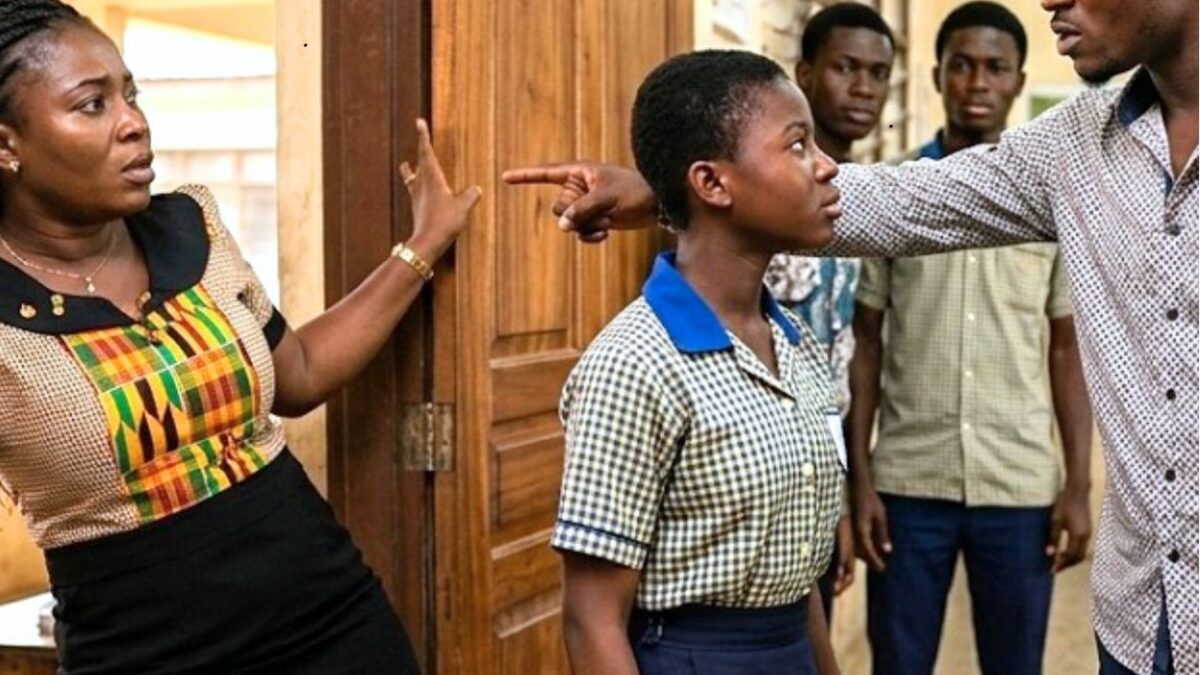
The heavy classroom door slammed open with a sharp, echoing violence that sliced through Ms. Boateng’s lecture. The wooden frame shuddered on its hinges, vibrating through the quiet afternoon air and jolting twenty students upright. Kweku Mensah walked past the threshold with two friends flanking him, carrying himself as though he owned the space.
He wore his tailored jacket unbuttoned, exuding an effortless arrogance that came from never being told no. His gaze swept past the rows of desks until it locked onto his fourteen-year-old sister sitting by the window. He thrust a single finger forward and barked, “Ama, get your bag right now; we are leaving immediately.”
Ms. Boateng paused mid-sentence, setting her dry-erase marker down on the sill with deliberate, steady movements. She did not scream, nor did she flinch, but stepped forward to place her slender frame directly between them. “Mr. Mensah, you cannot disrupt this instruction, and you cannot take a student without signing the proper register.”
Kweku chuckled, casting a mockingly incredulous glance at the silent, wide-eyed adolescents sitting in their chairs. He leaned down slightly toward the teacher, his grin razor-thin, cold, and dripping with an ugly, practiced malice. “Perhaps you have forgotten whose father built this campus, and who signs every single paycheck that feeds you.”
Before Ms. Boateng could utter another syllable of protest, Kweku stepped directly into her personal space. He raised his forearm and shoved her aside with enough brutal momentum to send her stumbling backward. Her shoulder struck the jamb with a hollow thud, leaving her gasping for breath as she caught herself against the wood.
Ama bolted from her seat, moving faster than thought, planting herself firmly between her older brother and her teacher. Her heart hammered against her ribs, her breath catching in her throat as she faced her towering brother. “Get to the car right now, Ama,” Kweku ordered, pointing a trembling, demanding finger toward the bright, empty corridor.
Ama did not move an inch, her sneakers planted like iron weights into the scuffed linoleum floor. His two companions had entered with broad, mocking grins, expecting another easy display of Kweku’s total dominance. Now, as the terrible stillness settled over the room, their smirks faded into uncomfortable, darting sideways glances.
Ms. Boateng straightened the wrinkles on her blouse, smoothing her collar while fighting to keep her breathing steady. Her fingers trembled against her sides, betraying the shock running hot beneath her calm exterior. “Ama, it is all right,” the teacher whispered, trying to shield the child from the fallout of this confrontation.
“Please do not make this worse for yourself,” Ms. Boateng pleaded softly, her voice barely carrying past the doorway. Ama turned slightly and saw the bright, unspilled moisture glistening at the corners of her teacher’s eyes. That tiny tremor of vulnerability pierced straight through Ama’s chest, sparking an unfamiliar fire deep within her belly.
She reached down, grabbed her leather school bag from the floor, and pulled the strap up onto her shoulder. Watching her move, Kweku exhaled a heavy, satisfied sigh, his shoulders relaxing as he turned toward the hall. He took it as the usual surrender, assuming the family name had once again obliterated all resistance in seconds.
Instead of turning to follow him, Ama swung the bag back down and slammed it hard onto her wooden desktop. She reached into her blazer pocket, pulled out her phone, and tapped the glowing glass screen to life. Kweku stopped in his tracks, his relaxed posture instantly vanishing into rigid, furious disbelief as he saw her hand.
“Ama, put that phone down immediately,” he hissed, taking an aggressive step forward with his teeth clenched tight. She did not blink, looking directly into his narrowing eyes as she swiped across the illuminated glass. Her thumb hovered over the contact list, scrolling down until she firmly pressed the entry saved as “Father.”
Kweku surged forward to snatch the device, but the sudden shift in the classroom air froze him mid-stride. Several students were standing up behind their desks now, watching him with hard, defiant stares rather than fear. The invisible barrier of intimidation had shattered, leaving him exposed under twenty pairs of unwavering young eyes.
“Dad,” Ama spoke clearly as soon as the line clicked open and Kwame Mensah answered his private line. “You need to come to the secondary wing right now,” she stated, her tone shockingly flat and devoid of tears. She listened to his confused voice for two seconds before fixing her gaze straight onto her brother’s tightening jaw.
“No, I will not explain it over the phone,” she said, cutting through her father’s immediate follow-up questions. “Kweku just laid his hands on Ms. Boateng in my classroom, and I want you to hear the rest here.” She ended the call without waiting for an answer, slipping the dark rectangle quietly back into her pocket.
Kweku stared at her in sheer, stunned horror, as though she had committed an unforgivable act of treason. In his mind, she had broken the one sacred law that had kept their family untouchable for so many years. Their father was coming, and every second ticking by narrowed the window Kweku had to rewrite the truth.
He jerked his chin toward the open hallway, his face dark with suppressed fury. “Come outside with me right now.” Ama hesitated for a fraction of a second, then walked only far enough to stand beside the heavy open door. She refused to take another step into the shadows of the empty corridor, keeping her back to the classroom.
Kweku drifted further down the tiled hallway, expecting her to trail behind him like she had always done. She remained completely stationary where the light fell, ensuring Ms. Boateng could still see her every move. “You are being utterly ridiculous,” Kweku snapped in a venomous whisper, his eyes darting toward the classroom doorway.
“I came here to pick you up for an appointment,” he hissed, waving his hands to minimize the act. “She blocked my path like an obstacle. I simply moved her out of my way to reach you. That is all.” Ama looked straight through his frantic hand gestures and replied evenly, “You shoved an adult woman against the wall.”
“Stop using dramatic, hysterical words just because people are emotional,” he shot back, his voice rising in irritation. “I am not going to soften my words just because you do not like the sound of them,” she countered. Kweku let out a sharp, joyless bark of laughter that bounced hollowly against the lockers lining the hallway.
“So that is what this is?” he scoffed, crossing his arms and glaring at his younger sibling. “You are going to humiliate your own flesh and blood in front of our father over an upset teacher?” Ama felt her stomach drop, but she clenched her teeth, determined not to let him see her waver.
Kweku stepped closer, leaning down until his shadow fell over her face, knowing precisely where to press. “When you scraped your knees or broke curfews, who took the blame and lied so you would not be punished?” “When you were terrified in the dark, who sat on your floor until you fell asleep? I did, Ama.”
“I am your brother,” he reminded her, his voice dropping into that familiar, suffocating cadence of family loyalty. “Blood protects blood. You do not invite outsiders to tear down your own brother over a stranger’s bruised pride.” For a heartbeat, Ama had no defense, the crushing weight of their shared childhood suffocating her righteous anger.
He was not inventing those memories; he had been the hero of her youth more times than she could count. He had driven across town in downpours to pick her up, bought her treats, and defended her against playground bullies. Standing in the cold corridor, remembering that genuine warmth made the present moment almost impossible to bear.
Then she glanced past his broad shoulder and looked back through the open doorway of her classroom. Ms. Boateng stood by the whiteboard, pretending to straighten papers while discreetly wiping beneath her eye. Twenty students sat in total silence, carefully looking down at their desks to spare their teacher further humiliation.
Ama turned her face back to her brother, her eyes completely devoid of the childish deference he expected. “I will tell Dad exactly what happened,” she said softly. “Nothing added to hurt you, nothing removed to protect you.” Kweku’s face tightened into an ugly scowl. “And you think acting like a traitor makes you noble and fair?”
“I do not care about being noble,” she whispered, her voice steady. “I care that it is the simple truth.” She turned her back on him, stepped over the threshold, and sat down at her desk beside her silent peers. Kweku remained stranded in the echoing hall, realizing with sickening certainty that his surname had lost its magic.
The school had always been a playground where rules were meant for other people, not for the Mensahs. Security guards bowed when his Mercedes arrived, receptionists smiled nervously, and administrators granted instant favors. Nobody had ever sat him down to declare him royalty; society had simply taught him through repeated silence.
He had learned from a young age that whenever he pushed against a rule, the world yielded without complaint. Now, facing a closed door and an immovable sister, he decided to attack the easiest target in the room. He stepped back into the classroom, keeping his posture loose and putting on an air of manufactured remorse.
“Ms. Boateng, could I have a quick word with you outside?” he asked, his tone polite and modulated. The teacher exchanged a brief, uneasy look with Ama before slowly stepping past the door into the corridor. “Look, things got out of hand,” Kweku said smoothly, adopting the reasonable demeanor of a misunderstood businessman.
“I raised my voice, which was wrong, and you blocked the door without checking who I was,” he continued. “We can easily agree this was a misunderstanding and settle it before my father arrives thinking something terrible happened.” The gentleness in his tone was far more terrifying than his shout, carrying the veiled threat of unemployment.
Ms. Boateng held her hands clasped together against her apron, staring at the floor between their expensive shoes. She knew that one phone call from his father could strip away her salary, her housing, and her career. “I have no desire to create a spectacle,” she replied quietly, her voice drained of all pedagogical authority.
“Neither do I,” Kweku answered instantly, offering an oily smile of relief. “Then we are in total agreement.” Ama sat by the window, catching every single word floating through the warm, heavy air of the classroom. When Ms. Boateng walked back inside, she avoided making eye contact with any of the young people watching her.
“Your father will be here shortly,” the teacher announced to the room, her voice trembling slightly around the edges. “We should all remain calm; there is no need to escalate an unfortunate misunderstanding into something devastating.” Ama felt a profound pang of sorrow settle in her chest, sharp and bitter like medicine swallowed too fast.
She had expected the truth to gain strength once she aligned herself with the person who had been wronged. Instead, the victim herself was begging for silence, retreating behind diplomatic phrases to preserve her fragile safety. Ama wondered if her insistence on calling her father was helping Ms. Boateng or stripping away her dignity.
She rose quietly from her wooden chair and walked across the silent floor toward the teacher’s desk. Ms. Boateng kept her eyes glued to her lesson plan, nervously organizing sheets of paper that were already neat. Ama leaned in close and whispered, “I will not force you to say anything you do not want to say.”
“If Dad asks me, I am going to tell him what I saw with my own eyes,” Ama continued gently. “You can say whatever you need to say to protect yourself, and I will not judge you for it.” Ms. Boateng looked up sharply, her eyes widening as she recognized the rare maturity in the young girl’s gaze.
It was one thing to fight a battle on someone’s behalf; it was another to acknowledge their right to survive. True courage, Ama realized in that heavy silence, could quickly morph into tyranny if forced upon the unwilling. Out in the hallway, the murmurs of Kweku’s two companions grew more anxious with every passing minute.
“Bro, we should leave before the old man gets here,” one friend muttered, tugging at his denim jacket nervously. “Take off now? And let Ama tell him I fled like a frightened dog?” Kweku sneered back in disgust. “No, I am staying right here. He will hear the proper story from me and understand the whole situation.”
Yet down in her seat, Ama knew a fundamental truth about Kwame Mensah that Kweku consistently chose to ignore. Their father was never more terrifying than when his voice dropped to an absolute, unhurried, razor-sharp whisper. The silence stretching through the school was suffocating, thick with impending judgment and twenty students waiting to breathe.
Ten long minutes crawled by until the muffled atmosphere of the hallway shifted into sudden, frantic activity. The head administrator appeared around the far corner first, his face pale and his tie hastily straightened. Behind him came the front desk receptionist, stepping aside with lowered eyes as footsteps echoed firmly down the hall.
Kwame Mensah arrived without a security detail, without a loud entrance, and without an ounce of wasted energy. He wore a simple charcoal suit, carrying himself with an understated gravity that commanded instant, instinctual deference. Kweku straightened his posture immediately and hurried forward to intercept his father before he could reach the classroom door.
Ama remained glued to her seat inside, choosing to stay close to Ms. Boateng rather than chase her father’s ear. That simple, physical separation spoke volumes before a single word of explanation had left anybody’s mouth. The entitled son rushed to flatter power, while the daughter remained anchored to the person who lacked it entirely.
“Dad, I am glad you are here,” Kweku began, his voice breathless as he attempted to control the narrative. “This entire situation has been blown completely out of proportion by people overreacting to routine friction.” Kwame did not break his stride until he stood level with the classroom threshold, his eyes fixed forward.
“Explain what occurred,” the patriarch commanded, his tone completely flat, giving away nothing of his internal state. “I arrived to collect Ama for an urgent family issue,” Kweku said smoothly, gesturing with open palms. “Ms. Boateng became unreasonable over bureaucratic procedures, blocking the door, and an unfortunate physical collision took place.”
Kwame turned his head slowly, fixing his dark, discerning eyes upon his oldest son’s shifting face. “What kind of collision?” Kwame asked, the words falling like heavy stones onto the quiet tiled floor. Kweku swallowed hard, clearing his throat before replying, “She barred the entrance; I moved past her, that’s all.”
“Did the woman fall to the floor?” Kwame pressed, his voice dropping an octave into dangerous calm. “No, she did not fall,” Kweku answered quickly, though his eyes darted away toward his loitering friends. “Did your hands make physical contact with her body?” the father asked, relentless in his simple inquiry.
“I moved her aside to enter,” Kweku confessed, his defensive tone souring into irritation at being questioned so thoroughly. “I admit my temper flared, but Ama became hysterical and made this into something malicious that never happened.” Kwame offered no reply to his son’s justification, simply turning his body and stepping into the quiet classroom.
Kweku followed close behind, while his two companions quietly retreated down the hall toward the outside exits. Kwame surveyed the room slowly, taking in the frightened children, the trembling teacher, and his quiet daughter. He bypassed the adult instructor and fixed his steady, expectant gaze entirely on fourteen-year-old Ama.
“Ama,” he said, the sound of her name filling the dead space of the classroom, “why did you call me?” Ama felt a knot tighten in her throat as every eye in the room pinned itself upon her shoulders. Speaking over a cell phone was easy; speaking while looking into her brother’s glaring eyes was excruciating.
She knew that whatever words she uttered now would ripple through their family dinners for years to come. If she spoke the truth, she would dismantle the comfortable lie that protected her brother from real consequences. She took a deep breath, filled her lungs with the chalky air, and lifted her chin toward her father.
“Kweku entered during our instruction and demanded that I pack my bag and leave immediately,” Ama stated clearly. “Ms. Boateng told him he had to visit the administration office first, following the safety rules for all visitors.” “He laughed at her and asked if she had forgotten who owned this entire school,” she continued without shaking.
“Ama, shut your mouth,” Kweku interrupted sharply, stepping forward with his hands clenched into tight fists. Kwame raised a single hand without looking at him, a silent, absolute command that cut Kweku’s voice off instantly. “You spoke your piece outside,” Kwame said softly. “Let your sister finish what she has to say.”
“Ms. Boateng refused to move from the door,” Ama said, her gaze locked squarely with her father’s dark eyes. “Kweku put his hands on her shoulders and shoved her violently against the frame so he could get inside.” “Her body hit the wood, she stumbled, and I decided right then that I was not leaving with him.”
Kweku shook his head in disgust, throwing his hands into the air as if appealing to an invisible jury. “Shoved her? Dad, listen to the venom in her voice! I bypassed someone who was deliberately obstructing my path.” Ama turned her head and looked straight into her brother’s eyes. “You pushed her because she would not obey you.”
Kwame’s eyes shifted from his daughter back to his son, his face settling into grim, unreadable stone. Kweku realized too late that his own words had confirmed the exact physical assault he was trying to deny. “I mean, she was escalating the entire encounter into an unnecessary power struggle,” Kweku stammered, his facade crumbling.
Kwame did not indulge the excuse; he turned his broad shoulders toward the woman standing beside the chalkboard. “Ms. Boateng,” he addressed her with formal respect, “did the sequence of events happen as Ama just described?” The teacher looked at the floor, her hands twisting the dry-erase marker until the plastic creaked under pressure.
She glanced at Kweku’s flushed, threatening face, then at Kwame Mensah, whose signature paid her monthly mortgage. “Sir,” she started, her voice faint and fragile, “I truly do not wish to cause friction within your family.” Kwame remained silent, refusing to rush her or offer platitudes that might ease her fear of retaliation.
He allowed the silence to hold the room, demanding that she find her own voice without coercion or pressure. Ms. Boateng looked up, met Ama’s steady, encouraging gaze, and felt her posture straighten beneath her blouse. “Yes, Mr. Mensah,” she said with sudden clarity. “Ama’s account is accurate; he used physical force against me.”
Kweku scoffed loudly, stepping toward her with outright disdain dripping from his sneering expression. “Are you serious right now?” he spat, glaring at her as if she were an ungrateful servant. “You are going to stand there and frame me as a monster because I came to collect my own sister?”
Ms. Boateng flinched, but Ama stepped forward instinctively, closing the gap to shield her teacher once again. Kwame saw that tiny, defensive motion, and something inside the patriarch shifted with profound, irreversible finality. “Dad, are you really taking the word of an employee over your own flesh and blood?” Kweku demanded loudly.
The question hung in the air like poison, exposing the corrupt foundation upon which Kweku built his life. He genuinely believed that loyalty meant lying, and that family status erased all accountability to ordinary human decency. Kwame did not answer with words; instead, he took three measured steps across the linoleum toward the teacher’s desk.
He came to a stop beside Ama and Ms. Boateng, physically placing himself on their side of the room. Kweku was left completely isolated on the opposite side, surrounded by a sudden, yawning gulf of empty space. Before Kwame even opened his mouth to speak, that deliberate physical stance had delivered the verdict to everyone present.
“This is not an issue of an employee versus a son,” Kwame said, his voice quiet yet terrifyingly heavy. “This is an issue of what you did, what your sister witnessed, and what this educator rightfully confirmed.” Kweku opened his mouth to argue, but Kwame cut him off with a look that froze the words in his throat.
“And it reveals something far more rotten,” Kwame continued, his gaze piercing into his son’s arrogant soul. “You walked into this building and used my hard-earned name as a license to commit violence against an innocent woman.” Kweku’s frustration boiled over into reckless anger. “Why shouldn’t I? You built this place! You own it all!”
“Precisely,” Kwame responded, the authority in his tone crushing the room’s remaining air. “I own this institution.” “That reality saddles me with total responsibility; it does not grant you the right to act like a tyrant.” Kweku laughed bitterly, running a trembling hand through his hair as he paced across his isolated patch of floor.
“I simply asked for a basic accommodation for my sister, and this woman chose to make a public scene.” “You did not ask,” Kwame corrected him coldly. “You barged into a lesson, disregarded rules, and demanded total submission.” “So now I am the enemy because some teacher felt disrespected?” Kweku yelled, his composure slipping into petulance.
“No,” Kwame replied, stepping forward until he loomed directly over his son. “You are responsible for your own actions.” “When a woman told you no, you believed your surname gave you permission to override her dignity and authority.” “And when your name failed to move her, you used your male strength to force her out of your path.”
Kweku looked past his father toward Ama, his eyes burning with a deep, furious sense of betrayal. “And you are proud of yourself, Ama? You orchestrated this entire humiliation of your own brother in front of strangers?” Ama felt the sting of his accusation, but she did not drop her gaze or apologize for her actions.
“I called Dad because you claimed his authority was the reason nobody in this world could stop you,” she said. “I wanted to see if that authority was real, or if you were just stealing it to hide your cruelty.” That answer hit Kwame Mensah like a physical blow, leaving the older man staring at his daughter in profound silence.
She had not summoned wealth to punish a sibling; she had called the owner of the power to audit its abuse. She had forced Kwame to look in the mirror and decide what his legacy was truly producing in the world. Kwame turned back to his son, his face settled into the cold, sorrowful certainty of a father administering discipline.
“Effective immediately, your unrestricted access to every part of this academic campus is permanently revoked,” Kwame announced. “You will not enter classrooms, you will not address staff members, and you will not collect your sister from school.” “Any communication regarding Ama’s schedule will go through the administrative office like any ordinary citizen of this town.”
Kweku stared at his father as if he had lost his mind. “You are banning me from our own property?” “I am stripping away privileges you used as weapons,” Kwame replied, his voice unyielding and steady as granite. “Consequences must match the offense; you weaponized your access to bully people, so today that access dies.”
Out in the hall, Kweku’s two companions turned away completely, disappearing down the corridor to save themselves from association. Kweku noticed their hasty departure out of the corner of his eye, the heat of total humiliation burning his cheeks. “You could have handled this quietly at our dinner table instead of stripping my dignity in public,” Kweku hissed.
“You selected a classroom filled with impressionable children when you chose how to conduct yourself,” Kwame answered without hesitation. “You wanted an audience for your arrogant display of power, so you will accept this public correction of it.” “So you are humiliating me just to prove a righteous point?” Kweku spat, clenching his fists in helpless rage.
“No,” Kwame said softly. “I am refusing to erase your misconduct just to spare you the discomfort of shame.” “Accountability feels like cruelty to those who have lived without boundaries for far too long,” Kwame added pointedly. Kweku glared at Ama one final time, searching for a trace of hesitation, but she looked back with resolute calmness.
Kwame then turned his back on his son and walked until he stood directly in front of Ms. Boateng. “I offer you my deepest and most sincere apologies,” Kwame said, bowing his head slightly before the astonished teacher. Ms. Boateng raised her hands in surprise. “Mr. Mensah, please, you do not have to apologize for his actions.”
“I do,” Kwame insisted firmly. “Not just for his violence, but for the culture of fear my presence unintentionally created.” “If my name made you hesitate to tell the truth for fear of losing your livelihood, then I failed you.” He turned toward the administrator waiting anxiously in the doorway and issued clear, uncompromising instructions to the staff member.
“Log this incident formally in the school’s disciplinary records, precisely as you would for any trespasser who assaulted an employee.” “Do not redact names, do not alter facts, and do not create a sanitized version to protect my family’s reputation.” Then Kwame faced the classroom full of students, his voice softening into genuine respect for their interrupted learning environment.
“Young people, I apologize for this disruption; please resume your studies and give your teacher your full attention today.” Kweku shook his head in complete, bitter disbelief, letting out a harsh breath that smelled of bruised ego and defeat. “Fine,” he muttered, turning on his heel toward the door, stopping for a split second right beside Ama’s desk.
For a brief, fleeting moment, the brother she had loved her entire life peered out from behind the fury. The vulnerability in his eyes broke her heart, but the cold poison in his parting words shattered the lingering warmth. “I hope this righteous performance was worth destroying our family,” he whispered, vanishing down the hallway before she could speak.
Ama watched his retreating figure through the doorway until his heavy footsteps faded into the background noise of the campus. The confrontation had ended in absolute victory for the truth, yet her chest felt hollow and weighed down with sorrow. She realized that doing the right thing rarely felt like a triumph; it often felt like surviving a painful fracture.
Every future family dinner, every shared holiday, and every childhood memory had just been irreversibly stained by this single afternoon. An hour later, after the final bell had rung and the students had cleared the building, Kwame found his daughter. She sat alone on a wooden bench outside the administration office, her school bag resting neglected between her knees.
Kwame sat down beside her, leaving an intentional, respectful distance so she did not feel crowded by his presence. Ama kept her eyes fixed on her clasped hands, watching her fingers twist together in her blazer lap. “Kweku is never going to forgive me for this, is he?” she finally whispered into the empty courtyard air.
Kwame did not insult her intelligence with cheap reassurances or easy promises that time would magically heal everything quickly. “He will likely be furious with you for a very long time,” Kwame answered honestly, his voice heavy with sadness. Ama looked up at him, her eyes searching his weathered face. “Then did I make a terrible mistake today?”
“You called me because you saw someone abusing my name to justify behavior you knew was wrong,” Kwame said. “You did not call out of spite or hatred; you called to hold power accountable to its own principles.” Ama swallowed hard against the lump in her throat. “He told me that family always protects family, no matter what.”
Kwame nodded slowly, looking out across the manicured green lawns of the school he had built from nothing. “Sometimes that is true, but hiding a person’s cruelty does not protect them; it merely accelerates their eventual destruction.” “When you shield someone from the consequences of their arrogance, you teach them that other people are disposable tools.”
“I should have stepped in and corrected the smaller signs years ago,” Kwame admitted, his voice dropping into quiet regret. “I watched him expect special favors at restaurants, watched people step aside for him, and told myself he would mature.” “Instead of maturing, he learned that my silence was a blank check he could cash whenever he wanted more room.”
Ama leaned back against the brick wall of the administrative building, feeling the cool mortar against her tired back. “What happens to him now?” she asked, worried about the brother who had carried her on his shoulders. “Now he must learn to walk through the world without using my reputation as a golden shield,” Kwame replied firmly.
“He will have to earn respect through character rather than inheritance, which is the only way a boy becomes a man.” Kwame turned toward her, reaching out to gently squeeze her trembling shoulder with his strong, calloused hand. “And remember this, Ama: telling the truth today was never about choosing an instructor over your own brother.”
“Then what was it about, Dad?” she asked, wanting to understand the deeper architecture of the day’s painful lesson. Kwame smiled faintly, a look of profound respect softening the hard lines around his tired, observant eyes. “It was about reminding your father that authority without accountability is merely another name for tyranny and oppression.”
He stood up from the bench, dusted his trousers, and extended an open hand toward his courageous young daughter. She reached out and took it, not because all their family fractures were mended, but because the foundation was clean. They walked together out into the golden afternoon sun, leaving behind the school where a name had lost its tyranny.
The following morning arrived with a cool, gray mist hanging over the flowering shrubs near the classroom entrance. Ama walked down the secondary corridor alone, her footsteps slowing as she approached the familiar wooden doorway of room four. The linoleum floor still bore the faint black scuffs from yesterday’s struggle, reminding her of the chaos that had erupted.
She paused just outside the frame, her hand gripping the strap of her bag as anxiety tightened her throat. She wondered if Ms. Boateng would treat her with awkward distance, or if her classmates would whisper behind her back. Inside, Ms. Boateng looked up from a stack of freshly printed worksheets, her expression calm, serene, and entirely unbothered.
Neither of them offered a dramatic greeting, and neither mentioned the name of the boy who had caused the storm. The teacher simply walked across the room, looked directly into Ama’s apprehensive eyes, and offered a warm, gentle smile. Then, Ms. Boateng deliberately stepped aside from the open doorway, leaving an unobstructed, welcoming path into the room.
Ama felt the lingering tension evaporate from her shoulders as she recognized the profound significance of that quiet gesture. Yesterday, that threshold had been a battleground where a young man used physical violence to force an unnatural entry. Today, nobody was pushing, nobody was demanding unearned deference, and nobody was hiding behind the weight of a powerful surname.
The teacher was offering space out of mutual respect and deep trust for the young woman standing before her. Ama walked across the threshold with her head held high, placed her leather bag onto her desk, and sat down. A few classmates looked in her direction, but their gazes held genuine admiration rather than the cruelty of schoolyard gossip.
Within minutes, the room filled with the comfortable, mundane rhythm of academic life: rustling papers, clicking pens, and quiet laughter. Ms. Boateng took her rightful place at the front of the chalkboard, beginning the morning lecture with complete, unwavering confidence. Nothing had been magically resolved in the wider world; Kweku was still nursing his wounds in an empty apartment.
Kwame Mensah was still facing the difficult task of dismantling years of parental indulgence and blind family pride. Ms. Boateng still had to earn her living inside an institution funded by the family of the boy who shoved her. Yet despite those lingering complications, an invisible, sacred boundary had been permanently erected within the walls of that school.
The Mensah name could no longer be brandished like a weapon to compel good people into humiliating, silent submission. And Ama sat by the window, realizing that the highest form of love does not mean defending your kin when wrong. Sometimes, true loyalty requires you to plant your feet, look family in the eye, and refuse to let them rot.

