Billionaire Was About to Fall Into the River, Until a Homeless Pregnant Woman Saved Him
Part 1
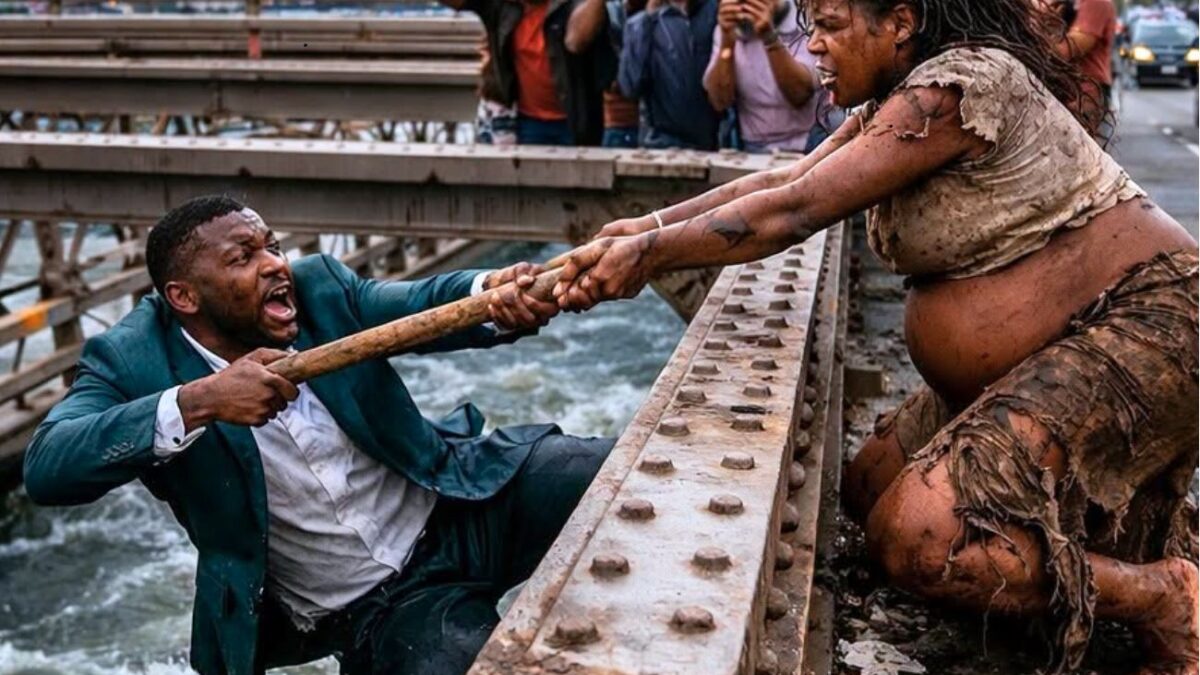
The billionaire was hanging from the edge of Third Mainland Bridge while dozens of people filmed him instead of saving him. His fingers were slipping from the wet metal rail, his designer shoes kicked helplessly above the dark Lagos lagoon, and his voice cracked with terror.
—Help me!
Some people screamed. Others pointed their phones closer. A bus conductor shouted for someone to call LASTMA. A young man even laughed nervously, as if death had become a live video for his followers. But no one touched the rail. No one leaned forward. No one wanted to risk falling with him.
Chief Tade Balogun, 43, was not a man Lagos was used to seeing helpless. He owned towers in Victoria Island, hotels in Abuja, oil contracts in Port Harcourt, and enough influence to make governors answer his calls before the second ring. That morning, he had walked out of Balogun Atlantic Group with murder in his eyes after discovering that someone inside his own family business had been moving 800 million naira through ghost accounts.
The boardroom had gone silent when he dropped the evidence on the table.
—One of you has been eating from my plate and poisoning my house.
His cousin, Kunle, denied everything too quickly. The finance director blamed “old system errors.” His uncle warned him not to disgrace the family name. Tade only picked up the file and said:
—By tomorrow morning, I will know who betrayed me. And whoever it is will lose more than a job.
He left before anyone could answer. His driver tried to take him home, but Tade ordered him to stop near the bridge. He needed air. He needed silence. His phone kept ringing. Kunle’s name flashed again and again until Tade answered, already furious.
—If you are calling to lie, save your breath.
He stepped toward the rail as the wind hit his face. Kunle was talking fast, begging him not to involve auditors, not to bring police, not to “destroy what Baba built.” Then a speeding okada brushed past a man beside him. Someone stumbled. Tade turned sharply. His polished shoe slid on damp concrete. His phone flew from his hand. His body hit the rail and tipped over.
Now the richest man on the bridge was nothing but a terrified human being begging strangers to value his life.
Across the road, a pregnant woman in a faded wrapper froze when she heard the screams. Her name was Amara Okorie. For 5 months, she had slept behind a closed spare-parts shop in Yaba, carrying her unborn child under the same sky that had watched people insult her, chase her, and pretend not to see her hunger. That morning, a food seller had pushed her away from a pot of jollof rice.
—Go away. You are making my customers uncomfortable.
Amara had lowered her head and moved on, one hand on her swollen belly, pretending the baby’s kicks did not feel like questions she could not answer.
Now she saw the man hanging over the lagoon. She saw the crowd. She saw phones. She saw fear dressed up as helplessness.
—Why are you recording him? Help him!
A woman turned and hissed.
—Madam, mind yourself. You are pregnant.
A man blocked her path.
—Leave it. Rescue people are coming.
Amara looked at Tade’s shaking hands. Rescue would come too late.
Beside the pavement lay a broken wooden plank from an unfinished roadside repair. It was dirty, heavy, and cracked at one end. Amara grabbed it with both hands. Pain shot through her back. Her knees trembled. But she dragged it toward the rail while the crowd shouted.
—Are you mad?
—She will fall!
—Somebody stop her!
Amara climbed onto the lower edge of the rail, balancing her body above the water with one hand pressed against her belly.
—Sir, hold this! Hold it now!
Tade looked up at her, eyes wide, face drained of pride. The plank dropped toward him. His first grab missed. His fingers slipped again.
—Please!
—Try again!
He lunged. This time his hand caught the plank. The wood jerked violently, pulling Amara forward. The crowd gasped as her body tilted over the rail. For one awful second, both of them seemed destined for the lagoon.
Then shame finally entered the hearts of the watching people. Two men grabbed Amara’s wrapper from behind. Another seized the plank. Someone caught Tade’s wrist. More hands joined. The bridge exploded with shouting as they pulled, dragged, and fought against gravity.
At last, Tade crashed onto the concrete, coughing, bleeding from his palms, alive.
A cheer rose around him, but Amara did not cheer. She fell to her knees, clutching her stomach, her face twisted in pain. Tade turned toward her, still gasping.
—Wait… the woman…
But before anyone could thank her, before any reporter could ask her name, before Tade could understand that his life had just been saved by someone the city had treated as worthless, Amara stood with trembling legs and disappeared into the crowd.
By the time Tade’s ambulance doors closed, one question had already begun haunting him more than the fall.
Who was she, and why did she vanish like someone afraid of being found?
Part 2
By evening, the bridge video had swallowed Lagos. Bloggers called Tade “the billionaire who escaped death,” news anchors praised the “dramatic rescue,” and thousands of people argued online about the shame of a crowd that recorded while a man nearly died. But Tade watched the footage in his hospital room and saw only Amara. He paused the video on her tired face, the torn sleeve, the swollen belly, the plank in her shaking hands, and something inside him shifted. No board member had ever shown him that kind of loyalty. No relative had ever risked blood for him without expecting a contract. He ordered his security men to find her quietly, but by morning, false claimants had already appeared. One woman came to his office pretending to be Amara’s sister. A man from Ajegunle claimed Amara owed him money. A pastor announced online that he knew the “bridge angel” and asked for donations. Tade trusted none of them. He returned to the bridge himself, against his doctor’s warning, and questioned hawkers, danfo drivers, fruit sellers, and street sweepers until an old woman selling oranges told him she had seen the pregnant girl near the abandoned textile warehouse behind Yaba bus stop. Rain started falling when Tade found her. Amara stood under a rusted zinc awning, soaked and pale, one hand pressed low against her stomach. She recognized him slowly, not as a billionaire, but as the man who had almost fallen. He thanked her. She laughed without joy and asked what thank-you could buy for a woman with no bed, no doctor, and no family that still wanted her alive. Before Tade could answer, her body folded in pain. He caught her before her face hit the ground. She begged him not to take her to a hospital because she had no money. The words entered him like shame. In the private maternity ward, doctors said she was malnourished, dehydrated, under severe stress, and at risk of early labor. While nurses checked her, one attendant handed Tade a small nylon bag containing her things: 2 baby clothes, a cracked comb, a photograph, and an old envelope wrapped in plastic. He meant only to confirm her identity, but the letterhead froze him. Balogun Atlantic Group. The document was 22 years old and carried his late father’s signature. It named Amara’s mother, Ifeoma Okorie, as a housekeeper dismissed from the Balogun family residence after an “internal theft matter.” Behind it was an unfinished complaint, written in frightened handwriting, claiming Ifeoma had been framed after she discovered illegal cash movement through the private household account. The same pattern. Ghost money. Family silence. Powerful men protecting themselves. Amara woke and saw the paper in his hand. Her eyes hardened with old pain. She told him her mother had died disgraced, blacklisted, and poor because the Baloguns called her a thief. Tade’s blood went cold. The woman who had saved him was the daughter of a woman his family had destroyed. Before he could speak, his phone rang. His auditor’s voice shook. The missing 800 million naira was tied to accounts first created under his father’s old domestic payroll system, and Kunle had just ordered the archive room sealed. The betrayal was not new. It had been living inside his family for 22 years.
Part 3
Tade reached Balogun Atlantic Group before sunrise with Amara’s envelope in his hand and fury moving quietly behind his eyes. The directors were already waiting, but this time their expensive suits looked like disguises. Kunle tried to smile, tried to call him “brother,” tried to say the family should settle things indoors, but Tade threw the old letter onto the table beside the new audit report. The same hidden payroll codes appeared in both files. The same ghost accounts used to ruin Ifeoma Okorie had been revived to steal 800 million naira from the company. His uncle begged him to think of his father’s name. Tade answered that his father’s name had survived long enough on another woman’s shame. By afternoon, police entered the building. Kunle was arrested. The finance director confessed. The old family lawyer, now weak and terrified, admitted that Ifeoma had been framed because she found evidence of illegal transfers linked to senior Balogun relatives. She had been threatened, dismissed, and blacklisted so thoroughly that every door closed to her daughter years later. But while the truth was breaking open in Lagos, Amara’s body was breaking inside a hospital room. The stress pushed her into early labor. Tade arrived breathless outside the maternity ward, powerless for the first time in his life in a way money could not fix. Hours passed. Her old street friend, Mama Nneka, sat beside him and warned him that finding the truth was not enough if he let Amara return to suffering after the headlines ended. Then a nurse stepped out smiling through exhaustion. Amara had survived. The baby had survived. When Tade entered the room, Amara lay pale against the pillows with a tiny boy wrapped against her chest. She looked at Tade as if she still did not know whether life had finally stopped punishing her. He told her that her mother’s name had been cleared, that the company would publicly admit what was done, that Kunle and the others would face court, and that every stolen benefit owed to Ifeoma would be restored to her daughter and grandson. Amara did not cry at first. She only looked down at her baby and whispered that her mother had died waiting for someone powerful to tell the truth. Days later, Tade stood before cameras and did what his family had feared for 22 years. He named the crime. He named Ifeoma Okorie. He named the people who buried her. Then he announced a foundation in her name for pregnant women sleeping on Lagos streets, with Amara as its first trustee, not as a symbol of pity, but as the woman whose courage forced a dynasty to face its own rot. Reporters wanted a perfect quote, something sweet about destiny, but Amara gave them something sharper. She said she did not save Tade because he was rich. She saved him because she knew what it felt like to fall while people watched. The clip went viral again, but this time Lagos did not only see a homeless pregnant woman with a plank. They saw a daughter, a mother, a survivor, and the living proof that the people society steps over can still carry the kind of heart that saves everyone else. And every year, on the birthday of her son, Amara took him to Third Mainland Bridge, held his small hand, and told him the same thing: the world may ignore pain, but one brave person can still make the whole world look back.

