Billionaire Believed She Died Pregnant — Until a Little Girl Walked In With His Pocket Watch
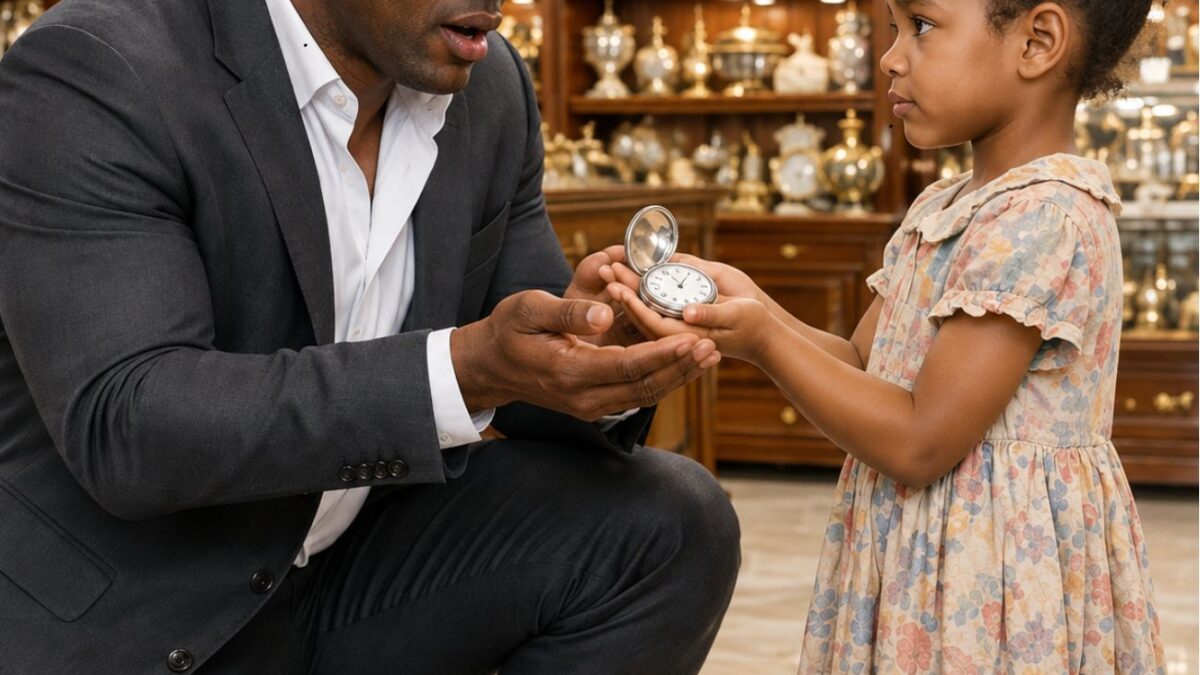
“I want to sell this watch.” The small voice cut through the dust-mote silence of the antique shop, barely rising above the low ticking of dozen grandfather clocks aligned along the back wall. The child standing by the counter could not have been more than seven years old, her small frame swallowed by a faded dress that was clean but worn paper-thin at the collar.
The shop manager adjusted his gold-rimmed spectacles and offered the reflexive, gentle smile reserved for neighbourhood strays wandering into high-end establishments. “Where did you get this, little one?” he asked, keeping his hands poised carefully on the velvet presentation tray. “It belongs to my mother,” she answered evenly, without the nervous shuffle typical of children caught in grand, quiet places.
Behind the manager, seated at a restored mahogany desk beneath an unlit brass reading lamp, sat Caleb Osayi. He had come into the gallery an hour earlier to escape a corporate conference call that was suffocating him, choosing this quiet retail asset over his top-floor executive suite. He was thirty-nine years old, draped in the effortless, understated tailoring of an empire he spent fourteen hours a day directing, yet carried an unshakable vacancy behind his gaze.
“You don’t have to sell this today,” the manager said with a soft, dismissive sigh, gently nudging the bundle toward the child’s scuffed canvas sneakers. “I do,” the little girl stated, her jaw set with an alarming, adult finality that made Caleb freeze mid-turn. “Why don’t I help your mother first, and we can figure out the watch later?” Caleb said, his voice cutting cleanly across the narrow aisle before he even understood his own impulse.
He had been holding a silver timepiece of his own when the little girl walked through the glass door, turning the scratched metal absentmindedly between thumb and forefinger. That single sentence took nine years to make sense, a winding road paved with deliberate devastation, quiet erasure, and an unyielding ache that time had failed to dull. This was how it happened, beginning long before Zoe walked into that shop with her mother’s most precious secret wrapped inside a stained cotton dish towel.
Seven years before that afternoon, Caleb Osayi still believed that love was a conscious territory a man could claim, defend, and inhabit out loud without permission. He was thirty then, the sole heir of Richard Osayi Senior, the formidable founder of the Osayi Capital Group, an sprawling conglomerate of private equity, logistics, and real estate. It was generational wealth that never needed to raise its voice or flaunt its reach, because every board room and political cabinet already knelt in its long shadow.
Caleb wore custom linen and cashmere without feeling the fabric, attended the correct seasonal galas without hearing the music, and smiled at the correct heiresses without a pulse of desire. The path surveyed and cleared for him was immaculate, glittering, and suffocating in equal, calculated measure, designed by an architect who viewed human emotion as a dangerous structural flaw. Then, on a damp Tuesday evening during an auxiliary hospital charity drive his aunt had organized, Caleb turned an unfamiliar corner on the third floor and saw Jade.
She was not beautiful in the performative, curated manner expected of the women who drifted through the Osayi family dining halls. There was no practiced fragility, no porcelain gloss, no delicate hesitation in her stride that invited protection or manufactured mystery. She worked in the hospital’s patient intake and records department, and she had stayed three hours past her shift to organize folders before the charity crowd arrived.
She wore a charcoal blouse with the cuffs turned back over her wrists, natural hair pinned in an efficient coil, and two modest gold studs catching the harsh fluorescent lights. She moved behind the laminate reception counter with the clean, rhythmic grace of someone who possessed a life too demanding for self-conscious posturing. When Caleb stepped toward the desk to ask for the side terrace exit, she did not look at his silk tie, his watch, or the tailored silhouette of his jacket.
She met his gaze directly, answered his brief inquiry with crisp politeness, and immediately dropped her focus back to a towering stack of green manila folders. Caleb remained where he was, his polished loafers rooted to the hospital linoleum, feeling an absurd prickle of irritation that swiftly dissolved into profound fascination. “You work here?” he asked, realizing immediately how superfluous the question sounded within an administrative intake office.
“Yes,” she said without glancing up from her systematic cross-referencing. “Aren’t you coming down to the atrium for the gala?” he continued, lingering over the counter with an uncharacteristic lack of purpose. She glanced at the mountain of case files threatening to cascade onto the vinyl floor, her expression completely devoid of social obligation.
“I’m still working,” she replied, stamping a document with firm, practiced pressure. “At this hour? The benefit dinner started forty minutes ago.” “Patients don’t stop getting sick for galas,” she said, delivering the truth without cynicism or resentment, simply laying it down like an indisputable law of nature.
That sentence followed him down the marble staircase, rode beside him in the quiet luxury of his town car, and echoed through his father’s cavernous dining hall that night. He returned three days later with an envelope of foundation receipts that no one in administration had requested or required him to deliver. He returned the following week under the pretense of checking on departmental resource allocations, standing awkwardly by her filing cabinets until she told him he was blocking the path.
When he appeared a third time with no file, no cover story, and no excuse, he leaned against the counter and said simply, “I wanted to see you.” Jade should have ended it at that exact threshold; she was an intelligent woman who understood the predictable, seasonal architecture of such encounters. She knew the archetype: the restless son of an untouchable dynasty, wandering down into the common world for an aesthetic distraction, gone by the first freeze of winter.
She had seen other women at the clinic attempt to reassemble their lives after colliding with men whose casual curiosity could shatter ordinary households without leaving a bruise. She knew the ending before he had even written the opening line, but Caleb proved entirely incapable of the expected carelessness. That was his singular danger: he listened to her answers, he remembered off-hand remarks, and he appeared precisely when he promised he would.
He learned which corner store she stopped at after her double shifts to buy ginger ale, and he knew that her younger brother’s state college tuition deadline was keeping her awake. He paid intense, quiet attention to her life without ever attempting to purchase it or convert his interest into leverage. When he finally asked her to dinner, he did not arrange for a private driver or book a terrace overlooking the skyline; he stood outside the ambulance bay at nine at night.
He was wearing a wool overcoat, holding two cardboard cups of cold brew coffee from the street vendor whose cart was rattling against the curb. “I know all the reasons why you should say no,” he told her as she emerged through the sliding glass doors, shivering against the autumn chill. “Then why are you standing in the cold asking?” she countered, wrapping her scarf tightly around her throat.
“Because I would rather know the ending than spend the rest of my life wondering what it felt like,” he said, handing her one of the cups. She took the cold paper cup, her fingers brushing his, her eyes searching his face for the usual signs of wealthy amusement. “This doesn’t mean I trust you,” she warned, taking a measured sip.
“Fair,” he replied instantly, his breath misting in the night air. “Or your family’s name.” “Also completely fair.”
“Or where any of this is supposed to lead.” Caleb nodded, stepping into stride beside her as they moved toward the crosswalk. “Neither do I,” he confessed softly. “I just know I want to walk there with you.”
It was not a smooth performance; it was hesitant, raw, and entirely too honest to belong to the polished world he inhabited by birth. Their courtship developed in the humble spaces where his name was meaningless: diner booths with sticky menus, humid car rides with the windows down, and Sunday markets. He would stand for half an hour debating the heat profile of small-batch pepper sauces, completely unbothered by the dust or the common press of shoulders.
In her modest apartment, surrounded by second-hand furniture and the smell of roasting garlic, he confessed realities he had never dared whisper in his father’s estate. He admitted that the family firm felt like a massive iron machine wearing his skin, that every promotion had been pre-stamped before his arrival, and that affection was merely another ledger. With Jade, he stripped away the defensive layers of his heritage; with Caleb, Jade dismantled her carefully fortified boundaries and allowed herself to be known.
By the second year, he had decided in the quiet chambers of his conscience that he was going to marry her, though he had not yet told his father. Richard Osayi Senior was sixty-one years old, square-shouldered, impeccably groomed, and dangerous in the specific way men of immense capital are dangerous. He did not govern through tantrums or physical intimidation; he governed through economic infrastructure, institutional dominance, and the total eradication of dissent.
Richard did not consider himself a cruel man; men who recognize their own cruelty occasionally pause for shame, but Richard operated under the clean banner of continuity. That singular conviction covered more catastrophic human damage than malice ever could, because he viewed individuals merely as interchangeable custodians of the Osayi name. He discovered Jade the way men of his station always uncover vulnerabilities: through second-hand intelligence delivered as casual administrative concern.
Drivers notice altered drop-off points, executive assistants verify unusual dinner reservations, and distant cousins eagerly trade surveillance for corporate standing. By the time Richard summoned Caleb to the central library of the Buckhead estate, the file was already complete and closed upon the mahogany blotter. “A hospital intake clerk,” his father murmured, standing before the floor-to-ceiling windows that looked out over forty acres of manicured, private forest.
“You are prepared to dismantle three generations of strategic alliance for a woman with no pedigree and no social capital?” Caleb remained standing, the old conditioning of filial obedience pulling against his spine like invisible cables, but he forced himself to meet his father’s level stare. “Her name is Jade,” Caleb said, his voice flat.
“Her name is utterly irrelevant to the survival of this house.” “It is relevant to me, and that is where the conversation begins and ends.” His father offered a cold, pitying smile, the expression of a chess player watching a novice throw away a queen for the temporary thrill of a pawn.
“You are entirely free to indulge whatever private appetites amuse you in your personal time,” Richard stated calmly, tapping his signet ring on the glass desk. “You are not free to introduce an institutional liability into the Osayi bloodline, nor will she ever share this table.” “This isn’t an appetite, and it isn’t a negotiation,” Caleb replied, his hands clenching in his pockets. “I love her.”
“That declaration,” his father said softly, without an ounce of warmth, “is the precise reason you remain entirely unfit to hold executive power.” There was no shouting, no slammed doors, no dramatic tearing of documents; Richard Osayi never weaponized noise when patience was vastly more lethal. He understood what Caleb had yet to realize: romantic passion easily survives direct hostility, but it rapidly suffocates beneath the steady, invisible weight of systemic sabotage.
The subsequent pressure arrived not as an open attack, but as an inescapable web of administrative inconveniences and logistical nightmares. Caleb found his corporate travel schedule violently reorganized, locking him into multi-week overseas acquisitions in London, Tokyo, and Zurich with no advance notice. Simultaneously, Jade’s supervisor at the hospital received an inquiry from a hospital board trustee regarding alleged ethical boundaries and timecard discrepancies in records.
Her landlord in Inman Park abruptly informed her that his brother needed the unit and declined to renew her lease, giving her thirty days to vacate. None of it carried an Osayi signature; every maneuver was completely deniable, entirely legal, and delivered with the cool precision of institutional machinery. It was amidst this suffocating, invisible encirclement that Jade stood in the middle of Caleb’s small private flat—rented under a blind corporate name—and told him she was pregnant.
Her hands were clasped protectively over her stomach, her shoulders braced against the walls, her eyes wide and dark as she waited for the reality to break him. Caleb did not hesitate; he crossed the timber floor in three strides and pulled her against his chest with an intensity that forced a startled laugh from her lips. “Did you hear what I said?” she whispered against the collar of his shirt, her body trembling with the weight of the secret.
“I heard you,” he said, burying his face in her hair, feeling the fierce, unmistakable rhythm of her heart. “Aren’t you terrified of what this means?” “I am terrified beyond words,” he murmured, pulling back just enough to frame her face in his hands. “And I am happier than I have ever been in my life.”
He sank to his knees on the wooden floorboards, resting his cheek gently against her abdomen, making an oath to the unborn child he did not yet know how to defend. “I will not let them push you into the dark,” he promised against her skin. “I won’t let them erase you, and I won’t let them erase this child. I swear it on my life.” He gave her the silver pocket watch that very evening, retrieving it from the top drawer of his desk where it had rested for five years.
It was not an Osayi family heirloom; he had bought it in an obscure antique shop off Portobello Road during a summer when he still dreamed of an autonomous life. It was solid, heavy silver, noticeably worn near the hinge, bearing an inscription he had personally paid a back-alley jeweler to engrave into the inner casing: For our time. “No one carries pocket watches anymore, Caleb,” Jade said, turning the heavy metal over in her palm, tracing the tiny scratches on the back.
“A man who wants to mark the exact second his life finally belongs to him does,” he answered, closing her fingers tightly over the polished casing. “It’s too much,” she whispered, her eyes shining in the soft lamplight. “It isn’t nearly enough,” he replied. “Whatever they try to build against us, Jade, this time is ours.”
For four weeks, they lived inside a fragile, luminous sanctuary, visiting private midwives under assumed names and making plans to relocate permanently to the West Coast. Jade bought a pair of miniature knitted yellow socks from an artisan market, keeping them hidden in the lining of her tote bag like a physical anchor to the future. Then, with the silent efficiency of a falling blade, the elder Osayi deployed his final maneuver, utilizing the family obligation that bound women like Jade to their roots.
A urgent call reached her desk stating that her grandmother in Savannah had suffered an acute cerebral hemorrhage and was calling for her from an intensive care bed. The message was fractured, the hospital line congested, and the timing deeply suspicious, but maternal panic and generational duty do not pause for tactical evaluation. Caleb was in Frankfurt, locked in an unyielding regulatory audit orchestrated by his father’s closest allies, unable to return for forty-eight hours without raising catastrophic alarms.
“Wait for me,” he pleaded over the crackling transatlantic line, hearing the wind whipping against the terminal glass. “Wait one day, Jade. I will charter a plane home tonight.” “She practically raised me, Caleb,” she whispered back, her voice tight with grief. “If she dies while I’m waiting for your schedule to clear, I will never forgive myself.” She promised to call from the road; she promised to turn back if anything felt wrong; she promised she would return by the following evening.
That was the final sentence he ever heard her speak before the fabrication consumed his world. What Caleb was told three days later in his father’s library was that the hired sedan had experienced a tire blowout along a secluded stretch of Interstate 16 near Macon. What actually occurred in the Georgia twilight was far colder, far uglier, and far more deliberate than any mechanical failure.
The car carrying Jade had been signaled off the highway into an isolated weigh-station detour by two unmarked vehicles driven by private contractors who spoke in calm, polite tones. They informed her that her grandmother was comfortable, that there was no medical emergency, and that her transportation was being permanently rerouted to an address outside the state. When she demanded to know who had hired them, the older driver looked at her with clinical sympathy and said, “Some families do not permit complications in their succession.”
Jade did not scream; she did not negotiate; she simply reached across the console, grabbed the emergency brake, and kicked the rear door open while the car was still rolling at speed. The sedan jackknifed across the rain-slick shoulder, flipped twice over an embankment, and settled upside down in a deep drainage ditch thick with pine brush and Georgia clay. The private contractor behind the wheel died instantly from a severed cervical spine; Jade survived, but her skull struck the shattered frame with catastrophic force.
By the time rural emergency rescue workers cleared the wreckage from the ditch, her conscious identity had fractured like dropped porcelain. She could not state her name; she could not recall where she was traveling; she could not identify the city she had left behind. The only object salvaged from the twisted metal was a heavy silver watch clutched so tightly in her left hand that the paramedics had to pry her fingers open one by one.
Richard Osayi’s crisis management team moved with a horrifying, bureaucratic speed that far outpaced the county coroner’s handwritten report. A separate, fatal accident from the same stretch of highway was quietly substituted into the official records through paid administrative negligence and hurried paperwork. A closed-casket funeral was arranged within seventy-two hours, Richard standing beside his devastated son, offering murmurs of Christian fortitude and family continuity.
Caleb stood in the cold cemetery dirt and watched a polished mahogany box descend into an empty grave, believing with every shred of his soul that his future was buried beneath it. The grief did not make him rebellious; it hollowed him out until he became the precise instrument his father had always desired: silent, lethal in negotiations, and completely detached from life. He returned to the corporate tower, occupied the executive suites, and presided over acquisitions with an icy competence that people mistook for generational maturity.
He never married; he allowed his father to introduce him to daughters of banking syndicates and shipping fortunes, but every courtship withered before reaching an engagement. Richard dismissed his son’s lingering solitude as lingering romantic melodrama, entirely confident that time and corporate exhaustion would eventually erode the phantom. Caleb knew better; he did not speak her name because naming her in that house felt like desecration, but he carried her absence like an unhealed fracture inside his chest.
Two hours south, in a county hospital in middle Georgia, Jade woke into a world stripped entirely of its history. She understood the physical sensation of pain, the smell of antiseptic, and the sound of an obstetrician saying, “The fetal heartbeat is remarkably strong,” before she faded back into darkness. She could speak standard English, read the charts at the foot of the bed, and follow logical commands, but the autobiographical library of her life had been burned to the foundation.
She was discharged after six weeks as an unidentified ward of the state, holding an infant daughter who had arrived during a furious November rainstorm. The baby had entered the world screaming with such raw, indomitable fury that the midwife had chuckled and noted, “This one fought her way back from somewhere dark.” Jade had looked down at the tiny, perfect face and whispered the name Zoe—a word that arrived from nowhere, carrying an ache like a fist closing around her heart.
They were taken in by an elderly woman named Miss Birdie, who operated a small second-hand clothing stall near the rail depot and refused to let vulnerable people drown. Miss Birdie gave them a narrow back room behind a laundromat, watched the baby while Jade cleaned offices, and never asked questions that produced tears. During the leanest winters, when the kerosene heater ran dry, Miss Birdie would eye the heavy silver pocket watch resting on the dresser and suggest pawning it for food.
Every time the suggestion was made, a blind, suffocating terror would seize Jade’s throat, so absolute and visceral that even the practical old woman learned never to speak of it again. Jade kept the watch wrapped in flannel at the bottom of a plastic crate, alongside Zoe’s immunization records and the handwritten receipts of their fragile survival. For seven years, Jade lived as a ghost who worked twelve-hour shifts, scrubbed industrial floors, and endured terrifying migraine episodes when a smell or a street name triggered phantom memories.
Sometimes, in the shallow sleep between shifts, a deep, cultured voice would echo through her dreams, saying: Whatever happens, this time is ours. She would awake with her pillow soaked in tears, her fingers reaching into the empty dark, unable to explain the grief that inhabited her bones. Zoe grew up with the sharp, watchful intelligence that poverty carves into children who realize early that the adults around them are balancing on a thread.
By seven, Zoe knew which days her mother’s smile was real and which days it was a mask worn to hide the blinding headaches that left her vomiting in the dark. She knew the local pharmacy refused credit, that rent took priority over winter coats, and that the silver watch in the bottom crate was sacred. When Miss Birdie passed away in her sleep that spring, the thin buffer between their small household and total catastrophe finally collapsed.
The county clinic doctor examined Jade’s worsening neurological symptoms and scribbled an illegible referral for advanced magnetic resonance imaging that cost twelve hundred dollars upfront. “Old trauma,” the physician told Jade, not unkindly. “Vascular complications from an unmonitored skull fracture. If you don’t see a specialist, the blackouts will become permanent.” Zoe had been sitting outside the consultation room, her knees pulled to her chest, listening through the thin acoustic tiles with the terrible clarity of a child who understands disaster.
That evening, while Jade lay shivering beneath two wool blankets after a severe dizzy spell, Zoe dragged the plastic crate from beneath the bed. She was looking for the blue envelope where her mother occasionally hid five-dollar bills for laundry detergent, but her small hands encountered the flannel bundle instead. She unwound the cloth, pressed the small silver button on the stem, and watched the front casing swing open with an oiled, mechanical click.
She could not decipher all the cursive lettering engraved within, but she recognized the cold, pristine gleam of real silver; children of shortage understand intrinsic value instantly. She did not consult her mother; desperate children do not ask for permission when they believe they are carrying out a rescue. Before dawn, while the rain tapped against the corrugated roof, Zoe slipped the watch into her pocket, wrapped her mother’s stained dish towel around it, and walked to the bus station.
A neighbor who drove an early-morning delivery van to the Atlanta terminal let her ride in the passenger seat, assuming the quiet child was meeting family at the depot. She arrived in the capital city at noon, clutching the bundle against her ribs, navigating the towering glass canyons with the stubborn courage of someone who had nothing left to protect. She had wandered off the main avenue into the upscale gallery district, drawn to the velvet-lined display windows of an antique dealer whose brass sign read Osayi Heritage Holdings.
She had pushed the heavy glass door open, her heart hammering against her small collarbone, stepping onto the thick oriental rugs with her worn sneakers. Caleb Osayi had looked up from the manager’s ledger simply because the voice addressing the room lacked the high, uncertain register of childhood. “I want to sell this watch,” she had announced, unfolding the coarse linen dish towel to reveal the scratched silver casing on the counter.
The world stopped spinning on its axis for Caleb Osayi; the air left his lungs in an agonizing rush that felt like a blow from an iron bar. He knew the curvature of that casing; he knew the microscopic cross-hatch scratch near the hinge where he had dropped it on a London pavement fifteen years earlier. His hand reached out before his conscious mind could intervene, his fingers trembling with an intensity that rattled the glass display case beneath them.
He pressed the release latch; the cover sprang open, revealing the delicate black lettering he had paid to have inscribed when his soul was still his own: For our time. He sank into the nearest leather armchair without realizing his knees had buckled, his vision narrowing until only the silver face remained in focus. “Where did you get this?” he managed to ask, his voice sounding like gravel grinding beneath an ocean swell.
The little girl retreated half a step, her dark eyes locking onto his face with acute suspicion, sensing the dangerous emotional current vibrating through his body. “It’s my mother’s,” she said defensively, her chin coming up. “What is your mother’s name?” Caleb whispered, terrified that speaking too loudly would shatter the hallucination and leave him alone in the dark again.
She hesitated, measuring the exits, calculating whether she could snatch the watch back and run before this strange, wealthy man could grab her. “Jade,” she said finally. The gallery, the street outside, the entire empire his father had built across forty ruthless years ceased to exist in that singular, impossible heartbeat.
Nine years of grief, nine years of visiting a stone marker in a manicured cemetery, nine years of carrying a phantom through board meetings dissolved into fire. He did not break down; the shock was too colossal, too terrifyingly vast to permit tears, forcing him instead into the absolute stillness of a predator tracking a miracle. “You don’t have to sell this today,” he told her, his voice dropping into the gentlest cadence he could summon through his constricted throat.
“I do,” Zoe insisted, her eyes filling with fierce, defensive moisture. “She needs the medicine. The clinic won’t give it to her without the paper money.” “What if I help your mother first?” Caleb said, rising slowly from the chair so as not to frighten her. “And we can figure out the watch together later?” Zoe studied him with the ruthless, unblinking assessment common to children who had been promised things by social workers and seen nothing materialize.
“Why?” she asked, demanding the transaction behind the mercy. Caleb looked at the small face before him and saw, with an impact that nearly brought him to his knees, the unmistakable arch of Jade’s brow and his own stubborn mouth. “Because someone gave me that watch to hold for safekeeping,” he answered, his voice steadying on the absolute truth. “And I would like to earn the right to explain that to her.”
Zoe reached into the pocket of her faded dress and pulled out a creased, damp index card from the county free clinic, bearing a handwritten address in Warner Robins. Caleb did not summon his security detail; he did not alert his corporate drivers; he took his personal vehicle and drove south down Interstate 75 like a man possessed. The speed limit blurred into insignificance; his knuckles remained white against the leather steering wheel as the miles burned away beneath his tires.
The address led him to a sagging brick tenement squatting behind an automatic car wash and a commercial tire depot, smelling of diesel exhaust and damp laundry. Zoe led him down an exterior concrete walkway, pushed open a warped screen door that had long lost its latch, and stepped into the dim interior. Caleb stopped dead in the doorframe, his palm gripping the splintered wood so hard the grain bit into his skin, his chest heaving as if he had run the entire hundred miles.
There, lying upon a narrow cot beneath a window covered by a faded yellow bedsheet, was Jade. She was thinner than his memory of her, hollowed out by nearly a decade of physical labor and chronic malnutrition, her cheekbones sharp beneath pale skin. Her hair was pulled back in the same unadorned fashion he remembered from the hospital basement, one hand resting across her brow, the other lying open on the mattress.
She was breathing; she was warm; she was inhabiting the same physical room as he was. She opened her eyes at the sound of his shoes on the floorboards, squinting against the afternoon glare that cut through the doorway, her expression guarded. “Zoe?” she rasped, her voice dry and strained from sleep. “Where have you been? Who is that?”
“I brought someone, Mama,” Zoe said, stepping between them like a small, protective sentinel. “He says he knows the watch. He says he can help.” Jade attempted to push herself upright too quickly, a violent spasm of vertigo hitting her so hard she had to grip the iron headboard with both hands. “Who are you?” she asked, her eyes darting between the stranger’s bespoke clothing and the luxury vehicle parked outside her window.
Caleb had rehearsed a thousand speeches at an empty grave in the middle of sleepless nights, crafting poetic confessions of endurance and sorrow. None of those speeches survived the reality of her breathing presence; they were useless relics of a grief that had just been rendered completely obsolete. “My name is Caleb,” he said simply, keeping his distance, letting the name hang in the quiet room like a dropped coin.
She stared at him, the sound of the word moving across her features like a cold wind passing over still water, disturbing the surface without revealing the depth beneath. “I don’t know you,” she said, shaking her head slowly, a defensive wall hardening behind her dark eyes. “No,” Caleb whispered, feeling a tear finally break over his lower eyelid and carve a path down his cheek. “You don’t. Not yet.”
Within forty-eight hours, through the sheer application of unlimited private capital and absolute executive authority, Caleb relocated them to Atlanta. He did not take them to the Osayi family compound in Buckhead, nor did he bring them to his penthouse; he leased an expansive, private residence in Druid Hills. He staffed it with specialized neurological nurses, arranged private consultations with the head of neurosurgery at Emory, and cleared the pantry shelves with organic provisions.
He instructed his legal team and personal security detail that the residents were under his direct, sovereign protection, suspending all external corporate inquiries. Jade accepted the transition with profound, deep-seated suspicion, her survival instincts remaining razor-sharp despite the fog that cloaked her personal history. She allowed the medical teams to perform high-resolution scans; she allowed Zoe to sleep in a bedroom with clean linen and central heating, but she kept Caleb at a distance.
On the fourth evening, while Zoe was eating dinner in the adjoining sunroom with a tutor, Jade stood by the tall living room windows and confronted him. “You look at me like I owe you something that was stolen,” she said, her arms folded tightly across her ribcage. Caleb remained seated in the armchair across the room, his hands resting motionless on his knees.
“I don’t think you owe me anything, Jade. I am just waiting for you to remember.” “Stop doing that,” she snapped, a flare of genuine anger breaking through her exhaustion. “Doing what?”
“Saying things that make my skull feel like it’s cracking open,” she whispered, pressing her palms against her temples as if physically holding her thoughts together. Caleb lowered his head, closing his eyes against the pain in her voice. “I am sorry,” he said softly. “I will be more careful.”
The neurological reports were delivered to his desk the following morning, confirming the tragic, mechanical reality of what had transpired nine years earlier. She had suffered an extensive traumatic brain injury with localized temporal lobe scarring, resulting in dense, chronic dissociative retrograde amnesia. The continuity of her autobiography had been violently severed at the point of impact, then left to calcify across years of brutal economic stress and isolation.
“Can the pathways be restored?” Caleb asked the chief neurologist, his voice devoid of emotion as he stared at the lightboard displaying her scans. “Memory is not a digital file that is deleted, Mr. Osayi; it is an associative network,” the physician explained, adjusting his glasses. “The architecture is still intact, buried beneath scar tissue and defensive trauma. Strong emotional keys—places, specific voices, familiar objects—can cause the synapses to bridge the gap.”
Caleb took the silver pocket watch from his pocket, set it upon the glass desk, and resolved to wage a campaign of absolute, patient restraint. He did not force old photographs upon her; he did not recount their romantic history; he simply existed within her perimeter as a reliable, protective presence. He brought the specific jasmine tea she used to drink during her hospital shifts, setting the tin on the counter without claiming credit for knowing her preference.
He sat on the porch with Zoe in the late afternoons, showing her how to tie complicated sailor’s knots and listening to her opinions on the universe. “Why do you look like you’re hurting when Mama goes to sleep?” Zoe asked him one evening, watching his profile as the sun dipped behind the pines. Caleb paused, his fingers tightening around the piece of cotton twine they were practicing with.
“Because I spent a very long time believing someone I loved was gone forever,” he answered honestly. Zoe considered his response with the solemnity characteristic of children who understood real loss. “Well, she’s in the kitchen making soup,” Zoe stated matter-of-factly. “So you can stop looking like that now.”
A sudden, startled laugh broke from Caleb’s chest—a sound so foreign, so bright and unburdened that it startled the little girl into a broad, infectious grin. It was the first time in nine years that genuine joy had crossed his threshold, and it provided him with the ferocious clarity required for his next move. While Jade rested and Zoe studied, Caleb unleashed a private forensic investigation into the events of that November evening on Interstate 16.
He utilized retired state prosecutors, independent forensic accountants, and private intelligence specialists who answered to no corporate board. Within ten days, the paper trail was pried open: the paid falsification of the highway patrol report, the offshore payments to the transport firm, and the hospital records buried in Macon. The architect of the entire atrocity was documented with undeniable precision, every signature leading directly back to the private discretionary account of Richard Osayi Senior.
The confrontation took place in the very room where Caleb’s life had been derailed: his father’s Buckhead library, under the same afternoon light. Caleb entered without knocking, walked across the antique Persian carpet, and dropped the two-hundred-page evidentiary dossier onto his father’s desk. Richard Osayi glanced at the title page, recognized the names of the private contractors, and slowly closed the folder without a flicker of panic.
“She would have destroyed the institutional trajectory of this family,” Richard said, his tone resembling a chairman addressing an unavoidable operational expense. “You destroyed an innocent woman’s life, and you buried your own grandchild in a ditch,” Caleb said, his voice dropping into a register that made the older man stiffen. “I protected this family from an irreversible error of sentiment,” Richard fired back, rising to his full height. “You were weak; you were governed by appetite.”
“She was carrying my daughter,” Caleb said, stepping forward until the distance between them shrank to inches, his body trembling with contained violence. Richard’s eyes narrowed slightly, but his cold arrogance did not yield an inch of ground. “Then I preserved the integrity of this lineage from an inferior bloodline, and you should thank me for having the stomach to execute what you could not.”
Caleb looked at the man who had sired him, realizing with absolute finality that Richard was not a father who had made a catastrophic error; he was a moral monster. “The board receives this file at eight o’clock tomorrow morning,” Caleb said, his voice terrifyingly calm. “The Department of Justice receives it at nine.” “You will destroy the Osayi name,” Richard warned, his voice finally betraying a tremor of alarm. “You will tear down everything that was built for you.”
“The name was built on blood and lies,” Caleb replied, turning his back on the patriarch. “It deserves to fall.” He walked out of the estate and never set foot on its grounds again, leaving the elder Osayi alone in the silent, suffocating museum of his own ambition. The weather broke violently the following Tuesday, a furious late-autumn gale that swept across northern Georgia, lashing the windows with sheets of freezing rain.
The storm seemed to agitate the delicate chemistry of Jade’s healing brain, triggering a severe, disorienting migraine that left her confined to her bed. Zoe had been pacing the apartment all afternoon, unsettled by the lightning and the oppressive, electric tension vibrating through the household. She had taken the silver pocket watch from the living room mantel, clicking the spring latch open and shut in a repetitive, rhythmic effort to calm her racing pulse.
“Zoe, please put that down,” Jade called out from the bedroom, her voice tight with agony as the mechanical clicking pierced her throbbing temples. “Stop clicking it, Zoe!” she repeated, her tone sharpening into an uncharacteristic, frantic snap that reverberated through the quiet corridor. The child, overstimulated by the howling storm and terrified by her mother’s distress, panicked, clutched the watch to her chest, and bolted through the front foyer.
By the time Caleb emerged from the study and the private nurse checked the exterior landing, the heavy fire-exit door at the end of the hall was swinging shut. Zoe had vanished into the driving rain, swallowed by the torrential downpour that turned the avenue into a rushing river of grey water. Jade appeared in the living room, her face completely drained of color, her eyes wide with a primal terror that obliterated all clinical boundaries.
“Zoe!” she screamed, lunging toward the open door in her bare feet, completely indifferent to the rain or her debilitating vertigo. Caleb caught her by the shoulders in the stairwell, his hands firm and grounding against the violent tremors wracking her frame. “Stay inside with the nurse,” he ordered, his voice cutting through the panic like an axe. “I will bring her back. I swear to you, Jade, I will bring our daughter back.”
The search through the storm lasted eleven excruciating minutes, each second stretching into an eternity of terror that threatened to unhinge Caleb’s sanity. He found her huddled beneath the stone portico of an old Baptist chapel two blocks away, crouched behind a stone column, soaked to the bone and sobbing hysterically. She was clutching the silver pocket watch with both hands, pressing the cold metal against her heart as if it were the only anchor keeping her anchored to the earth.
Caleb scooped the trembling child into his arms, wrapping his woolen overcoat around her shivering shoulders, pressing his face into her wet hair. “I’ve got you,” he whispered, his own tears lost in the rain washing over his cheeks. “You’re safe. Daddy has you.” He carried her back toward the residence, meeting Jade on the brick garden path where she had collapsed onto her knees in the mud, unable to run further.
When Jade saw Zoe in his arms, she let out an unearthly sound—part sob, part roar of deliverance—and pulled the child into a crushing embrace. “Don’t leave me,” Jade wept, kissing Zoe’s wet cheeks, her hands frantically cataloging every inch of her daughter’s body. “Don’t you ever leave me, Zoe.” During the desperate embrace, the silver watch slipped from the child’s cold fingers, striking the wet flagstones with a sharp ring and springing open.
Caleb dropped to his knees in the mud beside them, picking up the gleaming timepiece, the torrential rain streaming off his jaw. The wind howled through the overhanging oaks; the streetlights flickered against the deluge, casting long, fractured shadows across the stone walkway. Jade’s gaze fell upon the open silver lid, locking onto the cursive words revealed beneath the glare of the lamplight: For our time.
Caleb looked into her eyes, stripped of all caution, all strategic restraint, all distance, and spoke the exact words that had lived in his chest for nine agonizing years. “Whatever happens, Jade,” he said, his voice cutting clearly through the roar of the gale, “this time is ours.” The words did not merely enter her ears; they detonated within the locked vaults of her fractured consciousness like a lightning strike across a dark landscape.
Her breath seized in her throat; her eyes widened with an expression of such pure, terrifying recognition that Caleb reached out instinctively to catch her shoulders. The dam broke: the memory of his small flat in the city, the cold brew coffees in the autumn air, the warmth of his hand against her pregnant belly, the promise he had whispered. Then the horror: the flashing headlights on Interstate 16, the cold voices of the men by the roadside, the vehicle spinning into the dark, the waking without a name.
The nine years of invisible, unanchored suffering arrived all at once, not as an intellectual realization, but as an overwhelming tidal wave of recovered reality. “Caleb?” she whispered, her voice fracturing down the middle as the tears poured freely down her mud-spattered face. “I’m here,” he wept, pulling her and Zoe against his chest, wrapping his arms around the entirety of his restored world.
“You buried me,” she sobbed against his neck, her hands gripping his shirt with desperate, bruising force. “Caleb… you buried me in the ground.” “I know,” he answered, shaking violently against the cold rain. “I know, my love. But you are home now. You are finally home.” The recovery that followed that miraculous night was neither instantaneous nor did it conform to the tidy resolutions of romantic fiction.
Trauma that has carved nine years of deep neural pathways does not disappear simply because the truth has been spoken out loud. Jade endured weeks of severe physical exhaustion, weeping unexpectedly while folding laundry as forgotten memories—both beautiful and horrific—resurfaced without warning. She remembered the love they had shared, but she also carried the hard, suspicious armor of the woman who had scrubbed floors in Warner Robins to buy penicillin.
Three weeks after the night in the storm, while Zoe was fast asleep in her room, Jade sat on the balcony of their new home, holding the watch. “One of the men who stopped the car told me I should have taken the settlement money and disappeared quietly,” she said, her voice flat in the cool night air. Caleb stood against the doorframe, keeping a respectful distance, knowing that unearned intimacy would feel like another violation.
“I am so sorry, Jade,” he whispered. She turned her head, her gaze sharp and penetrating in the darkness. “Stop apologizing for the hurricane when you weren’t the one who summoned the wind,” she said firmly.
“My father summoned it with my name,” Caleb replied. “Yes, he did,” Jade agreed, looking back down at the city lights. “And if I let you carry his guilt, I am letting him win the argument. But do not expect me to be the girl from the hospital basement.” “I don’t,” Caleb said softly, stepping closer. “I want the woman who survived him, and every version of you that comes after.”
The dismantling of Richard Osayi Senior was executed with surgical, unsparing brutality through the federal courts and corporate governance committees. The evidentiary dossier detailing the kidnapping, the falsification of state records, and the financial payoffs destroyed his standing in every room that mattered. He was stripped of his chairmanship, ejected from his philanthropic boards, and abandoned by the political allies who had once traded favors for his endorsement.
He ended his days in an isolated estate in coastal Georgia, surrounded by private security guards he had to pay double to retain, his calls permanently unreturned. Caleb visited him a single time before the final civil judgments were sealed, standing in the doorway of his father’s study without sitting down. “Jade will decide if she ever permits you to look upon our daughter,” Caleb stated with icy clarity. “If you ever approach their perimeter without invitation, I will ensure you spend your remaining years in a federal penitentiary.”
Richard stared at his son with the hollow, bewildered rage of an emperor whose legions had vanished overnight. “I made you,” Richard whispered, his voice trembling with bitter venom. “No,” Caleb said, his hand resting on the brass door handle. “You managed me. She made me.”
The true resolution arrived seven months later, on a bright Saturday morning in May, inside a crowded elementary school auditorium. The room was filled with folding metal chairs, buzzing fluorescent lights, and proud parents fanning themselves with cheaply printed programs. On the stage, standing behind a microphone that occasionally squeaked with feedback, stood Zoe, wearing a crisp navy school uniform, her hair tied in neat yellow ribbons.
She was reciting a short poem about the ocean, her small voice ringing out clearly over the hushed gathering. Halfway through the second stanza, her memory faltered; she dropped her hands to her sides, her eyes sweeping across the sea of faces in a sudden spike of panic. Then she found them: sitting in the third row, side by side, their hands unashamedly intertwined upon the armrest between them.
Caleb nodded gently; Jade offered a radiant, encouraging smile that illuminated the entire room. The panic vanished from Zoe’s face, replaced by an expression of such complete, unshakeable security that she finished the recitation with triumphant, ringing clarity. The auditorium erupted into thunderous applause, parents around them cheering for the small girl who stood tall beneath the stage lights.
Jade turned her face toward Caleb, her eyes shining with tears that carried no pain, only the profound weight of reclaimed time. “This time is ours,” she whispered, her thumb tracing the knuckles of his hand. “And everything after,” Caleb answered, leaning down to press his forehead gently against hers.

