At Thanksgiving dinner, my son hurled the turkey at me and shouted, “Go back to the nursing home, you useless old woman!” — three weeks later, I sold the house and disappeared without telling them — and the greedy one ended up losing everything.
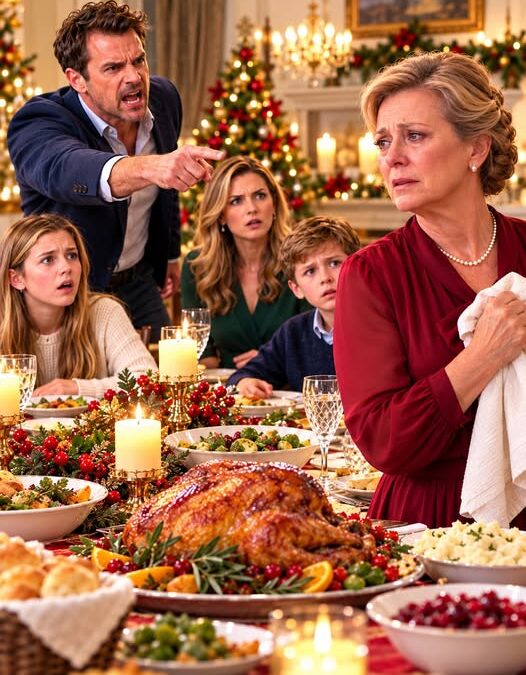
The platter struck my chest before I even had time to get up.
Gravy spread across the blue blouse I had carefully ironed that morning. Stuffing fell into my lap. The china platter crashed onto the floor with a sharp clatter, and for one stunned moment, everyone around my Thanksgiving table sat completely still.
My son Stuart stood opposite me, his face flushed red, one hand still extended toward where the platter had been.
“Go back to the nursing home, you useless old woman!” he shouted.
My grandchildren, Lily and Max, stared at us with their forks suspended halfway to their mouths.
Jennifer, Stuart’s wife, didn’t appear shocked.
If anything, she looked entertained.
I was sixty-five, a retired elementary school teacher, widowed for five years, and I had spent three full days preparing that meal. A twenty-pound turkey. Pumpkin pie. Pecan pie. Cranberry tarts. My late mother’s china. Crystal glasses I only brought out for special occasions.
And now my own son was standing inside my dining room telling me I had become a burden.
The argument had begun halfway through dinner.
“Mom, when are you going to sell this ridiculous house?” Stuart asked.
I handed the mashed potatoes to Lily.
“I’m not selling it. This is my home.”
Jennifer carefully folded her napkin beside her plate.
“At your age, you should be downsizing.”
“At my age?” I said. “I’m sixty-five, not ninety-five.”
Stuart laughed.
“You can barely take care of yourself. Last week you couldn’t even find your glasses.”
“They were on my head,” I said, trying to lighten the room. “That happens to everyone.”
“Not everyone,” Jennifer replied. “Some people need assisted living.”
Whatever appetite I had left disappeared.
“I am not going to a nursing home.”
Stuart leaned toward me across the table.
“Dad left you this house, but your teacher’s pension won’t maintain it forever. We need to talk realistically about your future.”
A moment later, he corrected himself.
Our future.
That was when I finally realized what this conversation was actually about.
I told him that my future wasn’t something we were going to debate during Thanksgiving dinner.
Then his chair slammed backward.
Then the platter came flying.
After it happened, not one person defended me.
I went upstairs, changed out of my stained blouse, washed my face, and waited for myself to cry.
No tears came.
Instead, something much quieter settled over me.
I walked back into the dining room.
Stuart had poured himself more wine. Jennifer was scrolling through her phone. Only Lily and Max seemed embarrassed by what had happened.
I returned to my seat.
“Who wants dessert?”
My voice didn’t shake.
That night, once everyone had gone home, I stood by myself in the kitchen surrounded by leftovers and dirty dishes.
I picked up a framed picture of Stuart as a little boy with missing teeth, smiling while I held him in my arms.
“What happened to you?” I whispered.
One week later, I learned the answer.
My car was being repaired that Tuesday, and a neighbor had given me a ride home after lunch. Stuart still had an emergency key, so when the front door opened, he and Jennifer assumed the house was empty.
I heard them walk into Robert’s study.
I remained behind the living room wall and listened.
“The sooner we get her into Cedar Grove, the better,” Jennifer said.
My fingers tightened around the duster in my hand.
Cedar Grove was a retirement community located outside town.
“Mom won’t go willingly,” Stuart replied.
Jennifer gave a quiet laugh.
“Well, your little turkey tantrum didn’t help.”
“I lost my temper.”
“We just need to document the incidents,” Jennifer said. “Dr. Campbell can evaluate her. Once we establish diminished capacity, the power of attorney kicks in.”
For a moment, I forgot to breathe.
Years earlier, after Robert passed away, I had appointed Stuart as my agent in case I ever became incapacitated.
I was nowhere close to being incapacitated.
Then Stuart said something that changed everything for me.
“The house should sell quickly. We could get seven hundred thousand, maybe more.”
Jennifer responded without hesitation.
“After Cedar Grove is covered, the rest is ours. We could finally renovate the kitchen and take that European vacation.”
My knees nearly gave way beneath me.
They weren’t concerned about my well-being.
They were calculating my value.
My pension. My home. My possessions. My future.
Jennifer even suggested slowly taking the silver and antiques because I “probably wouldn’t notice.”
Before they had a chance to discover me, I quietly moved back into the kitchen and started the kettle.
Twenty minutes later, Stuart appeared in the doorway.
“Mom? I didn’t know you were home.”
I calmly stirred my tea.
“We just stopped by to see if you needed anything,” he said.
“How thoughtful.”
I met his eyes directly.
“I’m fine, thank you.”
The moment they left, I went straight into Robert’s study.
Behind several old folders in his desk sat the fireproof box where we had always stored our financial paperwork.
Inside were investment accounts, stock certificates, insurance documents, and figures Stuart had never known existed.
I began adding everything up.
My pension brought in roughly four thousand dollars every month.
Robert’s investments had increased considerably over the years.
Even without including the house, my assets totaled nearly one million dollars.
I stared at the number in front of me.
Stuart believed he was arranging the future of a helpless elderly woman.
He had never taken the time to discover who that woman really was.
The following morning, I contacted my bank.
Then I called Martha Reynolds, a realtor I had known for many years.
“What can I do for you, Inz?” she asked.
I drew in a breath.
“I want to sell my house.”
She fell silent.
“Your Victorian?”
“Yes.”
“Are you sure?”
“Completely.”
I leaned farther across her desk.
“And Martha, I need this handled quietly. My son cannot know until it’s done.”
Three days afterward, she called me back.
A couple named the Hendersons had viewed the private listing. They adored the original woodwork, the stained glass, and every detail Robert had spent years restoring.
They made an offer for the full asking price.
Cash.
With a flexible closing date.
I accepted it.
Then Stuart called me.
“Mom, Jennifer and I are coming Sunday. There’s something important we need to discuss.”
I already knew exactly what they planned to bring with them.
Cedar Grove.
The glossy brochure appeared on the table after dessert.
Jennifer pushed it toward me with a carefully practiced smile.
“They have an opening next month.”
Stuart leaned closer.
“We already put down a refundable deposit.”
I slowly lifted the brochure.
“And the house?”
The two of them exchanged a quick look.
“We’ll help you sell it,” Stuart said.
I lowered my eyes to the smiling seniors pictured on the cover.
Then I looked back at my son.
He smiled, completely convinced that I had finally given in.
I smiled back.
What Stuart didn’t realize was that the house he had already begun spending in his imagination was no longer part of his plan.
“How much was the deposit?” I asked.
Jennifer blinked.
“What?”
“The Cedar Grove deposit.”
“Oh.” She smoothed one perfectly manicured finger along the edge of the brochure. “Five thousand.”
“And refundable?”
“Of course.”
“Good.”
Stuart’s shoulders relaxed.
I closed the brochure.
“Then you won’t lose anything when you cancel it.”
The smile stayed on his face for perhaps half a second too long.
Then it disappeared.
Jennifer’s fingers stopped moving.
“What do you mean?” Stuart asked.
“I mean I’m not going.”
The grandfather clock in the hallway gave a soft mechanical click.
Jennifer glanced at Stuart.
He leaned forward.
“Mom, we’ve already been through this.”
“No. You’ve been through it. I’ve mostly been listening.”
His jaw tightened.
“You agreed.”
“I asked questions.”
“You were smiling.”
“I smile at grocery clerks too, Stuart. It doesn’t mean I’m moving in with them.”
Jennifer let out a small breath through her nose.
The kind of breath people make when they believe someone else is being difficult.
“Inz, nobody is trying to take your independence away.”
I looked at her.
For one dangerous instant, I almost laughed.
Instead, I folded the Cedar Grove brochure once down the middle.
Then again.
Jennifer’s eyes followed my hands.
“I appreciate your concern.”
My voice was calm.
“But I’ll decide where I live.”
Stuart pushed himself back from the table.
“Fine.”
The word came out hard.
“You want to make this difficult? Fine. But eventually somebody is going to have to deal with reality.”
He stood.
Jennifer gathered her purse.
As she walked through the hallway, she paused beside the glass cabinet where Robert and I kept our wedding silver.
Her eyes rested there only briefly.
Most people would have missed it.
I didn’t.
Neither, I would later learn, did Lily.
Stuart called for the children.
Max came downstairs first.
Lily followed more slowly.
She looked at me.
Then at her father.
Her lips parted as though she wanted to say something.
Nothing came out.
I watched them leave.
The front door closed.
Their car backed down the drive.
Only when the red taillights disappeared behind the trees did I reach for the telephone.
The first person I called was not Martha.
It was an estate attorney.
The bank manager I had spoken with had given me his name.
Daniel Mercer arrived the next morning carrying a leather folder and the kind of calm expression that made me feel as though panic had no place in the room.
He listened while I told him everything.
The Thanksgiving dinner.
The platter.
Cedar Grove.
The conversation in Robert’s study.
The power of attorney.
The house.
When I finished, he didn’t immediately speak.
He took off his glasses and cleaned them slowly.
“Do you believe your son would actually try to have you declared incapacitated?”
I thought of Stuart’s voice behind the study wall.
We just need to document the incidents.
“Yes.”
Daniel nodded.
“Then we remove every tool he could use.”
That afternoon, I signed a formal revocation of the power of attorney.
Copies went to my bank, my investment firm, my doctor, and every institution where Stuart’s name might once have carried weight.
Then I did something that would later matter far more than Stuart or Jennifer could have imagined.
I called Dr. Campbell myself.
His receptionist sounded surprised.
“Mrs. Whitmore, your son actually called earlier this week asking about scheduling—”
“I know.”
There was silence.
“I’d like to schedule the evaluation myself.”
Two days later, Dr. Campbell sat across from me under the unforgiving fluorescent lights of his office.
He asked me the date.
The president.
Where I was.
He gave me words to remember, numbers to subtract, shapes to copy, questions about medication, cooking, finances, driving, and daily life.
Then he closed the folder.
“Inz, why exactly am I evaluating you?”
I looked at him.
“Because someone plans to use your opinion to take my choices away.”
His expression changed.
Not dramatically.
Just enough.
A tiny tightening around his eyes.
He asked me several more questions.
Then he wrote his conclusion.
No evidence of cognitive impairment.
No evidence of diminished capacity.
Fully capable of managing personal, financial, and medical affairs.
I read the words twice.
The strange thing was that I didn’t feel victorious.
I felt tired.
No mother should need a doctor to certify that she is still herself because her own child wants her house.
When I returned home, Martha was waiting beside the porch with a stack of documents.
“The Hendersons moved the closing up,” she said.
“How soon?”
“Friday.”
My fingers tightened around the porch railing.
That would be exactly three weeks after Thanksgiving.
I looked through the stained-glass window beside the door.
Robert had repaired that window himself.
For two months, colored pieces of glass had covered our kitchen table while he muttered about lead lines and symmetry.
I had teased him relentlessly.
When he finally finished, sunlight began spilling red and blue across our hallway every afternoon.
Selling the house had felt abstract until that moment.
Now it became real.
I touched the wooden banister.
“I’m ready.”
Martha studied my face.
“You don’t have to be brave with me.”
That almost broke me.
Not Stuart’s shouting.
Not Cedar Grove.
Not even the thought of leaving.
It was kindness.
One simple sentence.
My throat tightened.
“I know.”
Martha stepped forward and put both arms around me.
For several seconds, I stood rigid.
Then I let myself lean into her.
I cried against the shoulder of her wool coat.
Quietly.
Not because I regretted selling.
Because I finally understood that leaving the house did not mean losing Robert.
His fingerprints were not trapped in the wood.
His love wasn’t living inside the walls.
I could carry that with me.
That evening, I began packing.
Photographs first.
Then books.
Then the blue-and-white bowl my mother had given me.
Robert’s old fountain pen.
His wristwatch.
The Christmas ornaments Stuart had made as a child.
I held one small clay star in my palm for a long time.
His name was scratched across the back in uneven kindergarten letters.
STUART.
My son had not always been this man.
That truth hurt almost more than if he had always been cruel.
Around eight o’clock, my phone vibrated.
Lily.
I answered immediately.
“Hi, sweetheart.”
For several seconds, all I heard was breathing.
Then she whispered, “Grandma?”
“Yes.”
“Are you mad at me?”
I sat down on the edge of the bed.
“For what?”
“For Thanksgiving.”
The cardboard box beside my knees blurred.
“I didn’t say anything.”
Her voice cracked.
“Dad threw that thing at you and I just sat there.”
“Oh, Lily.”
“I wanted to say something.”
“You were scared.”
“That’s not an excuse.”
“You’re sixteen years old.”
Silence.
Then, very quietly, she said, “Mom told us before dinner not to argue with Dad because he was stressed about money.”
My eyes closed.
“Did you know what they were planning?”
“No. Not all of it.”
A pause.
“But Grandma…”
Her breathing changed.
“There’s something else.”
I waited.
“When we were leaving Sunday, Mom told Dad she forgot her phone.”
A cold feeling crept through me.
“She went back inside.”
I looked automatically toward the hallway.
“She came out carrying her big black tote.”
Lily swallowed audibly.
“And I heard metal moving inside it.”
I stood.
“Lily, are you sure?”
“Yes.”
My feet carried me toward the dining room before the call had even ended.
The glass cabinet looked normal.
At first.
Then I opened it.
Six sterling serving spoons were gone.
Robert’s mother’s silver tea strainer was gone.
So were two small antique candlesticks.
My stomach dropped.
Jennifer had already started.
Just as she had said she would.
Slowly.
Because I probably wouldn’t notice.
“Grandma?”
“I’m here.”
“I should’ve told you sooner.”
“No.”
My voice came out sharper than I intended.
I softened it.
“No, sweetheart. You should never have been put in the position of policing your parents.”
“Are you going to tell Dad?”
“Not tonight.”
“What are you going to do?”
I stared at the empty spaces inside the cabinet.
“I’m going to make sure nobody ever mistakes my silence for helplessness again.”
The next morning, Daniel helped me file a police report.
Martha’s listing photographer had photographed every room only four days earlier.
The silver was visible.
The candlesticks were visible.
Time-stamped.
Clear.
Documented.
Jennifer had not taken things from a confused woman’s house.
She had removed documented property from a home that was already under contract.
By Thursday afternoon, one of the candlesticks had been located at an upscale consignment shop thirty minutes away.
The shop required identification from sellers.
Jennifer’s name was on the receipt.
When Daniel told me, I sat very still.
“Do you want to pursue charges?”
I looked down at my hands.
Those hands had tied Stuart’s shoes.
Packed his school lunches.
Held cold washcloths to his forehead when he had fevers.
Written checks when he needed help with college.
Held his first child minutes after Lily was born.
“I don’t want revenge.”
Daniel nodded.
“I know.”
“I want it stopped.”
“Then let consequences do what revenge can’t.”
Friday morning arrived gray and cold.
The house was almost empty.
Every sound echoed.
My footsteps.
The hum of the furnace.
The scrape of one final box across hardwood.
At ten thirty, I signed the closing papers.
At eleven fifteen, the money appeared in my account.
Seven hundred and forty-two thousand dollars.
The house no longer belonged to me.
Strangely, I felt lighter.
At noon, the Hendersons were scheduled to come for the keys.
At eleven forty-seven, a familiar SUV tore into my driveway.
Stuart.
Jennifer.
Lily.
Max.
My stomach tightened.
Stuart got out first.
He slammed the door.
Jennifer came around the other side clutching a folder.
Lily saw the moving boxes through the front window and stopped walking.
Max nearly bumped into her.
Stuart came through the front door without knocking.
“Mom!”
His voice echoed through the empty hall.
I stood beside the dining room table.
The same table.
The same room.
But nothing felt the same.
He stared at the boxes.
“What the hell is going on?”
Jennifer stepped in behind him.
Then she saw the empty walls.
Her face drained.
“You’re moving?”
“Yes.”
“Where?”
“That isn’t something you need to know today.”
Stuart looked toward the hallway.
“Where’s the furniture?”
“Some went into storage. Some was donated. Some is coming with me.”
His breathing grew heavier.
“You sold the house?”
I looked directly at him.
“Yes.”
Silence.
Not ordinary silence.
The kind that seems to pull every sound out of the air.
Jennifer’s mouth fell open.
“You can’t.”
“I did.”
“How much?”
I almost smiled.
Of course that was her first question.
Stuart took one step toward me.
“How much, Mom?”
“The sale is complete.”
His eyes widened.
“Complete?”
“Yes.”
“When?”
“About thirty minutes ago.”
Jennifer opened the folder she was carrying so quickly several papers slipped onto the floor.
“No. No, that’s impossible.”
Her hands began shaking.
“We have power of attorney.”
“No.”
She looked at me.
“What?”
“You had power of attorney.”
I picked up the envelope Daniel had left with me.
“It was revoked.”
Stuart stared at the paper.
“When?”
“Before your Cedar Grove presentation.”
Color rose into his face.
“You had no right to—”
I stopped him.
“It was my power to give, Stuart.”
My voice remained quiet.
“And therefore mine to take away.”
He looked as if I had struck him.
Then Jennifer stepped forward.
“She’s confused.”
Lily flinched.
Jennifer pointed at me.
“This proves it. Selling a house secretly? Giving away furniture? Refusing to tell family where she’s going?”
She grabbed Stuart’s arm.
“Show her.”
He hesitated.
“Show me what?”
Jennifer pulled another document from the folder.
A petition.
Emergency guardianship.
My heart beat once.
Hard.
Even though Daniel had warned me they might try.
Seeing my own name printed beneath words questioning my competence felt like being erased while still standing in the room.
Stuart would not look at me.
“We were going to file this today.”
Lily whispered, “Dad…”
He ignored her.
“This has gone too far, Mom.”
“No.”
For the first time, my voice rose.
“This went too far when you threw a platter at me.”
His face tightened.
“It went too far when you entered my home and discussed taking control of my money.”
Jennifer went pale.
“It went too far when you planned to convince a doctor I couldn’t think for myself.”
Stuart finally looked at Jennifer.
Then back at me.
“How do you know that?”
I let the question sit there.
His expression answered it for me.
He understood.
“You heard us.”
“Yes.”
Jennifer recovered first.
“You misunderstood.”
“I heard you discussing the sale price.”
Her lips pressed together.
“The European vacation.”
Stuart’s eyes dropped.
“The kitchen renovation.”
Jennifer’s breathing became shallow.
“And the silver.”
Lily looked at her mother.
Max frowned.
“What silver?”
Jennifer’s face changed.
Just slightly.
But Lily saw it.
So did I.
I opened the cabinet.
The empty spaces were obvious now.
“Mom?” Lily said.
Jennifer turned toward her.
“You stay out of this.”
“No.”
Lily’s voice trembled.
But she didn’t look away.
“I saw you.”
Stuart turned.
“What?”
Lily’s hands were shaking at her sides.
“I saw Mom come back inside Sunday.”
“Lily.”
Jennifer’s voice became sharp.
“I said stop.”
“You had the black bag.”
Max stared at his mother.
Jennifer’s face flushed.
“That proves nothing.”
I reached into Daniel’s envelope.
“The consignment shop receipt does.”
The room went still.
Jennifer’s eyes snapped to mine.
Stuart whispered, “What receipt?”
“One of my candlesticks was sold Wednesday.”
I laid a photocopy on the table.
“Identification required.”
Stuart picked it up.
I watched his eyes move across the page.
Then stop.
“Jennifer.”
She said nothing.
“Jennifer.”
“I was going to put it back.”
Max made a small sound.
Almost a laugh.
But there was no humor in it.
“How do you put back something you sold?”
Jennifer turned on him.
“You don’t understand anything about this.”
“I understand Grandma’s stuff wasn’t yours.”
“Enough!”
Her voice cracked against the empty walls.
At that exact moment, a car door closed outside.
Then another.
Martha entered first.
Behind her came Mr. and Mrs. Henderson.
The new owners.
They stopped when they saw all of us.
Martha’s gaze moved from my face to Stuart’s, then to the papers spread across the table.
“Inz?”
“I’m all right.”
Stuart turned toward Martha.
“You sold my mother’s house without contacting me?”
Martha didn’t blink.
“It was your mother’s house.”
“I’m her son.”
“Yes.”
Martha’s voice remained level.
“But you weren’t the owner.”
The words landed harder than shouting.
Jennifer looked around the room.
At the stripped walls.
The boxes.
The new owners.
The empty cabinet.
The children staring at her.
For the first time since I had known her, she had no expression ready.
No polished smile.
No practiced concern.
Nothing.
Just fear.
Stuart lowered the receipt.
“What else did you take?”
Jennifer stared at him.
“What?”
“From my mother.”
“Stuart—”
“What else?”
“I said I was going to return it.”
“You sold it.”
“We needed money.”
“For what?”
Her eyes flicked toward me.
That was enough.
Stuart’s expression changed.
Slowly.
“Jennifer.”
She looked away.
“What did you spend?”
The answer came in fragments.
A nonrefundable deposit on the European trip.
New appliances already ordered for their kitchen.
A designer retainer.
Several thousand dollars transferred from their joint savings.
Money Stuart believed was still there.
“You told me the trip was refundable.”
“I thought we’d have the house money before the balance came due.”
“There is no house money!”
His voice cracked.
Jennifer stepped backward.
“We were supposed to have it.”
“No.”
The word left me before I could stop it.
Everyone looked at me.
“You were never supposed to have it.”
Jennifer stared at me.
And suddenly the anger came out.
Raw.
Ugly.
“You have more money than you could ever spend!”
Lily recoiled.
Jennifer pointed at the walls.
“You’re sixty-five years old. What are you going to do with all of it? Sit on it until you die?”
Stuart whispered, “Stop.”
But she couldn’t.
Not anymore.
“We have kids. We have bills. We have a life to build.”
“So do I,” I said.
She laughed bitterly.
“At your age?”
The words hung in the room.
I saw Lily’s face crumple.
Max turned away.
Stuart looked at his wife as though he were seeing her clearly for the first time.
And perhaps he was.
But I was seeing him clearly too.
That mattered.
Because it would have been easy to let him become innocent simply because Jennifer had become crueler.
He wasn’t.
“You threw a turkey at me,” I said.
Stuart closed his eyes.
“You stood in this room and called me useless.”
His face twisted.
“Mom—”
“You listened while your wife planned to take my possessions.”
“I know.”
“You planned to use my trust in you to take control of my life.”
“I know.”
His voice broke.
The room grew quiet.
When he looked at me again, his eyes were wet.
“I know.”
Jennifer stared at him.
“Are you seriously taking her side?”
Stuart turned toward her.
“This isn’t a side.”
He held up the consignment receipt.
“This is theft.”
Her face hardened.
“You were fine with everything until the money disappeared.”
That struck him.
Because it was true.
Stuart didn’t answer.
Jennifer gave a short, humorless laugh.
Then she picked up her purse.
“If you want to spend the next ten years apologizing to your mother, go ahead.”
She walked toward the door.
Lily didn’t move to follow.
Neither did Max.
Jennifer stopped.
“Kids.”
Lily’s chin trembled.
“I’m staying with Dad.”
Max nodded.
Jennifer stared at them.
Then at Stuart.
Then at me.
For one brief second, something fragile appeared beneath her anger.
Fear.
Not fear of the police.
Not fear of money.
Fear of realizing that every person in the room had finally stopped moving around her.
She opened the door.
Outside, another car had pulled into the driveway.
A police sedan.
The officer had come regarding the recovered candlestick and the remaining missing property.
Jennifer froze.
Her shoulders dropped.
No one said a word.
The officer stepped onto the porch.
And for the first time since Thanksgiving, Jennifer had nowhere left to redirect the consequences.
She had created them herself.
I did not watch when she was questioned.
I turned away.
The Hendersons stood awkwardly near the doorway.
Mrs. Henderson touched my arm.
“We can come back.”
I looked at her.
Then around the house.
Robert’s stained glass threw pale winter colors across the floor.
Blue.
Red.
Gold.
“No.”
I took the old brass keys from my pocket.
“This is your home now.”
Mrs. Henderson’s eyes softened.
“We’ll take care of it.”
“I know.”
I placed the keys in her palm.
Behind me, Stuart was crying silently.
I could hear him trying not to.
For most of his childhood, I had known every version of his crying.
The furious cry.
The frightened cry.
The embarrassed cry.
The exhausted cry.
This one was different.
It was the sound of a man finally understanding the size of what he had done.
I turned toward him.
He wiped his face with both hands.
“I don’t know how I became this person.”
There it was.
The question I had asked the photograph.
What happened to you?
I could have answered for him.
Money.
Fear.
Jennifer.
Entitlement.
Resentment.
But all of those answers would have let him escape himself.
So I said, “You made choices.”
He nodded.
Tears slipped down his cheeks.
“Yes.”
“And you kept making them.”
“Yes.”
“I love you.”
His face collapsed.
“But love does not mean access.”
He pressed his lips together.
I continued.
“You will not have my keys.”
He nodded.
“You will not control my money.”
Another nod.
“You will not make medical decisions for me.”
“I understand.”
“And you will never raise your hand, throw something, or speak to me that way again.”
His breathing shook.
“I won’t.”
“I don’t know that yet.”
That hurt him.
I saw it.
But truth was supposed to.
“Trust isn’t something you promise back into existence.”
He looked at the floor.
“I know.”
“No. You’re starting to.”
Lily crossed the room then.
Not toward her father.
Toward me.
She wrapped her arms around my waist.
Her body was trembling.
“I’m sorry.”
I held her.
“You don’t owe me that apology.”
“Yes, I do.”
She buried her face against my shoulder.
“I should’ve said something at Thanksgiving.”
I stroked her hair.
“You’re saying something now.”
Max joined us more awkwardly.
He was old enough to be embarrassed by affection and young enough to desperately need it.
His arm went around my back.
For a few seconds, the three of us stood together in the nearly empty dining room.
Stuart watched from several feet away.
I did not invite him into the embrace.
Not yet.
Forgiveness and reconciliation were not the same thing.
He needed to learn that.
So did I.
The police recovered almost everything Jennifer had taken.
What had been sold had to be repaid.
The guardianship petition was never filed.
Daniel sent Stuart copies of my cognitive evaluation and the revocation documents, along with formal notice that any future attempt to interfere with my finances would be challenged immediately.
Jennifer moved out of their house before Christmas.
The money she had spent was gone.
The trip deposit was gone.
The designer retainer was gone.
The new appliances could not be returned without enormous penalties.
The legal expenses from the theft investigation were hers.
More painfully, Lily refused to stay with her for several weeks, and Max stopped answering most of her calls.
The money Jennifer had tried so hard to possess had cost her the one thing money could not replace.
Trust.
I did not celebrate that.
Consequences rarely feel as joyful in real life as people imagine they will.
Mostly, they feel quiet.
Heavy.
Necessary.
I moved into a smaller house near a park.
Not Cedar Grove.
Not assisted living.
Not anybody’s idea of where a sixty-five-year-old widow was supposed to disappear.
My house had two bedrooms, a little sunroom, and a kitchen window that faced a maple tree.
The first night, I slept on a mattress surrounded by unopened boxes.
At three in the morning, I woke confused because the ceiling looked wrong.
Then I remembered.
I was home.
My new home.
I laughed into the darkness.
A month later, Stuart asked if he could see me.
Not come over.
See me.
That difference mattered.
We met at a coffee shop.
He looked older.
Not physically, exactly.
Something in his posture had changed.
He kept both hands around his coffee cup.
“I started counseling.”
I nodded.
“I’m glad.”
“I keep wanting to explain Thanksgiving.”
“Don’t.”
His mouth closed.
“There isn’t an explanation that makes it acceptable.”
“I know.”
He looked out the window.
“I was angry about money. Jennifer and I were fighting constantly. I was scared. I felt like everyone had something I didn’t.”
He swallowed.
“And instead of admitting I was scared, I decided you were the problem.”
I said nothing.
He looked back at me.
“Dad would be ashamed of me.”
“Probably.”
A tiny, broken laugh escaped him.
I almost smiled.
Then his face became serious.
“I’m ashamed of me.”
That mattered more.
He did not ask for forgiveness.
He did not ask about my will.
He did not ask where the sale money had gone.
He asked about my sunroom.
My garden.
Whether I had found a place for Robert’s books.
When we stood to leave, he hesitated.
“Can I hug you?”
I studied him.
Then nodded.
His arms came around me carefully.
Not possessively.
Not automatically.
Carefully.
Like someone holding something he finally understood could be lost.
I hugged him back.
Briefly.
It was not the hug we used to have.
But it was honest.
That was enough for then.
Lily and Max began visiting most Saturdays.
Lily helped me paint the sunroom.
Max assembled shelves badly, refused instructions, took them apart, and assembled them again.
We ordered pizza.
Played music too loudly.
Argued about where photographs belonged.
One rainy afternoon, Lily helped me unpack the final box from Robert’s study.
At the bottom was the photograph I had held on Thanksgiving night.
Stuart as a little boy.
Missing teeth.
My arms around him.
“What happened to you?” I had whispered to that picture.
I lifted it from the box.
Something rattled inside the frame.
I turned it over.
The paper backing had loosened.
A folded piece of white paper slipped onto the floor.
Lily went completely still.
I bent down.
“What’s this?”
Her face turned red.
“Grandma…”
The paper had been folded four times.
I opened it.
The handwriting was uneven.
Written in blue ink.
Grandma,
I’m sorry I didn’t say anything.
I was scared Dad would get worse.
I don’t think you’re useless.
I don’t think you’re old.
I think this house feels safe because you’re in it.
Please don’t think I agreed with them.
I love you.
Lily.
My vision blurred.
I looked up.
“When did you write this?”
Her eyes filled.
“Thanksgiving.”
I stared at her.
“Before we left, I told Mom I forgot my sweater. I came upstairs.”
Her voice trembled.
“I didn’t know where to put it. I saw the picture and thought you’d find it.”
I looked down at the note.
“I didn’t.”
“I know.”
She gave a tiny, embarrassed laugh through her tears.
“I kept wondering why you never said anything.”
I covered my mouth.
All those weeks.
All that pain.
All those nights remembering my grandchildren frozen at the table.
Believing their silence meant abandonment.
It hadn’t.
It had meant fear.
There was a difference.
I opened my arms.
Lily came into them.
I held her the way I had held Stuart in that photograph decades earlier.
Her head rested beneath my chin.
Outside, rain tapped softly against the sunroom windows.
Max was in the kitchen burning popcorn.
Music played from somebody’s phone.
The maple branches moved slowly in the gray afternoon light.
My old house belonged to another family.
My son was learning that forgiveness had to be earned one honest day at a time.
Jennifer was living with the consequences of the future she had tried to steal.
And I was no longer waiting for anyone to decide whether my life still belonged to me.
I folded Lily’s note and slipped it behind the photograph again.
Not because I was afraid of losing it.
Because now it belonged there.
Then I placed the frame on the shelf in my new home, where the last light of the afternoon touched Stuart’s childhood face, Lily’s hidden note rested safely behind it, and my granddaughter’s hand remained warm inside mine.

