At His Cousin’s Engagement Party, His Cousin Joked And Asked If We Were Next He Smirked
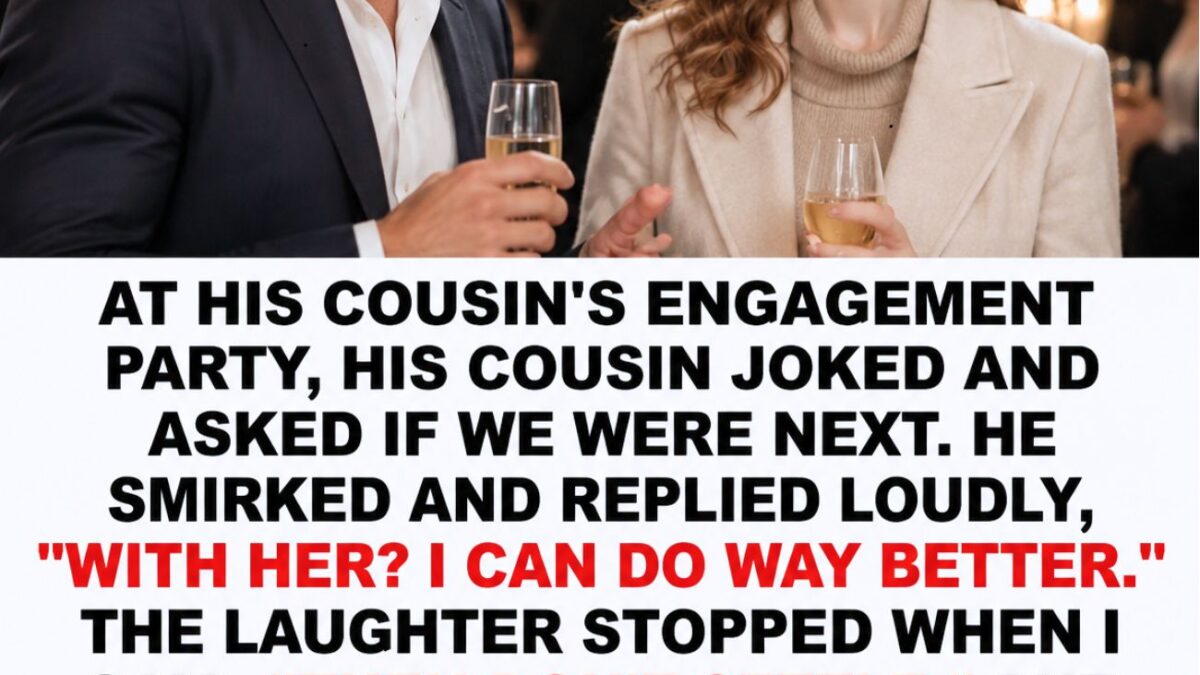
My name is Eunice T. Door, twenty-nine years old, and right now I am watching a video clip make its rounds through our mutual friend groups. The glowing screen reflects the faces of the exact same people who were laughing in the background while my entire life split cleanly in half beneath the rooftop string lights. At the time, I did not know anyone was filming, but of course someone was recording the entire scene on their phone.
That is simply what people do at glamorous engagement parties in the city. They capture candid reactions, they bottle social awkwardness, and they trade it later like cheap, disposable entertainment. What I never expected was to become the precise moment everyone replayed in their private message threads over cocktails.
I had been with Mason for two full years before that night. We met through work, started out casual, and somewhere along the line it transitioned into something serious, or at least that was what I had convinced myself. He was always charming in public, exceptionally confident in rooms packed with strangers, and the kind of man who could make anyone laugh as long as the joke was not aimed at him.
When we were completely alone, he could be warm, attentive, and almost undeniably sweet. Yet he also possessed a relentless habit of dropping small, sharp comments at my expense, and he always delivered them with the exact same warm smile, as if I were supposed to be profoundly grateful he had noticed me at all. At first, the barbs seemed harmless, or perhaps I simply worked very hard to convince myself that they were harmless.
He would say my career sounded stable but terribly boring, then kiss my forehead gently as if that tender touch balanced the scales. He would tease me about my car, referring to it as dependable in a cadence that sounded like an insult poorly dressed up as faint praise. He would frequently comment on my clothes being safe and uninspired, suggesting I lacked an adventurous spirit.
Whenever I held his gaze a little too long, silently deciding whether I possessed the energy to push back, he would chuckle and insist he was only teasing. He would routinely add that he loved me anyway, his voice thick with unearned benevolence. It always felt as though his love were a generous consolation prize handed out for enduring the humiliation of being laughed at.
Last Saturday, we attended his cousin Emma’s engagement party at an upscale rooftop venue downtown. The setting was undeniably elegant, with warm string lights crisscrossing the patio and expensive champagne flowing freely into crystal flutes. Roughly sixty guests were celebrating together with that immaculate, polished happiness people usually reserve for high-end photography sessions.
I wore a tailored navy dress that Mason had once admitted made me look sophisticated. He wore a dark designer suit, carrying himself as though he owned the very air circulating through the high-rise terrace. We arrived side by side, smiled warmly for the cameras, and exchanged polite small talk with distant relatives I only half-remembered.
The evening felt normal enough that the protective knot in my chest almost loosened completely. Around nine-thirty, Emma and her fiancé began making their formal rounds to thank everyone for showing up to celebrate. Emma was positively radiant, holding up her left hand to let the diamond catch the amber patio lighting.
When the happy couple reached our table, Emma pulled me into a tight hug before turning toward Mason with an infectious grin. She held out her hand once more to display the ring, her cheeks flushed with the sheer joy of the moment. Then, with an expectant tilt of her chin, she asked the question everyone invariably asks at engagement parties.
“So, when are you two next?” she teased, her voice carrying over the low hum of the ambient jazz. A few people standing nearby immediately turned their heads to watch the exchange unfold. The ambient rooftop air shifted into that familiar, expectant pause where everyone waits for a tender smile, a witty deflection, or an affectionate promise.
I turned toward Mason and felt that sickening, familiar tightness clench hard in the pit of my stomach. It was the exact physical warning that always signaled he was about to turn me into a punchline. He smirked, casting a sideways glance at me as if I were merely an unpaid prop in his personal stand-up routine.
Then he looked straight back at Emma and raised his voice so that at least twenty guests could hear him clearly. “With her? I can do way better.” The words did not stumble; they were delivered with absolute, theatrical timing.
A sudden burst of laughter rippled through the circle, sharp and immediate. Emma did not join in; her face fell instantly, looking as though she had been struck across the mouth. But the other guests standing around us, holding their drinks and hungry for social diversion, chuckled as if it were the cleverest quip of the night.
I stood completely frozen for several long seconds, which was just long enough to watch Mason revel in the attention. It was long enough to watch his eyes dart across the circle, drinking in their amused reactions like cheap fuel. And it was long enough for a profound, absolute realization to crystallize inside my chest.
Without a word, I reached out and lifted my glass from the high-top table, setting it down with deliberate gentleness. I looked straight into his smug, expectant eyes without blinking once. “Then don’t settle,” I said.
My voice was quiet, even, and devoid of any tremor. I turned around on my heel and walked directly toward the illuminated elevator vestibule. There was no screaming, no shattered glass, and no theatrical speech, just the measured, steady rhythm of my heels clicking across the polished marble.
Behind me, the collective laughter died instantly, dropping into silence as though someone had severed the power line. By the time the mirrored elevator doors slid closed, my phone was already vibrating frantically against my hip inside my coat pocket. The smooth descent felt infinitely longer than it had on the way up to the party.
My reflection in the glass wall looked remarkably placid, almost detached, yet my fingers were shaking enough that I had to bury them into the seams of my coat. I could still hear the ghost of that laughter echoing in my ears, not because it was loud, but because it was terribly familiar. It echoed every slight I had ever swallowed, every excuse I had made for his cruelty, and every time I had quieted my own voice to keep his fragile peace intact.
Outside the venue, the autumn air was cold, crisp, and clean, cutting through the fog in my mind with sudden clarity. I walked toward my car at a leisurely pace, unlocked the door, and sat behind the steering wheel in the darkness. The screen on my phone flashed repeatedly on the passenger seat: Mason, Mason, Mason.
I reached over and turned the device face down against the leather without reading a single word. I did not need to check the incoming notifications to know the exact arc his messages would follow. It would be disbelief first, followed quickly by wounded ego, and finally burning indignation directed entirely at me.
As I steered the car into the quiet midnight traffic, memories began playing across my mind in uninterrupted sequence. It felt as though my subconscious had merely been waiting for permission to stop defending the man who had continuously diminished me. Mason belonged to a family that never described itself as wealthy, yet carried itself as if constantly performing for an invisible gallery.
In his social circle, surface appearances were the only currency that carried genuine weight. Value was systematically calculated by vehicle makes, postal codes, professional pedigrees, and how neatly your trajectory presented itself on paper. His father operated a mid-sized management consultancy, projecting an aura of calculated authority.
His mother hosted philanthropic luncheons that functioned as thinly veiled corporate networking sessions. His older sister had married a corporate attorney, wearing her husband’s career milestones like custom jewelry. During our very first month of dating, Mason had evaluated my sedan, dubbing it remarkably reliable but utterly forgettable.
I had laughed it off at the time because the romance was young and I desperately wanted to appear easygoing. A few weeks later, surrounded by his former classmates, he announced that it was adorable how deeply I cared about my ordinary job. I was a senior project coordinator at a regional logistics enterprise, earning a competitive salary and building a solid career through relentless discipline.
Yet within the boundaries of his social orbit, an earned career without a prestigious pedigree was merely an awkward fact to be brushed aside. His social circle was predominantly composed of corporate attorneys, private equity analysts, and brand strategists who traded in insider jargon. I conversed with them easily enough, yet I could never shake the persistent sensation of undergoing an informal background check.
Mason invariably introduced me with a tiny, patronizing hesitation: “This is Eunice. She works in… logistics.” That deliberate micro-pause always hung heavy in the air, transforming my title into a mild apology. His family remained uniformly polite yet undeniably detached whenever I entered their immaculate living rooms.
At Thanksgiving, his father offered me a crisp handshake and immediately inquired about the exact trim of my vehicle. When I answered honestly, he merely gave an ambiguous nod and pivoted the conversation to municipal tax incentives. His mother inquired about my lineage with practiced charm, her smile freezing when I explained that my father was a retired diesel mechanic and my mother taught third grade.
“How quaint,” she murmured, reducing my parents’ decades of honest, backbreaking labor into an amusing piece of regional folklore. The disparaging jokes began escalating roughly six months prior to the rooftop gathering. At his sister’s birthday dinner at an upscale steakhouse, Mason announced to the entire table that I still frequented the local municipal gym instead of hiring a private trainer.
During an after-work gathering with his colleagues, he casually pointed out that my blazer was purchased off the rack rather than custom-tailored. They were small incisions, always delivered with an easy grin, and perpetually dismissed as harmless teasing whenever they drew blood. Whenever my face betrayed my hurt, he would briefly soften, take my wrist, and assure me that he loved me regardless.
It was as if his affection were a magic eraser meant to wipe away basic human dignity. I had confronted him about the habit only once, several months prior, while we were driving home from a colleague’s wedding reception. The amber streetlights had flickered across the dashboard as I quietly asked if he realized how often he demeaned me in front of company.
He had stared at me as though I were speaking an alien language, scoffing that I was simply looking for reasons to be offended. “It’s banter, Eunice. Don’t be so dramatic,” he had insisted, shaking his head at my apparent lack of sophistication. I had let the matter drop because I dreaded becoming the stereotypical humorless partner who ruined everyone’s good time.
I convinced myself that his humor was merely sharper, a product of an environment where affection was expressed through caustic wit. But the cuts accumulated silently beneath the surface, month after month, eroding my foundation until every public chuckle at my expense felt like undeniable evidence that I was merely being endured. By the time we stepped onto Emma’s rooftop terrace, I had developed a thick, protective numbness toward his casual jabs.
I had braced myself for some minor insult regarding my shoes, my background, or my practical sensibilities. I had certainly not prepared myself for him to stand before his extended family and declare that I was a temporary compromise. Somewhere between the tenth floor and the ground lobby, the bitter illusion finally dissipated.
He had not made a harmless joke; he had issued a public declaration of contempt. He had informed the people whose validation he craved that I was beneath him, and he had done so with a triumphant grin on his face. When I finally unlocked my apartment door, the living room was dark, wrapped in a profound silence that amplified my own thoughts.
I sat down on the edge of the sofa without switching on the overhead lamps, staring at the muted city lights beyond the blinds. I replayed the entire rooftop scene in high definition: his self-satisfied smirk, the ripples of laughter, Emma’s stricken expression, and my own calm departure. Then don’t settle.
No screaming, no profanities, no undignified begging; just an unreserved grant of permission. That was the unexpected variable that would ultimately unravel his composure. I had not handed him the theatrical lover’s quarrel he likely anticipated.
Instead, I had publicly agreed with his cruel assessment and promptly erased myself from the equation. The balance of power had inverted in an instant. He was no longer the witty master of ceremonies delivering a sharp punchline to an adoring crowd.
He was suddenly just an arrogant man standing beside an empty glass, holding an invisible microphone in front of people who now had to look at him without a buffer. I knew, with absolute certainty, that panic would soon set in. It would not stem from a broken heart, but from the sudden, terrifying realization that he had lost total control over his own narrative.
When I finally turned my phone over, the screen was practically pulsing with unread notifications stacked in an endless, illuminated queue. There were missed calls, urgent text messages, and voicemails, nearly all originating from Mason during the first frantic hour. His initial dispatch had arrived precisely twelve minutes after I stepped into the elevator: “Where the hell did you go?”
Three minutes later, another notification had buzzed against the table: “Are you seriously storming off over an obvious joke?” Then, shortly before ten o’clock, the tone had shifted directly toward social anxiety: “Everyone is asking where you went. You are embarrassing me right now.” I read each sentence with a clinical detachment, observing how effortlessly his focus migrated from superficial confusion to outright resentment.
Not once did he ask if I had made it home safely through the downtown traffic. Not once did he pause to examine the grotesque cruelty of the statement he had projected across the terrace. The phone calls had started immediately after that third text, ringing until the voicemail kicked in, only to restart thirty seconds later.
I had simply let the device vibrate until the screen went dark again. Around ten-thirty, his strategy had softened slightly: “Look, I didn’t mean it the way it sounded. You know I was just messing around with Emma.” By eleven-thirty, irritation had crept back into his phrasing: “Can you please just pick up? This silent treatment isn’t funny anymore.”
Then, right on schedule, the predictable defensive wall had snapped into place just past midnight: “Fine. Be impossible. We’ll deal with this tomorrow when you’ve calmed down.” I had switched the phone completely off, set it on the nightstand, and gone to sleep with an unsettling, dreamless peace.
When I woke on Sunday morning, bright autumn sunlight was stretching across the hardwood floor, and my phone displayed dozens of missed notifications. Most were subsequent frantic attempts from Mason, but two other names immediately caught my attention: Emma and Mason’s older sister, Claire. Emma’s initial message had been sent shortly after the gathering broke apart: “Eunice, I am so incredibly sorry. That was horrific, and I feel sick. Are you okay?”
Her second message had arrived forty minutes later: “Mason left early. People were whispering about him the rest of the night. I think he finally realizes what he did.” Then, well past midnight, Emma had sent a final, heartfelt thought: “For what it’s worth, you handled that moment with more dignity and grace than anyone I know.”
I sat on the edge of my mattress and typed a calm reply to Emma: “Thank you, Emma. I am completely fine. Please don’t let this ruin your celebration. Congratulations again to you both.” Her response landed within seconds, accompanied by a heart icon, as if she were desperately seeking confirmation that her joy had not been permanently poisoned by her cousin’s arrogance.
Claire’s messages were characteristically blunt, lacking any of the diplomatic softening her brother usually demanded from his family. “That was completely unacceptable behavior from Mason,” she had texted plainly. A follow-up followed five minutes later: “He’s pacing around making excuses, but he brought this entirely on himself.”
Reading those words from his own sister produced a strange, grounding sensation, validating the quiet anger I had carried for months. Meanwhile, Mason’s overnight messages read like a desperate case study in escalating panic. At one in the morning, he had texted: “Everyone here is acting like I committed a federal crime. It was a joke, Eunice. You turned me into the villain by walking out.”
By two-thirty, his anger had dissolved into fractured bargaining: “Please talk to me. I know you’re upset. Let me come over so we can fix this.” His final text, sent near dawn, had simply read: “I can’t believe you’re throwing away two years like this.”
I stood up, started a pot of dark coffee, and leaned against the counter, waiting for the inevitable knock. At nine-thirty sharp, the rapid rapping began on my apartment door. When I opened it, Mason stood on the welcome mat, still wearing his rumpled trousers and the dress shirt from the night before, his jacket absent and his tie shoved haphazardly into his pocket.
His hair was disheveled where he had clearly dragged his hands through it all night, and the manufactured confidence had peeled away to reveal exhaustion and raw defensiveness. He stepped past me without waiting for an invitation, tossing his car keys onto my dining table with an aggressive flick of his wrist. “Are we actually going to discuss this, or are you going to keep acting like a child?” he demanded, wheeling around to face me.
I picked up my coffee mug from the counter and held it with both hands, meeting his bloodshot gaze evenly. “What exactly would you like to discuss, Mason?” I asked, my voice flat and completely unbothered. “About you making a massive theatrical scene and walking out on me in front of my entire extended family!” he snapped, his voice rising an octave.
“You told your entire extended family that you could do far better than me,” I replied, keeping my volume entirely level. “I simply agreed with your assessment and removed myself. What seems to be the issue?” His pale cheeks flushed crimson, the veins along his jawline tightening as he struggled to regain control of the room.
“It was a joke!” he shouted, throwing his hands into the air. “It was banter, Eunice! You know how my family talks at these things!” “It didn’t sound like banter to anyone on that terrace,” I countered. “It sounded like you were stating an absolute fact, and you were waiting for them to applaud you for it.”
“Oh, come on!” he groaned, pacing between the sofa and the window. “You are blowing this completely out of proportion! People make self-deprecating relationship jokes all the time!” I took a measured sip of coffee, watching his frantic movements with a sense of detachment that surprised even me.
“Do you actually want to be in a partnership with me?” I asked quietly, cutting through his rehearsed monologue. “Or do you just enjoy keeping someone around who never pushes back when you need to make yourself feel superior?” He stopped pacing, his mouth falling slightly open as if he had run into a glass wall. “What are you talking about?”
“You have spent the better part of two years dropping small, calculated insults into our conversations,” I told him, each word deliberate. “You degrade my work, you mock my car, you belittle my background, and you criticize the way I dress. I let it slide because I was naive enough to believe it was just your clumsy way of joking.”
“Because it was just joking!” he insisted, his voice trembling with frustration. “You’re taking things completely out of context!” “Last night on that rooftop, you didn’t just make a sarcastic comment,” I continued, ignoring his frantic interruption. “You announced to a crowd of sixty people that I was merely a placeholder until something more impressive came along.”
“That is not what I meant, and you know it!” he fired back, crossing his arms tightly over his chest. “So what, you’re really going to throw away a two-year relationship over six careless words at an open bar?” “I am ending this relationship because you do not respect me,” I said, looking him dead in the eyes. “And I have finally run out of patience for pretending that your disrespect is acceptable.”
The defiant posture he had maintained suddenly fractured, his arms dropping awkwardly to his sides as the reality penetrated his ego. “Wait… are you actually breaking up with me?” he stammered, his eyes searching my face for any hint of hesitation. “Yes, Mason. We are done.”
“Over a stupid comment at a party?” he repeated, his voice dropping into disbelief. “Over two years of small cruelties that you disguised as affection,” I corrected him gently. He stood entirely motionless in the center of my small living room, staring at me as if waiting for me to break into a laugh and release him from the nightmare.
When the silence stretched on between us, cold and permanent, his shock hardened back into defensive indignation. He snatched his keys off the dining table with trembling fingers and stormed toward the entrance. “Fine!” he spat, glaring at me over his shoulder with pure venom. “If you want to throw away something solid over your fragile ego, go right ahead! You’re going to regret this, Eunice!”
I did not offer him the satisfaction of an answer. The heavy wooden door slammed shut behind him, rattling the picture frames along the entryway before the apartment settled back into complete stillness. I walked over to the kitchen sink, rinsed my mug under the running water, and felt a profound, unprecedented tranquility wash over my entire being.
The calm that settled into the apartment was not fragile; it felt solid, like the quiet that follows the clearing of an oppressive storm. Outside, the morning traffic continued its rhythmic hum, completely indifferent to the quiet conclusion that had just occurred inside my living room. I spent the remainder of the morning unpacking my schedule, breathing the fresh air drifting through the open balcony door.
Around noon, my phone rang again, displaying Emma’s name across the screen. I answered immediately, greeting her with a warmth that felt entirely natural despite the tension of the weekend. “Eunice, I just had to call,” Emma began, her voice carrying that specific brand of exhaustion that comes from managing family chaos.
She proceeded to tell me that Mason had arrived at his parents’ house in a state of absolute fury, attempting to rewrite the entire incident. He had claimed to anyone who would listen that I had suffered an emotional breakdown over nothing and made an unprovoked scene. “Nobody believed him, Eunice,” Emma told me firmly, her voice leaving no room for ambiguity.
“I pulled him into the kitchen and told him that what he did was cruel, humiliating, and completely unacceptable under my roof,” she continued. “I told him that if he couldn’t treat his partner with basic decency, he had no business showing his face at family functions.” Hearing his cousin advocate for me so fiercely caused something long-buried to release inside my ribcage.
Less than an hour later, Claire sent another concise, illuminating message: “I told him he crossed a line that no woman with self-respect would ever tolerate. He isn’t heartbroken, Eunice; he’s embarrassed that his image took a hit, and you need to remember the difference.” That single distinction—between wounded pride and genuine remorse—clarified everything I had witnessed over the preceding twenty-four hours.
By early afternoon, Mason had clearly realized that his initial aggressive posture was failing to generate the desired leverage. His text messages morphed into calculated displays of contrition: “I am so sorry, Eunice. I was completely overwhelmed by the crowd, and I panicked under the spotlight. You know my family always pressures me about milestones, and I made a terrible, stupid joke trying to deflect.”
I read the words without typing a single character in response. The message did not read like an earnest realization of harm; it read like a rehearsed legal defense crafted to mitigate reputational damage. At precisely three o’clock, the doorbell chimed twice in rapid succession—his trademark, demanding cadence.
I walked to the entrance and pulled the door open, but I remained firmly planted in the threshold, barring entry. Mason stood in the hallway, holding a brown paper carryout bag from the local café, his eyes ringed with dark circles. “Can we just talk for five minutes?” he pleaded, holding the bag out toward me like an olive branch. “I brought that cold brew you always get from the corner bakery.”
A few months earlier, that small gesture might have successfully disarmed my anger, drawing me back into his orbit. But staring at the branded paper bag, all I could see was an insulting attempt to purchase absolution for the price of iced coffee. “I don’t want the coffee, Mason,” I told him, keeping my hands resting comfortably at my sides.
He leaned forward slightly, lowering his tone into an intimate, urgent register. “Eunice, please. You know me. You know I didn’t mean it literally. I was put on the spot by Emma, and I didn’t think before I spoke.” “That is precisely the root of the problem,” I said calmly. “You didn’t think, and whenever your guard drops, your instinct is to diminish me to elevate yourself.”
He rubbed his forehead with an irritated groan, his patience visibly wearing thin. “You’re treating me like some kind of emotional abuser, Eunice! It was one bad joke!” “No,” I countered, looking directly into his exhausted eyes. “I am simply treating you like a man whose true opinion of me was finally spoken aloud.”
He attempted a dismissive chuckle, but the sound caught awkwardly in his throat. “So that’s really it? Two entire years down the drain because you won’t allow a guy to make a single mistake?” “Two years are ending because you showed me exactly who you are when you feel comfortable and secure,” I answered.
His expression hardened instantly, the apologetic veneer falling away as his deep-seated arrogance resurfaced. “You’re throwing away a great life together over pure, stubborn pride,” he sneered, his voice dropping into a cutting whisper. “This has nothing to do with pride,” I told him, feeling the absolute truth of the statement vibrating in my chest. “This is basic self-respect.”
That specific phrase seemed to strike him with the force of a physical blow, leaving him momentarily speechless. For a split second, I wondered if the realization might finally crack through his defenses, but his ego mobilized once more to protect itself. “You really think you’re better than me now, don’t you?” he hissed, his jaw clenching.
“No, Mason,” I said quietly, feeling an overwhelming sense of liberation. “I simply know that I am much better to myself when I am away from you.” He stared at me in stunned silence, then let out a sharp, bitter laugh that echoed off the hallway walls. “Fine. Walk away then. Let’s see how long it takes before you realize that mature adults don’t abandon relationships over words.”
“I just did,” I said. Before he could formulate another retaliatory sentence, I stepped back and closed the heavy door firmly between us. I stood in the entryway, listening to the muffled sound of his footsteps retreating down the carpeted hallway toward the elevators.
A profound, weightless relief washed through my body, confirming that the person who had just walked away held no remaining authority over my life. Later that evening, my phone chimed with an unexpected message from Emma’s fiancé, David: “Eunice, I just wanted to reach out and say that your exit last night was absolutely legendary. More than a few people here told Mason today that he owed you an apology he isn’t man enough to deliver. Take care of yourself.”
I smiled, set the phone aside, and declined to reply. I no longer required outside confirmation to validate my choices; the internal clarity I possessed was more than sufficient. Mason ceased calling by nightfall, and for the first time in two years, I drifted off to sleep without a knot in my stomach.
The following morning, my apartment seemed distinctly brighter, as if the space itself were recovering from a long, suffocating illness. His running shoes still sat beside the entryway bench, an extra jacket remained draped over the dining chair, and his mug rested on the drying rack. They were mundane artifacts of a shared life that had ended abruptly without bothering to pack its bags.
Mason sent a single message later that afternoon: “I will be coming by around six to collect the rest of my belongings.” I replied with two words: “I’ll be here.” When the knock arrived, he was not alone; he had brought Claire along, clearly hoping her presence would serve as a shield against further embarrassment.
Claire offered me a tight, sympathetic nod as she stepped across the threshold carrying a couple of collapsed cardboard boxes. The packing proceeded with mechanical efficiency, books, running gear, toiletries, and clothing being quietly boxed and sealed without unnecessary discussion. Mason avoided my eyes entirely, focusing his attention on his phone while his sister methodically cleared his shelves.
That sullen, avoidant silence felt remarkably honest, far more authentic than any of the practiced charm he had exhibited throughout our relationship. When the final container was packed, Claire carried it out to the landing, pausing briefly beside me while Mason hauled the garment bags toward the elevator. “For whatever it’s worth,” Claire murmured, keeping her voice low so it wouldn’t carry, “I told him he completely ruined something exceptional. Look after yourself, Eunice.”
“Thank you, Claire,” I said, offering her an earnest smile. She nodded once with genuine warmth, turned, and disappeared down the corridor behind her brother. As the elevator doors closed on them for the final time, the apartment seemed to expand, opening up spaces that had been crowded with his demands for validation.
In the weeks that followed, the social ripples of that evening continued to unfold throughout our extended network. Emma phoned to inform me that she had formally revoked Mason’s invitation to several pre-wedding celebrations, refusing to tolerate his behavior around her closest friends. Learning that his family was holding him accountable brought a fleeting, wry amusement, demonstrating that arrogance rarely survives when confronted with unwavering boundaries.
Occasional messages arrived from acquaintances who had witnessed the rooftop scene, offering retrospective support and quiet confessions. A mutual friend from his university days confided that Mason had always possessed a cruel streak, routinely humiliating others under the protective banner of good humor. Another relative admitted they had often wondered why a woman with my competence had tolerated his subtle condescension for so long.
I chose not to engage with most of the correspondence; I had no interest in presiding over an informal tribunal regarding his character. I was occupied with the much more important task of rebuilding my own routines without his critical commentary playing in the background. Approximately a month later, Emma contacted me to reiterate her wedding invitation, emphasizing that Mason would not be attending with a companion and that she genuinely wanted me present.
I accepted, knowing that attending would signify a meaningful closure rather than a painful reminder of what had fallen apart. When the wedding arrived six weeks after the rooftop incident, the late-afternoon ceremony bathed the venue in a soft, amber glow that felt completely devoid of tension. I sat in the fifth row among guests who greeted me with uncomplicated kindness, free from the suffocating expectations that had defined my time with Mason.
During the reception, David sought me out near the terrace, offering a warm toast to quiet strength and personal clarity. Later, Emma embraced me warmly on the dance floor, whispering how deeply grateful she was that I had chosen to celebrate their beginning with them. Mason was completely absent from the celebration, his seat quietly reassigned without fanfare, his absence passing without inquiry.
Driving back to my apartment that night, watching the distant city skyline glimmer through the windshield, I realized that the lingering anger had dissolved entirely into peaceful indifference. Mason had attempted a few clumsy public relations maneuvers on his social media accounts, sharing inspirational platitudes regarding personal resilience, yet the reception had been noticeably cold. Eventually, he ceased performing entirely, his manufactured persona crumbling under the weight of his own conduct.
Several months later, his younger brother Ben sent a brief, considerate message mentioning that Mason was seeing someone new, wanting to give me a courtesy alert in case we crossed paths downtown. I typed back a sincere thank you, noticing with absolute satisfaction that the news produced no visceral reaction, no jealousy, and no lingering grief. The life I had built since that rooftop party was entirely my own, anchored in a profound self-respect that no punchline could ever diminish.
Sometimes my mind drifts back to that crowded downtown terrace, remembering the cold champagne, the laughter, and the smug expression on Mason’s face right before the floor dropped out from beneath him. In that split second, walking away had felt like an admission of defeat, as though I were conceding the territory to his casual cruelty. Now, with the benefit of miles and months between us, the truth is indisputable.
I had not surrendered anything that night on the roof; I had merely stopped participating in my own degradation. I had set down my glass, spoken four transformative words, and stepped into the elevator toward my own life. It turns out the easiest way to defeat a punchline is to simply stop playing the fool.

