“At 19, She Was Forced to Marry an Apache — But His Wedding Gift Silenced the Whole Town”
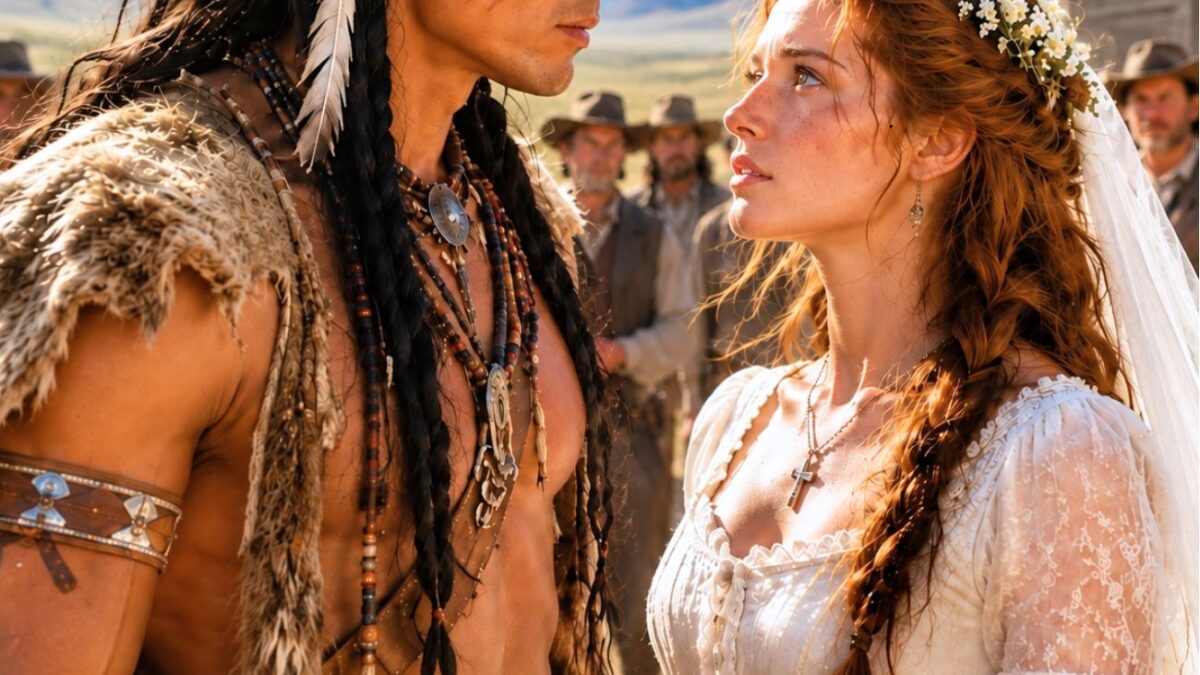
Charlotte Bennett was nineteen years old the morning she learned her future had already been sold. The sun had barely risen above the rolling hills beyond Willow Ridge, washing the frontier town in soft gold. Wooden storefronts awakened one by one as merchants swept dusty porches and stable hands led horses toward fresh water. It looked like the beginning of an ordinary summer day. For Charlotte, it was the end of the life she had imagined.
She stood outside the small farmhouse where she had been born, her hands wrapped around a weathered basket filled with fresh bread she no longer intended to deliver. Through the open kitchen window, she heard her father speaking with two men whose voices carried the unmistakable weight of final decisions. The debt is settled. A pause. Then another voice answered. The agreement stands. Charlotte’s heart tightened. She recognized neither voice.
She had learned long ago that adults lowered their voices only when children were never meant to hear the truth. She stepped closer. Her father sounded older than he had the night before. I never wanted it this way. No father does. The silence that followed was heavier than any argument. Finally, one sentence drifted through the window and settled over Charlotte like cold rain. She’ll marry the Apache before next week’s moon.
The basket slipped from her fingers. Warm loaves tumbled into the dust. For several seconds, she could neither breathe nor move. The Apache, she had heard the stories since childhood, whispered warnings around fireplaces. Travelers describing silent warriors riding across endless plains. Children daring one another to venture beyond the hills where they believed Apache scouts watched from hidden ridges.
Some stories painted them as merciless. Others claimed they were ghosts who appeared without leaving footprints. No one seemed to know which stories were true. Yet every version ended the same way. People feared them. Charlotte stumbled backward before anyone inside noticed she had been listening. The world suddenly felt unfamiliar. The cottonwood trees still swayed in the morning breeze. The birds still greeted the sunrise.
Nothing around her had changed. Everything inside her had. She wandered toward the edge of town without direction, barely noticing the familiar faces that greeted her with polite smiles. Mrs. Harlo waved from the bakery. Young Samuel Cooper chased chickens across the road. Old Mr. Ellis tipped his hat while repairing a broken wagon wheel. Ordinary moments, ordinary people. Charlotte wondered how many already knew.
She found herself standing beside the small church where her mother had once taught Sunday hymns before illness claimed her years earlier. The wooden doors stood open. Inside, colored sunlight spilled gently across empty pews. Charlotte sat alone in the last row. She had often come here seeking answers. Today, silence offered only more questions. Why her? Why now? Why marriage? Why an Apache she had never met?
The soft creak of the church door interrupted her thoughts. Reverend Thomas entered quietly before noticing her. Charlotte. She quickly brushed away the tears she had hoped no one would see. I’m sorry. You have nothing to apologize for. He sat several pews ahead, giving her space instead of sympathy. After a long silence, she finally asked the question burning inside her. Is it true?
The reverend lowered his eyes. Your father owes more money than he can repay. So I am the payment. His expression revealed more sorrow than surprise. I wish I could tell you otherwise. Charlotte stared toward the simple wooden cross above the altar. I don’t even know his name. The reverend looked toward the bright doorway where morning sunlight poured across the floorboards. His name is Elías Red Hawk.
She waited. He came to town yesterday. I never saw him. He did not stay. Another silence settled between them. What kind of man is he? The reverend considered the question carefully. I’ve spoken with him only once, and he listened far more than he talked. Charlotte almost laughed through her tears. That tells me nothing. No, he smiled gently, but sometimes it tells you everything.
She left the church no less frightened than when she had entered. As she crossed the town square, she noticed people gathering near the general store. Whispers traveled more quickly than wagons in Willow Ridge. Heads turned as she passed. Conversations stopped, not cruelly, almost uneasily. Everyone seemed to know something she wished desperately were untrue. Near the hitching rail, two women lowered their voices. Poor girl. They say she has no choice. I heard the Apache agreed without asking for anything.
Charlotte kept walking. Every whispered word followed her like a shadow. By late afternoon, she reached the small hill overlooking the valley west of town. The prairie stretched endlessly beneath a vast blue sky, its tall grass bending with the summer wind. Far in the distance, barely visible against the golden landscape, a lone rider guided a dark horse across the open plain, too far away to distinguish his face, too distant to know whether it was truly him.
Yet something about the rider’s calm, unhurried pace held her attention. He neither rushed nor wandered. He simply rode with quiet purpose, as though the immense frontier already knew his name. Charlotte watched until horse and rider disappeared beyond the distant hills. She realized with quiet dread that in only a few days the stranger on the horizon would become her husband. She knew nothing about his voice, nothing about his heart, nothing about the truth hidden beneath the fearful stories that had shaped her childhood.
Only one certainty remained. The entire town pitied the girl being forced to marry an Apache. No one, not even Charlotte herself, could have imagined that the greatest surprise of her life would not arrive on her wedding day. It would arrive afterward inside a simple wooden gift that would leave an entire town without a single word to say. The following morning, Willow Ridge awoke beneath a sky so brilliantly blue that it seemed impossible for sorrow to exist beneath it.
Charlotte Bennett wished the weather had matched her heart. She had slept little. Every time she closed her eyes, she saw the distant rider disappearing beyond the western hills. His face remained hidden, yet somehow that made him more frightening. Fear had a way of filling empty spaces with its own imagination. She rose before sunrise and quietly began the familiar chores her mother had once taught her. She swept the front porch, collected eggs from the chicken coop, watered the small vegetable garden behind the farmhouse.
She performed each task carefully, as though ordinary routines might somehow delay the future waiting only days away. Her father stepped onto the porch just as the morning light reached the fields. Samuel Bennett looked older than he had only a week before. The deep lines across his weathered face seemed carved by regret instead of age. Charlotte, she continued watering the tomatoes. You don’t have to explain. I wasn’t going to. She finally looked at him. I know.
For a long moment, neither spoke. The silence between father and daughter was no longer angry. It was simply tired. I failed your mother, he said quietly. Charlotte lowered the watering can. You loved her. I promised I’d protect you. His voice almost broke. I couldn’t even keep that promise. She wanted to tell him none of this was his fault, but she could not. Not yet. The debt had begun after two seasons of failed harvests, followed by sickness that had taken nearly every animal they owned.
Then came a fire that destroyed half the barn during the previous winter. Misfortune rarely traveled alone. When it arrived, it invited more of itself. I’ve heard the stories, Charlotte whispered. So have I. They say Apache warriors. I know what they say. She searched his face. Are they true? Samuel looked toward the open prairie beyond their fields. I honestly don’t know. His answer surprised her. I’ve never met him. You agreed to this marriage. I agreed because there were worse men asking for the debt.
Charlotte frowned. Worse. He nodded slowly. One wanted the farm and the other. He hesitated. The other wanted you. A chill passed through her despite the warm morning. Samuel stepped closer. The Apache asked for neither. Charlotte stared at him in confusion. Then why? I don’t know. That uncertainty unsettled her even more. By midday, preparations for the wedding had quietly begun throughout Willow Ridge. Not because anyone celebrated, but because frontier towns understood necessity.
Mrs. Harlo altered an old ivory dress that had belonged to Charlotte’s late mother. The church caretaker polished the wooden pews. Someone repaired the front gate leading into the churchyard. Everything happened with quiet efficiency. No music, no excitement, only duty. Late that afternoon, Reverend Thomas arrived at the farmhouse carrying a small leather Bible wrapped in worn cloth. It belonged to your mother. Charlotte accepted it carefully. I thought it was lost. She asked me to keep it until the day you married.
The words landed heavily between them. I don’t think this is the day she imagined. No. The reverend smiled sadly. I don’t believe it is. He reached into his coat pocket and unfolded a small piece of paper. Elías asked me to give you this. Charlotte blinked. He sent something. The reverend handed her the folded note. There was only one sentence written in neat, deliberate handwriting. You owe me nothing. No signature. No explanation. Charlotte read it twice, then a third time.
What does it mean? I didn’t ask. He wrote this. Yes. She turned the paper over. Blank. Nothing else. No instructions, no promises, only those four words, You owe me nothing. They made no sense. She was being forced into marriage. How could she owe him nothing? The question lingered long after Reverend Thomas had gone. As evening settled across the valley, Charlotte walked once more toward the western ridge overlooking the prairie. The air smelled of dry grass and sage carried by a gentle breeze.
She unfolded the note again. You owe me nothing. The handwriting was steady, confident. Whoever Elías Red Hawk was, he had not written those words in anger or triumph or possession. They felt strangely gentle. The sound of approaching hoofbeats interrupted her thoughts. Charlotte instinctively stepped behind a large cottonwood tree overlooking the trail. A lone rider emerged from the fading sunlight. The same dark horse, the same unhurried pace. This time he was much closer.
He was taller than she had imagined, broad-shouldered and powerfully built, sitting his horse with effortless balance. His long black hair was gathered into a single thick braid that rested against sun-browned buckskin. A leather knife sheath hung naturally at his waist, while a small bundle of freshly gathered herbs was secured behind the saddle. He did not resemble the terrifying monster from childhood stories, nor did he resemble the reckless warriors described by frightened travelers. He simply looked calm.
As though violence had never interested him, his deep brown eyes slowly swept across the surrounding hills. For one terrifying moment, Charlotte thought he had discovered her hiding place. Instead, he guided his horse toward a section of broken fencing near the edge of the Bennett property. He dismounted without hesitation. Charlotte remained perfectly still behind the tree. The damaged fence had been leaning for weeks after a fallen branch snapped two support posts. Samuel had planned to repair it after harvest.
He never found the time. Without calling for anyone, without expecting thanks, Elías removed several tools from his saddle. Working quietly beneath the fading light, he straightened the posts, replaced cracked rails, and secured each section with practiced precision. He never approached the house, never knocked on the door, never announced himself. When the final rail stood firm again, he gathered his tools, mounted his horse, and rode away exactly as quietly as he had arrived.
Charlotte remained hidden until the sound of hoofbeats disappeared into the distance. Only then did she step forward. She ran her fingers across the newly repaired wood. The craftsmanship was careful, strong, made to last. She looked west toward the endless prairie where the lone rider had already become another distant silhouette beneath the setting sun. The stories she had believed her entire life suddenly felt less certain than they had that morning. She still feared the stranger she was about to marry. But for the first time since learning her fate, another feeling quietly found its place beside that fear. Curiosity.
Three mornings later, the church bell rang only once. Not in celebration, not in mourning, only as a quiet signal that everyone in Willow Ridge already understood. The wedding day had arrived. A thin layer of mist drifted across the prairie before sunrise, softening the distant hills into pale blue shadows. The frontier seemed unusually still, as if even the wind had decided to watch what would happen next. Charlotte Bennett stood before the cracked mirror in her bedroom, while Mrs. Harlo adjusted the final buttons of her mother’s ivory dress.
Time had faded the fabric from brilliant white to warm cream, but every careful stitch still carried traces of the woman who had once worn it with joy. Charlotte barely recognized the young woman reflected in the glass. The freckles across her pale cheeks remained. The loose braid of auburn hair rested gently over one shoulder. Her green eyes, however, belonged to someone older than nineteen. You look beautiful, Mrs. Harlo whispered. Charlotte offered a faint smile. I don’t feel beautiful. The older woman paused before smoothing a wrinkle from the skirt. You don’t have to feel ready. I don’t even know what I’m walking toward.
Mrs. Harlo had no answer. Outside, wagons rolled slowly toward the church. Families arrived dressed in their Sunday clothes, speaking quietly as though louder voices would somehow make the occasion more painful. No one laughed. Children who normally chased each other across the square remained unusually close to their parents. Even the horses seemed calmer than usual. The entire town had come, not because they approved, but because history was about to unfold in front of them.
Charlotte’s father waited beside the farmhouse gate. Samuel Bennett held his hat in both hands, turning its brim nervously between rough fingers. When he saw his daughter step outside, emotion briefly overcame him. For a moment, he simply stared. You look just like your mother. Charlotte slipped her arm through his. I hope she would forgive us. Samuel closed his eyes. I hope she would forgive me. They walked toward the church together. Every familiar building along Main Street now felt strangely distant.
The blacksmith stopped hammering. The general store owner removed his hat. Mrs. Cooper quietly pulled her children aside to make room. No one openly stared. Yet Charlotte felt every pair of eyes following her. The whispers began anyway. They say the Apache is already here. I heard he came before dawn. Has anyone spoken to him? No. They say he hasn’t said ten words. Fear spread fastest where certainty did not exist. As Charlotte reached the church steps, she noticed Sheriff Daniel Harper standing beside the entrance with folded arms.
He nodded respectfully. Miss Bennett. She returned the greeting. Is everything all right, Sheriff? It will be. His answer sounded more hopeful than confident. The church doors opened. Sunlight streamed through tall windows, filling the small sanctuary with warm amber light that softened the worn wooden pews. Every seat was occupied. People lowered their voices as Charlotte entered. Then silence gradually settled over the room. At the front of the church stood Reverend Thomas. Beside him stood Elías Red Hawk.
Charlotte had imagined this moment countless times. None of those imagined versions resembled reality. He stood tall without appearing proud. His broad shoulders remained relaxed beneath simple buckskin clothing that had been carefully cleaned for the occasion. His long black braid rested neatly along his back. A carved leather belt circled his waist while a small silver pendant caught the morning light against his bronze skin. His expression revealed neither excitement nor resentment, only quiet composure.
Most surprising of all, he did not immediately look at Charlotte. Instead, he lowered his eyes respectfully as she approached, allowing her to reach the altar before meeting her gaze. When their eyes finally met, Charlotte found none of the hatred she had prepared herself to endure, nor triumph, nor possession. His deep brown eyes remained calm, steady, almost careful, as though he understood she had entered this church carrying fear he had never wished to cause.
The ceremony began. Reverend Thomas spoke slowly about commitment, honor, and choosing compassion when life refused to offer easy roads. Charlotte heard only fragments. Her heartbeat drowned out most of the words. When the vows arrived, Elías spoke first. His voice surprised everyone. Deep, quiet, measured. Each word carried the calm certainty of someone who never wasted speech. I give only what I choose freely. The unusual wording caused several people to exchange confused glances.
Reverend Thomas hesitated only briefly before continuing. Charlotte repeated the traditional vows almost automatically. Her voice trembled. His never did. When Reverend Thomas finally declared them husband and wife, no applause followed, only silence. Outside, townspeople gathered beneath the bright afternoon sun, while simple tables were arranged with bread, roasted vegetables, preserves, and fresh coffee. No musicians played. No dancing began. People spoke politely, but uncertainty lingered over every conversation.
Charlotte stood near the church porch, unsure what came next. Elías remained several yards away, speaking quietly with Reverend Thomas. Again, he seemed to listen more than he talked. A young stable boy accidentally dropped a wooden bucket while leading a nervous horse across the yard. The startled animal reared sharply, snapping its lead rope. Panic rippled through the crowd. The frightened horse lunged toward a group of children gathered beside the church fence.
Before anyone could react, Elías moved. There was no shouting, no dramatic display, only swift, practiced precision. Within seconds, he stepped calmly into the horse’s path, catching the trailing rope without jerking it. His free hand rested lightly against the frightened animal’s neck while he spoke in a voice too soft for anyone else to hear. Almost immediately, the horse stopped struggling. Its breathing slowed, its ears relaxed. The frightened children stood frozen.
Elías simply handed the rope back to the stunned stable boy. You did nothing wrong, he said gently. The boy nodded, still speechless. Without waiting for gratitude, Elías stepped back exactly as quietly as he had entered the moment. Charlotte watched from across the churchyard. For the second time in less than a week, the man she had expected to fear had solved a problem without asking anyone to notice. The whispers around the yard changed. Not completely, not yet, but enough for Charlotte to hear the uncertainty replacing old prejudice.
I thought. So did I. That isn’t what I expected. Neither, Charlotte realized, was anything else about the man she had just married. As the afternoon sun stretched long shadows across the churchyard, she caught Elías looking toward her for only a brief moment. He offered no smile, no claim, no demand, only a small respectful nod before turning away once more. And somehow that quiet gesture unsettled her heart far more than anything she had feared before the wedding ever began.
The celebration ended before sunset. Not because anyone announced it, but because no one quite knew how to celebrate. Families drifted away from the church in quiet groups, their wagons disappearing one by one beneath the golden light of late afternoon. Conversations remained low, careful, unfinished, as though the entire town had witnessed something they could not yet explain. Charlotte Bennett stood alone near the hitching rail, watching the emptying square. She had expected this moment to feel like the end of something. Instead, it felt like standing at the edge of an unfamiliar road.
Her father approached slowly, removing his worn hat. I wish I could walk you home. Charlotte managed a small smile. You already have. Samuel glanced toward Elías, who was fastening a saddle blanket onto his dark horse several yards away. He built the cabin himself. Charlotte looked up. The cabin? Samuel nodded. It’s north of Miller Creek. I thought you’d be living with his people. She hesitated. I didn’t know. There are many things none of us knew. Before she could ask another question, Samuel embraced her for the first time since her mother had died. It was brief, awkward, honest. I’m sorry, he whispered. Charlotte closed her eyes. I know.
When he finally stepped away, he climbed into his wagon without another word. She watched until the wagon disappeared beyond the cottonwood trees. For the first time in her life, there was no home waiting for her behind him, only the unknown. Elías finished securing the last leather strap before turning toward her. The ride is not long. His voice remained calm, almost gentle. Charlotte nodded silently. He offered his hand, not to lead her, but simply to help her climb onto the horse. When she hesitated, he waited. No impatience, no pressure, only quiet patience. She accepted.
His hand was warm and calloused from years of honest work. Yet his grip remained unexpectedly careful. Once she was seated, he mounted behind her with practiced ease, leaving respectful space between them. Without another word, they rode west. The town gradually disappeared behind rolling fields painted gold by the lowering sun. Neither spoke for nearly half an hour. The only sounds were steady hoofbeats, distant meadowlarks, and wind moving through endless prairie grass. Charlotte found herself relaxing despite everything. Silence no longer felt threatening. It simply existed.
As the trail crossed a shallow creek, Elías guided the horse to slower footing. The water rises after heavy rain, he said. She looked down at the clear current flowing over smooth stones. It must be beautiful in spring. It is. Another silence followed. This one felt easier. Eventually, the cabin appeared. It rested beneath several tall cottonwood trees overlooking Miller Creek, surrounded by a modest vegetable garden and a neatly stacked supply of firewood. Wildflowers bloomed beside the front porch. The roof had been repaired recently.
Everything looked simple. Everything looked cared for. Charlotte blinked in surprise. This is yours. It is ours now. The words could have sounded possessive. Instead, they sounded like an invitation. Elías dismounted first before helping her safely to the ground. He carried neither authority nor expectation in his movements, only courtesy. Inside, the cabin smelled faintly of cedar and fresh pine. Sunlight streamed through clean windows onto polished wooden floors. A stone fireplace occupied one wall. Two rocking chairs faced the hearth.
Shelves held neatly arranged books, dried herbs, and carefully folded blankets. Nothing luxurious, nothing neglected. Charlotte slowly walked through each room. Everything had been prepared, not lavishly, but thoughtfully. She stopped at the bedroom doorway. Two separate beds stood against opposite walls. She turned toward Elas in surprise. He quietly set her small travel bag beside one of them. I thought you should decide what comes after today. Charlotte stared at him. You expected me to be afraid. Yes. And this.
She looked again at the two beds. Was your answer. It seemed kinder than making assumptions. For several long moments, she could think of nothing to say. Every frightening story she had ever heard seemed to lose another piece of itself. As twilight settled outside, Elías lit a single lantern before placing a small wooden box on the dining table. The box was no larger than both hands together, carved from smooth walnut with delicate patterns winding across its lid. Charlotte immediately recognized it. It was the same box she had briefly noticed near the altar after the ceremony.
Her pulse quickened. The wedding gift, she whispered. Elías nodded. Yes. She stepped closer, instinctively reaching toward it. Before her fingertips touched the carved lid, Elías spoke in the same calm voice he had used since the morning they met. Not tonight. Charlotte looked up. There was no secrecy in his expression, only quiet certainty. I don’t understand. You will when opening it becomes a beginning instead of an answer. The words only deepened the mystery.
Elías gently moved the box toward the center of the table, where the lantern’s warm light illuminated every careful carving across its surface. Neither of them touched it again. Outside, night settled softly across the prairie, while inside the little cabin, the unopened wedding gift waited between two strangers whose story had only just begun. The first week of their marriage passed with the quiet rhythm of ordinary days. Morning sunlight spilled through the cabin windows before either of them spoke.
Elías always rose first. By the time Charlotte stepped into the main room, water already simmered above the fireplace. Fresh bread rested beneath a clean cloth, and another bundle of split firewood had appeared beside the hearth. She never saw him preparing any of it. It simply seemed to be done. Each morning he nodded politely. Good morning. Each morning she answered, Good morning. Nothing more. There was no awkward attempt to force conversation, no expectation that silence needed to be filled.
At first, Charlotte mistook the quiet for distance. Gradually, she began to understand it was respect. He allowed her space to become comfortable before asking anything of her. That simple courtesy was unlike any man she had ever known. After breakfast, Elías disappeared into the hills carrying little more than his knife, a waterskin, and a woven gathering basket. Sometimes he returned with herbs, sometimes with fresh fish from Miller Creek, sometimes with lumber balanced across one shoulder.
Whatever he brought home, he carried with the same calm expression, as though usefulness mattered more than praise. Charlotte slowly found her own rhythm inside the cabin. She cleaned, cooked, mended worn blankets. She planted herbs beside the vegetable garden, surprised to discover the soil had already been prepared before she arrived. Nothing around the house suggested haste. Everything suggested patience. One afternoon, while hanging freshly washed clothes beneath the cottonwood trees, she noticed something unusual.
A rabbit limped across the edge of the clearing. One hind leg dragged awkwardly behind it. Before Charlotte could move, Elías quietly knelt several yards away. He did not chase the frightened animal. He simply waited. The rabbit hesitated. Then, almost unbelievably, it hopped toward him. Charlotte watched in silence. Elías gently examined the injured leg before wrapping it with a narrow strip of clean cloth taken from his own sleeve. He whispered something too softly for Charlotte to hear.
A few moments later, he set the rabbit back onto the grass. Instead of fleeing immediately, the little animal paused beside him as though recognizing kindness before disappearing into the brush. Charlotte remained motionless beneath the clothesline. You’ve done that before, she said when he finally approached the cabin. He smiled faintly. My grandmother believed that pain remembers gentle hands. Charlotte looked toward the woods where the rabbit had vanished. Did she teach you everything? Most things worth remembering.
That evening they shared supper on the front porch while the last colors of sunset painted the western sky in shades of amber and rose. The prairie stretched endlessly before them. Wind moved through the tall grass like quiet waves upon an invisible sea. Charlotte found herself speaking before realizing she had planned to remain silent. People in town were afraid of you. Elías did not seem offended. I know. Weren’t you angry? He considered the question for several moments. Fear often grows where understanding never has the chance.
You could have defended yourself. Would they have believed me? Charlotte lowered her eyes. Probably not. My grandfather used to say that arguments can win an afternoon. He looked toward the horizon. A life wins much more. The words lingered between them long after the conversation ended. The following morning, Charlotte decided to walk into Willow Ridge alone. She wanted flour, sewing thread, and a few jars for preserving vegetables before autumn arrived. Elías saddled the horse, but did not offer to accompany her. Instead, he handed her a small leather pouch for the supplies.
She accepted it. You trust me with your money. Our money? The quiet correction caught her by surprise. Before she could answer, he added gently, You shouldn’t have to ask permission to buy what the household needs. It was such an ordinary sentence, yet no woman Charlotte knew had ever heard her husband say it. Willow Ridge grew unusually quiet as she entered town. Several neighbors greeted her politely. Others studied her with cautious curiosity. Mrs. Harlo embraced her warmly.
You look well. I’ve been busy. The older woman searched Charlotte’s face. And happy? Charlotte hesitated. I don’t know yet. Mrs. Harlo nodded with understanding. Sometimes the heart takes longer than life. As Charlotte left the bakery carrying fresh flour, she overheard two ranchers speaking outside the blacksmith shop. I woke up yesterday and found my broken pasture gate repaired. I thought my boys fixed it. They didn’t. My fence, too.
Another man joined the conversation. Someone stacked firewood outside my widow sister’s house. No one saw who. Charlotte slowed her steps. The stories sounded strangely familiar. That evening, after returning home, she noticed fresh scratches across Elías’s hands, small cuts, new blisters. She placed the flour on the kitchen table before looking at him carefully. Were you repairing fences? He looked up from sharpening a gardening tool. Some, and chopping wood for those who needed it.
You never told anyone. There wasn’t much to tell. Charlotte frowned. They think miracles are happening. A soft smile touched the corner of his mouth. No, they think neighbors are. Charlotte looked at the man sitting across the table. The same man the town had feared. The same man who mended broken fences in secret, who cared for injured animals, who never accepted praise because no one even knew where to offer it. Outside, twilight settled once again over Miller Creek.
Inside the cabin, the carved wooden wedding gift still rested untouched in the center of the table. Charlotte glanced toward it, then back at Elías. For the first time, she found herself wondering whether the greatest mystery inside the cabin was not the unopened box at all. Perhaps it was the quiet man who refused to let anyone see the goodness he carried every single day. Summer slowly settled over the valley surrounding Miller Creek. The mornings arrived earlier now, wrapped in golden light, and the gentle songs of meadowlarks hidden among the tall prairie grass.
The vegetable garden beside the cabin had begun to flourish. Young beans climbed their wooden stakes. Tomato vines stretched confidently toward the sun. Wild lavender attracted butterflies that drifted lazily through the warm afternoon air. To anyone passing along the narrow trail, the little cabin appeared peaceful. Few would have guessed that its two occupants had begun their marriage as strangers. Fewer still would have noticed how quietly those strangers were changing.
Charlotte no longer startled when Elías left before sunrise. She knew he would return, sometimes with baskets filled with herbs, sometimes carrying fresh trout from the creek, sometimes with nothing except dust on his boots and another quiet smile that suggested the day had been worthwhile. She had stopped asking where he went every morning. Instead, she watched what happened afterward. Every evening, another small kindness revealed itself somewhere around Willow Ridge. Mrs. Cooper’s leaking roof had somehow been patched before a thunderstorm arrived.
Old Mr. Ellis discovered a broken wagon axle replaced during the night. The church garden, abandoned since Reverend Thomas injured his shoulder, suddenly bloomed with fresh vegetables that no one remembered planting. The town debated endlessly. Charlotte already knew. One Saturday afternoon she rode into Willow Ridge carrying a basket of vegetables from the garden. People greeted her differently now, not warmly, not completely, but the uncertainty that had once filled every conversation had begun to soften.
Mrs. Harlo welcomed her into the bakery with flour still dusting her apron. You’ve brought squash again. Charlotte smiled. The garden grows faster than two people can eat. Mrs. Harlo accepted the basket before lowering her voice. May I ask you something? Charlotte nodded. Is your husband? She searched carefully for the right words. The one helping everyone. Charlotte hesitated. She remembered every repaired fence, every chopped stack of firewood, every quiet disappearance before dawn. I’ve never seen him tell anyone.
Mrs. Harlo smiled gently. That wasn’t my question. Charlotte looked toward the bakery window where children chased one another across the street. No, she admitted softly. He never tells anyone. The older woman folded Charlotte’s hands between her own. Then perhaps that’s answer enough. As Charlotte left the bakery, she found Sheriff Daniel Harper speaking with several ranchers near the hitching posts. The sheriff noticed her and tipped his hat. Mrs. Red Hawk. Charlotte still wasn’t accustomed to hearing the name. Good afternoon, Sheriff.
Daniel glanced toward the distant western hills. I owe your husband an apology. Charlotte looked surprised. For what? I judged a man before giving him the chance to prove who he was. He smiled quietly. Turns out he never needed to prove anything. She followed his gaze. What changed your mind? The sheriff chuckled softly. About three weeks ago, my horse slipped crossing Pine Creek. Charlotte listened carefully. I wasn’t hurt badly, but the saddle rolled down the embankment, and I spent nearly an hour trying to climb after it.
He shook his head with embarrassed amusement. When I finally reached the bottom, Daniel paused. The saddle was already sitting at the top. Charlotte couldn’t help smiling. You never saw who carried it. I did. The sheriff looked toward her knowingly. He disappeared before I could say thank you. She walked home with those words echoing quietly inside her heart. He disappeared before I could say thank you. That evening she found Elías kneeling beside the garden, carefully tying young tomato vines to wooden supports.
The fading sunlight rested across his bronze skin while a gentle breeze stirred the long black braid hanging over one shoulder. Charlotte set her basket beside the porch. Sheriff Harper told me about Pine Creek. Elías continued tying the vines. He recovered well. You knew he would tell someone eventually. I hoped he wouldn’t. She laughed softly. I don’t understand you. He looked up with calm curiosity. I’m still learning to understand myself. She sat beside the garden row, folding her skirt beneath her knees. Why hide every good thing you do?
Elías rested both hands on the handle of the small wooden stake he had been placing into the soil. My father believed that work loses some of its value if praise becomes its purpose. Charlotte remained silent. He continued, When people are hungry, they need bread. He secured another vine. They do not need to know who baked it. A breeze carried the scent of wild sage across the hillside. Charlotte watched his careful hands moving gently among the fragile plants.
My father taught me different things. Elías waited. He said, A person earns respect by making sure others notice hard work. And did it make him happy? She considered the question honestly. Sometimes, and the rest of the time. Charlotte smiled sadly. He worried people had forgotten. Elías brushed loose soil from his palms before meeting her eyes. My grandmother used to tell me something when I was a boy. What was it? He looked toward the endless prairie glowing beneath the setting sun.
If you plant a tree because someone is watching, you may stop when they leave. He paused. Plant it because someone unknown will one day need its shade. The words settled quietly between them. Charlotte lowered her eyes to the flourishing garden surrounding them. Everything Elías built seemed to follow that same belief. The repaired fences, the chopped wood, the herbs he quietly left for sick families, even this garden. Nothing demanded recognition. Everything offered shelter.
As darkness slowly covered the valley, they carried baskets of vegetables inside together. The carved wooden box still rested upon the center of the dining table, untouched since their wedding night. Charlotte stopped beside it. Her fingers traced the intricate carvings without lifting the lid. She no longer wanted to open it simply because she was curious. Now she wanted to understand the man who had carved it. Only then, she realized, might she understand the gift waiting patiently inside.
Across the room, Elías lit the evening lantern. Its warm glow filled the cabin with gentle light, catching Charlotte’s thoughtful expression as she looked from the unopened box to the quiet man preparing supper. Some mysteries, she was beginning to learn, were never meant to be solved quickly. They were meant to be lived until the answer revealed itself. Autumn announced itself not with cold, but with color. The cottonwood trees surrounding Miller Creek exchanged their deep summer green for shimmering shades of gold.
Every breeze carried loose leaves across the cabin porch where Charlotte had begun sweeping each morning before Elías returned from his early rides. It had become a quiet habit between them. She swept. He gathered wood. She prepared breakfast. He carried fresh water from the creek. Neither had ever discussed dividing the work. The rhythm simply found them. Nearly three months had passed since their wedding, three months since Charlotte had crossed the church threshold believing she was walking into a life built on fear.
Instead, she found herself living beside a man whose kindness rarely announced itself, and whose silence no longer felt unfamiliar. One crisp morning, while Charlotte harvested late-season beans from the garden, the distant sound of galloping horses echoed through the valley. She looked toward the trail. Sheriff Daniel Harper rode at the front, followed by two ranchers. Their horses slowed as they reached the cabin. Elías stepped from the woods carrying a bundle of cedar branches. Something in the sheriff’s expression immediately told Charlotte this was no ordinary visit.
Morning! Daniel called. Elías nodded. Sheriff, we need your help. Charlotte quietly set down her basket. Daniel removed his hat before continuing. A wagon from Silver Creek broke an axle yesterday crossing Raven Pass. Elías listened without interrupting. A widow and her two boys were stranded overnight. They’re safe. They are now. Daniel smiled faintly. Someone repaired the wagon before sunrise. Charlotte already knew the answer. The sheriff continued. They described the man who helped them. He looked directly at Elas. They wanted to thank him.
Elías simply rested the cedar branches against the porch. They don’t need to. Daniel chuckled. I told them you’d probably say that. One of the ranchers stepped forward carrying a folded blanket. The widow insisted. He held it out. She made this herself. Charlotte recognized the careful stitching immediately. Every square had been sewn by hand. It wasn’t expensive, but it represented many evenings of patient work. Elías accepted the blanket respectfully. Please tell her she’ll keep someone warm this winter.
The rancher frowned. It already belongs to you. Elías gently folded it again. It belonged to her first. Daniel watched the exchange with quiet admiration. You really don’t make this easy. Elías smiled. Gratitude shouldn’t become another burden. After the visitors rode away, Charlotte remained standing on the porch. You were going to return it. If she needs blankets enough to sew them herself, then yes. But accepting it would have made her happy. He considered her words. So will knowing someone else stayed warm.
Charlotte laughed softly. I never seem to win these conversations. I’m not trying to win. I know. That was exactly why they lingered in her thoughts. Later that afternoon, they traveled into Willow Ridge together for the annual harvest gathering. It was the first time Charlotte and Elías had entered town side by side since their wedding. The square looked different now. Children ran between market stalls decorated with pumpkins, dried corn, and baskets overflowing with apples. Fresh cider simmered in iron kettles. Fiddlers played cheerful melodies beneath strings of autumn leaves hanging across Main Street.
For the first time in months, the town felt lighthearted. As Charlotte and Elías walked through the gathering, conversations briefly paused. Not from fear, but from recognition. Mrs. Harlo hurried forward first. I’ve been hoping to see both of you. She pressed two warm apple turnovers into Charlotte’s hands before turning toward Elías. And these are for the man who still refuses to let anyone thank him properly. Elías accepted them with a grateful nod. Thank you. You actually said more than two words. Mrs. Harlo laughed. I’ll remember this day.
Nearby, old Mr. Ellis waved enthusiastically. My wagon’s still rolling because of you. Elías raised one hand politely. It was only a wheel. It was my livelihood. The older man smiled. There’s a difference. Charlotte quietly observed every greeting. None of them sounded forced. The walls between Elías and Willow Ridge had not vanished overnight. They had simply worn away, one quiet kindness at a time. As afternoon settled over the celebration, Reverend Thomas invited everyone to gather near the church.
A long wooden table had been arranged with baskets of bread donated by nearly every family in town. We have more than enough this year, the reverend announced. I’d like to send the extra food to the settlement beyond Dry Bluff. Several people nodded before anyone volunteered. Elías quietly stepped forward. I can deliver it tomorrow. Charlotte wasn’t surprised. The reverend smiled warmly. I was hoping you’d say that. The crowd laughed gently. Not at him, but with him.
Charlotte looked around the square. Only months earlier these same people had whispered fearful stories about the Apache warrior. Now they trusted him with food meant for families they would never meet. The change had happened so slowly that almost no one had noticed. As twilight painted the sky with soft shades of orange and violet, Charlotte and Elías rode home beneath the first evening stars. Halfway across the prairie, Charlotte finally broke the comfortable silence. May I ask you something? Always.
She looked ahead toward the winding trail. When we married, were you ever disappointed? He turned slightly toward her. About what? That I was afraid of you. Elías was quiet for several moments. I was disappointed. Charlotte’s heart tightened. He continued before she could speak. Not in you. She looked at him in the fading light. The answer settled gently between them. My grandfather believed fear is often inherited. He looked toward the horizon. It isn’t always chosen.
Charlotte lowered her eyes. I wish I’d known you sooner. So do I. It was the simplest sentence he had ever spoken to her, perhaps because it was also the most honest. The cabin came into view beneath the moonlit cottonwood trees. Inside, the familiar lantern still waited beside the carved wooden box resting quietly at the center of the table. Charlotte no longer hurried past it. Instead, she paused beside the unopened gift before gently brushing her fingertips across its smooth lid.
For the first time since their wedding day, she realized she was no longer waiting to discover whether she could trust the man who had given it. Without ever asking for her confidence, Elías had already earned it. The mystery inside the box remained unopened. But the mystery inside her own heart had begun quietly and unmistakably to unfold. The following morning arrived beneath a silver veil of mist that floated quietly above Miller Creek. Charlotte awoke before sunrise. The cabin was still, only the gentle crackling of dying embers remaining inside the fireplace.
She reached instinctively for the shawl folded beside her bed before noticing that Elías’s bed was already empty. That no longer surprised her. What surprised her was the feeling that followed. She missed the quiet sound of his footsteps. Stepping outside, she found the eastern sky steadily brightening beyond the cottonwood trees. Dew rested upon every blade of prairie grass, catching the first hints of dawn like scattered pieces of glass. Near the garden, Elías was saddling his horse.
Beside him stood the wagon Reverend Thomas had prepared the previous evening, now filled with baskets of bread, dried beans, smoked meat, and preserved vegetables collected during the harvest gathering. You are going to leave without breakfast, Charlotte observed. He smiled faintly. I hope to return before supper. She glanced toward the overflowing wagon. That seems unlikely. Probably. Without another word, she disappeared back inside the cabin. A few minutes later, she returned carrying two wrapped bundles.
One contained fresh bread she had baked before sunrise. The other held dried apples, cheese, and a small jar of blackberry preserves. I packed enough for two days. Elías accepted the bundle with quiet gratitude. You expected I’d forget. I expected you’d give everything away before thinking about yourself. For the first time that morning, he laughed. It was soft, brief, but unmistakably genuine. I may have done that once or twice. More than once or twice.
He gently tucked the food into the wagon. There, he looked at her for a long moment. Thank you. The words felt different now. Not distant, not formal, simply honest. I’ll come with you. The sentence surprised them both. Elías hesitated. The road to Dry Bluff is long. I know it will be cold before we return. I know the trail crosses steep country. Charlotte stepped beside the wagon. So then you’ll make sure I cross it safely. For several seconds he said nothing. Then he nodded once. I will.
The journey carried them farther west than Charlotte had ever traveled. Rolling grasslands gradually gave way to rocky hills where cedar trees clung stubbornly to weathered cliffs. Hawks circled high above narrow valleys, while small streams disappeared beneath smooth stone ledges polished by generations of spring floods. Most of the morning passed in comfortable silence. Unlike months before, silence no longer separated them. It accompanied them. Near midday, they stopped beside a clear spring shaded by towering sycamores.
While Charlotte filled their canteens, she noticed Elías kneeling beside a weathered stone marker overlooking the valley. There was no name carved into it. Only a simple circle carefully etched into the surface. She waited until he stood again. Someone you knew. My grandmother. Charlotte looked surprised. I thought your people buried their loved ones elsewhere. They did. He rested one hand gently upon the stone. She asked to remain here. Why?
She said travelers needed reminding that someone had loved this land before they arrived. Charlotte quietly placed a handful of late autumn wildflowers beside the marker. Neither of them spoke again until they resumed the journey. By late afternoon, the settlement at Dry Bluff finally appeared beyond a line of cottonwood trees. It consisted of only a handful of cabins gathered around a small well. Children noticed the wagon first. Within moments, families emerged, smiling from every doorway.
The bread disappeared quickly. So did the preserves, the dried beans, the blankets. Charlotte watched Elías greet every person exactly the same way, with respect. No matter their age, no matter how little they owned, an elderly woman embraced him warmly. You’ve come back. I promised. You always do. She smiled before noticing Charlotte. And this must be your wife. Charlotte nodded politely. The woman studied her face with kind eyes. He speaks very little.
Charlotte laughed softly. I’ve noticed. But when he does, the elderly woman smiled knowingly. People remember. As the afternoon faded, Charlotte helped distribute the last baskets while Elías repaired a broken wagon wheel belonging to one of the settlers. No one asked him to. He simply noticed it leaning against a fence. An hour later, it rolled again. A young boy watched him work with wide eyes. How did you learn all this? Elías tightened the final wooden peg. My grandfather.
Was he a carpenter? He believed every person should leave things stronger than they found them. The boy nodded solemnly as though receiving important wisdom. Charlotte stood nearby, quietly listening. Those words remained with her long after the wagon was repaired. Before sunset, the settlers insisted they stay for supper. Simple stew simmered over an outdoor fire while children chased one another through drifting autumn leaves. For the first time since their marriage, Charlotte saw Elías surrounded by people who had known him for years.
He smiled more often, listened carefully, accepted teasing with quiet amusement. She realized he had never been a lonely man, only a private one. When darkness finally settled across Dry Bluff, the settlers prepared a small room where Charlotte and Elías could spend the night before returning home at dawn. Inside, a single lantern cast warm light across rough wooden walls. As Charlotte folded an extra blanket, she noticed Elías carefully placing the carved wedding box upon the small table beside the window.
She stared. You brought it. I always do when we travel. You’ve carried it all this time. Yes. Charlotte stepped closer. Why? He rested his hand gently upon the carved lid. Because I knew there would come a day when it no longer belonged to me. She looked at him puzzled. I still don’t understand. You will soon. His voice held neither mystery nor hesitation now, only quiet certainty. Charlotte reached toward the box before stopping herself.
Somehow she no longer felt impatient. The answer had waited this long. It deserved a little longer. Outside the cabin window, autumn wind moved softly through the cottonwood leaves while stars slowly filled the western sky. Inside, surrounded by people whose lives had been quietly touched by Elías’s kindness, Charlotte realized something had changed inside her without her ever noticing exactly when it happened. Months earlier, she had feared becoming the wife of a stranger.
Now standing only a few feet away from him beneath the gentle glow of a lantern, she found herself grateful that fate had introduced her to a man whose greatest gift had never been hidden inside a wooden box. It had been quietly shaping every ordinary day they had shared together. And somehow she sensed that tomorrow when the box finally opened, it would simply reveal what his life had already been saying all along. Morning arrived quietly over Dry Bluff.
The first rays of sunlight slipped through the cabin window, painting long golden lines across the wooden floor. Outside, smoke already curled from stone chimneys while children laughed somewhere near the well. The settlement was awake, carrying on with the ordinary work of another frontier day. Charlotte Bennett stood beside the small window, watching the valley emerge beneath the gentle light. Behind her, Elías Red Hawk carefully folded the blanket they had borrowed during the night.
As always, he left every place exactly as he had found it, perhaps a little better. When he finished, he lifted the familiar carved walnut box from the table. This time, he carried it toward her. Charlotte turned slowly. Neither of them spoke. The silence no longer belonged to uncertainty. It belonged to trust. Elías placed the box into her hands. Its smooth surface felt warm beneath the morning sunlight. You told me it wasn’t time, she said softly.
He nodded. It wasn’t. And now? A faint smile touched his face. Now you’re no longer opening it because you’re afraid. Charlotte lowered her eyes to the intricate carvings that wound across the lid. I’m not. You aren’t opening it because you’re curious either. She smiled. I’m not. Then why? Charlotte looked back at him. Because I finally understand the man who gave it. For the first time since they had met, genuine warmth reached Elías’s eyes before he quietly stepped back.
It belongs to you. Her fingers rested upon the carved lid. Slowly, carefully, she opened the box. Inside lay no gold, no jewelry, no rare treasures, only three simple things. The first was a folded sheet of carefully written parchment. The second was a small leather pouch. The third was a wedding ring. Charlotte stared silently. The ring was beautifully crafted but modest, formed from polished silver with a narrow turquoise stone set gently into its center.
It had clearly been made by hand. She looked up. I don’t understand. Read the letter. With trembling fingers, she unfolded the parchment. The handwriting matched the short note Reverend Thomas had once delivered. Steady, deliberate, patient. She began reading. Charlotte, if you are opening this, it means time has already answered questions that words never could. The day I agreed to this marriage, I made one promise to myself. You would never belong to me unless you first chose to.
Inside this box is the deed to the cabin at Miller Creek. Charlotte’s breath caught. She looked quickly toward the leather pouch. Inside rested carefully folded legal papers bearing official county seals. Her name, only her name. She continued reading. The land, the cabin, the horses, every tool, every tree we planted, they are yours. If one morning you decide your happiness lives somewhere beyond my doorstep, you may leave with everything here. You owe me nothing.
Tears blurred the words. She remembered the note Reverend Thomas had delivered before the wedding. You owe me nothing. Now she finally understood. She continued, If you stay because you feel trapped, then I have failed you. If you stay because you choose to, then no greater gift could ever be given to me. The ring inside this box is not the one placed upon your hand in church. That ring honored an agreement. This one honors only a choice.
If someday you wish to truly become my wife, place it on your own hand. If not, keep it anyway. It was always yours. The letter ended with only two words. Thank you. Charlotte lowered the paper slowly. The room had become completely silent. She looked at the legal papers once more. Everything. Everything belonged to her. Not because she had demanded it, but because he had quietly prepared it before the wedding had even begun.
You planned this. Elías nodded. The week before we married, you expected me to leave. I expected you to deserve the freedom to decide. Charlotte’s voice trembled. You gave away your home. I shared it. No. She shook her head through tears. You gave it away. He smiled gently. A home is only wood and stone. He looked toward the open window where sunlight filled the valley. What makes it worth keeping is the person who wishes to return.
Charlotte suddenly remembered every moment of the past months, the separate beds, the repaired fences, the injured rabbit, the widow’s blanket, the food he quietly carried to strangers, the horse he calmed without frightening it further. Every gentle silence, every patient act, every choice had been leading here, not toward possession, but toward freedom. She reached into the box and lifted the silver ring. For a long moment, she simply held it between her fingers.
Then, without taking her eyes off Elías, she slipped it onto her left hand. It fit perfectly. I choose to stay. The words were barely louder than a whisper, yet they seemed to fill the little cabin. Not because anyone applauded, not because music played, but because truth has its own kind of silence. Elías looked at the ring, then at Charlotte. You don’t have to answer today. I already did. He smiled this time fully.
The quiet smile Charlotte had spent months hoping to see. It transformed his entire face. Not because it was dramatic, but because it was rare. Outside, voices echoed across the settlement as families prepared to begin another day’s work. Charlotte gently folded the letter and placed it back inside the box. She closed the lid. I don’t think I’ll ever need to open it again. You won’t. The gift wasn’t inside. Elías tilted his head slightly. No.
She stepped closer until only a few inches separated them. The gift was every day before I opened it. For several heartbeats, neither moved. Then, for the first time since their wedding, Elías carefully reached for her hand, not to lead her, not to claim her, simply to hold it. She intertwined her fingers with his without hesitation. Together they stepped outside into the crisp autumn morning. The settlers smiled as they prepared the wagon for the journey home.
The elderly woman who had greeted them the day before noticed the new silver ring. She said nothing. She only smiled knowingly before returning to kneading bread. Some moments needed no announcement. The ride back to Miller Creek felt different. The prairie stretched endlessly beneath a brilliant blue sky, while flocks of birds drifted south above fields glowing with autumn gold. Charlotte rested one hand lightly upon the small walnut box secured behind the saddle, not because she feared losing it, but because it reminded her that love had entered her life disguised as freedom.
When they reached Willow Ridge that afternoon, the town gathered naturally around the square. Sheriff Daniel Harper welcomed them first. Trip went well. It did, Charlotte answered. Mrs. Harlo noticed the silver ring almost immediately. Her eyes widened before softening with quiet understanding. You opened it. Charlotte smiled. Yes. And? Charlotte looked toward Elías, who was helping an elderly rancher unload sacks of grain before anyone had even asked. Her smile deepened. It wasn’t what anyone expected.
Words slowly spread that the mysterious wedding gift had finally been revealed. Many imagined hidden riches. Others guessed rare family heirlooms. When Reverend Thomas eventually learned the truth, he quietly shared it with those who asked. Not the legal papers, not the value of the land, only the heart behind the gift. That an Apache warrior had entered a marriage by placing freedom into the hands of the woman who had every reason to fear him.
No argument followed, no gossip, no mocking laughter, only thoughtful silence. For once, the entire town found no words large enough to hold what they had witnessed. Months later, winter snow would settle gently across the roof of the cabin beside Miller Creek. Neighbors would visit often. Children would chase one another beneath the cottonwood trees. The garden would sleep until spring. And every evening before the lantern was lit, Charlotte would find Elías somewhere outside repairing a fence, carrying water for an elderly neighbor, or leaving firewood where no one expected it.
Some habits never changed. Neither did the woman who now quietly walked beside him, carrying an extra bundle whenever she could. People often said Willow Ridge became a kinder town after the strange marriage that had once filled everyone with fear. Perhaps they were right. Kindness, after all, has always traveled farther than suspicion. It simply walks more quietly. And on certain peaceful evenings, when the prairie wind whispered through the cottonwood leaves outside their little cabin, Charlotte would glance at the carved walnut box resting upon the shelf above the fireplace.
She rarely touched it. She never needed to, because every sunrise beside the man she had freely chosen became another reminder that the greatest gifts are not the ones that bind two lives together. They are the ones that set both hearts free. For even in the harshest lands, a quiet mercy survives, and the land remembers kindness.

