At 18, She Married the COMANCHE WARRIOR… And On That Night, She Learned Why His Bed Terrified Women.
The trading post smelled of leather, tobacco, and rain that had not yet fallen.
Cecily Warren stood behind the counter with a bolt of blue calico in her arms, watching the door the way she had watched it every afternoon for the last three weeks.
Though she would have denied it to anyone who asked, she was eighteen, and she had decided a great many things about herself that spring.
That she was practical, that she did not blush, and that she was not the kind of girl who counted the hours until a particular man rode into town.
All three of these things had been true until the day Maeko first walked through that door.
Tall enough that he had to duck beneath the frame, his shoulders filling the space the way a storm fills a valley before it breaks.
He had come to trade for iron cookware and rope, and he had said perhaps twelve words to her that first day.
She had said perhaps six back, and yet something had passed between them in that brief exchange, something neither of them had been able to name, though both had felt it settle low and warm beneath the ribs.
That had been four months ago, and now the whole town knew his name, knew the shape of his horse’s gait on the road into town, and knew that the youngest Warren girl went a little too still whenever a Comanche warrior appeared on the ridge above the post.
“You’re doing it again,” said Abigail Foss, leaning her elbows on the counter beside her, grinning like she’d caught Cecily stealing peppermint candy.
“Staring at that door like it owes you money.”
“I am not staring at the door.”
“You’ve refolded that same bolt of calico four times.”
Cecily set the fabric down with more force than necessary.
“I like it folded properly.”
“Mhm,” said Abigail, unconvinced, and went back to arranging spools of thread with the particular smugness of a woman who had already guessed the ending of a story someone else was still living.
The door opened, and Cecily’s heart did the thing it always did, a small violent lurch before she had even looked up to confirm who it was.
She looked up anyway, and it was him.
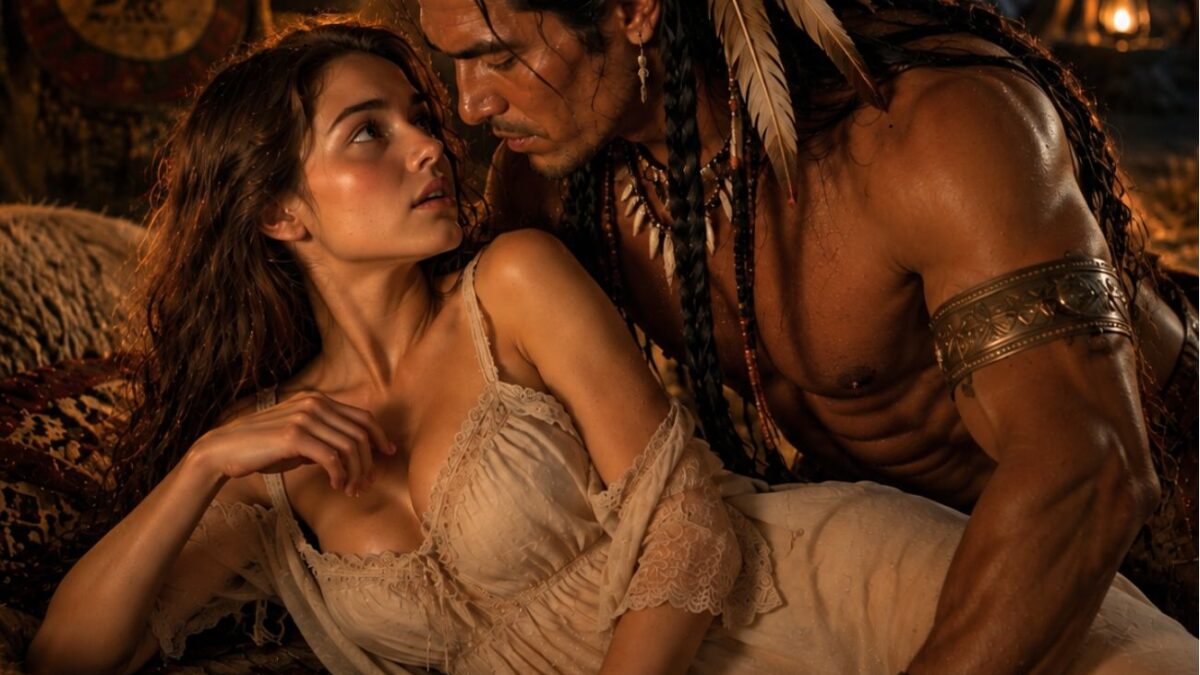
Maeko filled the doorway the way he always did, dark hair loose past his shoulders except where two thin braids were bound with strips of red-dyed leather at his temples, a string of trade beads, and a single curved claw hanging at his throat.
He wore no shirt beneath his vest despite the cool morning, and the muscle across his chest and arms was not the soft strength of a man who worked behind a desk, but the hard, corded power of a man who had spent his whole life riding, hunting, and pulling his own weight up canyon walls.
He was, without exaggeration, the most beautifully made man Cecily had ever seen, and she had spent four months trying very hard not to think about that fact in the middle of the day.
“Cecily,” he said, and her name in his mouth always came out low and unhurried, as though he had all the time in the world to say it.
“Maeko.” She was proud of how steady her voice sounded.
“Come for the rope again?”
“Come for you,” he said simply, the way he said most things without games, without the practiced flattery of the young ranch hands who tried their luck with her on Sundays.
“Though I will take the rope also, if you insist on selling it to me.”
Abigail made a small strangled sound behind her thread spools and suddenly found urgent business in the back room.
Cecily came around the counter because that was permitted now, because four months of him arriving with gifts of tanned hide and sweet dried plums and careful patient conversation had earned him the right to stand close to her without her father’s shotgun making an appearance.
He was a full head taller than her, broad enough that he blocked the light from the window when he stood where he stood now, and when he looked down at her, the way he was looking at her now, something in her chest went tight and liquid at once.
“I spoke to your father this morning,” Maeko said, and Cecily’s breath caught.
“You did?”
“He says the decision is yours, and he says he will not stand in the way of it if it is truly what you want.”
A pause, brief and deliberate followed before he continued.
“I am asking you now, not your father. You.”
She had known this was coming, and she had wanted it to come, having lain awake more nights than she would admit counting the ways she wanted this exact question asked of her.
And still faced with it, standing in a trading post that smelled of leather and rain, she found her mouth had gone dry.
“Yes,” she said.
“Maeko.”
“Yes.”
Something moved across his face then, something she had never seen there before, not the careful patience he always wore like armor, but a raw flash of relief and want that he mastered again almost as quickly as it appeared.
He reached out, slow and giving her every chance to step back, and closed his hand around hers so that his palm swallowed hers entirely.
She could feel the calluses there, the strength banked and controlled, and she thought, not for the first time, that a man built the way Maeko was built could break a person without meaning to if he was not careful.
He was always careful, which was the thing about him that undid her most.
“Then I will speak with the elders,” he said.
“The moon after next. We will marry when the grass is high.”
“The moon after next,” she repeated, and it felt like both an eternity and no time at all.
He lifted her hand, pressed his mouth briefly to her knuckles—a gesture he had picked up from watching the trappers court the rancher’s daughters, and adapted into something entirely his own, slower and more deliberate—with his eyes never leaving hers while he did it.
Then he stepped back because that was the rule they had built between themselves without ever speaking it aloud, as he always stepped back first.
Cecily watched him go, watched the door swing shut behind those broad shoulders, and pressed the back of her still warm hand against her chest as though she could keep her heart from climbing out of it.
Abigail reappeared from the back room the instant the door closed, thread spools abandoned.
“Well?”
“We’re to be married the moon after next.”
Abigail shrieked with delight, loud enough that old Mr. Foss two doors down probably heard it, and pulled Cecily into an embrace that smelled of cedar and starch, though when she pulled back, her expression had shifted into something more careful and knowing.
“You’ll want to talk to my sister-in-law before the wedding,” she said.
“Ruth. She married a Kiowa man three winters back.”
“Talk to her about what?”
Abigail’s cheeks went pink, which was on Abigail a genuinely alarming sight.
“About the wedding night, Cecily. About… about him.”
“What about him?”
“He’s built like a mountain, Cecily. You’ve seen him. You’ve seen the size of his hands.”
Abigail lowered her voice, glancing toward the door as though Maeko might have doubled back to listen.
“Ruth says her husband’s cousin married a girl from Fort Worth who couldn’t sit a horse comfortably for a week after her wedding night, and her husband was a small man compared to yours.”
“Abigail.”
“I’m only saying what everyone says. A man that size, that strong… it isn’t a small thing. What happens between a husband and wife like that? You ought to know what you’re walking into.”
Cecily laughed it off in the moment, waved a hand, and told Abigail she was being dramatic, that women had been marrying large men since the beginning of the world, and the world had not ended.
But the words lodged themselves somewhere behind her ribs the way certain careless comments do, burrowing in deep enough that laughing did not dislodge them.
She thought about it that night, lying in her narrow bed at her father’s house and staring at the ceiling.
She thought about the size of Maeko’s hands wrapped around hers, the breadth of his shoulders filling the doorway, the low rumble of his voice, and the controlled, careful way he moved, as though he was perpetually aware of his own strength and perpetually working to contain it.
And for the first time since she had fallen in love with him, somewhere underneath the wanting, a small cold thread of fear began to wind itself through her chest.
She did not speak of it, not to Abigail, not to her father, and certainly not to Maeko.
Instead, over the following weeks, she did what she always did when she was afraid of something, leaning into it sideways, testing its edges, and refusing to let it see that it had found purchase in her.
She teased him more, letting her fingers trail along his forearm when he reached to help her down from the wagon, feeling the way the muscle there flexed and held beneath her touch.
She stood a little closer than propriety strictly allowed when they walked together along the creek in the evenings, close enough that she could feel the heat radiating off him even through her sleeves, and close enough to catch the scent of wood smoke and leather and something warmer underneath that was entirely his own.
And every time she pushed, he held.
It became, without either of them naming it as such, a kind of contest where she would find some new small liberty to take, resting her palm flat against his chest to feel his heartbeat, letting her mouth linger a half second longer than necessary when he kissed her cheek in farewell, or once, daringly, pressing her lips to the strong line of his jaw instead of waiting for him to come to her.
And every time she watched something flare hot and dangerous behind his dark eyes before he reined it in again, gentle as ever, controlled as ever, and stepped back first.
It should have reassured her, and in a way, it did, but it also began to feel like proof of something else entirely, proof that whatever lived beneath that iron control was vast enough that he did not trust himself to let even a corner of it show.
And if a man that disciplined, that deliberately gentle, felt the need to hold himself in check so completely around a woman he had not yet touched in full, what exactly was he holding back?
Three days before the wedding, he came to help her father repair a section of fence along the north pasture, and Cecily brought water out to the two of them at midday, the sun high and merciless, sweat gleaming along the long line of Maeko’s back and shoulders as he worked.
She stood at the fence rail longer than she needed to, watching muscle shift under sun-warmed skin, and when he finally noticed her there and came to take the water from her hands, she made the mistake, or the choice—she was never entirely sure which—of asking him a question she had been turning over for days.
“Everyone says you’re the most controlled man anyone has ever seen,” she said, handing him the ladle, watching his throat work as he drank.
“Do you think you’ll still be that controlled when we’re finally alone? Truly alone?”
He lowered the ladle slowly, water caught in a bead at the corner of his mouth, and she watched, unable to help herself, as it slid down toward his jaw.
“You are asking questions,” he said, “whose answers you intend to discover yourself three nights from now.”
Her stomach dropped in a way that was not entirely unpleasant.
“That’s not an answer.”
“No,” he agreed, and something in his voice had gone low and rough in a way she had not heard from him before, a texture like gravel under velvet.
“It is not.”
He did not elaborate, handing the ladle back to her, letting his fingers brush hers a half second longer than the exchange required, and turning back to the fence, leaving her standing there with her pulse hammering and her mind spinning through every possible meaning of what he had not said.
That night, lying awake again, she admitted to herself for the first time what she had been circling for weeks, realizing she was not afraid of marrying Maeko, but rather wanted that with a hunger that sometimes frightened her more than any warning from Abigail or Ruth or the women who whispered behind their hands at the trading post.
What she feared, specifically, precisely, was that first night, the size of him against the smallness of her own inexperience, the stories she had heard about men built like mountains and the women who could not keep pace with them, and the terrible possibility that wanting something and being able to bear it were two entirely different matters.
She thought of the way his hand swallowed hers whole, the barely leashed heat she had glimpsed behind his eyes more than once now, quickly hidden and carefully governed, and what Abigail had said about Ruth’s sister-in-law, about the size of a man mattering in ways young brides were rarely warned about honestly, pressing her own hands flat against her stomach as though she could physically hold the anxious flutter there still.
The day after the fence, an older Comanche woman named Tosawi came to the post with hides to trade and stayed longer than usual, watching Cecily fold linen behind the counter with an expression of open, unhurried appraisal.
She was one of the women from Maeko’s camp, one of the few who had spoken to Cecily with real warmth in the months since the courtship began, and when the last of the other customers finally cleared out, she set down her basket and studied Cecily the way a woman studies a horse she is thinking of buying.
“You are frightened,” Tosawi said without preamble in the careful, unhurried English she had learned from decades of trading with the fort, making it not a question.
Cecily’s hands stilled over the linen.
“Is it that obvious? To me?”
Tosawi came around the counter uninvited and took Cecily’s chin gently between two fingers, turning her face into the light as though checking for fever.
“You have the look of a woman who has heard too many stories and asked too few questions of the man they concern. It isn’t proper to ask him.”
“It is not proper to ask him what happens in a marriage bed before it is his to answer honestly.”
Tosawi agreed.
“But it is proper to ask an old woman who has watched that boy grow from a child who cried when his horse died into the man who will marry you tomorrow.”
She studied Cecily a moment longer.
“What have they told you?”
Cecily hesitated, then, because there was something in the older woman’s directness that made lying feel both impossible and unnecessary, told her the whispers, the warnings, and the specific, humiliating fear that had lodged itself under her ribs and would not be laughed away.
Tosawi’s expression did not shift into pity, which Cecily was grateful for, but into something closer to quiet amusement layered over something else, something almost protective.
“That boy,” she said finally, “has spent ten winters making certain no woman comes near that bed who does not matter to him. You’re worried about the wrong thing entirely.”
She patted Cecily’s cheek once—the gesture of a grandmother rather than a stranger—and picked her basket back up.
“Ask him tomorrow why the bed frightens women, watch his face when he answers, and you will understand everything you need to understand before he says a single word.”
She left before Cecily could ask what she meant, the bell over the door ringing behind her, and Cecily stood there turning the strange, cryptic comfort of it over and over in her mind for the rest of the afternoon, no closer to easy than before, but with the sharpest edge of her fear, for the first time in weeks, beginning to dull.
Two nights before the wedding, her mother sat with her by lamplight and spoke to her plainly, the way mothers were meant to, about what would be expected of her, about patience and trust, and about the particular vulnerability of a wedding night.
Her mother’s words were kind and practical and entirely useless against the specific shape of Cecily’s fear, because her mother had married a man of ordinary size, an ordinary rancher with ordinary hands, and had no frame of reference for what it might mean to give yourself for the first time to a man built like Maeko.
The night before the wedding, Cecily could not sleep at all, lying in the dark and thinking of tomorrow, of the ceremony, and of the moment the door of the marriage lodge would close behind them and leave her alone with a man whose strength she had only ever felt in careful, restrained fragments, a hand around hers, an arm steadying her down from a wagon, or lips pressed gently to her knuckles.
She thought about the bed she had heard whispered about even among some of the Comanche women who came to trade at the post, a bed with a reputation none of them would explain outright, only exchanging glances and small knowing smiles whenever Maeko’s name came up in conversation, as though there was something about that particular piece of furniture that every woman in the territory understood except her.
She did not know, lying there in the dark with her wedding only hours away, that the truth behind that reputation had nothing to do with what she feared and everything to do with a kind of restraint so complete it had shut every other woman out entirely, knowing only that tomorrow she would walk into a room with Maeko alone and something enormous and unknown was waiting for her on the other side of that door.
She pressed her hand to her racing heart and despite everything, despite the fear coiled tight beneath her ribs, found that underneath it, stubborn and undimmed, the wanting was still there, too.
“Tomorrow,” she thought, “tomorrow I will know.”
She did not sleep until the sky had already begun to gray at the edges, and when she finally did, she dreamed of enormous careful hands and a low voice telling her that she was the one who would decide how the night began.
The wedding took place at dusk when the sky over the valley turned the color of a struck match, and Cecily stood at the edge of the camp in a dress her mother had spent three weeks sewing, watching Maeko walk toward her through a crowd of people who had, in four months, gone from strangers to something closer to family.
He wore a shirt of soft tanned hide worked with beadwork in deep red and blue, his hair loose and gleaming, the two braids at his temples bound now with fresh strips of hide instead of the leather he usually wore, and around his neck resting against his collarbone a pendant of carved bone that she would later learn had belonged to his grandfather.
He looked, she thought, like something carved out of the landscape itself, inevitable and overwhelming, and when he reached her and took both her hands in his, the fear that had kept her awake for two nights running went quiet just for a moment beneath the simple enormous fact of wanting him.
The ceremony itself passed in a blur of drumbeats and low chanting, of her father’s hand trembling slightly as he gave her away, and of Tosawi’s knowing eyes finding hers across the fire at one point and holding steady and reassuring.
Cecily remembered very little of the words spoken over them, but she remembered with far greater clarity the exact weight of Maeko’s hand closing around hers when the elder bound a strip of woven cloth around their joint wrists, the exact heat of him standing so close beside her, and the exact low rumble of his voice when he repeated whatever vow the moment required of him, steady and certain in a way that made her own voice shake when it came time to answer.
At one point during the ceremony when the elder paused to speak a long passage in Comanche that Cecily could not follow, she felt Maeko’s thumb move once slowly across the back of her hand, a small private gesture meant only for her, and when she glanced up at him, she found he was already watching her—not the elder, not the fire, not the assembled camp—watching her as though nothing else in the clearing warranted his attention at all.
It struck her standing there with her wrist bound to his that this was a man who had spent years being watched by everyone around him, admired, sought after, and discussed in low voices by women who had never so much as spoken to him directly, and who had chosen, out of all of it, to spend this particular evening looking only at her.
Afterward, there was food and dancing and more laughter than she had heard in one place in her whole life, with Abigail weeping happily into a handkerchief, and her father clapping Maeko on the shoulder with the particular relief of a man handing off a responsibility he had come to trust.
The night wore on, the fires burned low, and at some point, without any formal announcement, Cecily became aware that the crowd around them had begun, gently and without fuss, to thin, leaving space for the two of them to slip away unnoticed.
Maeko found her hand in the dark and simply said, “Come.”
And she went, her heart climbing steadily into her throat with every step that carried them away from the noise and firelight and toward the lodge that had been prepared for them at the edge of the camp.
His hand around hers was warm and certain in the darkness, his thumb tracing one slow, idle stroke over her knuckles as they walked, and she was intensely, almost painfully aware of every point where his body brushed against hers, his shoulder against hers when the path narrowed, the heat of him at her back when he paused to hold aside a low branch, and the low, unhurried cadence of his breathing beside her in the cool night air.
He did not rush her, never rushing her, and yet every unhurried step only wound the anticipation in her tighter, until by the time the lodge came into view at the edge of the trees, her pulse was a living thing in her throat.
It stood apart from the others, larger, its hide walls painted with symbols she did not recognize, smoke already curling gently from the smoke hole where a fire had been laid and lit sometime earlier in preparation.
Maeko held the entrance flap aside for her, and Cecily stepped through into warm firelit dark and stopped.
The bed dominated the space, being enormous, wider and longer than any bed she had slept in in her life, built up on a low platform and piled high with furs so thick and soft they looked like drifted snow gone dark gold in the firelight.
Buffalo hide lay beneath, and over it layer upon layer of smaller pelts, beaver and fox and something pale and luxurious she could not name, all of it arranged with a care that suggested someone had spent real time making certain every surface a person might touch would feel like the finest thing they had ever felt.
She stood in the doorway and simply stared at it.
Maeko let the flap fall closed behind them, sealing out the last distant sounds of drums and laughter, and came to stand a few feet behind her, close enough that she could feel the warmth radiating off him without him touching her at all.
“Cecily,” he said quietly.
She did not turn around.
“It’s larger than I imagined.”
“It was made larger than most,” he agreed.
“Many years ago, before I was old enough to understand why my father thought it necessary.”
A pause hung in the air before he added, “You have gone very pale.”
She turned then because there was no more putting it off and found him watching her with an expression she had never seen on him before, not the careful patience, not the banked heat, but something quieter and more searching, as though he were trying to read a language he had only partially learned.
“I need to tell you something,” she said, “and I need you to not laugh at me while I tell it.”
“I have never laughed at you, and I do not intend to begin tonight.”
She twisted her hands together in front of her, the fine fabric of her wedding dress suddenly feeling too tight across her ribs.
“The women at the trading post, some of them—not all—they told me things about men your size, about what a wedding night is meant to be like when the man is built the way you’re built, when he’s as strong as you are, as experienced as everyone says you are.”
She stopped, mortified, but made herself continue anyway.
“They told me it would be difficult, that I should be prepared for it to be difficult, and I have spent three weeks being afraid of you, Maeko, which is the most ridiculous thing I have ever felt in my life, because I know you, and I know you would never hurt me.”
Her voice dropped.
“And still I lie awake at night terrified of my own wedding bed, and I didn’t want to marry you carrying that fear like some kind of secret, so there it is, and that’s what’s wrong with me tonight.”
She had expected many reactions, though laughter was not among the things she had feared, and true to his word, he did not laugh.
What crossed his face instead was something far more complicated—a flicker of surprise, quickly suppressed, followed by something that looked almost like sorrow, and beneath that, steady and warm, an understanding that seemed to settle the last of the tension from his shoulders.
“Come,” he said again, softer this time, and gestured not to the bed, but to the low bench beside the fire.
She went, grateful for the excuse to sit, and he lowered himself beside her, close but not touching, giving her exactly the distance she needed without her having to ask for it.
“This bed,” he said, “has a reputation in the camp, and you are not the first to have heard whispers about it, though I did not know they had reached as far as the trading post.”
“What kind of reputation?”
“Not the kind you were told.”
He was quiet a moment, choosing his words the way he always chose them, with care.
“My father built this lodge and this bed for my mother before I was born, and when she died, he never took another wife, though many women wished to be considered, keeping this place as it was.”
He looked at her steadily.
“When I came of age, when I became a warrior of some standing in the camp, women began to seek me out, not always for myself, but for what I represented—status, a strong husband, a name that carried weight—and some of them made it very clear, very directly, that they would be glad to share this bed with me for exactly those reasons, whether I wanted them there or not.”
Cecily said nothing, watching him and beginning to understand.
“I turned every one of them away,” he continued, “not because I did not want a wife, for I wanted one very much, but because I did not want a woman in this bed who was here for what I could give her, or for the reputation of the man who slept in it.”
His gaze locked onto hers, dark and unflinching.
“I wanted a woman who was here because she chose me, specifically, entirely, for reasons that had nothing to do with strength or status or anything a stranger could see from across a trading post counter.”
He paused.
“That is the reputation of this bed, Cecily, not that men like me are difficult for a woman to survive, but that this particular man was impossible for any woman to reach until you.”
The fear that had lived under her ribs for three weeks did not vanish all at once, but something in it cracked wide and sudden, and what came flooding through the crack was not relief, exactly—though there was relief in it—but something closer to wonder.
“I’m the first,” she said slowly.
“Not the first woman to want you. The first one you let close enough to be afraid of the bed at all.”
“Yes.”
“They should have been afraid of something else entirely, then,” she said, and heard her own voice go unsteady around the words.
“They should have been afraid they’d never get near enough to find out.”
Something shifted in his expression at that, dark and warm and dangerously close to the surface, the careful control she had spent weeks testing finally visibly beginning to fray.
“Cecily.”
“I’m not afraid anymore,” she said, and found to her own surprise that it was entirely true, because what lived in her chest now had nothing to do with fear at all.
He reached out slowly, the way he always reached for her, giving her every chance to pull back, and drew one fingertip along the line of her jaw, tilting her face up toward his.
“You should be a little afraid,” he murmured, his voice having dropped into that low, rough register she had heard only once before at the fence three days ago.
“Only a little, for I’ve wanted you for four months, Cecily Warren, and I’ve been very, very disciplined about it.”
“I noticed.”
“Tonight,” he said, “I do not have to be.”
For a long moment, neither of them moved with the fire cracking softly beside them and the weight of everything unspoken between them thickening the air until Cecily thought she might come apart simply from the waiting.
She could feel the warmth of him along her whole side, could see the pulse beating fast at the base of his throat—faster than she had ever seen it—and understood with sudden clarity that the discipline he had shown her all these months had cost him something every single time.
“Then stop being disciplined,” she whispered.
He kissed her then, and it was nothing like the careful, restrained kisses he had allowed himself before, being slow and deep and utterly without hesitation as his hand slid from her jaw into her hair, angling her head exactly where he wanted it.
Cecily felt the whole, careful architecture of her fear collapse into something entirely different, with heat pooling low and insistent everywhere he touched.
She felt the difference in him immediately—not violence, nothing close to it, but a kind of focused, deliberate intensity, as though every ounce of restraint he had spent months building had been redirected all at once into paying attention to her.
His hands moved to her waist, spanning nearly the whole of it, and she felt herself lifted effortlessly, the strength she had feared for weeks now simply a fact of him, a fact that made her breath catch not with fear, but with something far more urgent.
He set her down among the furs, and the softness of them against her bare arms drew a small, helpless sound from her that made him go still above her for a moment, dark eyes searching her face.
“Tell me if I should stop,” he said, low against her ear, his breath warm against her skin and his weight braced carefully above her rather than on her, every muscle in his arms holding him with a control that made her fingers dig involuntarily into his shoulders.
“Don’t you dare,” she whispered back, and felt him laugh low and rough against her throat.
She had thought in all her weeks of wondering that she understood something of what to expect from a man of his size and strength, but she understood nothing.
What she had not anticipated was the sheer attentiveness of him, the way his enormous hands, capable of things she had genuinely feared only hours earlier, moved over her now with a restraint so total it felt like its own kind of intimacy, as though he were memorizing her by inches, cataloging every small gasp and shiver, and as though it mattered more to him than anything else in the world.
She felt the roughness of his palm against the softness of her waist, and the contrast undid her more than she expected it to, feeling the warmth of his skin against hers, the solid, steady thud of his heart beneath her hand, and the faint tremor that ran through his powerful frame when she finally tentatively let her own hands explore the breadth of his shoulders and the hard planes of his chest, understanding that for all his strength, he was no less affected by her than she was by him.
What followed unfolded slowly, deliberately, the way he did everything, with his mouth tracing a careful, unhurried path along her jaw and down the line of her throat while his hands mapped her with a gentleness that seemed almost unbearable given the size and strength of them, every touch a question and every pause an invitation for her to answer it.
She felt his heartbeat hammering hard beneath her palm when she pressed it flat to his chest, felt her own breath coming faster and shallower with every place his mouth chose to linger, and felt the furs shift soft and warm beneath her as the last of her fear dissolved entirely into something molten and eager.
Outside, the night had gone fully dark, stars crowding thick and bright above the valley, and the last wood smoke from the wedding fires drifted soft on the cool air, though none of it reached them inside the lodge where there was only firelight and furs gone warm beneath them, and the low murmur of his voice against her skin asking again and again in different ways whether she was well, whether she wanted him to continue, and whether this and this pleased her until she thought she might dissolve entirely from the sheer tenderness of being asked.
She answered him each time with her hands, with the catch of her breath, and with the way her body arched instinctively toward his, understanding, somewhere beneath the haze of it, that this was what Tosawi had meant, and that this was the truth the whispers at the trading post had never come close to touching—not danger, but attention, devotion made physical.
The firelight moved gold and low across the lodge walls, and somewhere beyond the hide walls, the last of the wedding drums had gone quiet, leaving only the crackle of the fire and the sound of their own breathing, ragged now and unguarded, as two people who had spent months holding back finally allowed themselves to stop.
His hands found the ties of her dress with a patience that undid her more than urgency ever could have, pausing at each one, watching her face for permission she gave again and again until fabric and fear alike had fallen away entirely, leaving nothing left between them but firelight and skin and the low wondering sound of her own name in his mouth.
The furs closed soft and warm around them both, and the lodge and the night and the enormous careful hands that had frightened her three weeks ago gave her nothing left to be afraid of at all.
What happened after that belonged only to the two of them and to the fire that burned low and gold until well past midnight, and to a bed that had waited a very long time to finally mean something.
When at last the fire had burned down to embers and the lodge had gone quiet but for the sound of two people breathing slow and even in the dark, Cecily lay with her head against his chest, his arm curved protectively around her, and thought that whatever fear had walked her into this lodge hours earlier had been left somewhere far behind her in a life that belonged to a different, more frightened version of herself, for she was not that woman anymore.
She fell asleep to the steady drum of his heartbeat and the certainty, warm and unshakable, that she had married exactly the right man.
Three weeks into her marriage, Cecily discovered that being Maeko’s wife came with a particular kind of visibility she had not fully anticipated, being watched everywhere she went in the camp not unkindly mostly, but with the frank assessing curiosity of people who had known their most respected young warrior his entire life and wanted to understand the woman who had finally, after years of careful refusals, become his wife.
She was also, she began to notice, treated with a caution that grated more than she expected it to, as older women stepped in to carry water before she could reach for it herself, men lowered their voices when trade negotiations grew heated as though the topic were too coarse for her ears, and even Maeko, without seeming to realize he was doing it, had developed a habit of steering her gently away from anything resembling difficulty, physical or otherwise, with a hand at the small of her back and a murmured suggestion that she might be more comfortable elsewhere.
It came to a head on a morning when a dispute broke out near the horse pens between two young men over a trade gone sour, with voices raised and one man’s hand closing hard around the other’s wrist.
Cecily, who had grown up on a working ranch and had broken up more fights over livestock than she could count, started toward them without a second thought, only to find Maeko’s arm sliding in front of her, gentle but immovable, blocking her path entirely.
“Let the men handle it,” he said, already moving past her toward the pens.
She stood rooted to the spot, staring after him, something hot and unfamiliar rising in her chest.
He resolved the dispute in under a minute, calm and authoritative, with the two young men backing down the instant he spoke, which was, objectively, well handled.
It was also, Cecily thought, watching from the sidelines where she had been placed like a piece of furniture moved out of the way of foot traffic, the third time in a week he had physically stepped between her and anything that might have required her to raise her voice or use her hands.
That night, once the lodge fire had burned down and the camp outside had gone quiet, she raised it with him directly, sitting cross-legged on the furs while he worked a length of sinew between his fingers, twisting it into cord with the same unhurried patience he brought to everything.
“You did it again today,” she said, “at the pens.”
He glanced up.
“Did what?”
“Stepped in front of me, moved me out of the way like I was a child who might get underfoot.”
Something shifted behind his eyes, not quite defensive, more surprised.
“There was a fight.”
“I grew up on a ranch, Maeko.”
“I have separated grown men twice your friend’s size from each other over a stray steer.”
“I know how to handle a raised voice and a closed fist, and I did not marry you to be tucked behind your shoulder every time something in this camp requires a firm hand.”
“I was protecting you.”
“I know you were,” she said, “and that’s the part that’s hard to be angry about, and I am angry about it anyway because you cannot spend the rest of our marriage protecting me from every single thing that might ask something difficult of me, and I want to be your wife, not your…”
She searched for the word, frustration making her blunt.
“…not something you keep behind glass.”
He set the cord down slowly, giving the words the same careful weight he gave everything, and for a long moment said nothing at all, which she had learned by now meant he was turning the problem over from every angle before he trusted himself to answer it honestly.
“My mother,” he said finally, “died when I was young of a sickness that came through the camp in a hard winter, and my father could not protect her from it no matter what he did, and I remember watching him try anyway, past the point where trying still meant anything because the alternative—standing still and doing nothing while someone he loved was in danger—was unbearable to him.”
He looked at her then, something raw moving behind his usual composure.
“I do not know how to watch you near difficulty and simply let it happen, not because I believe you incapable, but because some old unreasonable part of me does not know how to stand still.”
The anger in her chest did not vanish, but it softened around the edges, making room for something gentler alongside it, and she moved across the furs and took his hand—the same hand that had steered her away from the horse pens that morning—holding it between both of hers.
“I understand where it comes from,” she said.
“I do, but you have to trust me to know my own strength, Maeko, the same way I trusted you to know yours on our wedding night, for you didn’t hide from me what you were capable of, letting me see it and letting me decide I wasn’t afraid of it.”
She looked into his eyes.
“I need you to do the same for me, to let people see what I’m capable of, and to let me decide when I need your hand at my back and when I don’t.”
He was quiet a long moment, his thumb moving slowly over her knuckles.
“That will not be easy for me.”
“I’m not asking for easy. I’m asking for tries.”
A faint reluctant smile pulled at the corner of his mouth.
“You are very stubborn for a woman who spent three weeks afraid to marry me.”
“I contain multitudes,” she said primly, and startled a real laugh out of him, low and warm, the sound of it settling something loose and anxious in her chest.
Not everyone in the camp was as easily won over as the trader from the fort, for there was a woman named Isavoni, a distant cousin of Maeko’s on his mother’s side, who had made her opinion of the marriage clear in small cutting ways since the wedding, such as appointed silence whenever Cecily entered a gathering, comments made just loud enough to carry about warriors who married outside their own people, and the children who would grow up belonging fully to neither world.
Cecily had held her tongue through most of it, unwilling to give Maeko one more difficult thing to feel responsible for, but the resentment had a way of finding new angles to press against, coming to a head at a gathering to prepare for the winter hunt when Isavoni suggested in front of a dozen other women that perhaps Cecily should notbe trusted with organizing the distribution of dried meat and hides, since she had not grown up understanding how carefully those stores needed to last through the hardest months.
“She has counted goods behind a trading post counter,” Isavoni said, not quite looking at Cecily as she said it.
“That is not the same as knowing what a family needs to survive January.”
The circle of women went quiet, several exchanging uncertain glances, waiting to see whether Cecily would retreat the way a newer, less certain wife might have.
Cecily set down the hide she’d been sorting and met Isavoni’s eyes directly.
“You’re right that I didn’t grow up rationing meat through a Comanche winter,” she said, even then unhurried, using the same tone she used when a trader tried to shortchange her at the post.
“I grew up rationing supplies through a drought that killed half my father’s herd when I was twelve, and figuring out how to stretch what was left so six people didn’t go hungry before the next trade wagon came through.”
She kept her voice level.
“The math isn’t different because the food is, and I’d be glad to show you the ledger I’ve been keeping if you’d like to check my figures yourself instead of guessing at what I do and don’t understand.”
She held out the tally sticks she had been using to track the stores, offering them without heat, without triumph, and simply as an open hand.
Isavoni stared at them a long moment, clearly caught off guard by the lack of a fight, and something in her expression shifted, grudging but real.
“Show me,” she said finally, and took the sticks.
They spent the better part of an hour bending over the tally together, Isavoni testing her figures against her own knowledge of past winters, and by the end of it, though nothing had been said aloud that resembled an apology, the sharpness had gone out of the older woman’s manner entirely.
She began, in the weeks that followed, to seek Cecily out for her opinion on trade matters rather than avoiding her, and once, without any particular ceremony, brought a small carved comb to the lodge as a wedding gift several weeks late, muttering something about how she supposed she had been wrong to judge a woman before watching her work.
Maeko heard the story secondhand from one of the other women, and found Cecily that evening with an expression of quiet astonishment.
“You won over Isavoni,” he said.
“She has not approved of anyone’s choices but her own since I was a boy.”
“I didn’t win her over,” Cecily said.
“I showed her my math, for she’s not unreasonable, just certain I’d be useless, and I understand why she thought that, as I’d have thought the same in her position.”
She shrugged, but there was pride underneath the modesty, and Maeko did not miss it.
“You continue to surprise me,” he said, and the warmth in his voice when he said it settled something in her chest that no amount of arguing about fence line rescues ever quite managed to reach.
The following weeks tested his promise more than either of them expected, culminating ten days later when a trader from the fort arrived attempting to negotiate an unfair exchange of blankets for hides, clearly assuming the camp’s youngest warrior would defer the matter to older men.
Cecily, who understood the arithmetic of fair trade better than most people twice her age thanks to years behind her father’s counter, stepped forward before anyone else could and dismantled the trader’s offer point by point, laying out the actual value of the goods with a crisp, unhesitating confidence that left the man stammering apologies within minutes.
She glanced at Maeko once mid-negotiation, bracing herself for the hand at her back and the gentle steering away, but it did not come.
He stood a few feet off, arms crossed, watching her with an expression she had not seen from him before—not indulgence, not anxiety on her behalf, but something that looked remarkably like pride, undisguised and entirely without reservation.
When the trader finally left with a fairer deal struck and his tail between his legs, Maeko crossed the distance between them and pressed his mouth to her temple in front of the whole gathered crowd, an open, unhidden gesture that made several of the older women exchange delighted, knowing looks.
“You handled that better than I would have,” he murmured against her hair.
“I know, for you are insufferable.”
“I know that, too.”
That night, the tension between them had changed shape entirely, no longer the anxious current of unresolved argument, but something warmer, charged with the particular electricity of watching someone you love be extraordinary in front of people who mattered.
Maeko drew her down onto the furs the moment the lodge flap fell closed behind them, his mouth finding hers with a hunger that had none of the careful restraint of their wedding night and all of the confidence of a man who had spent a month learning exactly what made his wife lose her composure entirely.
“You were magnificent today,” he said against her throat, his hands already working at the ties of her dress with far more efficiency than he’d managed the first time.
“I have never wanted you more than I did watching you take that man apart with nothing but arithmetic and a raised eyebrow.”
“Is that so?”
She arched into his touch, feeling the low laugh rumble through his chest against hers.
“I’ll have to argue with traders more often, then.”
“Do not,” he growled, only half joking.
“Give me reasons to want you this badly in the middle of a public negotiation, for I very nearly embarrassed us both today.”
She laughed, breathless, the sound dissolving into something else entirely as his mouth found the curve of her shoulder, patient and thorough despite his own clear urgency, with every touch a deliberate unraveling of whatever composure either of them had left.
The firelight caught the sheen of his skin as she pushed his shirt from his shoulders, mapping the solid heat of him with hands that had lost every trace of the hesitancy they’d carried a month ago.
And when his weight settled over hers, careful as always despite the barely leashed want radiating off him, she felt none of the old fear at all, only anticipation, sharp and eager for a man who had learned every place she wanted to be touched and seemed determined to prove it.
What passed between them after that was slower than the urgency of the moment suggested it might be, with Maeko’s discipline reasserting itself the instant his hands found bare skin, drawing out every response from her with a patience that bordered on devastating until the furs and firelight and low, unsteady sound of her own voice saying his name were the only things left in the world worth attending to.
The lodge walls held the sound of it, low and private, long after the fires outside had burned to embers and the whole camp had gone still and sleeping around them.
In the weeks that followed, the balance between them settled into something neither had quite managed before, with Maeko learning, slowly and not always gracefully, to let her stand in her own strength, and Cecily learning that asking for space did not mean asking for distance, and that a man could step back and still stay close.
She took on more of the camp’s trade negotiations, her reputation for shrewd, fair dealing spreading as far as the fort itself, and she organized the distribution of winter stores with an efficiency that impressed even the camp’s oldest matriarchs.
Through all of it, Maeko watched her with a pride he no longer bothered to hide, no longer needing to prove his devotion through the size of the distance he kept between her and difficulty, but through the simple, steady fact of standing beside her instead.
The first hard frost came early that year, silvering the grass along the creek bank and sending the whole camp into the brisk, purposeful rhythm of final winter preparations, finding Cecily woken before dawn most mornings by the sound of Maeko already up and moving, checking the lodges’ stores of wood and testing the hide walls for any place the cold might find a way in.
The careful protectiveness she had once found suffocating now expressed itself in a hundred small domestic gestures that made something warm settle behind her ribs each time she noticed one, as she learned him in pieces the way any new wife learns a husband.
She recognized the particular quiet that came over him on the anniversary of his mother’s death, which she now understood without needing to ask, the low unselfconscious hum he fell into when working leather with his hands—a habit he seemed entirely unaware of—and the way he still, even now, always let her decide when a conversation about the wedding night or anything after it had gone far enough, checking her face for hesitation before he ever pushed further out of an old habit from those first careful weeks of courtship that neither of them had any reason to keep and neither of them wanted to give up.
She was learning too how to be watched by an entire community without flinching from it, how to let the older women test her, how to let the younger ones ask blunt, curious questions about life at the trading post, and how to stand at Maeko’s side during councils and trade negotiations as an equal rather than an ornament, contributing her own opinion when she had one and holding her tongue when she didn’t, the way any respected voice in the camp learned to do.
It did not happen all at once, but it happened steadily, the way trust generally does, one small proof at a time.
Late one evening, working together over a hide he was preparing for winter boots, she caught him watching her with an expression so openly fond it made her pause mid-stitch.
“What?” she asked.
“Nothing,” he said, and then, because he had never been a man to hide behind half-truths for long, added, “I’m only thinking that I spent years certain no woman would ever be allowed close enough to matter to me the way you do, and I did not expect when I finally let one close that she would also be the most formidable person in this camp.”
“Disappointed?”
“Undone,” he said simply, and reached across the hide to draw her hand to his mouth, pressing a kiss to her knuckles the same way he had the day he asked her father’s permission to marry her, except this time there was nothing careful or restrained about the way he was looking at her while he did it.
“Entirely, permanently undone,” he said the way he said most things that matter to him, without flourish, without needing her to answer it with anything but the small, pleased smile that was already spreading across her face.
She smiled and let him pull her closer, thinking that whatever fear had once lived in her chest about the size of him and the strength of him had transformed so completely into something else—trust and hunger, and a fierce, settled kind of love—that she could no longer remember exactly what it had felt like to be afraid at all.
Winter settled over the valley in earnest by the time the camp gathered for the season’s first great feast, with snow banked deep against the lodges and the air sharp enough to sting the lungs on a clear morning.
Cecily found herself six months into her marriage, standing at the center of preparations she would never have imagined herself capable of managing when she first arrived among Maeko’s people, having spent the autumn learning the rhythms of the camp the way she had once learned the rhythms of her father’s ranch: by watching, by asking blunt questions without embarrassment, and by making mistakes in full view of women who had decades more experience than she did and refusing to let the mistakes shame her out of trying again.
It had earned her something she had not expected to earn so completely, so soon: respect that did not depend on being Maeko’s wife at all.
Her father had come to visit twice since the wedding, the second time only a month before the feast, riding out with a wagon of trade goods and an expression of undisguised wonder at how thoroughly his daughter had woven herself into a life he had once worried she was too young, too inexperienced, and too soft-handed from town living to survive.
He had watched her negotiate a fair trade for winter blankets with a sharpness that made him laugh out loud and clap Maeko on the shoulder, declaring that he had clearly raised a daughter far too capable to have stayed behind a trading post counter for the rest of her life.
He had watched Maeko, too, in the unguarded moments between negotiations—the way his hand found the small of Cecily’s back without thought, the way his eyes tracked her across a crowded gathering, and the way a man’s eyes tracked the one thing in a room that actually matters.
Before he left, her father had taken Maeko aside and told him plainly that he had never seen his daughter look as certain of anything as she looked standing beside him.
“I did not doubt you,” Maeko told her afterward.
“But I confess it eased something in me hearing it from him, for a father knows a daughter’s true face better than most.”
“He was ready to be disappointed,” Cecily admitted.
“Every father worries his daughter has thrown herself away on a stranger.”
“And now?”
“Now he asks when he can visit again and spends the whole ride home complaining that our stores are better organized than his own.”
She had laughed at that, delighted, and something in her chest had settled more firmly into place, as the last small worry she had not fully admitted to carrying—that choosing this life might have meant losing some piece of the one she came from—finally quieted for good.
She was overseeing the division of stores for the feast, tally sticks in hand, when Tosawi found her, the old woman’s sharp eyes taking in the organized chaos of the preparations with open approval.
“You have done well,” Tosawi said, settling herself on an overturned crate beside the stores.
“Better than well, for three winters ago when the fort sent a man to negotiate for grazing rights along the river, it was the elders who spent two days arguing him down to a fair price, and this year, they tell me, it took you one afternoon.”
“He was easier to read than most,” Cecily said.
“Men who overexplain a bad offer are usually nervous about how bad it is.”
Tosawi laughed, low and delighted.
“You have the eye for a bad trade that most people spend a lifetime failing to develop.”
She studied Cecily a moment longer, something more serious moving behind the humor.
“Do you remember the night before your wedding, I told you to ask him why the bed frightened women, and to watch his face when he answered?”
“I remember.”
“Do you understand now why I told you that instead of simply telling you the answer myself?”
Cecily considered it, turning the tally sticks over in her hands.
“Because you wanted me to hear it from him, to see it in his face, not just his words.”
“Because a man’s face does not know how to lie about what matters to him,” Tosawi said.
“Words can be arranged into anything a person wishes to hear, but a face in the right light at the right moment cannot.”
She rose, gathering her shawl against the cold.
“You saw the truth of him before you ever stepped into that lodge, and that is why the fear did not win, for some women never see it at all and spend a marriage waiting for a danger that was never real to begin with.”
Cecily watched the old woman make her slow way across the snow toward the fires being built for the evening’s feast, and found, not for the first time since her wedding, that the camp she had once entered as a nervous outsider now felt entirely, unmistakably like home.
As the afternoon wore toward dusk and the last of the meat was set to roast over the fires, a small commotion broke out near the horse pens—not the sharp, quarrelsome kind she had once rushed toward in her early weeks in the camp, but a different sort entirely involving a cluster of the camp’s youngest boys gathered around a colt that had gotten itself tangled in a length of rope and worked into a lathered panic, kicking dangerously at anything that came near.
Cecily arrived at the edge of the small crowd just as one of the older men moved to approach the frightened animal head-on, and something in the set of the colt’s ears told her, from years spent around spooked livestock on her father’s ranch, that a direct approach would only make it worse.
“Wait,” she said, and to her own quiet surprise, the man actually paused, waiting on her word the way he might once have waited only on Maeko’s.
“Let me.”
She approached the colt from the side, low and slow, speaking to it in the same low, unhurried murmur she had used a hundred times on frightened animals back home, and let it see her hands were empty before she reached for the tangled rope.
It took several long minutes, with the whole gathered crowd gone quiet and watching while the colt trembled and rolled its eyes, before it finally, gradually, allowed her close enough to work the rope free.
When it finally trotted off toward the herd, unhurt and calming by the step, a ripple of quiet approval moved through the onlookers, and Cecily caught Maeko’s eye across the pen, his expression unreadable for a moment before breaking into something unmistakably proud.
“You did not even look toward me for permission,” he said later, walking back toward the fires with her.
“I didn’t need it.”
“No,” he agreed, something warm and settled in his voice.
“You did not.”
“I am only glad, finally, to have learned that in time to simply watch you work instead of getting in your way.”
The feast that evening was the largest Cecily had attended since her wedding itself, with the whole camp gathered around bonfires that threw sparks up toward a sky gone clear and hard with cold, drums and laughter and the smell of roasting meat filling the valley from end to end.
She sat beside Maeko near the center fire, wrapped in a buffalo robe he had insisted on draping over her shoulders the moment the temperature dropped, and watched the community that had become hers move through the easy, familiar choreography of a celebration they had performed every winter of their lives.
It was during a lull in the dancing, with the fire burned down to a steady orange glow, that one of the camp’s senior warriors, a broad-shouldered man named Parwa who had known Maeko since childhood, raised his cup and called across the fire for quiet.
“Six months ago,” Parwa said, loud enough to carry to the edges of the gathering, grinning in a way that suggested he had been waiting some time for the right moment to say this, “half this camp wondered whether our most stubborn warrior would ever let a woman close enough to marry him, while the other half wondered whether any woman brave enough to try would survive the reputation of that lodge he built such thick walls around.”
Laughter rippled through the crowd, warm and knowing, and Cecily felt her face heat despite the cold.
“I have known Maeko since we were boys chasing rabbits with sticks too big for our arms,” Parwa continued, “and I have never, in all that time, seen him look at anything the way he looks at his wife.”
He raised his cup higher.
“To the woman who proved every rumor about that bed wrong, and to the warrior smart enough to finally let her.”
Isavoni, seated not far off with a bowl of stew balanced on her knee, called out over the laughter before it had even finished rolling through the crowd.
“She proved a great many rumors wrong,” she said, loud enough to carry, with a rare genuine smile on her face as she looked toward Cecily.
“I was one of the people spreading a few of them, and I will say plainly, since I made her prove herself the hard way, that I have not been sorry to be wrong about anything in a long while.”
She lifted her own cup toward Cecily, a gesture that meant more to Cecily than the older woman likely realized, given how many months it had taken to earn it.
“To the tally sticks that never lie.”
The whole gathering laughed again, warmer this time, and Cecily lifted her own cup in answer, her throat tight with something that had nothing to do with embarrassment anymore.
The camp erupted into laughter and cheers, cups raised all around the fire, and Cecily buried her burning face against Maeko’s shoulder while he laughed low and unbothered, his arm tightening around her.
“They have been waiting months to make that joke,” he murmured against her hair.
“I am only surprised it took Parwa this long.”
“I will never live this down.”
“No,” he agreed, entirely unrepentant.
“You will not, for I intend to remind you of it regularly for the rest of our lives.”
Cecily spent a long while after that simply watching the fire and the people gathered around it, letting the warmth of the evening settle into her the way the buffalo robe settled warm around her shoulders, thinking of the nervous eighteen-year-old girl who had stood behind a trading post counter refolding the same bolt of calico four times, terrified of a future she could not yet see clearly enough to trust.
That girl had been afraid of so many things that had turned out in the end to be exactly the opposite of what she feared—a man’s strength that turned out to be devotion, a community’s scrutiny that turned out to be the slow, careful work of people deciding whether to let you matter to them, and a bed’s reputation that turned out to be nothing more than the story of a man who had simply been waiting for the right woman to walk through his door.
Later, once the fires had burned low and most of the camp had drifted back toward their own lodges, sated and warm with food and drink, Maeko drew her away from the last of the gathering and walked with her back through the snow, her hand tucked warm inside his and the buffalo robe still wrapped close around her shoulders.
“I want to ask you something,” he said once the noise of the feast had faded behind them and only the crunch of snow underfoot and the distant call of some night bird broke the quiet.
“Six months ago in the trading post, you told me yes before I’d finished asking whether you wanted to marry me, and I have wondered since then whether you would answer the same way if I asked again now, knowing everything you know now about this life, this camp, and this man.”
Cecily stopped walking, turning to face him in the moonlit snow with his breath fogging pale in the cold air between them and his dark eyes steady on hers the way they had been steady on her since the very first day he walked into that trading post, filled the doorway with his shoulders, and changed the whole shape of her life without either of them realizing it yet.
“Ask me and find out,” she said.
He took both her hands in his—the same enormous, careful hands that had once terrified her with rumor and now felt like the safest place in the world—and asked her plainly, without ceremony, whether she would choose this life, this camp, and this man all over again, knowing everything she now knew.
“Yes,” she said, using the same words she had given him in the trading post six months earlier, except this time it came without a single thread of fear woven through it.
Nothing held back, nothing uncertain.
“Maeko, yes, a hundred times yes, for I would choose you in every version of this life there is to live.”
He kissed her there in the snow, unhurried despite the cold, his hands framing her face with a gentleness that still, after everything, managed to steal her breath, and when he finally drew back with his forehead resting against hers, she felt him smile against her skin.
“Come home,” he said.
“I have missed having you to myself.”
They walked the rest of the way to their lodge in comfortable silence, and when Maeko pushed the entrance flap aside and drew her in out of the cold, Cecily found the fire already banked low and warm inside, with the furs on their enormous bed catching the light in soft gold waves, exactly the way they had on her wedding night and exactly the way they had a hundred nights since.
She stood in the doorway a moment, the way she had stood there six months earlier, paralyzed by rumor and fear and a story she had believed without ever having asked the man at the center of it for the truth.
So much had changed since that first frightened night, for the careful distance she and Maeko once kept between themselves had become effortless closeness, the community that had once watched her as a curious outsider now welcomed her as one of its own, and the fear that had once made her hands tremble had long since transformed into something steadier and far more powerful.
This time, standing in the same doorway with the same firelight catching the same furs, she felt nothing but the warm, certain pull of wanting to be closer to him.
Maeko watched her pause, something knowing crossing his face.
“Do you remember the last time you looked at that bed like that?”
“I remember being terrified of it.”
“And now?”
She crossed the space between them, closing the door of the lodge firmly behind her, shutting out the cold and the snow and the last distant sounds of the feast, and looked past him to the bed that had once represented every fear she carried into this marriage and now represented nothing but six months of a happiness she had not fully believed herself capable of until she lived it.
“Now,” she said, stepping into his arms and feeling them close around her the way they always did, careful and enormous and entirely, permanently hers, “I understand perfectly well why every woman in this camp was afraid of that bed.”
“Do you?” he murmured, already lowering his head toward hers with the low, rough note back in his voice, the one she had come to recognize and crave in equal measure.
“They should have been afraid of never getting the chance to find out what it’s actually like,” she whispered against his mouth, echoing the words she had said to him on her wedding night.
“And I am the only woman in the world who ever will.”
His laugh was low and warm against her lips, and then there were no more words at all, only the fire burning steady in the hearth, the furs waiting soft and familiar beneath them, and a marriage that had begun in fear and become instead the safest and most certain thing either of them had ever known.
Outside, snow fell soft and silent over the valley, over the sleeping camp, and over a lodge at its edge where the light burned warm behind hide walls long into the night, where a bed that had once terrified an entire trading post full of women had finally, completely found the only person it had ever truly belonged to.
Somewhere beyond the hide walls, the camp slept on, undisturbed, unaware, and uninterested in the private happiness unfolding within one particular lodge at its edge, exactly as it had slept through a hundred nights before this one, and would sleep through a thousand more to come.
And in the morning, when the fire had burned to ash and the first gray light crept in through the smoke hole, Cecily woke tucked warm against Maeko’s chest, his arm curled protective and easy around her even in sleep, and understood with the same simple certainty she had felt the day she first said yes to him across a trading post counter that she had not merely survived the life she had once feared, but had built inside it the truest happiness she had ever known.
When Maeko stirred beside her and murmured her name, still half asleep, pulling her closer against the cold morning air, she thought there was nowhere else in the whole of the territory or the whole of the world that she would rather wake up than exactly here.

