25 Brutal Truths About Being a Prostitute in the Victorian Era That Hollywood Erased
She worked a narrow alley just off Waterloo Road where the only light came from a sputtering gas lamp at the corner.
Her customary fee was threepence a time, and fourpence of whatever she earned was swallowed by hunger before she could close her eyes.
A sip of adulterated gin kept her upright against the damp masonry while mercury quieted the syphilis until it claimed her teeth and scattered her wits.
When breath finally left her body, the desperate women sharing her crowded doss house scraped together their pennies to split the cost of a plain deal coffin.
The parish authorities that had taxed her meager livelihood refused to spare a single coin to bury her in consecrated ground.
Decades later, cinema screens draped her in shimmering satin and reimagined her misery as a tragic, grand love story.
The comfortable Victorian world possessed an entire vocabulary designed to sanitize the brutal reality of its paved underbelly.
Polite society preferred to call her an unfortunate rather than acknowledge the transaction of bodies under the soot.
The term carried a deliberate softness, implying that her presence in the gutter was an act of unpredictable weather rather than deliberate policy.
Henry Mayhew encountered this title continually as he walked among the laboring poor and documented the city’s quiet starvation.
The broadsheet newspapers embraced the word, court scribes inked it into the margins of criminal ledgers, and clergymen preached it from elevated pulpits.
It performed a specific sleight of hand by rendering every systemic failure entirely invisible to the comfortable eyes of the middle class.
She was not seen as a laborer betrayed by starvation wages or a citizen abandoned by unequal statutes.
Her neighbors and patrons were encouraged to believe she had simply slipped upon an unlucky stone in life’s journey.
The language served as the opening act of erasure, functioning so well that modern heritage tours still parrot the phrase without thinking.
Behind the polite label lay an economic machine that ground young women down with mechanical precision.
The Children’s Employment Commission of 1843 called needlewomen the most mercilessly exploited laborers in the entire kingdom.
Seamstresses hunched over linen shirts until their eyes failed, earning mere copper pennies for garments that took days to complete.
A woman working alone in a freezing garret might sew three full shirts to earn a single penny.
She had to compete against the unpaid labor of workhouses where parish authorities auctioned off desperation at below-market rates.
At the Bryant and May factories, matchgirls endured chemical necrosis of the jaw for six to twelve shillings a week.
Laundresses carried blistering copper pots and hauled saturated bedding through winter chill to bring home two shillings a day.
Not a single one of these legitimate trades paid enough to cover rent, bread, a shovelful of coal, and passable boots in London.
When Mayhew sat in damp rooms and asked these women why they took to the paving stones, they answered without theatrics.
The stark choice was not between upright modesty and depraved wickedness, but between trading flesh and starving in an empty room.
Selling oneself was not a sudden moral collapse or an inherent defect of the feminine soul.
It was an inescapable calculation made by women who had exhausted every other possibility of surviving until morning.
The geography of the trade aligned with mathematical exactness along the great divisions of social rank.
Up near the theaters of the West End, fashionable courtesans leased elegant drawing-room floors for three or four guineas a week.
There, at the Haymarket, men of title and capital drank port while purchasing companionship dressed in crinoline and lace.
Four miles east, across an invisible frontier of class, lay Waterloo Road, Ratcliffe Highway, and the rotting warrens of Whitechapel.
Police Commissioner Charles Warren estimated that over twelve hundred women walked the cobblestones of Whitechapel alone in 1888.
Between the velvet carpets of the Haymarket and the raw slaughterhouses of the East End lay an unbridgeable ocean of human misery.
Popular retellings and period romances invariably focused their attention on the Haymarket parlor, where tragedy looked elegant.
They lingered on crystal decanters, witty banter, and expensive silks draped across velvet settees.
Yet the vast, documented majority of women in the trade inhabited the dripping, unpaved courts of the eastern parishes.
Survival in those eastern slums was measured out in fourpenny increments every twelve hours.
Whitechapel housed more than two hundred registered common lodging houses, packing over eight thousand souls into squalor each night.
Four pence purchased a shared mattress on a floor crawling with vermin beneath a grease-stained blanket.
Those who lacked the full fourpence paid twopence for the right to lean against a taut rope stretched across a crowded room.
Men, women, and children slept hanging over the hemp line until the keeper cut the cord at dawn to clear the floor.
Along Flower and Dean Street, more than three hundred human beings were shoehorned into a single terrace of decaying brick.
The rent deputies made their rounds twice every day, banging on scarred doors and demanding cash on the spot.
A tenant without the fee by nightfall was thrust instantly into the freezing mud, regardless of sleet, sickness, or age.
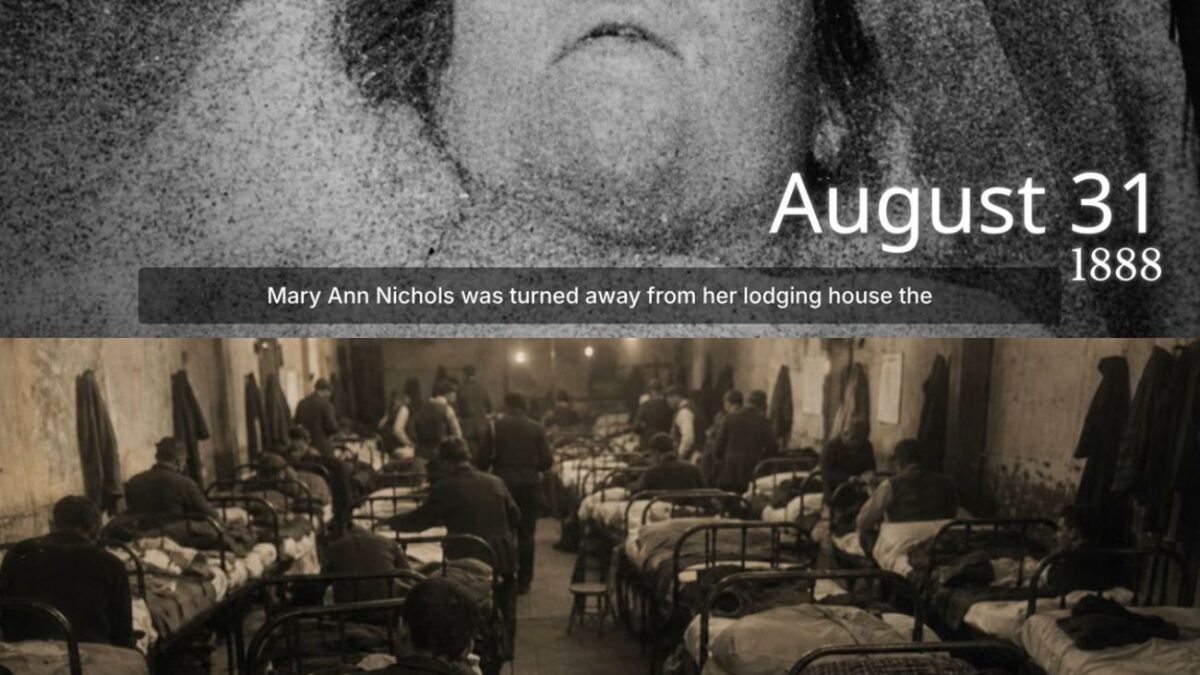
Mary Ann Nichols was cast out of her lodging house into the cold on the final night of August in 1888 for want of fourpence.
She turned to the deputy keeper at the doorway and told him not to worry, for she would soon find her doss money on the street.
She walked into the shadows of the East End wearing a brand-new bonnet she had managed to acquire, determined to earn her bed.
She never returned to claim a place upon the straw, her throat cut before the dawn bells began to chime.
The modern imagination insists on viewing these women as career prostitutes who had crossed an absolute line of no return.
Yet extensive historical research reveals that most women who sold their bodies did so only casually and intermittently.
They were factory workers, charwomen, and fruit hawkers whose seasonal wages regularly dipped below the cost of bread.
When the winter freeze stopped work at the London docks or a garment shop laid off half its hands, they stepped onto the curb.
The national census takers could never track this fluid, desperate movement across the boundaries of respectable employment.
The moral crusaders of the period refused to admit that ordinary working girls moved between the counter and the street out of necessity.
The border separating the respectable working-class woman from the ruined outcast was never a sheer cliff edge.
It was a muddy slope that tens of thousands of women traversed back and forth as rent day approached.
When an extra shilling meant keeping an ailing mother warm or buying bread for a toddler, the decision was already made.
Out upon the pavement, personal appearance served simultaneously as an indispensable currency and an unavoidable trap.
Women pinched their pale cheeks, dusted their skin with chalky powder, and parted with half their income for secondhand satin.
A bright straw bonnet or a fringed mantle could easily consume an entire week’s earnings from the night trade.
Mary Ann Nichols took immense pride in the bonnet she wore on that final, rainy night in the Whitechapel alleys.
Her companions at the doss house remembered how clean it looked against the soot-caked masonry of the court.
The garment was both a tool to entice passing customers and a target that drew the eyes of passing constables.
A domestic servant’s chapped, reddened hands advertised her social station to every gentleman who passed her by.
For the woman on the street, however, wearing fine clothes carried a distinct and dangerous paradox.
The more presentable she made herself to win clients, the more visible she became to officers hunting for public indecency.
A peculiar hypocrisy anchored the Victorian legal framework governing the sale of human flesh.
The act of exchanging money for sexual access was entirely legal under English common law.
What the statutes relentlessly penalized was soliciting—the public visibility of the impoverished woman who dared to offer it.
The law gave men absolute permission to purchase whatever they wanted within the privacy of shadowed rooms.
It reserved its ferocity for the woman who stood under the streetlamp and revealed the existence of the trade to respectable eyes.
A woman could be seized simply for lingering near a theater awning or standing too long outside a tavern door.
In 1887, a working seamstress named Elizabeth Cass walked along Regent Street to purchase a pair of gloves before the shops closed.
A patrolling constable grabbed her arm and dragged her to the station, insisting that no decent female had business out after dark.
Her arrest sparked an uproar in Parliament, yet working-class women without wealthy advocates were swept away nightly without a word.
The state’s policing of poor women reached its most invasive form with the passage of the Contagious Diseases Acts.
These laws established a specialized corps of plainclothes officers who became known across garrison towns as the spy police.
These men were paid to stalk the docks, barracks, and public houses, watching women and noting their habits in private notebooks.
An officer possessed the unilateral authority to declare any working-class girl a common prostitute based solely on his suspicion.
Many of the young women he followed were unable to read the documents he thrust into their hands.
Without a trial, without a jury, and without witnesses, a man’s whispered accusation was sufficient to put her name upon a permanent register.
Once a woman was entered into that official ledger, the bureaucratic stain followed her across the county for the rest of her days.
If she attempted to take honest service as a parlor maid, the police ledger stood ready to expose her past.
If she married a laborer or found work in a textile mill, the record ensured she remained under constant police observation.
The state never asked whether she had left the streets or whether she had been falsely accused in the first place.
It treated her submission to the ledger as an irreversible surrender of her civil standing under the crown.
The only men who held the power to place her on that list were the very plainclothes inspectors who answered to no court.
The Contagious Diseases Acts of 1864, 1866, and 1869 carried an even more terrifying mechanism of physical control.
Any woman designated by the police was forced to submit to a biweekly internal examination by military surgeons.
She was strapped down while a cold metal speculum was driven into her body to inspect her for signs of infection.
Josephine Butler, the pioneering reformer who took up their cause, rightly denounced the procedure as nothing less than surgical rape.
French sex workers, subjected to a similar regulatory nightmare, gave the heavy brass instrument a grim and fitting name: the government’s penis.
If a terrified girl struggled or refused to climb onto the leather table, magistrates sentenced her to three months of hard labor.
While these invasive examinations took place every two weeks, the soldiers and sailors who spread the diseases were exempt.
Not a single guardsman, dockworker, or member of the gentry was ever strapped down or inspected by an army physician.
The initial bill slipped through an empty House of Commons in 1864 without debate because gentlemen considered the subject unfit for discussion.
When the examining physician detected sores or discharge, the woman was immediately removed from the community and locked away.
She was not escorted to a clinic for humane medical care, but marched under guard into the isolation of a lock hospital.
In an era that predated the discovery of penicillin, medicine had no genuine cure to offer for the advanced ravages of venereal sickness.
These lock hospitals operated far more like penal institutions than places devoted to healing the sick.
The damp ledgers of the Colchester lock hospital reveal patients who were twelve, thirteen, and fourteen years old.
In Glasgow, the 1891 census recorded twenty-three women locked inside the municipal lock wards, every one of them classified under the single heading of prostitute.
The law granted administrators the power to hold these women behind high brick walls for up to nine months at a stretch.
They were fed thin gruel, kept in isolation, and subjected to daily lectures on the eternal peril awaiting their immortal souls.
When their quarantine expired, the iron gates swung open and delivered them back to the same starving streets that had broken them.
Inside those institutional basements, medical treatment consisted almost entirely of aggressive doses of mercury.
A wealthy gentleman suffering from a chancre could afford silver-coated pills that moderated the poison entering his veins.
A penniless girl inside a charitable ward was subjected to the concentrated brutality of a mercurial vapor bath.
At the Glasgow facility, women were locked inside a sealed basement chamber where raw mercury was heated over open stoves.
The patients inhaled the toxic metallic fumes until their gums turned spongy, their teeth loosened, and their nervous systems collapsed.
Physicians offered them an impossible dilemma: descend into the tremors of syphilitic madness, or endure the kidney failure of industrial poisoning.
The medical establishment blamed the women alone for carrying the pestilence, treating them as biological cesspools threatening the empire’s vitality.
The respectable gentlemen who brought the bacteria home to their innocent, confined wives were spared every indignity.
No surgeon ever arrived at a townhouse in Belgravia to demand that a husband climb onto a stirrup table for the public good.
This pervasive exploitation reached downward into the lives of girls who had barely left their childhoods behind.
Prior to 1875, the legal age of consent across England stood at a staggering twelve years of age.
Even after reformers managed to raise the threshold to thirteen, child brothels operated with near impunity across central London.
Hospital archives from the 1840s record long columns of prepubescent girls treated for advanced venereal ulcerations.
The London Society for the Protection of Young Females gathered proof of organized rings purchasing daughters from starving rural families.
These operations were not rare, hidden aberrations committed by lone madmen in the shadows of the docks.
They functioned as an organized industry, taking advantage of absolute poverty and a legal code that looked away.
It took the shocking journalism of W. T. Stead in the summer of 1885 to crack the polished facade of the metropolis.
Writing for the Pall Mall Gazette, Stead published his explosive series entitled The Maiden Tribute of Modern Babylon.
He laid bare the machinery that bought English children and shipped them across the Channel to continental brothels.
To prove that the transaction was real, Stead went undercover and purchased a thirteen-year-old girl named Eliza Armstrong from her mother for five pounds.
Though his investigation proved the horror beyond debate, the establishment retaliated by imprisoning Stead on a technicality of abduction.
Public outrage finally compelled Parliament to pass the Criminal Law Amendment Act of 1885, raising the age of consent to sixteen.
Yet the legislative victory arrived decades too late for the thousands of girls whose youth had already been destroyed.
Their names survived only as faded strokes of iron gall ink in the intake books of municipal workhouses and cemetery trenches.
Victorian medical orthodoxy held that syphilis was spontaneously generated within the corrupt bodies of degraded women.
William Acton, the most prominent specialist on prostitution in Victorian England, considered the speculum an essential weapon of social defense.
The legislation he helped shape turned that medical conviction into a terrifying instrument of state violence against poor females.
The woman was categorized as the active pathogen, while the man who paid her was viewed merely as a natural, blameless consumer.
Wives who contracted the disease from philandering husbands possessed no grounds for legal separation under the divorce laws.
The infection was carried through the front doors of grand suburban villas every evening by the very men who sat on parish councils.
Yet the law kept its watchful gaze fixed exclusively upon the alleyways where penniless women walked through the freezing fog.
To dull the cold, the hunger, and the constant humiliation, those women turned to the only medicine they could afford.
The gin sold in the rookeries was not an innocent spirit, but a caustic brew stretched with turpentine, vitriol, and industrial scrapings.
A few drams of that poisonous liquid offered the quickest escape from a life that offered no warmth and no tomorrow.
Every one of the women murdered in Whitechapel during the autumn terror was described as heavily intoxicated at the time of her death.
Mary Ann Nichols had earned the price of her lodging earlier that day and spent it immediately at the gin palace counter.
Middle-class moralists pointed to her drinking as proof of an inherent character defect that had brought about her ruin.
In truth, the woman was using the only anesthetic she could purchase to make the wet paving stones bearable for another hour.
The glass of vitriolic spirit was cheaper than a warm loaf of bread, and it quieted the screaming of a shattered body.
Physical violence was not an occasional tragedy on the street; it was the baseline condition of daily existence.
Women faced routine beatings, daylight robberies, and gang rapes as the common hazards of their trade.
Constables rarely bothered to record complaints brought by women they had already marked down in their ledgers as public outcasts.
Until the butcher of Whitechapel began slicing his victims apart in 1888, the violent murder of poor women in the East End was ignored.
The word unfortunate did double duty for the magistrates who heard reports of blood in the gutters.
It provided a sigh of public sympathy while relieving the metropolitan authorities of any obligation to hunt down the killers.
When youth departed and the body could no longer endure the winter rains, the workhouse opened its doors to receive the remains.
There was no pension, no savings account, and no family hearth waiting for a woman who had worked the pavements.
The very institution she had spent her twenties avoiding became the only shelter left when her limbs swelled and her teeth fell away.
Judith Walkowitz’s historical studies show that most women worked the streets for a brief window of three or four years.
Some managed to marry laborers, others found backbreaking domestic positions, but many slid directly into permanent institutionalization.
The workhouse admission books from the 1870s and 1880s list dozens of women in their thirties who arrived with nothing but rags.
Maternity was an absolute death sentence for any unmarried woman trying to survive on the margins of the city.
An unwed mother was instantly dismissed from service, thrown out of lodgings, and turned away from church charity.
If she entered the workhouse to give birth, the parish guardians frequently separated her from the child within hours of delivery.
Between 1845 and 1859, over one hundred and fifty-seven thousand bastardy summonses were filed across the courts of England.
Fewer than two-thirds of those petitions resulted in maintenance orders requiring the father to pay a single penny.
More than fifteen thousand cases were thrown out by all-male benches who demanded impossible standards of corroborating proof.
Every year, thousands of illegitimate babies were cast back upon destitute young women who possessed neither a roof nor a weekly wage.
With no nursery to take them in and no employer willing to hire a nursing mother, the streets swallowed both parent and child.
Some abandoned their infants on church steps, while others carried them through the rain until cold and cholera ended the misery.
For those who sought redemption, the Victorian landscape offered the grim hospitality of the Magdalene institutions.
These charitable refuges, penitentiaries, and rescue homes promised to wash away the sins of the fallen female through Christian labor.
In practice, they operated as commercial laundries where women worked twelve-hour shifts over boiling wash tubs without pay.
The inmates were forbidden to speak to one another, condemned to complete silence as they scoured the linen of respectable households.
Religious instruction was administered every morning, penance was demanded every night, and the freedom to walk out was an illusion.
Wealthy benefactors donated handsomely to these charities, congratulating themselves on rescuing brand-plucked sinners from the fire.
In reality, the Magdalene home was merely an unpaid prison whose keys were held by sanctimonious committees rather than state wardens.
The desperate girls inside scrubbed endless sheets because the only alternatives were the river Thames, the workhouse stone yard, or the frost.
It was not salvation; it was forced labor wrapped in the language of Christian mercy and respectable philanthropy.
The immense cultural gulf between the reality of the trade and its representation was carefully maintained by Victorian literature and art.
The comfortable classes preferred to imagine the courtesan—the tragic, beautiful creature who fell from grace in a cloud of perfume.
They read novels about fallen angels who died beautifully of consumption while clutching miniature portraits of their aristocratic lovers.
They looked at oil paintings of sorrowful maidens gazing out of curtained windows onto the misty, romantic Thames.
They deliberately ignored the reality of Ratcliffe Highway, where women sold themselves for the price of a fried herring.
The popular imagination chose the drawing-room tragedy because it did not implicate the social order that built the drawing room.
When the autumn of 1888 brought terror to London, the press solidified this mythic distortion forever.
Mary Ann Nichols, Annie Chapman, Elizabeth Stride, Catherine Eddowes, and Mary Jane Kelly were grouped together under the Ripper’s knife.
History reduced their complicated, difficult lives into a single identity: the five victims of an elusive male phantom.
Recent investigations into their lives have revealed that several of these five were not actively selling sex when they were killed.
They were homeless women who had failed to secure the fourpence needed for a doss bed and had nowhere else to lay their heads.
The murderer’s monstrous notoriety became the only reason the wider world ever bothered to preserve their names.
Yet their destruction had been set in motion decades before an assassin stepped out of the fog with an open blade.
The violence that ended them was merely the final, dramatic stroke of an engine of poverty that had starved them since birth.
The murder was the sensational conclusion; the life of cold rooms and impossible choices was the actual tragedy.
Against this vast machinery of state oppression stood a handful of agitators who refused to accept the double standard.
In 1869, Josephine Butler stepped forward to lead the national campaign against the Contagious Diseases Acts.
She was a clergyman’s daughter who possessed an unyielding fury against the laws that treated poor women like cattle.
She traveled to Liverpool’s darkest slums, pulled dying girls out of workhouse sheds, and brought them into her own home.
She took the platform at public meetings across Britain, speaking plainly about medical instruments, venereal rot, and state-sanctioned rape.
Her appearances caused national outrage, with riots breaking out as mobs of respectable men threw stones and set fire to her likeness.
For sixteen years, Butler and her allies fought the medical establishment, the military high command, and the government in Whitehall.
Through stubborn organizing and moral clarity, they forced Parliament to suspend the acts in 1883 and repeal them in 1886.
Butler then turned her fury toward the international networks of child trafficking, demanding an end to legal complicity in procurement.
She remains one of the most courageous figures of nineteenth-century social reform, yet her name rarely graces the public monuments.
The social order she fought against preferred to forget that it had ever required such a battle in the first place.
The statutes may have disappeared from the law books, but the ideology that created them survived intact.
The entire structure of the Victorian legal and moral universe rested upon a shameless, institutionalized double standard.
The state mandated that the poor woman be registered, tracked, and held in isolation, while her male customer was shielded from scrutiny.
The bastardy statutes forced the mother to carry the shame and the financial ruin, while the father vanished into the morning crowd.
The pulpits thundered against the corruption of the woman, while medical books explained away male lust as an uncontrollable physiological need.
The doctors located the origin of disease exclusively within the female body, turning a blind eye to the men carrying it through the city.
The police arrested the woman for her visibility on the street, but never touched the respectable gentleman whose demand created the trade.
Every lever of authority, every police baton, and every medical instrument was aimed down at the most vulnerable creature in the city.
She bore the entire weight of social condemnation, while the men who created her necessity walked into their clubs without a stain.
This imbalance was not a legislative mistake or a failure of administrative oversight; it was the deliberate design of the machine.
What the system was actually built to protect was the spotless reputation of respectable Victorian patriarchy.
It existed to safeguard the standing of wealthy families, the health of imperial regiments, and the comfort of the ruling class.
It maintained the convenient public fiction that male demand played no part in the misery festering across the eastern parishes.
The law sacrificed the woman it called unfortunate in order to shield the respectable gentleman who made her trade necessary.
The cinema screen gave subsequent generations the seductive myth of the gaslit courtesan, tragic and beautifully adorned.
The heritage industry restored the Georgian brick facades of Spitalfields while painting over the blood and hunger that soaked the floorboards.
The forced examinations, the speculum, the lock hospitals, and the cold metal tubs of the workhouse were scrubbed from historical drama.
The true archives were always there, resting quietly in dusty hospital books, workhouse ledgers, and forgotten police returns.
They told the story of an empire that built its wealth upon industry while reducing its poorest daughters to meat.
In 1868 alone, the police ledgers of London recorded nearly three thousand arrests of destitute women for street offenses.
The national census takers could not find them in their comfortable surveys of domestic life.
The lock hospitals confined them behind iron gates for months at a time, only to fling them back into the sleet.
The Magdalene laundries confiscated their illegitimate babies, gave them coarse wool dresses, and set them to scrubbing sheets in silence.
The moralists of the day labeled them fallen, while economists ignored the brutal survival mathematics that drove them to the curb.
When Mary Ann Nichols stepped out of her lodging house for the last time, she had only her new straw bonnet left in the world.
It was the single possession she owned that had not been assigned to her by a charity, a workhouse master, or a turnkey.
Her battered life ended upon the stones of Buck’s Row, fourpence short of a bed, beneath a sky thick with industrial smoke.
Her story, and the story of the thousands who shared her pavement, was never a romantic fable about the dark beauty of old London.
It was the documented, relentless destruction of human lives by an empire that demanded their bodies and erased their names.
The soot has long settled over the alleys off Waterloo Road, and the gas lamps have been replaced by the hum of electric streetlights.
Yet the stones beneath the pavement remember the price paid by those the world agreed to call unfortunate.

